Most standard bikes can be converted to electric — but not every bike should be. The real answer comes down to five checks: does the motor fit your wheel or bottom bracket, can the frame take the extra weight and force, is there a secure spot for the battery, can the brakes stop the heavier bike, and does the build stay legal where you ride? This guide walks each check in plain English, ends with a simple go / no-go test, and covers the UK law that decides where you can ride the result.
Yes — most mountain, hybrid, commuter, road and folding bikes can take some type of conversion kit. A good candidate has a sound steel or aluminium frame, a common wheel size, standard dropout spacing, dependable brakes and a secure spot for the battery. Cracked, badly rusted, bent or damaged-carbon frames should not be converted. For UK roads, the finished bike must stay within 250W and 15.5 mph to count as a normal bicycle.
- Commuters who already own a bike and want to add electric assist — not buy a whole new e-bike
- DIY builders checking whether a specific frame, wheel size or dropout will accept a motor
- Anyone weighing convert-vs-buy who wants the real total cost before committing
- UK riders who need the build to stay road-legal — or who understand higher power means off-road only
Can Any Regular Bike Be Converted?
Most standard mountain, hybrid, commuter, folding and road bikes can accept some kind of conversion. The harder question isn’t can it be done — it’s whether the finished bike will be safe, comfortable, legal and worth the total cost.
Compatibility depends on far more than wheel diameter. You also need to check the frame material, dropout width, axle type, bottom bracket, brakes, battery space and the condition of the wear parts. A bike that won’t take a rear hub motor may still accept a front hub or a mid-drive. A frame with a cramped triangle may need a rear-rack battery instead of a down-tube pack.
Bikes that are usually suitable
Steel or aluminium bikes in good condition are the easiest candidates. Common wheel sizes, standard quick-release axles and open frame triangles keep kit selection simple:
- Hardtail mountain bikes with 26″, 27.5″ or 29″ wheels
- Hybrid and commuter bikes with 700C wheels
- Steel touring bikes with strong racks and mounting points
- Standard road bikes with enough tyre and battery clearance
- Folding bikes supported by a model-specific kit
- Fat bikes paired with the correct wide-hub motor
A bike doesn’t need to be new. An older model works well when the frame is straight, the components are serviceable and replacement parts are easy to find.
Frame material at a glance
Frame material affects how the bike handles motor torque, clamping and battery weight — but condition and design matter more than the material name. A well-kept aluminium bike is a better donor than a rusted steel one.
The Conversion Compatibility Checklist
A quick visual once-over isn’t enough. Measure the parts that decide motor fit, inspect the structure, and estimate repair costs before you buy. One failed check may not end the project — but several together mean a complete e-bike is the better buy.
- Frame condition — no cracks near welds or dropouts, no deep rust, no crash damage or twisted rear triangle
- Frame material — steel, aluminium, carbon or titanium; a magnet sticks to steel only
- Wheel size — read the tyre sidewall (e.g. 26×2.0, 700×35C); match the motor wheel exactly
- Dropout & axle spacing — measure the gap: ~100mm front, 130/135mm rear are common
- Bottom bracket (mid-drive) — measure the shell, usually 68–73mm; identify the thread type
- Battery mount — a solid spot with full tyre, crank and suspension clearance
- Brakes & drivetrain — firm levers, serviceable pads, clean shifting under load
- Cable & controller room — a wiring route clear of the tyre, rotor and steering
Will a Hub Motor Fit Your Bike?
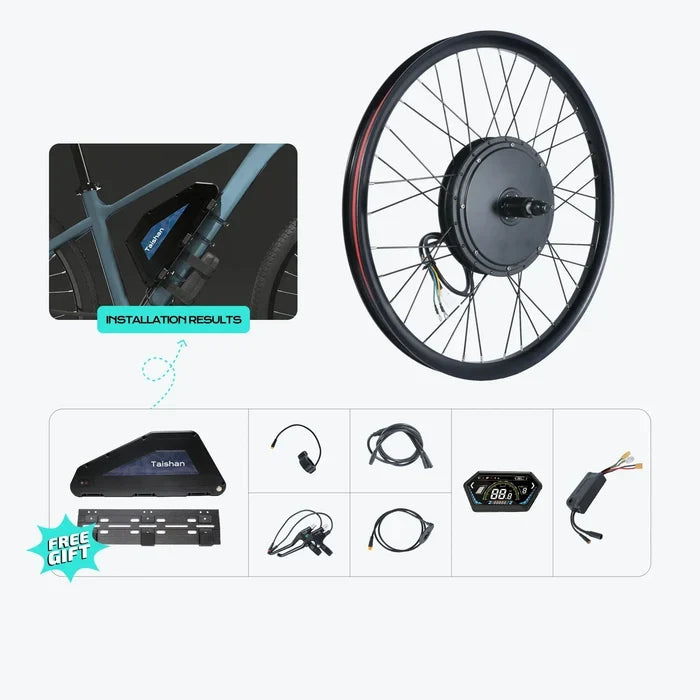
A hub motor replaces the centre of the front or rear wheel. Fit depends on wheel diameter, dropout spacing, axle style, brake type and the space around the fork or rear stays. Front hubs are simpler because they don’t touch the cassette; rear hubs give better traction but need closer drivetrain matching.
Match the motor to the wheel size
Buy a motor wheel built for the same rim diameter as the original. Common sizes are 20″, 24″, 26″, 27.5″, 29″ and 700C; small folding wheels and wide fat-bike rims need model-specific options. Unsure of your size? The wheel and dropout size guide shows how to confirm it from the tyre.
Measure the dropout width
With the wheel out, measure the inside gap between the fork ends or rear dropouts with a ruler or caliper — don’t estimate. Front motors usually target 100mm forks; rear motors are built for 130mm, 135mm or wider; fat-bike hubs can need 170–190mm. And width is only part of it — the axle shoulders, washers, rotor, freewheel and cable exit all need room too.
Quick-release, thru-axle and brakes
Many hub motors use a solid axle with flat sides, made for the open dropouts of a quick-release wheel. A thru-axle frame has closed holes — a standard solid-axle motor won’t fit unless the system was built for that standard. Don’t treat a basic spacer as a universal adapter. A rim-brake bike needs a motor wheel with a machined braking surface; a disc-brake bike needs a compatible rotor mount and caliper clearance.
Do you need a torque arm?

A hub motor tries to spin its axle the opposite way to the wheel, and the dropout has to resist that force. A torque arm spreads the load onto a longer section of the fork or frame. It matters most on aluminium dropouts, high-torque systems, front motors, and any build with hard starts or steep climbs. Use one shaped for the bike — the installation accessories cover the usual hardware — not a loose universal part that can’t sit flat.
Hub Motor or Mid-Drive — Which Suits Your Bike?
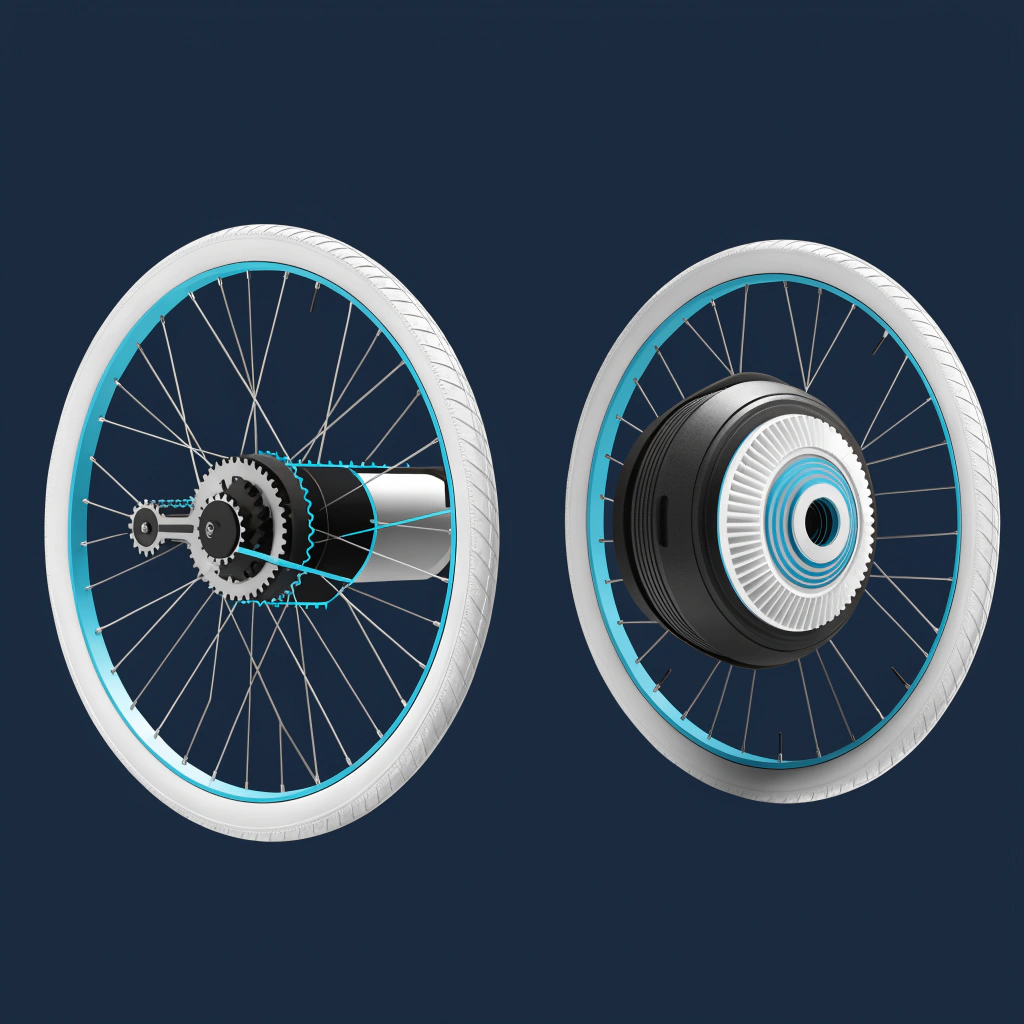
Both are proven routes; they solve different problems. Hub motors are the simpler wheel-swap. Mid-drives use the bike’s own gears, which helps on hills and heavy loads.
Hub motor strengths
- Front or rear wheel swap — no bottom-bracket work
- Front hub leaves your gears completely untouched
- Rear hub adds less chain and cassette wear
- Usually cheaper and faster to install
- Great for flatter routes and simple commutes
Mid-drive trade-offs
- Needs the crank removed and the bottom bracket measured
- Sends power through the chain — faster drivetrain wear
- Hangs lower, reducing ground clearance
- Poor chainline causes noise and dropped chains
- Costs more to buy and to fit
Fitting a mid-drive: the extra checks
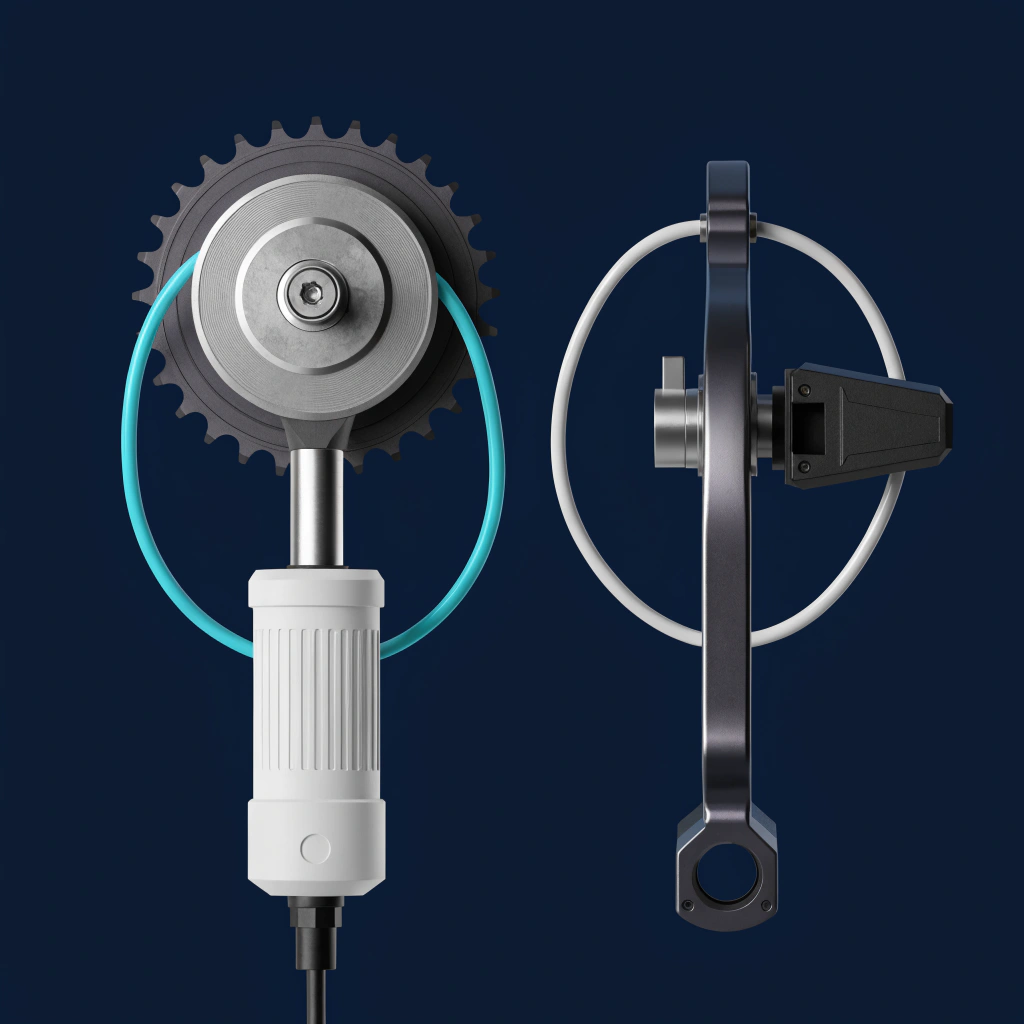
A mid-drive mounts at the crank and drives the chain, so the bottom bracket is the make-or-break measurement. Measure the fixed frame shell face to face — don’t include cups, spacers or crank arms. Most aftermarket mid-drives fit threaded 68–73mm BSA shells. Press-fit systems (BB30, PF30, BB86, BB92) may need an adapter and can leave a poor chainline. Check clearance between the motor body and the down tube and chainstay, and confirm the finished ground clearance suits your terrain.
Where Can the Battery Go?
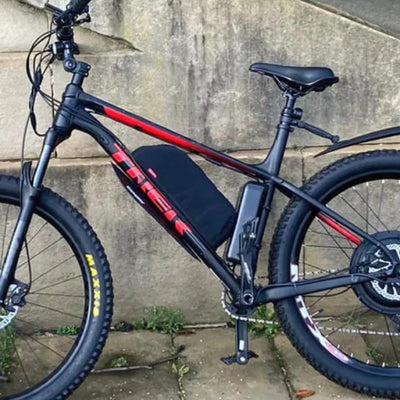
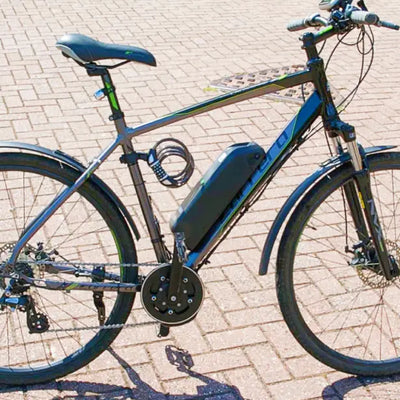
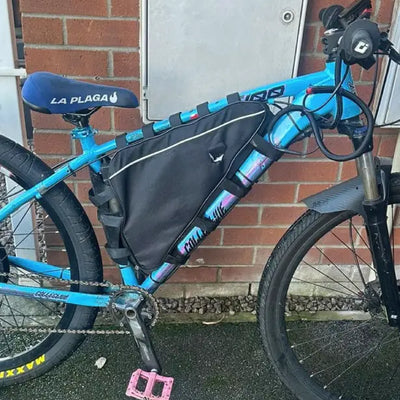
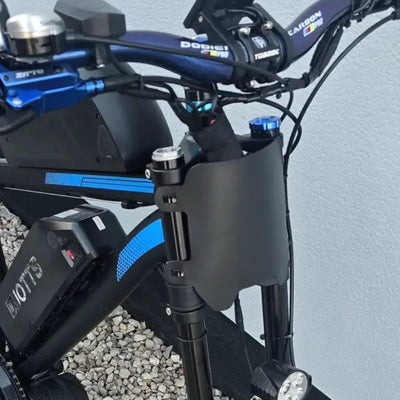
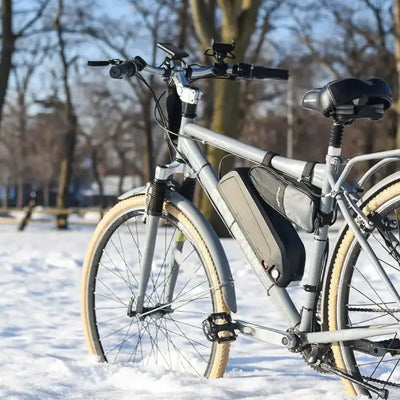
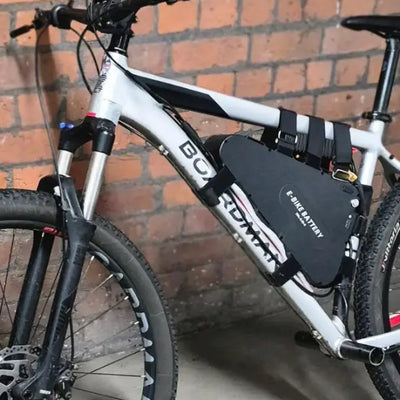
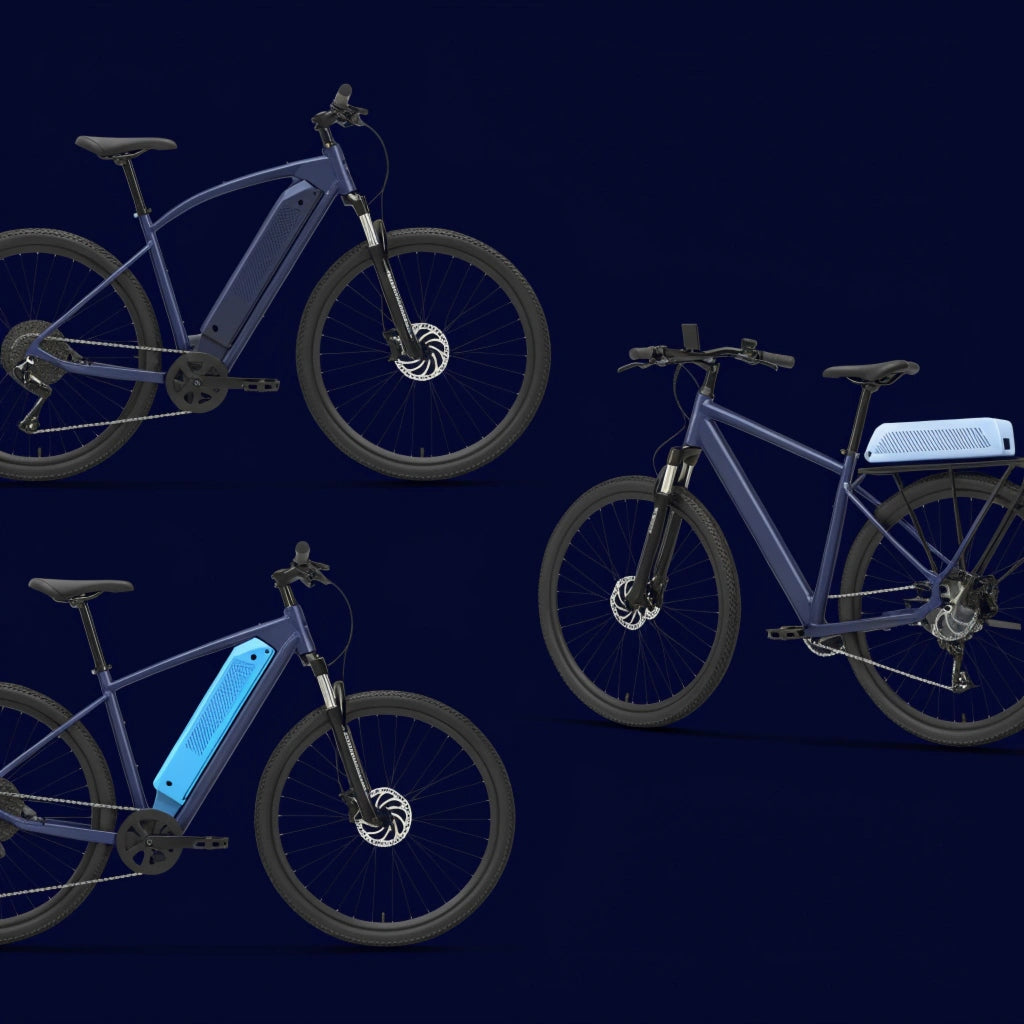
The battery is usually the heaviest single part of a conversion, so its position drives the bike’s balance and how easy it is to control. Lower and more central is best; a secure rear-rack pack is a fine fallback when the triangle has no room.

| Mounting position | Best when… | Watch for |
|---|---|---|
| Down tube | The triangle is open with bottle bosses | Front-tyre clearance when the fork compresses |
| Rear rack | The front triangle is crowded or step-through | Top-heavy feel; use a properly rated rack |
| Frame / triangle bag | You want good weight distribution | The pack must be held tight against bounce |
| Seatpost or bars | A small, light pack and short range are fine | Added steering weight; rear-tyre clearance |
Before buying the pack, put a cardboard template in the intended spot. Check it slides on and off without hitting the top tube, shock, crank or bottle cage — and turn the bars fully and compress the suspension while you check. A dedicated battery mount that spreads the load onto solid frame points is safer than two light-duty bottle bolts.
Are Your Brakes Strong Enough?
A conversion adds the motor, battery and hardware — and you’ll spend more time at assisted speed. Worn brakes become a bigger problem. Brake type alone doesn’t decide safety: pad condition, setup, rotor or rim wear, rider weight and weather all matter.
Copes well
- Hydraulic discs — strongest, light lever effort
- Mechanical discs — dependable, easy to service
- Well-maintained rim brakes — fine for a road-legal commuter
- Any brake paired with a motor cut-off sensor
- Larger rotors, where the frame and fork support them
Fix or rethink first
- Rim brakes on wet, worn or heavy long-descent use
- Any brake with hardened pads or frayed cables
- Spongy hydraulics that need bleeding
- Coaster-only bikes once the rear hub is replaced
- Oversized rotors fitted on unsupported mounts
Fit a brake cut-off so the motor stops the moment you pull a lever. Mechanical setups often use replacement levers with built-in switches; hydraulics usually use a magnet-and-sensor on the existing lever. Test each lever with the driven wheel safely raised before your first ride.
Can Your Type of Bike Be Converted?
Most bike categories have at least one workable route. Don’t copy another rider’s kit just because they had the same general bike — model year and component standards change the measurements.
| Bike type | Usual route | Key thing to check |
|---|---|---|
| Hardtail mountain | Rear hub or mid-drive | Suspension-fork material for a front motor |
| Hybrid / commuter | Front or rear 250W hub | Easiest of all — common sizes and mounts |
| Road bike | Light front hub / friction | Thru-axles and flat-mount discs rule out many kits |
| Folding bike | Front hub | Fold clearance and total carrying weight |
| Full-suspension | Mid-drive | Motor clears linkage; cables slack for travel |
| Fat bike | Wide-hub, matched | Dropout width and tyre clearance |
| Vintage steel | Removable front hub | Nonstandard old sizes; avoid permanent changes |
| Single-speed / coaster | Front hub | A coaster rear hub loses its brake if replaced |
Which Kit Type Fits Your Bike?
The main kit types solve different jobs:
- Front-hub kits — easiest to fit; leave the gears untouched; ideal for moderate commuter power on paved roads.
- Rear-hub kits — push from the weighted wheel for better traction; must match your freewheel or cassette.
- Mid-drive kits — use the rear gears for efficient climbing; add stress to the chain and cassette.
- Friction / clip-on — sidestep axle and BB fit and can move between bikes; watch wet grip and tyre wear.
The KirbEbike range, by what you’re converting

| KirbEbike option | Key spec | Best for |
|---|---|---|
| EZ Rider 250W (standalone) | 36V 250W front hub, dual battery, 40–60 mi | Road-legal commuting when the completed bike meets EAPC rules |
| 250W front kit | 36V/48V 250W front hub | Flat-city commutes, first conversion |
| 500W / 750W MTX | Value power upgrade | Mixed terrain, light hills off-road |
| 48V 1000W kit | High-power hub, waterproof | Strong hills, simpler install off-road |
| Z16 mid-drive (standalone) | 48V 1000W torque-sensored mid | Steep climbs, Bafang/Tongsheng switchers off-road |
How Much Does It Cost to Convert a Bike?
Budget for the complete working bike, not just the advertised motor price. Battery, charger, display, sensors, tools, shipping and repairs all move the total. Bundled systems cost more upfront than a bare motor, but make matching far easier — and remove the risk of a cheap headline price that hides a separately-sold battery.
*Independent testing by Cycling Weekly reports roughly £300–£750 for many reputable kits, with premium removable systems over £1,000. KirbEbike offers battery-inclusive and kit-only variants — compare the selected configuration, charger and installation parts, not the lowest headline price.
Don’t forget the donor-bike repairs
A worn bike may need tyres, tubes, brake pads, cables, rotors, a chain, a cassette or bearings before it’s fit to carry a motor. Mid-drives expose chain and cassette wear quickly. Set aside part of the budget for a first service too — spokes settle, fasteners loosen and cables need repositioning after the early rides.
Is Your Old Bike Worth Converting?
An old bike is worth converting when it fits you, rides well, has a sound frame and needs only modest maintenance. Familiar geometry can make the finished bike more comfortable than a cheap complete e-bike. Sentimental value alone isn’t enough — add the repair costs to the kit price and compare the total with a new or refurbished e-bike.
Converting makes sense
- You like the fit and don’t need to replace major parts
- The frame is straight and the wheels are sound
- You want a specific size, cargo or folding setup
- You value a removable, swappable battery
- A bundled kit keeps the all-in cost sensible
Buying may be better
- The frame is damaged, ill-fitting or unusual
- The build needs several custom adapters
- You’d rather not maintain a custom electrical system
- You want factory cable routing and one warranty
- Repairs approach the price of a better donor bike
UK Law for Converted Electric Bikes
A converted bike ridden on UK public roads must meet the rules for an Electrically Assisted Pedal Cycle (EAPC) to be treated like a normal bicycle. Starting life as a pedal cycle does not automatically make the finished conversion legal.

Current GOV.UK guidance requires working pedals, a motor with a maximum continuous rated output no greater than 250W, and assistance that cuts off at 15.5 mph (25 km/h):
- 250W continuous, not peak — a motor marked 500W or 1000W isn’t a 250W EAPC just because you ride slowly; the rated output and markings matter.
- Assistance stops at 15.5 mph — you can pedal faster, but the motor must not drive the bike past the cut-off. Re-check settings after any wheel-size change.
- Pedal assist required — a cadence or torque sensor must drive the assist, starting and stopping predictably.
- Throttles are restricted — a throttle that propels the bike beyond walking speed without pedalling may need type approval and can void EAPC status.
What Limit Mode can and cannot do
On compatible systems, KirbEbike’s Smart Controller and Ride Power App switch between preset power, throttle and assistance settings. Limit Mode makes output easier to control — but it does not change the motor’s documented continuous rating or turn a high-power system into an EAPC.
| Mode | Throttle | Pedal assist | Where to use it |
|---|---|---|---|
| Limit 1 | 250W / 25 km/h | 250W / 25 km/h | Reduced-output preset; not legal proof for a >250W motor |
| Limit 2 | Disabled | 250W / 25 km/h | Pedal-assist preset; classification depends on the completed bike |
| Limit 3 | 6 km/h walk-assist | 250W / 25 km/h | Walk-assist preset; check completed-bike classification |
| Unlimited | Unrestricted | Unrestricted | Private land / closed tracks only |
Final Go / No-Go Test
A bike is ready for conversion only when the frame, motor interface, battery mount, brakes and wiring all pass — and the cost and legal use stack up. Use these three groups to make the call.
- Frame and fork have no cracks, deep corrosion or crash damage
- Measurements match the chosen motor at wheel, axle, dropout or bottom bracket
- Battery has a solid mount with full tyre and crank clearance
- Brakes stop firmly and have serviceable parts
- Drivetrain shifts cleanly and isn’t badly worn
- Wiring routes safely away from moving and hot parts
- The build matches the law for where you intend to ride it
- Carbon or titanium frame, aluminium suspension fork, or thru-axles
- Press-fit bottom bracket or an internal gear hub
- Tight battery clearance, or a fit that needs frame spreading or filed dropouts
- Any plan that changes the brake system or alters suspension movement
- Cracked, bent or badly rusted frame, or a repair you can’t verify
- The motor axle can’t seat fully, or the battery has no secure mount
- Brakes can’t be made dependable, or the wheel won’t sit straight after fitting
- The motor hits the frame or ground, or the chain keeps dropping on a mid-drive
- A public-road build exceeds EAPC limits, or repairs cost as much as a better bike
Match Your Bike to the Right Kit
Battery-inclusive and kit-only options, with Bluetooth app tuning on supported controllers and UK support. Start road-legal, or build for private land.
Not sure which level suits you? Start with the Road Legal Kits collection for a compliant commuter build, or the full range if you’re building for private land.
Frequently Asked Questions
Can any bike really be converted to electric?
Will a hub motor fit my bike?
Do I need a torque arm?
Can I convert a carbon-fibre bike?
Is a converted bike road-legal in the UK?
Does a 1000W kit become legal if I set the display to 250W?
Is it cheaper to convert or buy a new e-bike?
Which bikes should never be converted?
What’s the easiest bike to convert?
The Bottom Line
Most regular bikes can be converted to electric — but a successful build starts with the condition and measurements of the donor bike. A sound steel or aluminium frame, standard wheel and bottom-bracket dimensions, dependable brakes and a secure battery position are strong signs the project is practical. Don’t force a motor into incompatible dropouts, and don’t use adapters to hide a poor fit.
The right kit depends on how and where you ride: front hubs suit many commuter builds, rear hubs give better traction, mid-drives shine on hills. Include the battery, install, repairs and future wear when you compare against a complete e-bike. And for UK roads, keep the finished bike within 250W and 15.5 mph — or ride higher-power builds on private land only. Pass every check, match the kit to your use, and a conversion turns the bike you already own into exactly the e-bike you want.
Sources
- GOV.UK — Electric bikes: licensing, tax and insurance. gov.uk/electric-bike-rules
- UK Department for Transport — EAPC standards and legal requirements. gov.uk/guidance/electric-bike-rules
- GOV.UK — Battery safety for e-cycle users. gov.uk
- Cycling Weekly — Best electric bike conversion kits 2026. cyclingweekly.com
- KirbEbike — Conversion kit range & fit guide. kirbebike.com