KirbEbike 52V 2000W E-Bike Kit Review: Battery Range, Hill Starts, Heat and App Control
Our own kit, reviewed plainly: range by battery size, hill starts, motor heat, what the Ride Power app changes, fitting and the UK legal position. We say which figures are specification, owner reports or not yet measured.
KE
KirbEbike Editorial
Reviewed by the KirbEbike conversion-support team
Share
Unlock £10 off today
On this page
PRIVATE LAND ONLYFIRST-PARTY REVIEWUK MARKET
The Quick Answer
The 52V 2000W MTX kit pairs a direct-drive rear hub with a 35A FOC controller, Bluetooth tuning through the Ride Power app, and a choice of 52V packs from 20Ah to 30Ah. Its real strength is configurability: DC current, acceleration strength and speed settings can each be adjusted, so one kit can be set up for range, for urban riding, or for private-land performance.
Its limits are equally clear. It is a heavy, high-power system that demands a sound donor bike, strong brakes and proper torque restraint, and at 2000W continuous rated power it is outside EAPC classification in Great Britain whatever the app is set to (GOV.UK). This is a private-land kit for experienced converters, not a commuter upgrade.
Specification at a Glance
Component
Specification
What it means in use
Evidence
Motor
2000W direct-drive rear hub
Strong sustained power, no internal gears to wear
Manufacturer spec
Controller
35A FOC, Bluetooth
Smooth delivery and app-configurable limits
Manufacturer spec
Battery options
52V 20Ah, 25Ah or 30Ah
Roughly 1,040Wh to 1,560Wh nominal
Manufacturer spec
App
Ride Power, iOS and Android
Current, acceleration, PAS, speed settings
Manufacturer spec
UK road status
Outside EAPC classification
Private land with permission
GOV.UK
Manufacturer specification unless stated.
💡
ON THE TOP-SPEED FIGURE
Our product page gives one figure for this kit: 34–38 mph (55–60 km/h) on the flat. Owner builds we have seen report the high 30s to around 40 mph. Expect real speed to vary a lot with wheel size, battery voltage under load, rider weight, terrain and setup — and remember it applies to private land only.
Battery Range: 20Ah, 25Ah or 30Ah
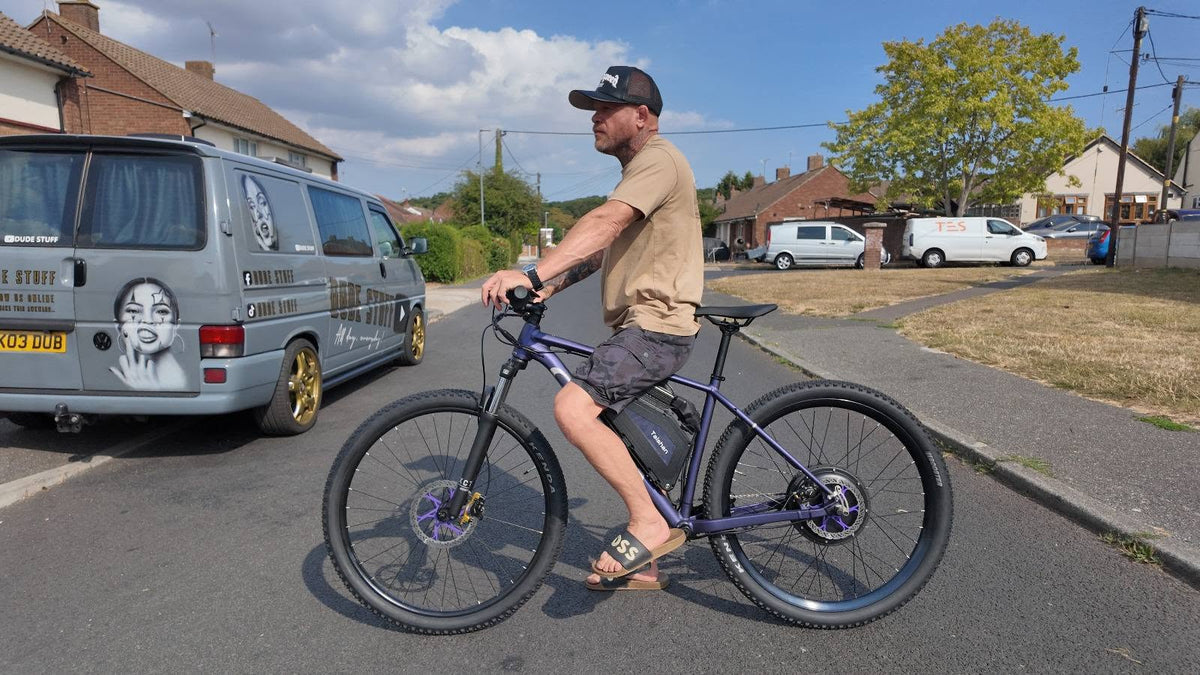
Battery in the frame. A customer build with a Taishan pack. Bigger packs mean more range and more weight to carry.
Compare watt-hours rather than amp-hours, because capacity only means something alongside voltage. At 52V nominal, a 20Ah pack holds roughly 1,040Wh, a 25Ah pack about 1,300Wh and a 30Ah pack around 1,560Wh. Runtime is usable energy divided by average electrical load, and a 2000W system rarely draws anything like 2000W continuously — which is why we will not publish a figure like "20Ah lasts three hours". Our battery range lists the current options.
Pack
Nominal energy
Main advantage
Main compromise
52V 20Ah
About 1,040Wh
Lightest, lowest cost
Range is the first thing you notice
52V 25Ah
About 1,300Wh
The balanced choice for most builds
Heavier and dearer than 20Ah
52V 30Ah
About 1,560Wh
Longest range, best for sustained load
Heaviest, largest, most expensive
Nominal energy is voltage times amp-hours; usable energy is lower.
On advertised versus real-world range, any single range claim for a 2000W kit is close to meaningless, because the system can draw far more current than a commuter setup ever would. Low assist on flat ground gives a completely different figure from full power on climbs. Plan on watt-hours divided by your own consumption, and expect a hard-ridden build to consume well above the 25Wh per mile a loaded commuter might see.
Hill Starts and Sustained Climbing
These are two different demands and the kit handles them differently. A hill start needs a short burst of torque, which a 2000W direct-drive hub with a 35A controller supplies readily — pulling away on a gradient from stationary is where the power is most obviously useful, and where a legal 250W commuter kit feels most limited.
Sustained climbing is a thermal test rather than a torque test. A direct-drive hub has no reduction gearing, so on a long slow climb it works at its least efficient point with little airflow, and heat builds in the motor. That is a characteristic of the motor type rather than a fault — our guide to hub motor internals explains why. What we cannot honestly give you is a number: we do not publish standardised motor or controller temperature testing, so we are not going to claim a specific thermal ceiling. Owner reports are encouraging on short and moderate climbs. On long, steep climbs expect the controller to cut power to protect the motor (thermal rollback).
Heat: Controller and Motor
The controller uses field-oriented control and is resin-potted, which address two different things. FOC feeds the motor smooth current instead of sharp six-step pulses, so less energy is wasted as heat in the motor. Potting seals the electronics against water and vibration. Neither is a cooling guarantee, and potting has a real cost: a potted controller is a sealed unit, so a fault means replacement rather than repair.
Of the two, the motor usually gets hot first, because slow climbing under heavy load is exactly the condition a direct-drive hub finds hardest. Watch for gradual power reduction on long climbs — that is protection working, not failure. Repeated cut-outs, a burning smell or discoloured insulation are different, and mean stop and investigate.
Ride Power App: What You Can Actually Tune
This is the part of the kit we would defend most strongly, because it changes what the bike is rather than just how it is set up. Four settings do most of the work.
DC current sets the electrical ceiling and therefore the available torque. Lowering it is the most effective way to extend range on a given pack, and it is the setting most riders should adjust first if they want mileage rather than acceleration. Raising it costs more heat than it appears to, because doubling the current roughly quadruples the heat in wires and coils, and it must stay inside what the battery can continuously supply — our BMS amps guide covers the matching.
Acceleration strength sets how quickly power ramps toward that ceiling. This is the setting that adapts the bike to the surface: a softer ramp for urban riding gives controlled pull-away in traffic and better traction on wet roads, while a sharper ramp suits loose ground and climbs on private land where you want power immediately. On a 2000W system, restraint here does more for control than anything else, because the motor has more torque available than the tyre can always use.
PAS mapping decides what each assist level delivers, which matters on a powerful kit where factory maps often make level 1 too strong for filtering. Speed settings cap assisted speed, and there is also a walk-assist setting at 6km/h. Live diagnostics and saved profiles round it out: being able to export a configuration means you can experiment without losing a setup that worked.
Against a standard LCD controller, a fixed system gives you assist levels someone else chose. Fine if their choices suit you; if not, there is no route to change them, which on a high-power kit is a real limitation.
One Kit, Three Ride Profiles
That is the strongest practical argument for Bluetooth programming on a high-power system. For maximum range, drop DC current well below the ceiling and soften the ramp. For urban riding, moderate current with a gentle ramp and a capped speed makes a heavy bike manageable in traffic. For private land, current at your safe ceiling with a sharper ramp is where the kit does what it was built for.
Save all three rather than re-tuning from memory, and change one setting at a time so you can attribute any change in behaviour. A configuration you can return to is worth more than a configuration you cannot reproduce.
Brakes first. A heavier, faster bike needs brakes and tyres up to the job before the motor goes on.
The wiring is the easy part. Connectors are keyed, the harness is colour-matched, and anyone who has fitted a hub kit before will recognise the layout. The mechanical side is where this kit asks more than a commuter conversion does. A 2000W direct-drive motor twists hard against the frame ends (the dropouts) as it pulls, so a torque arm is not optional — see our torque arm guide. The wheel is heavy, the donor frame needs to be sound, and brakes and tyres must be up to a bike that is both heavier and faster than it was.
Check dropout spacing and wheel size against the published sizing before ordering, confirm the gearing interface, and work through our installation mistakes guide before the first ride. If any of that sounds like more than you want to take on, this is the wrong kit for you and we would rather say so here than after you have bought it.
What We Like
Battery choice across 20Ah, 25Ah and 30Ah, so range is a decision rather than a fixed compromise
FOC control rather than basic square-wave, which means smoother delivery and less harmonic heating
Genuine app depth — current, acceleration, PAS and speed settings, with saved profiles
Direct-drive simplicity, with no internal gears or clutch to wear out
Modular, replaceable components rather than a sealed proprietary system
Wide wheel-size support across common donor bikes
What We Would Improve
Top speed is now one figure on the product page (34–38 mph, 55–60 km/h); the next step is publishing the test conditions behind it
More published thermal testing. We ask riders to trust the cooling design without giving them standardised motor and controller temperature data to judge it by
Range claims need test conditions. A range figure without rider weight, terrain, assist level and speed is not information
Mechanical installation documentation could go further, particularly on torque-arm fitting and dropout suitability, which is where high-power conversions actually go wrong
We have also removed older copy that described a button press as making the bike road legal. The reasons are set out below.
Alternatives Worth Comparing
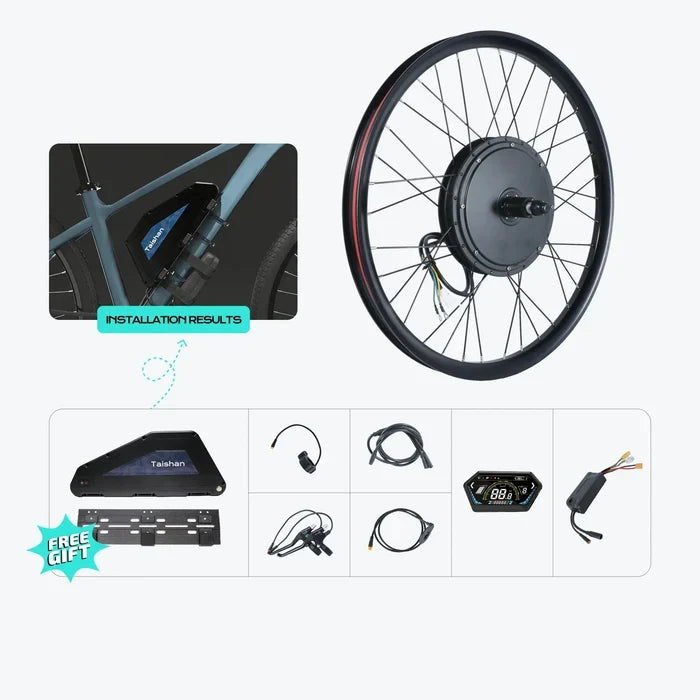
What is in the box. Motor wheel built to your size, battery and charger, controller, colour display, sensors and wiring.
Four routes, listed alphabetically and judged on the same criteria: power class, battery approach, configurability and intended rider. Confirm current specifications on each supplier’s page before buying.
1. Cytronex C1
The opposite end of the market and a useful reference point. A lightweight 250W front-hub system with a bottle-format battery, aimed at riders who want a road-legal bike that still looks and rides like a bicycle. Installation is measurement-based and the system is deliberately simple rather than configurable. It is road legal in Great Britain where the 2000W kit is not, and it is a premium-priced, low-power proposition. If legality on public roads is your requirement, this class of kit answers it and a 2000W kit cannot.
2. Generic 45A 2000W MTX Kits
Unbranded 2000W MTX-style rear hub kits sold on marketplaces, often listed with a 45A controller and a choice of 48V–72V batteries. They are usually cheaper. The obvious contrast is 45A against our 35A, but a higher headline figure is not automatically better: usable current is limited by the battery, the motor’s heat capacity and the wiring, not by the controller label. Check what battery is supplied, whether its continuous current matches the controller, what the display can configure, and who answers questions after purchase.
3. KirbEbike 52V 2000W MTX
The kit reviewed here: a 2000W direct-drive rear hub, 35A FOC controller, Ride Power app tuning and 52V packs up to 30Ah — see the product page and the controller range. Best suited to an experienced converter who wants deep app control and a large battery on private land. Stated limits: heavy, demanding of the donor bike and its brakes, potted controller so faults mean replacement, and outside EAPC classification whatever the settings.
4. Tongsheng and Bafang Mid-Drives
Worth considering if hills are the reason you are looking at 2000W. A mid-drive sends torque through the bicycle gears, so it climbs efficiently at lower power and keeps weight low and central, and torque-sensing options feel more natural to pedal. The trade-offs are faster chain and cassette wear, bottom-bracket compatibility requirements and less outright power. Our mid-motor collection and layout comparison set out the differences.
Option
Power class
Battery
Configurability
Road legal in GB
Cytronex C1
250W front hub
Proprietary bottle
Limited
Yes, as configured
Generic 45A 2000W MTX kits
2000W rear hub
Multiple options
Model dependent
No
KirbEbike 52V 2000W
2000W rear hub
52V 20–30Ah
Deep, via app
No
Tongsheng / Bafang mid-drive
250W upward
Usually separate
Varies by model
250W versions only
Listed alphabetically. Power class and legal status are the two axes that matter most here.
Is the KirbEbike 52V 2000W Kit Road Legal in the UK?
No, and this deserves a direct answer rather than a hedge. To be an Electrically Assisted Pedal Cycle in Great Britain a cycle must have pedals that can propel it, an electric motor with a maximum continuous rated power not exceeding 250W, and electrical assistance that cuts off at 15.5mph (GOV.UK EAPC standards). A 2000W motor exceeds that power limit by a wide margin, so the completed cycle is treated as a motor vehicle under the Road Traffic Acts (GOV.UK).
💡
A SWITCHABLE SPEED LIMIT DOES NOT CREATE COMPLIANCE
This matters because programmable controllers can cap assisted speed. The Department for Transport addresses the point specifically: some electric cycles offer a temporary increase in top speed, often advertised as "off road" mode, and vehicles that have this feature "do not, in our opinion, comply with the EAPC regulations and are considered motor vehicles". So a selectable limit is the feature that disqualifies a bike rather than a route to compliance. Two further points: continuous rated power is fixed by the motor, not by a software setting, and an unapproved twist-and-go throttle needs type approval or a Motorcycle Single Vehicle Approval even at 15.5mph. The 6km/h walk-assist setting is a separate, permitted convention.
So use this kit on private land with the landowner’s permission and subject to site rules, or meet the full motor-vehicle requirements for approval, registration, tax, insurance, licence and equipment. Speed limiting remains genuinely useful for controlling a heavy bike, matching a site’s rules and reducing energy use — it simply is not a legal mechanism.
Who Should Buy It, and Who Should Not
A good fit if you are an experienced DIY converter, ride on private land or off-road, want deep control over how power is delivered, need a large battery for sustained load, and have a donor bike with sound frame, brakes and dropouts to match.
Look elsewhere if you need a road-legal bike for commuting, want a light or discreet conversion, are converting your first bike, have a thru-axle or lightweight frame, or expect to fit it without checking torque restraint and braking. For public-road use, a 250W kit such as the EZ Rider is the correct product and this one is not.
Verdict
The 52V 2000W MTX kit does what a high-power direct-drive conversion should: strong hill starts, a broad battery range, FOC control rather than basic square-wave switching, and app tuning deep enough that one kit genuinely covers range-focused, urban and private-land riding. For an experienced converter with a suitable donor bike, that configurability is the reason to choose it.
It is not for everyone, and we would rather be plain about that. It is heavy, it demands a sound frame and strong brakes, its potted controller is a replacement rather than a repair, sustained climbing is a thermal test we have not published standardised data for, and it is firmly outside EAPC classification. Match the battery and charger properly (GOV.UK), fit the torque restraint, and ride it where a 2000W bike belongs.
One kit, three configurations
Set it for range, for urban control or for private-land performance — within what your battery and the law allow.
Runtime is usable energy divided by average load, so it depends entirely on how hard you ride. A 52V 20Ah pack holds roughly 1,040Wh nominal; at low assist on flat ground that goes much further than at full power on climbs.
How fast can a 52V 2000W e-bike kit go?
Our product page states 34–38 mph (55–60 km/h) on the flat, and owner builds report the high 30s to around 40 mph. Actual speed varies with wheel size, voltage under load, rider weight, terrain and setup, and the kit is for private land only.
Which battery should I choose: 20Ah, 25Ah or 30Ah?
The 25Ah pack is the balanced choice for most builds. Choose 20Ah for lowest weight and cost, or 30Ah if you ride long distances or use high power sustained, accepting extra weight and size.
Is a 2000W e-bike conversion kit legal in the UK?
No. An EAPC needs a motor rated no higher than 250W continuous with assistance cutting off at 15.5mph. A 2000W kit is treated as a motor vehicle, and a switchable speed mode does not change that.
Does limiting the speed in the app make it road legal?
No. DfT states that cycles offering a temporary top-speed increase, often advertised as off-road mode, do not comply with the EAPC regulations and are considered motor vehicles. Continuous rated power is fixed by the motor, not by software.
Can I use a 52V battery on a 48V e-bike?
Only if the controller, display and motor are documented for 52V. A fully charged 52V pack sits near 58.8V, so a system rated only for 48V may be damaged or may refuse to run.
What does the Ride Power app actually change?
DC current limit, acceleration strength, PAS level mapping, throttle response and speed settings, plus live diagnostics and saved profiles. Together those let one kit be configured for range, urban riding or private-land use.
Should I charge the battery after every ride?
Charge for the next ride rather than by habit, follow the manufacturer’s instructions, use only the authorised charger, and never charge a damaged, swollen, wet or unusually hot pack.
Can I leave an e-bike battery charging overnight?
Avoid it. Charge where you can monitor it, in a dry ventilated place away from escape routes, and unplug once complete rather than leaving it connected unattended.
What are the most common problems with high-power conversion kits?
Inadequate torque restraint, brakes not upgraded to match, batteries whose continuous current cannot support the controller, poor connector quality, and motor heat on sustained climbs.
A note on safety & legality. This is a first-party review of our own product, not an independent test. Where figures are manufacturer specification, owner report or not yet measured under standardised conditions, the article says so. A 2000W system requires a sound donor frame, brakes and tyres matched to the added weight and speed, and the torque restraint specified for the motor. Never set a current limit above what the battery can continuously supply or its BMS allows, and use only a charger authorised for your pack. In Great Britain an EAPC must have pedals that propel it, a motor rated no higher than 250W continuous and assistance cutting off at 15.5mph; a 2000W kit is outside that classification and a switchable speed setting does not change it. Use on private land with the landowner’s permission and subject to site rules, or meet the full motor-vehicle approval, registration, tax, insurance, licence and equipment requirements (GOV.UK).
About this guide
Author: KirbEbike Editorial. Technical review: KirbEbike conversion-support team. Last reviewed: October 2026. Methodology: this is a first-party review, and evidence is separated into three categories throughout — manufacturer specification, owner reports, and what remains unproven. We do not publish standardised motor or controller temperature testing, hill-start timings or Wh/km range figures for this kit, so no thermal ceiling, climb time or universal range figure is claimed. Top speed is quoted as the single figure on the product page alongside owner reports. Legality is cited to GOV.UK and Department for Transport guidance current at October 2026. The ride-profile chart shows illustrative settings to demonstrate configurability and is not a recommendation of values. Confirm compatibility and current specifications before ordering.
Stay in the know
Conversion guides, fitting advice and the deals worth knowing about. No spam.