Spend £300, Save £40

Cart

Your cart is empty

Ebike Batteries for Conversion Kits 36V–72V · chosen by controller, not by motor

Match voltage, current and frame space first — capacity and price come after. Three families, every pack with named cells, a matched charger and a quick-release mount.

540–1,560 Wh range60A continuous BMS800–1,000 charge cycles21700 named cells
HS-II triangle ebike battery, the highest-capacity pack in the KirbEbike range

Shop ebike batteries

Every pack ships with its matched charger and mounting kit. Prices, voltages and stock live on the product cards — the guide below helps you pick between them.

Start from your controller label

Read the voltage on the controller, confirm the maximum input it accepts, then pick its card. Full-charge voltage is listed because that is the figure that catches people out.

Voltage · energy · published range
SystemFull chargeTypical kitOptionsEnergyPublished range
36V42V250W–750WEntry XS 15Ah540 Wh30–50 km (19–31 mi)
48V54.6V500W–1,500WEntry 16/20Ah · Taishan 30Ah768–1,440 Wh30–80 km (19–50 mi)
52V58.8V500W–3,000WEntry 20Ah · Taishan 25Ah · HS-II 30Ah1,040–1,560 Wh35–85 km (22–53 mi)
60V71.4V2,000W–3,000WTaishan · HS-II 20Ah1,260 Wh40–55 km (25–34 mi)
72V84V3,000W–4,000WTaishan · HS-II 20Ah1,440 Wh30–40 km (19–25 mi)

Higher voltage buys performance, not distance — range bands are the manufacturer's figures for the motor class shown.

Entry Down-Tube, Taishan or HS-II?

Three families, three different problems solved.

Entry Down-Tube battery measured 368 by 95 by 125 millimetres shown above its mounting rail
Lightest

Entry Down-Tube

Best for: commuters, flat routes, budget builds.

  • Energy540–1,040 Wh
  • BMS30A / 40A
  • Weight2.5–5.1 kg
  • Case≈ 368 × 95 × 125 mm
  • MountDown tube, bottle bosses
See the Entry range
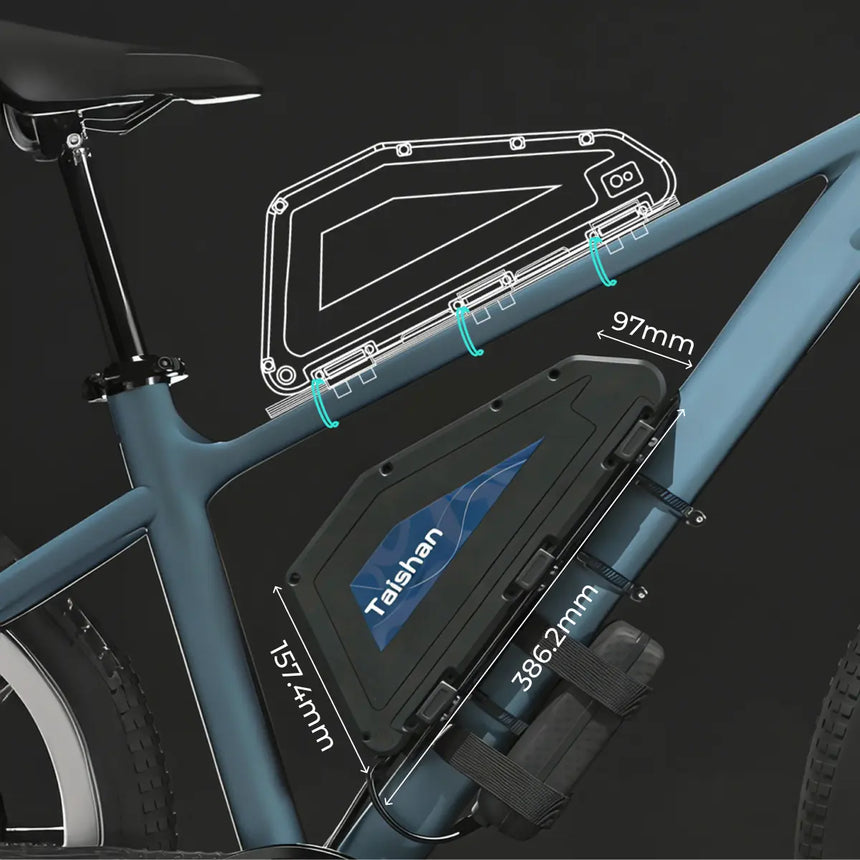
Taishan battery measured 386.2 by 97 by 157.4 millimetres, supplied with charger and mount holder
Fits most frames

Taishan

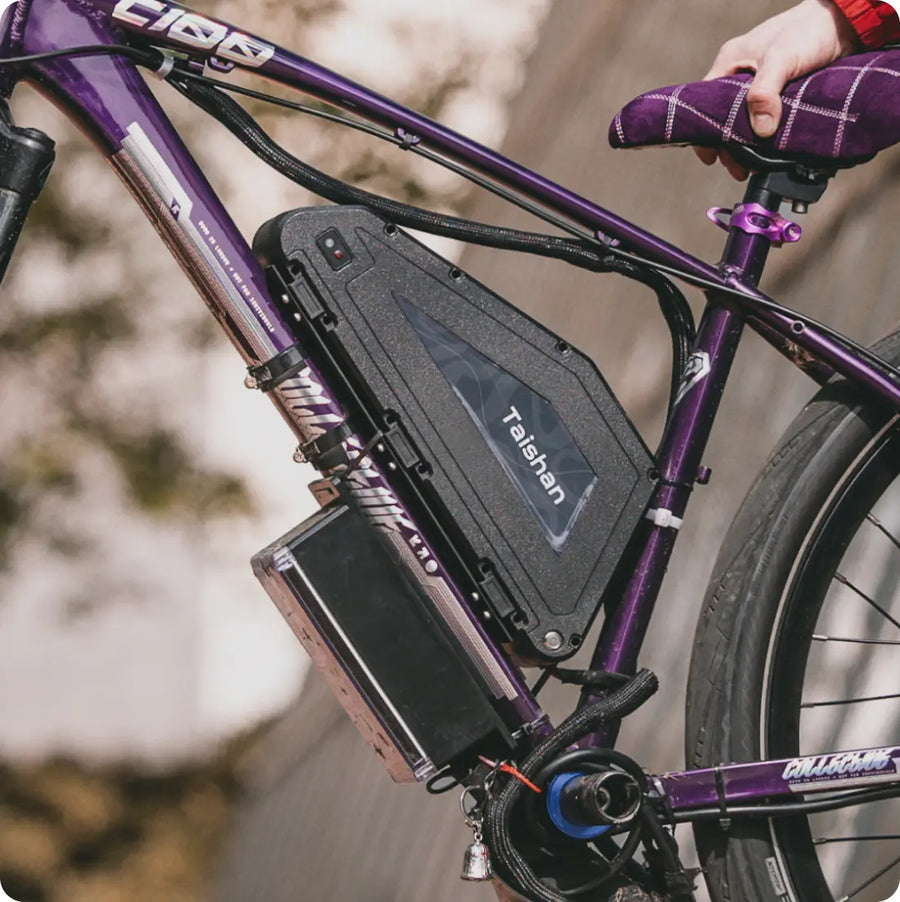
Best for: most conversions — its shallow wedge clears frames taller packs cannot.

  • Energy1,260–1,440 Wh
  • BMS60A continuous
  • Weight6.2–6.8 kg
  • Case386.2 × 97 × 157.4 mm, all voltages
  • MountFrame triangle, low 157 mm profile
Compare Taishan battery options
HS-II battery supplied with its fast charger and slotted quick-release mounting rail
Most energy

HS-II

Best for: long distance, delivery and hills — needs a deeper triangle.

  • Energy1,260–1,560 Wh
  • BMS60A continuous
  • Weight6.4–7.55 kg
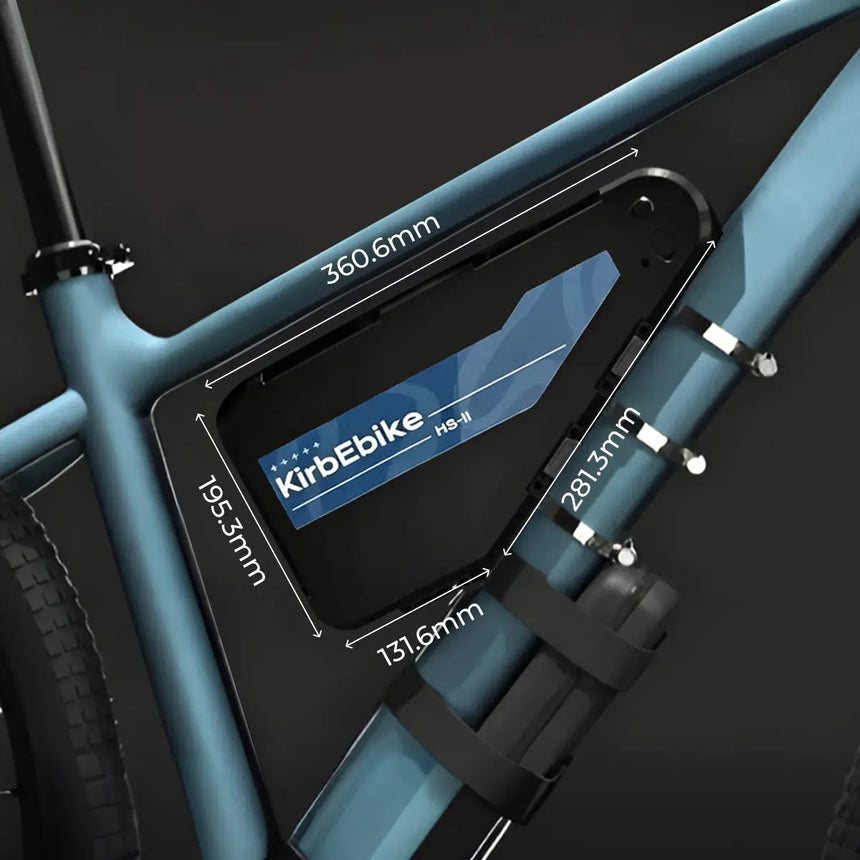
  • Case360.6 / 281.3 / 195.4 / 131.6 mm · 97 mm thick
  • ExtraUSB-C output
View the HS-II high-capacity battery

A worked example. A 90 kg rider on a 52V 2,000W kit, hills, 40 km a day → HS-II 52V 30Ah. The same rider on flat 15 km commutes → Taishan 48V 30Ah or Entry 52V.

The highest price in the range is only the right answer when your riding earns it.

Entry Down-Tube vs Taishan vs HS-II
FieldEntry Down-TubeTaishanHS-II
Voltages36V, 48V, 52V48V, 52V, 60V, 72V52V, 60V, 72V
Capacity540–1,040 Wh1,260–1,440 Wh1,260–1,560 Wh
CellsLG 21700 / EVE by modelLG 21700 · Samsung 50S on 72VLG 21700 · Samsung 50S on 72V
BMS continuous30A / 40A60A60A
Charge time7–10 h4–6 h4–5 h
Cycle life800–1,000800–1,000800–1,000
ConnectorXT60XT60 (48/52V) · XT90 (60/72V)XT60 (52V) · XT90 (60/72V)
MountingDown tubeFrame triangle, low profileFrame triangle, deeper
AdvantageLightest, lowest costFits the most frames at 60AMost energy on board
Trade-offLower current, slow chargingCosts more than EntryLargest and heaviest

Specifications vary by the variant you select — treat product-page variant data as the final ordering reference.

Electric bike batteries: what actually decides the right battery

Motor wattage is a category. The controller decides what the battery must deliver — so answer these four, in order, and the shortlist is usually two packs.

Voltage

What nominal voltage does the controller run — and what maximum input does it accept at full charge?

Current

What continuous current will it pull at full throttle? The BMS must meet it with margin.

Space

How much frame room is left once the rail, connector and slide-off travel are counted?

Energy

Only now — how many watt-hours does your daily distance actually need?

Types of ebike batteries

The standardLithium-ion The most popular type of ebike battery: most energy per kilogram, holds voltage under load, hundreds of cycles. Every KirbEbike pack is lithium-ion.
Not worth itNiMH Heavier and less efficient than lithium-ion — the same energy costs noticeably more weight.
AvoidSLA The heaviest with the shortest lifespan. The upfront saving disappears within a year or two of replacements.

Factory bikes commonly run 24V, 36V or 48V. Conversions go further — and 52V batteries improve hill performance and acceleration over a 48V pack of the same amp-hours, felt on every steep climb.

Legality, because it is often confused: UK road-legal status is decided by the motor's continuous rated power and assisted speed — not battery voltage.

What every pack is built around

Sealed HS-II battery case seen side-on, housing the 21700 lithium cells and management board

Named cells

LG 21700, Samsung 50S 21700 on 72V, EVE on specified Entry models — checkable, not claimed.

Heavy-gauge XT discharge lead carrying current from the battery pack to the controller

60A continuous

Every Taishan and HS-II pack feeds a high-current controller without sagging.

D-Power lithium battery charger supplied with KirbEbike packs, with its mains and output leads

Matched charger

Output matched to the pack it ships with — part of the system, not an accessory.

Close-up details of the USB-C port, charge port, power switch and battery power display

Sealed & locked

Covered ports, power display, IP65 on specified packs, quick-release mount in four steps.

What to check before buying an e bike battery

Full-charge voltage

A 52V pack reaches 58.8V off the charger — a 48V-only controller may not survive it. If the label lists one voltage and your pack charges above it, it is not safe.

BMS current

Continuous rating must meet the controller's maximum current with margin: 60A on Taishan and HS-II, 30A/40A on Entry. Peak figures are an allowance, not a budget.

Wiring & cutoff

XT60 on 36–52V, XT90 on 60/72V. Confirm the low-voltage cutoff, and pair the pack with the Smart eBike Controller with App Programmable Settings rather than choosing them in sequence.

Will it fit? Measure before you order

Fit is three-dimensional: add the rail, the connector and the slide-off travel to your measurements. If the pack fits but cannot be removed, it does not fit.

Taishan battery drawn at 386.2 by 97 by 157.4 millimetres for frame clearance checks
Taishan — one case across all voltages, 386.2 × 97 × 157.4 mm.
HS-II dimension drawing showing 360.6, 281.3, 195.4, 131.6 and 97 millimetre measurements
HS-II — 360.6 / 281.3 / 195.4 / 131.6 mm, 97 mm thick.
Mounting positions compared
PositionAdvantagesLimitationsSuits
Frame triangleBetter protection and aesthetics — weight low and central, best handling, largest capacitiesNeeds a clear triangle: both packs are 97 mm thick, so height decides — Taishan's 157.4 mm wedge vs HS-II's 195.4 / 281.3 mm uprightsTaishan · HS-II
Down tubeFamiliar, low centre of gravity, easy to reachLimited by bottle-boss spacing and the ≈368 mm caseEntry packs
Rear rackFrees the frame — suits small and step-through framesWeight high and rearward; can affect handling on heavily loaded bikesSmall frames, folders
Mounting rail supplied with four stainless hose clamps and a set of M5 fixing screws
Rail, four clamps, M5 screws
Technical drawing of the mounting rail showing its 260 millimetre length and M5 hole positions
260 mm · thirteen M5 positions
Mounting hardware packed in its box with the rail and clamps seated in foam
Packed in foam, ready to fit
Aluminium battery mounting rail with its slotted adjustment holes along the full length
Slotted for fore-and-aft adjustment

Not sure?Send a side-on frame photo with measurements — we confirm the combination in writing before you order.

Charge times, and the habits that protect them

Charging

  • Taishan & HS-II, fast charger: ≈4 h for 20Ah, ≈5 h for 25–30Ah, ≈6 h for the 48V 30Ah.
  • Entry Down-Tube, lower-output charger: 7–10 h — built for overnight.
  • Fast charging is a system property — cells, BMS and charger together. Not every battery accepts a fast charger.
  • Always use the supplied charger. A connector that fits is not proof of compatibility.

Battery care

  • Avoid deep discharges below 20% — the fastest way to lose capacity over a few years.
  • Store dry at 20–25°C, part-charged for long storage — never full or empty.
  • Cold weather temporarily cuts range; let the pack warm before charging after a cold ride.
  • Charging to ≈80% daily reduces cell stress — general guidance; the supplied instructions come first.

One-year warranty, regional support.

Free full-system and battery repair service in the UK, free battery repair service in the US and Netherlands, and manufacturing-defect cover worldwide—all backed by secure, tracked delivery.

Ask before you order

Cells, BMS and battery life

Cell quality decides a battery, and it is the hardest thing to see from outside — which is why so much battery marketing is adjectives. KirbEbike names the cell instead, and whether Samsung cells or LG suit better depends on the job, not the badge.

A good battery retains around 60% capacity after 1,000 charge cycles; these packs are rated 800–1,000 cycles — three to five years of commuting before range drops noticeably.

The BMS monitors voltage, current and temperature and disconnects on a fault. Around it, the battery cover does the quiet work: IP65 sealing on specified packs and a quick-release mount that fits in four steps.


Down-tube battery showing its power button and five-bar charge level indicator on the case

Ebike battery FAQs

How do I know which battery voltage my controller needs?

Read the controller label, not the motor. It states the nominal system voltage and often a maximum input voltage. Match the nominal figure first, then confirm the controller accepts the pack's full-charge voltage: 42V for 36V packs, 54.6V for 48V, 58.8V for 52V, 71.4V for 60V and 84V for 72V. If the controller lists only one voltage and your pack charges above it, that combination is not safe.

What is the difference between Ah and Wh?

Amp-hours measure charge capacity and only compare fairly at the same voltage. Watt-hours measure stored energy and compare across voltages: nominal voltage multiplied by amp-hours. A 48V 20Ah pack is about 960 Wh, while a 52V 20Ah pack is about 1,040 Wh. Use watt-hours whenever you are comparing packs of different voltages.

How far can an ebike battery go on one charge?

It depends on how quickly you use the energy. Divide usable watt-hours by your consumption per kilometre: gentle assisted riding on the flat can approach 20 Wh/km, while hard riding on hills can exceed 30 Wh/km. Motor power, controller current, speed, rider and cargo weight, gradient, tyre pressure, temperature and assistance level all change the result. Published range bands assume a motor class rather than promising a distance.

What battery capacity do I need for hills?

A 350 Wh battery is sufficient for flat urban routes, but batteries over 350 Wh are recommended for hilly terrain because climbing pulls far more current than cruising. For repeated steep climbs, a heavier rider, or cargo, start at 1,000 Wh and upwards. A 52V system also improves hill performance and acceleration over a 48V pack of the same amp-hour rating, so voltage and capacity should be chosen together.

How long does a battery take to reach a full charge?

On the Taishan and HS-II packs, about four hours for a 20Ah pack, around five hours for 25Ah to 30Ah, and about six hours for the 48V 30Ah pack. Entry Down-Tube models ship with a lower-output charger and take seven to ten hours. Fast charging is a system property, so always use the charger supplied with the pack.

Will the battery fit my bike frame?

Measure the usable space in three dimensions, then add the mounting rail, the connector and the room needed to slide the pack off. Taishan and HS-II are both 97 mm thick, so height is usually what decides it: Taishan is a shallow wedge at 157.4 mm, while HS-II rises to 195.4 mm and 281.3 mm on its upright edges. That is why Taishan clears frames the HS-II cannot. If you are unsure, send a side-on frame photograph with measurements and we will confirm before you order.

Are Samsung or LG battery cells better?

Both are established manufacturers, and the more useful question is which cell suits the job. KirbEbike uses LG 21700 cells across most models and Samsung 50S 21700 cells in the 72V packs, where sustained high-current output matters most. What matters more than the brand is that the cell is named, and that the BMS and charger are matched to it.

How long will an ebike battery last?

These packs are rated at 800 to 1,000 full charge cycles by model, and a good battery can retain around 60% of its original capacity after 1,000 cycles. For most riders that is three to five years of regular commuting before range drops noticeably. Avoiding deep discharges below 20%, storing the pack at around 20–25°C and using the matched charger all extend that.

Still deciding between two batteries? Send your controller details and a frame photograph and we will confirm the match before you order.