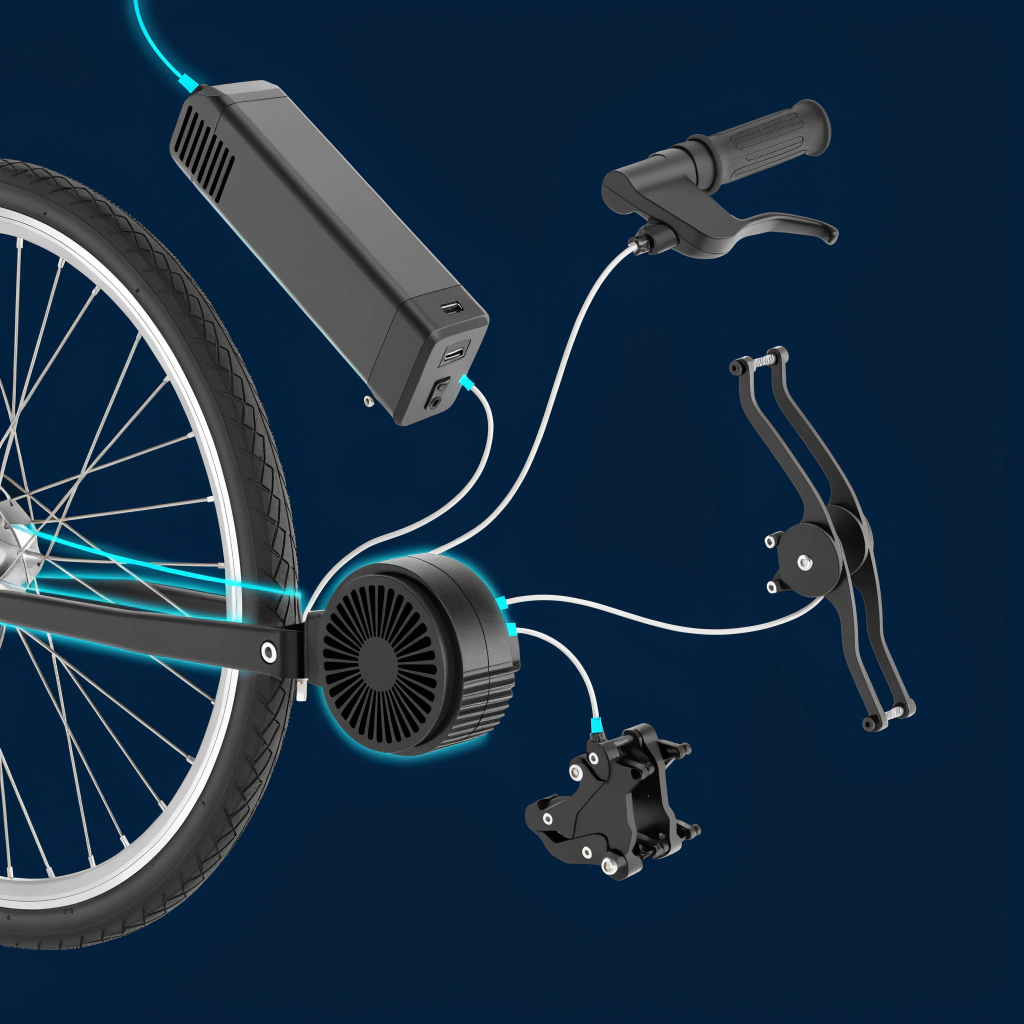
Can You Use an E-Bike Conversion Kit With Rim Brakes or V-Brakes?
KE
KirbEbike Editorial
Reviewed by the KirbEbike conversion-support team
Share
Unlock £10 off today
On this page
Rim brakes do not rule out a conversion. One specification decides it: whether the motor wheel you order has a machined braking surface your pads can grip. A hub motor arrives already laced into a rim, so that is settled at the point of order and cannot be added later.
The Quick Answer
Yes, if the motor wheel has a machined brake track — and many disc-specific motor wheels have none at all. That is the gate. The second half is condition: a conversion makes the bike heavier and usually faster, so assess pads, rims, cables and levers honestly, and fit the motor cut-off. For public roads in Great Britain, keep it at 250W with assistance stopping at 15.5mph. Confirm brake-track availability for your exact wheel size in writing before ordering — including on our kits.
A rim-brake bike is a candidate, not a write-off. The wheel you order decides whether a kit fits it; the condition of the brakes decides whether it should.
Direct Answer: Will Your Brake Setup Take a Conversion?
What you have
Likely verdict
The deciding check
Verify exact model
V-brakes (linear pull)
Usually workable
Motor wheel has a machined brake track
Wheel size and rim model ordered
Side-pull calipers
Often workable
Brake track plus caliper reach to the rim
Rim width against caliper clearance
Cantilever brakes
Often workable
Brake track plus straddle-wire setup
Pad type, smooth or threaded stud
Rim worn to its indicator
Not until replaced
Rim wall thickness, not pad depth
Wear indicator or measurement
Disc-only motor wheel
Incompatible
No braking surface exists to use
Wheel specification before ordering
Read down to your brake type. Every row depends on the wheel you order.
🛑
Do not order yet if any of these apply.
No compatible machined brake track on the motor wheel for your exact size and variant
Rim sidewall at or beyond its wear limit, concave or cracked
Brake arms that cannot reach the new rim with correct pad alignment
Rim width outside your caliper or pad range
An axle interface that does not match the frame or fork
A fork or frame not approved for a motor, including carbon
Braking capacity insufficient for your route, load and the finished speed
Any one of these is a stop, not a caution. Most cannot be fixed after the wheel arrives.
Brake naming causes half the confusion, so settle it first. Park Tool separates rim brakes into side-pull, centre-pull, linear-pull (V-brake), cantilever and caliper designs — a V-brake is one type of rim brake rather than a different family. Pads, arms and levers are matched within a family, so identify yours before comparing anything else.
The Gate: A Motor Wheel Needs a Machined Braking Surface
This is the test the rest of the article hangs on. A hub motor arrives already built into a rim, so the braking surface is decided at the point of order and cannot be added later. A disc-only rim has no machined band to brake against, and machining one into an existing rim is not a repair anyone should attempt.
Rim-brake conversion: the six-point pass/fail
Work down in this order. Steps 1 to 3 decide whether a kit is a candidate at all; 4 to 6 decide whether it is safe to ride.
Brake type identified — side-pull, centre-pull, linear-pull or cantilever, so you know what the pads need
Motor wheel brake track — the ordered rim has a machined braking surface compatible with your pad compound
Rim wall within wear limit — the wear indicator is not reached and the sidewall is not concave or cracked
Pads, cables and levers — sound, adjustable, with enough reach and travel for the rim width
Axle interface first — identify the axle system, then the width, then the fork or frame material
Cut-off and legal power — a motor cut-off is fitted and the completed bike is legal where you ride
Order matters within that list. Identify the axle system before any width figure: an open-dropout wheel and a thru-axle frame are different interfaces, not two widths of one thing, and if the hub does not match the frame’s specified interface the default answer is incompatible. Never file dropouts, never spread aluminium or carbon, and cold-set steel only with the frame manufacturer’s approval and a competent professional. Our wheel and dropout size reference covers the identification steps.
V-Brakes vs Disc Brakes on a Conversion
A disc-specific motor wheel. Note there is no machined band on the rim sidewall — nothing for a brake pad to grip, and nothing that can be added afterwards.
Factor
Rim brakes, including V-brakes
Disc brakes
Motor-wheel choice
Needs a machined brake track
Wider choice of motor wheels
Wet performance
Reduced until the rim clears
Less affected
Wear item
Pads and the rim itself
Pads and rotor
Retrofit to a rim-brake frame
Not applicable
Usually impossible without mounts
Neither is a safety guarantee; setup and condition decide.
Disc brakes are better for sustained wet descents and high-load builds, and that is a real advantage. But “hydraulic” is not a safety label. Stopping performance comes from rotor or rim diameter, caliper and pad condition, heat capacity, tyre grip, wheel build and total system mass together. A well-maintained V-brake with fresh pads on a sound rim can out-brake a neglected hydraulic disc with glazed pads. What matters is a competent assessment of the whole system, plus bedding pads in and testing at low speed before relying on them.
Why the Same Brakes Have More Work to Do
Why a conversion asks more of the same brakes
Kinetic energy the brakes must dissipate to stop, for one worked scenario — a bike and rider going from 90kg to 105kg. Arithmetic from ½mv², not a measured stopping test. Teal = unassisted baseline; blue = after conversion.
Before conversion 90kg · 12mph
1.29 kJ (1.0×)
After conversion 105kg · 12mph
1.51 kJ (1.2×)
At the legal assist limit 105kg · 15.5mph
2.52 kJ (1.9×)
Downhill, unassisted 105kg · 20mph
4.20 kJ (3.2×)
In that specific example, going from 90kg at 12mph to 105kg at the 15.5mph assist limit raises kinetic energy by roughly 95% — close to double. That is one scenario, not a rule.
The change for another rider depends entirely on their own before-and-after figures, because braking energy scales with total mass and the square of actual speed. A rider who already travelled at 15.5mph before converting sees a far smaller increase — mass alone, perhaps 15 to 20%. A rider who goes from 8mph to 15.5mph on a heavily loaded bike sees considerably more than double. Work it out for your own case rather than carrying a single multiplier around: the point is that the brakes have measurably more to do, not that any particular number applies to everyone.
Front Hub vs Rear Hub With Rim Brakes
A front hub is the usual rim-brake route, because front motor wheels are more commonly built into rim-brake rims and the rear drivetrain is left alone. That makes it a simpler drivetrain fit — but it moves motor torque into the fork, which is its own set of conditions.
Consider
Front hub
Rear hub
What it simplifies
The drivetrain. Freewheel or cassette, derailleur and sprocket clearance are untouched.
The fork. No motor torque through the fork legs or dropouts.
What it puts under load
The fork legs and fork dropouts, plus whatever torque restraint the maker specifies.
The rear dropouts and the frame around them.
Material and approval gate
Not suitable on a carbon fork. Some aluminium forks and suspension lowers are also unsuitable — the fork must be approved for a motor and the specified torque restraint.
Frame dropout material and thickness must suit the motor, with the specified torque restraint fitted.
Drivetrain checks
None beyond normal service.
Freewheel or cassette identified first, speed count matched, derailleur and chain capacity checked.
Clearance checks
Fork crown, brake arm reach, pad alignment to the new rim.
Brake arm clearance over a wider hub, plus derailleur clearance.
Traction
Less weight over the driven wheel; can slip on wet or steep starts.
Better traction, particularly on climbs and in the wet.
Neither layout is inherently lower risk — brake type does not decide this.
The fork approval question and the drivetrain question are different problems, and the right answer depends on which one your bike can satisfy. Identify the axle interface before any width figure, and settle freewheel or cassette with Park Tool’s identification guide before ordering a rear wheel.
Rim Brakes at 250W, 500W and 750W
Tier
Rim-brake suitability
Motor-wheel reality
Legal position in Great Britain
250W
The intended use case
Rim-brake motor wheels available
Can be an EAPC if pedals, 250W continuous and a 15.5mph cut-off are met
500W
Requires a stronger case
Often disc-specific wheels
Outside EAPC classification
750W
Rarely appropriate
Usually disc-only
Outside EAPC classification
Power raises both the braking demand and the chance the motor wheel is disc-only.
Be precise about what “outside EAPC classification” means, because the shorthand people use is wrong. Above 250W the completed cycle is not an EAPC: it may be used on private land only with the landowner’s permission and subject to site rules, or on public roads only if the relevant motor-vehicle approval, registration, tax, insurance, licence and equipment requirements are met (GOV.UK electric bike rules). That is a classification change, not a surface preference — the EAPC information sheet sets out the conditions in full. Practically, if your bike has rim brakes, 250W is the tier that suits it.
Rim Wear, Wet Weather and Long Descents
A conversion turns the rim into a consumable. Braking wears the sidewall from the outside in and a failed rim can deflate the tyre suddenly, so inspect the wear indicator where fitted, or measure against the manufacturer’s limit. Look for a concave sidewall, cracks near the spoke holes and bulging. Park Tool’s guidance on rim-brake pad replacement covers pad alignment and toe-in, which is what keeps wear even rather than gouging one band.
In the wet, expect reduced initial bite until the pads clear water and grit, so brake earlier and more progressively. On long descents heat builds in the rim, which can affect tyre pressure and, with old pads, cause fade. The mitigations are unglamorous: brake in firm intermittent applications rather than dragging, keep the rim clean, replace pads before the wear line, and check the rim after a winter of heavy use.
Do Kits Include Brake Levers and Cut-Off Sensors?
Levers and cable entry. Confirm the supplied e-brake levers match your brake family and cable pull — linear-pull arms need more cable pull than a side-pull caliper.
Most reputable kits do. KirbEbike kits ship with e-brake levers that cut motor power when pulled, which is a functional safety part, not an accessory. Fit them, test each lever with the driven wheel safely raised before the first ride, and confirm the supplied levers suit your brake type — replacement levers need the correct cable pull for linear-pull arms, which differs from a side-pull caliper. Sensor-based cut-offs that clip to existing levers are an alternative where you want to keep your original brakes.
💡
Worth saying plainly, because it comes up in customer feedback. Some riders skip the brake sensors because the motor already stops when they stop pedalling. We do not recommend that. Pedal-assist cut-out and a brake cut-off are different protections, and the second is the one that helps when you are actually trying to stop.
Send Us These Five Photos Before You Order
The fastest way to get a definite answer instead of a maybe. Photograph each subject below in good light, at the framing described — a photo taken too far away or at the wrong angle usually cannot answer the question it was sent to answer.
#
Subject
How to frame it
What it tells us
1
Brake arms
Side on, whole caliper in frame. Stand level with the hub, fill about half the frame
Side-pull, centre-pull, linear-pull or cantilever
2
Rim braking surface
Close up, square to the sidewall, 20–30cm away. Wear indicator visible
Whether a machined track exists, and its wear state
3
Tyre sidewall
Rotate the marking upright and fill the frame — e.g. “54-622” must be legible
ETRTO size, so the wheel is not guessed from an inch label
4
Fork or rear dropout
Wheel out. Lay a ruler across the inner faces to show the spacing. Show whether the slot is open
Axle interface and dropout spacing
5
Lever and cable entry
From above the bar, showing the lever body, barrel adjuster and any existing switch or sensor
Cut-off compatibility and cable pull
Usable brake track
Flat machined band, even width
Distinct from the anodised or painted rim finish
Wear indicator groove or dot still visible
No concavity, cracks or bulging at the sidewall
Disc-only rim — unusable
No machined band anywhere on the sidewall
Sidewall finish continuous from bead to spoke face
Nothing can be added — machining a track is not a repair
The wheel is wrong for the bike, whatever the kit claims
Add your measured dropout spacing and the bike’s make, model and year. With those five images the kit selector becomes a short list rather than a guess.
Rim-Brake Options
The 500W/750W MTX kit and the higher-power kits specify disc-brake wheels. If your bike has rim brakes and you want that power, the honest position is that the wheel is wrong for your bike and the power is outside EAPC classification anyway.
Among alternatives, Boost builds its rear wheel to order with rim-brake and disc-brake rim choices, a genuine option for a rim-brake commuter; Cytronex offers a lightweight front-hub route whose brake compatibility depends on the wheel build; and Swytch builds front wheels across many sizes with compatibility set by the ordered variant. All three are 250W-class and all three need the same brake-track confirmation.
Kit
Motor position
Rim-brake wheel
Power tier
Deciding check
Boost
Rear
Available by wheel build
250W class
Rim choice and rear axle interface
Cytronex
Front
Configuration dependent
250W class
Wheel, fork and brake type
KirbEbike 250W
Front
Alexrims EV23, confirm by size
250W
Brake track and 100mm fork
KirbEbike 36V/48V 250W
Front
Stated for V-brake or disc
250W
Wheel size ordered
KirbEbike EZ Rider
Front
Variant dependent
250W
Exact wheel and brake option
Swytch
Front
Configuration dependent
250W class
Fork and wheel specification
Listed alphabetically. Availability is set by the wheel, not the brand. Published specifications, checked 6 August 2026.
Of our own range, the 36V/48V 250W front kit is the one that states V-brake or disc compatibility explicitly, and the 250W front-wheel kit is built on Alexrims EV23 CNC-machined rims — confirm the brake track for your exact size. The EZ Rider kit is variant dependent, so ask before ordering.
Upgrade to Disc Brakes, or Change Donor Bike?
Converting a rim-brake bike to discs is usually not viable. The frame and fork need disc mounts and both wheels need disc-compatible hubs, so without mounts the answer is no — bolt-on adapters for frames not designed for disc loads are not a safe substitute. Where mounts exist, cost the wheels, rotors, calipers, levers or hoses and fitting before deciding.
So the real choice is between converting the rim-brake bike you have with a suitable 250W kit, or picking a disc-equipped donor if you want higher power or heavy year-round wet use. Convert when the frame and rim are sound, the route is moderate and 250W suits you. Change donor when you need more power, carry heavy loads, or ride long wet descents.
Common Rim-Brake Conversion Mistakes
Mistake
Why it costs you
Ordering a disc-only motor wheel
No braking surface exists, and none can be added
Assuming V-brake and rim brake are different things
V-brake is the linear-pull type of rim brake
Judging the rim by pad depth
The rim sidewall is the wear item that matters
Treating hydraulic as automatically safer
Condition, heat capacity and tyre grip decide stopping
Skipping the brake cut-off sensor
Pedal cut-out is not the same protection
Buying power above 250W for a rim-brake bike
Wrong wheel type, and outside EAPC classification
Final Rim-Brake Conversion Checklist
Brake family identified, and pads and levers matched to it
Motor wheel confirmed in writing to have a machined brake track for your pads
Rim sidewall inside its wear limit, with no concavity or cracks
Axle interface identified first, then spacing, then fork or frame material
Brake arms reach the new rim, with correct pad alignment and toe-in
Motor cut-off fitted and tested with the driven wheel safely raised
Battery matched to the controller by voltage, continuous current and watt-hours, using an authorised charger
Power level and configuration legal for where you intend to ride
⚠️
Two things to confirm before ordering a KirbEbike 250W kit for public-road use. First, brake-track availability for your exact wheel size and variant, in writing. Second, the assistance cut-off: our 250W product pages currently advertise maximum speeds of 25–35km/h in places, which is above the 15.5mph (25km/h) assistance limit an EAPC must observe. For public-road use, select only a configuration verified to meet the applicable EAPC conditions, and confirm the exact wheel and controller variant before ordering.
Product touchpoint
Getting a definite answer on a rim-brake bike
The wording to look for on any kit is explicit brake-type compatibility for your exact wheel size — not a general mention of a rim brand. Send the five photos above with your measured dropout spacing and we will confirm the brake track and the cut-off configuration against your specific order. If your bike has rim brakes and you want more than 250W, we would rather tell you the wheel is wrong for your bike than sell it to you.
Conclusion: The Wheel Decides, the Condition Confirms
Rim brakes and V-brakes are not an obstacle to converting a bike. The motor wheel has to carry a machined braking surface your pads can use, and that single specification decides whether a kit is a candidate. Ask for it in writing, for the exact wheel size you intend to order.
Then be honest about condition. A conversion raises the energy your brakes handle — by how much depends on your own before-and-after mass and speed, as the worked example above shows. Fresh pads, a rim inside its wear limit, properly adjusted arms and a working cut-off matter more than which technology is fitted, and a bed-in plus low-speed test is the step most people skip. For public roads in Great Britain keep the build at 250W with assistance stopping at 15.5mph, use only an authorised charger, and get any uncertain measurement confirmed in writing before ordering.
Confirm the brake track, then order
One specification decides whether a kit suits a rim-brake bike. Everything else is condition.
Can you use an e-bike conversion kit with rim brakes?
Only when the motor wheel has a machined braking surface suited to your pads, confirmed in writing for your exact wheel size and variant, and the brakes are sound. The wheel specification is the deciding factor, not the brake itself.
Are rim brakes and V-brakes the same thing?
V-brakes are one type of rim brake, known technically as linear-pull. Park Tool also lists side-pull, centre-pull and cantilever designs, so all V-brakes are rim brakes but not all rim brakes are V-brakes.
Do hub motor wheels work with V-brakes?
Only when the rim they are built into has a machined brake track. Many motor wheels are disc-specific and have no usable braking surface, and nothing can be added to one afterwards.
Are rim brakes safe on an electric bike?
They can be, on a 250W build with sound pads, a rim inside its wear limit and correct adjustment. A conversion raises the braking energy substantially, so condition and setup matter more than before.
Are disc brakes better than rim brakes for an e-bike?
Discs are better for sustained wet descents and higher loads, but hydraulic is not a safety label. Rotor or rim size, pad and caliper condition, heat capacity, tyre grip, wheel build and total mass all decide stopping performance.
How do I know if my rim is worn out?
Check the wear indicator if the rim has one, or measure the sidewall against the manufacturer’s limit. A concave or dished braking surface, cracks near the spoke holes or bulging all mean replace it before converting.
Do conversion kits come with brake levers?
Reputable kits usually include e-brake levers that cut motor power when pulled, or clip-on sensors for existing levers. Confirm the supplied levers match your brake type and cable pull.
Can I convert my rim-brake bike to disc brakes?
Usually not. The frame and fork need disc mounts and both wheels need disc-compatible hubs. Adapters on a frame not designed for disc loads are not a safe substitute.
What power conversion kit suits a rim-brake bike?
250W. It is the tier for which rim-brake motor wheels are commonly available, and the only one that can qualify as an EAPC in Great Britain when the completed bike meets the pedal and 15.5mph conditions.
Do I need a brake cut-off sensor on a rim-brake conversion?
Follow the instructions for your exact controller and kit — architectures differ, and the manufacturer’s documentation is the authority. KirbEbike recommends fitting and testing the brake cut-off supplied with its applicable systems, because it stops motor assistance when you brake, and we would always fit one. Two things it is not: a cut-off is not a legal requirement — EAPC classification turns on pedals, a 250W maximum continuous rated output and the 15.5mph cut-off, not on a sensor — and it is not a substitute for correct brake setup.
A note on safety & legality. General information, not a substitute for the manufacturer’s instructions or a competent brake assessment. Do not convert a bike whose rim has reached its wear limit, never file dropouts or spread an aluminium or carbon frame, and always fit and test the motor cut-off. Bed pads in and test at low speed before relying on them. Use only a charger authorised for your pack. In Great Britain a converted cycle is an EAPC only when it has working pedals, a motor rated no higher than 250W continuous and assistance that stops at 15.5mph; above that it is outside EAPC classification and may be used on private land with the landowner’s permission, or on roads only with the relevant motor-vehicle approval, registration, tax, insurance, licence and equipment.
About this guide. Author: KirbEbike Editorial. Technical review: KirbEbike conversion support. Last reviewed: 6 August 2026. Methodology: brake families, pad alignment and service procedures cross-checked against Park Tool documentation, legality and battery safety against GOV.UK and London Fire Brigade guidance, all cited inline. The braking-energy chart is arithmetic from kinetic energy for the stated masses and speeds, not a measured stopping test. KirbEbike and competitor wheel, rim and brake specifications were read from each supplier’s live product page on 6 August 2026, are labelled as published claims, and change by wheel build and variant; confirm the brake track for your exact ordered wheel size in writing before purchase.
Stay in the know
Conversion guides, fitting advice and the deals worth knowing about. No spam.