A rear-wheel conversion kit can have the right wheel size, motor power and battery voltage and still be unusable if its gear-mounting system doesn’t match your bike. Freewheel and cassette hubs use different, non-interchangeable interfaces — so before you compare price or power, you have to identify your drivetrain and choose the correct rear hub. This guide shows you exactly how.
The gear interface behind the motor decides whether the kit fits at all. A rear-hub motor with a disc rotor on a hardtail — wheel size and power mean nothing if the drivetrain interface is wrong.
The quick answer
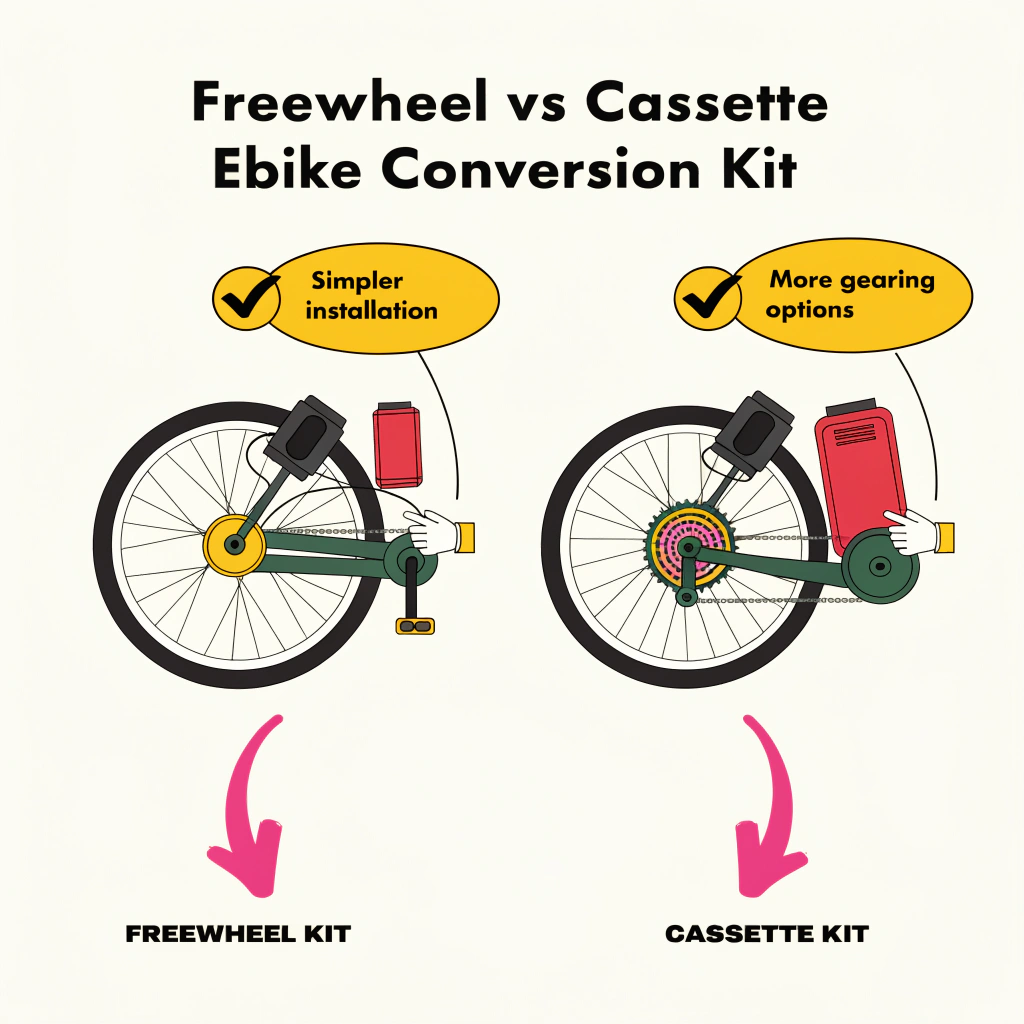
A freewheel screws onto a threaded motor hub as one complete gear-and-ratchet unit. A cassette slides over a splined freehub body and is held by a lockring. The two are not interchangeable on the same motor hub. Choose a freewheel-compatible motor when your donor bike uses a screw-on freewheel and you want a simpler, lower-cost drivetrain. Choose a cassette-compatible motor when your bike uses a splined cassette and preserving an 8-, 9-, 10- or 11-speed drivetrain matters — and only when the motor’s freehub standard explicitly supports the cassette you intend to fit. Don’t order on gear count alone: confirm the mounting interface, the motor’s installed hub width against your frame, axle shape, brake compatibility and supported sprocket count first.
Not sure which interface your bike uses? Identify it physically before you order — a photo of your rear hub takes thirty seconds and prevents the single most common conversion return. Compare rear-hub kits →
Freewheel vs Cassette at a Glance
Benefits and drawbacks are folded into this one table rather than repeated below. If you only read one thing on this page, read this.
Factor
Freewheel Motor Hub
Cassette Motor Hub
Gear attachment
Screws onto threads cut into the hub
Slides onto splines, held by a lockring
Ratchet location
Inside the gear cluster
Inside the freehub body
Typical use
Simpler and older drivetrains
Modern multi-speed drivetrains
Common sprocket counts
Single-speed to 7-speed
Commonly 8-speed and above
Gear range
Fewer modern options; limited extremes
Wider range; smaller high & larger climbing gears
Replacement
Whole unit swapped; usually cheaper
Sprockets swapped individually; usually dearer
Removal
Unscrews as one block; can tighten with use
Lockring off first, then sprockets slide off
Frame-width impact
Can leave more room for the motor body
Freehub body can increase required hub width
Main risk when buying
Caps you at a low sprocket count
Freehub standard may not match your cassette
Interchangeable on same hub
No
No
Treat the sprocket-count ranges as useful clues, not universal rules. Seven-speed cassettes exist and eight-speed freewheels exist. Neither system is stronger, narrower or more reliable in the abstract — those outcomes depend on the individual motor design.
⚠️
“Cassette” does not mean one standard. Common cassette interfaces include Shimano/SRAM HG, Shimano Micro Spline, SRAM XD/XDR and Campagnolo. Shimano further separates the shorter HG spline M body (common 8/9/10-speed and some MTB 11-speed) from the longer HG spline L body used for road 11- and 12-speed. A listing that simply says “cassette” tells you almost nothing — confirm the spline type and freehub body length on the product specification before you assume your cassette will fit.
How to Tell Whether Your Bike Has a Freewheel or Cassette
This is the check that prevents the wrong order. Work through the methods in order and stop as soon as you have a definite answer.
Look at the drive side. The gear cluster mounts here — a lockring means cassette; a one-piece threaded block means freewheel.
Method 1 — Check for a cassette lockring
A cassette normally has a visible lockring around the axle at the centre of the smallest sprocket, often carrying markings (though dirt or the axle can obscure them). A freewheel has no separate lockring — the whole cluster is one threaded unit.
Method 2 — Spin the sprockets backwards
With the rear wheel removed, rotate the sprockets backwards and watch the central tool fitting. On a freewheel, the outer gear cluster rotates around a stationary central removal fitting. On a cassette, the lockring and sprockets rotate together. This is Park Tool’s own distinguishing characteristic, though it’s worth confirming with Method 1 or 4 rather than relying on it alone.
Method 3 — Check the bike or hub specification
Look up the bike model and year, the rear-hub model and the current gear-cluster model in the manufacturer’s technical documents or your original purchase specification. Shimano publishes its compatibility and service documentation openly. This often confirms the system without touching a tool.
Method 4 — Remove the gear cluster
The definitive method, but it needs the correct tool. A freewheel unscrews as a complete ratcheting gear block; a cassette’s lockring comes off first, then the sprockets slide off the freehub body. Park Tool’s guide to determining cassette or freewheel type shows the tool fittings. If you’re unsure, send clear photos to the kit supplier or ask a bike mechanic before ordering.
Does the number of rear gears tell you which system you have?
Not conclusively. “Seven gears always means freewheel” and “eight gears always means cassette” are rough guides only. Five-, six- and seven-speed systems are commonly freewheels, and eight-speed and above are commonly cassettes — but seven-speed cassettes exist and eight-speed freewheels exist. A gear count is a first clue, not proof of the interface.
Fit Is More Than a Gear Question
A compatible gear interface does not guarantee the motor wheel will go into your frame. Five other checks decide that.
Interface, width and axle all have to match. A threaded freewheel lifted clear of its hub — the gear count is only one of several fit checks.
Rear dropout width and over-locknut dimension (OLN)
Measure the internal distance between the rear dropouts with the wheel removed, and compare it with the motor wheel’s over-locknut dimension (OLN) rather than a generic label like “standard rear hub”. Common frame standards include 130mm, 135mm, 141mm QR, 142mm thru-axle, 148mm Boost and wider fat-bike standards. These are not automatically interchangeable.
⚠️
Frame standard is not the same as motor width. A number like “142mm” on a modern frame usually describes a 12×142 thru-axle rear end — a closed axle standard, not an open slot. Quoting a motor as fitting “135–142mm” invites riders with thru-axle frames to order a bolt-on motor that physically cannot go in. Match your measured frame spacing to the motor’s published OLN for the exact variant, and confirm your dropouts are open slots.
Bolt-on axle vs quick-release vs thru-axle
Many hub motors use solid bolt-on axles with flat sides, even when the original bike uses a quick-release skewer. Modern thru-axle frames generally require a conversion motor engineered specifically for that standard. Do not file, bend or force a standard motor axle into a thru-axle frame.
Frame material and dropout condition
Check the frame material — steel, aluminium, carbon, magnesium or specialist — and inspect the dropouts for cracks, corrosion or damage. Frame spreading or cold-setting should not be treated as a universal DIY fix, particularly on aluminium or carbon frames, where it can cause hidden damage.
Brake-rotor alignment
Confirm the rotor mounting standard and diameter, the caliper clearance and any required spacers, whether the motor casing contacts the caliper, and whether the wheel remains centred after spacing.
🔧
Rotor spacers — safety boundary. A rotor spacer is sometimes needed on disc-brake conversions, but only where the motor or adaptor manufacturer permits one and publishes a thickness range for that part. Before fitting any spacer, confirm:
remaining bolt thread engagement meets the manufacturer’s minimum
rotor position relative to the caliper, with the pads centred on the braking surface
the wheel is still centred in the frame after spacing
no interference between the motor casing, rotor, caliper and frame
Never stack spacers to make a motor fit a frame it was not designed for — that is a fit problem, not a spacing problem. KirbEbike does not publish a general spacer range; if you think you need one, send photos and measurements to after-sales for your exact motor.
Derailleur and chainline clearance
Check the smallest sprocket-to-frame clearance, the largest sprocket-to-motor clearance, the derailleur cage movement, the chain angle in the highest and lowest gears, and cable routing near the motor axle. Poor chainline causes noise, poor shifting and accelerated wear.
Can You Change From a Freewheel to a Cassette During Conversion?
Yes — but not by installing a cassette onto a threaded freewheel motor. Changing systems requires a cassette-compatible motor wheel. Because a rear-hub conversion replaces the whole wheel anyway, the practical decision is simply which interface the new motor wheel has. These are the four combinations riders actually face.
Your bike now
Motor you order
What happens
What to check
Freewheel
Freewheel motor
Simplest path — the new motor arrives with its own threaded freewheel.
Sprocket count matches your shifter indexing; chain condition
Cassette
Cassette motor
Your existing cassette may transfer if the freehub standard matches.
Spline type & freehub body length; largest sprocket vs derailleur capacity
Cassette
Freewheel motor
Your cassette cannot be reused — it won’t thread on. You buy a freewheel.
You buy a cassette — your freewheel can’t slide onto the splines.
Cassette matched to the motor’s spline standard; shifter speed count; chain width; derailleur capacity
How can I use a freewheel e-bike kit on a cassette bike?
You fit the freewheel that comes with (or suits) the motor, and accept that your old cassette is retired with the old wheel. The motor brings its own interface; nothing from the old hub transfers. Get right: your shifter’s indexing against the new freewheel’s sprocket spacing, the freewheel’s width against your frame and chainline, and a chain that matches. If you’re running 8-speed or higher now, dropping to a 7-speed freewheel usually means changing the shifter too.
When your existing shifter and derailleur may still work
Your original controls may still work when the new gear cluster has the same number of speeds, the cog spacing matches the shifter’s indexing, the derailleur supports the largest sprocket, the chain suits the sprocket count, and the chainline remains acceptable. Mixing an old, worn chain with a new gear cluster commonly causes skipping under load — replace the chain when you change the cluster.
Which KirbEbike Variant Should I Order?
KirbEbike lists rear-hub kits across several power levels with a freewheel or cassette option selectable per wheel size. Use this table to narrow down, then confirm the exact variant on its product page before ordering.
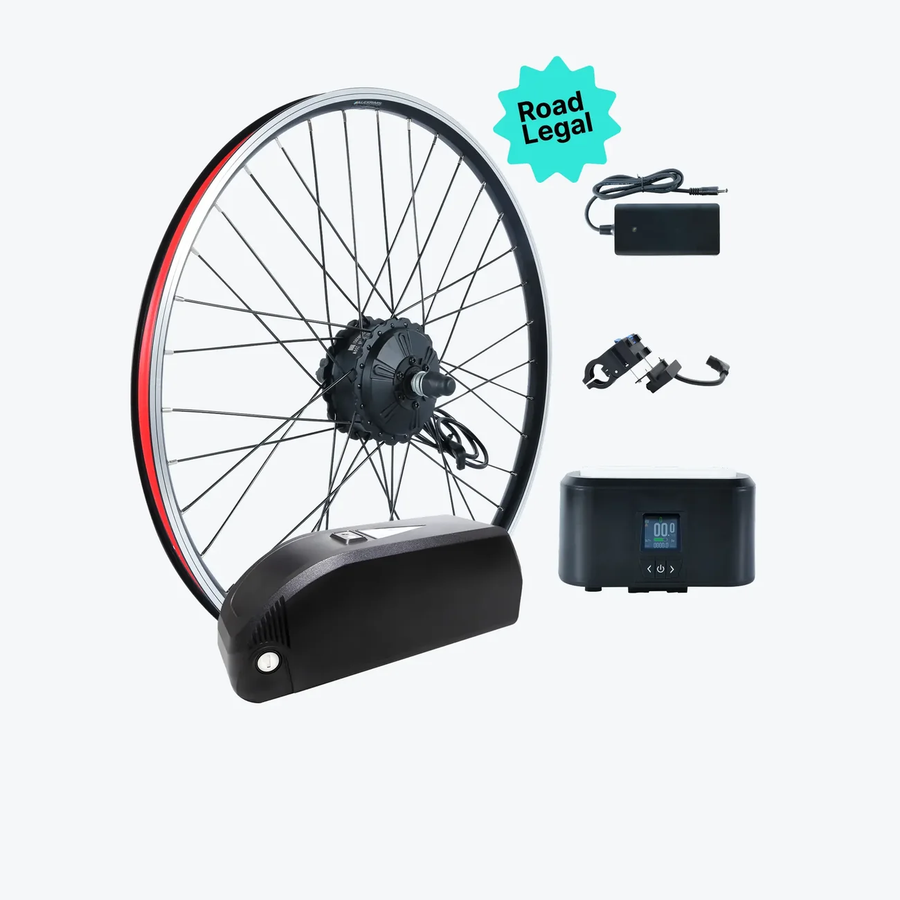
Match the gear cluster to your bike’s interface. A KirbEbike rear-hub kit — motor wheel, gear cluster, colour display, controller, sensors and an HS-II battery.
Selection point
Freewheel variant
Cassette variant
Sprocket count
7-speed
8, 9, 10 or 11-speed
Dropout type
Open slotted dropouts
Open slotted dropouts
Thru-axle frames
Not 12×142 thru-axle
Not 12×142 thru-axle
Brake type
Disc brake
Disc brake
Battery
Optional on most kits
Optional on most kits
Wheel sizes
Selectable per kit
Selectable per kit
Power levels include the 500W/750W MTX, 48V 1000W and 52V 2000W MTX kits. Interface, sprocket count and dimensions vary by variant and can change — confirm on the live product page before ordering.
⚠️
Before you order.Thru-axle: KirbEbike rear-hub motors use a solid bolt-on axle with flats, which needs an open slotted dropout. If your frame takes a 12×142 thru-axle, these kits do not fit it — measure your frame and check the axle type; don’t read a frame-standard number as a compatibility promise. Cassette: an “8/9/10/11-speed” label describes the sprocket count — confirm the exact cassette details for your variant, and buy a cassette matched to your speed count, largest sprocket and derailleur capacity.
Freewheel or cassette · your size
KirbEbike Rear-Hub Conversion Kits
Pick the interface and wheel size that match your bike — 500W to 2000W MTX, built to order with a colour display, potted controller and optional battery.
Brand rankings go stale fast — stock, versions and fitment change without notice. What doesn’t change is the set of things you have to confirm. Judge any rear-hub kit, from any seller, on these points.
Check
What good looks like
Confirmed interface
States freewheel or cassette explicitly, not just a gear count
Freehub standard
Spline type and body length published, not just “cassette”
Supported sprocket count
A specific number for the specific variant you are buying
Installed hub width
A published OLN figure, not a frame-standard range
Axle and dropout
Axle type stated; open dropout vs thru-axle unambiguous
Wheel-size availability
Your size actually in the variant list, not just the range
Brake compatibility
Rotor standard and caliper clearance addressed
Battery inclusion
Clear whether the battery is in the price
Sprockets included
Stated explicitly — assume not included unless it says so
Torque-arm provision
Supplied hardware identified, with quantity
Support & documentation
A real installation document for that variant
Run these same checks whichever brand you choose. Don’t buy an unnamed marketplace kit because its title contains the word “cassette” — and don’t trust a brand-level width range covering several power levels, because different variants within one brand routinely differ.
What About Mid-Drive Conversions?
A mid-drive doesn’t replace the rear hub, so you normally keep your existing freewheel or cassette — this decision doesn’t apply. Because the motor sends power through the chain and rear sprockets, drivetrain strength and replacement-part availability matter more instead.
Tools and Parts Needed for Installation
Tools for a freewheel setup
The correct freewheel-removal tool (patterns differ between brands), a large adjustable spanner or bench vice to turn it, an axle-nut spanner, a torque wrench and grease. The removal tool inserts into the central fitting and the freewheel unscrews as one block — no chain whip is involved.
Tools for a cassette setup
A compatible cassette lockring tool, a chain whip to hold the sprockets while the lockring is undone, a torque wrench, a cassette spacer where specified, and derailleur adjustment tools.
Conversion-specific parts
Regardless of interface, budget for a torque arm or torque plates, correct axle washers, brake-rotor spacers only where approved for your motor, cable protection, frame-safe battery mounting hardware, and a replacement chain if the old one is worn. KirbEbike lists installation accessories alongside its conversion-kit collection.
Final Pre-Purchase Checklist
Each line here is also a mistake people make. Confirm all of them before you pay.
Freewheel or cassette interface — physically identified, not inferred from gear count. Seven-speed does not conclusively mean freewheel.
Number of rear sprockets and shifter indexing — and, for a cassette motor, the spline standard behind the speed count.
Rear dropout width measured, compared against the motor’s published OLN. Never tighten axle nuts to pull an incompatible frame around an oversized hub.
Axle standard: bolt-on, quick-release or thru-axle. An open-dropout motor will not fit a 12×142 thru-axle frame.
Wheel size and rim compatibility.
Brake type, rotor size and caliper clearance — with any spacer approved for your specific motor.
Cassette or freewheel clearance to frame and motor, and chainline.
Whether sprockets are included. Assume not unless the page says otherwise.
Battery, controller and torque-arm provision. Powerful hub motors need a torque arm regardless of interface.
A fresh chain if the old one is worn — a worn chain on new sprockets skips under pedal load.
Conclusion: The Right Hub Beats the “Better” System
Neither system is automatically best. A freewheel can be the practical, economical choice for a simple drivetrain; a cassette usually gives more gearing options on a modern bike. The right choice is the interface that matches your donor bike and the exact rear motor hub you’re buying.
If you’re changing from one system to the other, account for shifter indexing, chain width, derailleur capacity, axle standard and frame spacing — and let the exact product dimensions and supported sprocket counts override generic advice. Identify your existing drivetrain first, measure the rear frame, then choose a motor wheel whose published interface and dimensions match what you found.
📷
Still not certain what you’ve got? Photograph your rear hub, count your sprockets and measure your dropout width — then check those three against the variant before you order. Compare rear-hub kits →
FAQs
How do I identify whether my bike has a freewheel or cassette?
Look for a lockring at the centre of the smallest sprocket — a cassette has one, a freewheel doesn’t. Spin the sprockets backwards and watch the central fitting: on a freewheel it stays still while the cluster turns. Removing the cluster with the correct tool is the definitive check.
Can I use a freewheel e-bike kit on a cassette bike?
Yes, because the kit replaces the whole rear wheel and brings its own interface. Your existing cassette won’t transfer — it can’t thread onto a freewheel hub. Check your shifter’s indexing against the new freewheel’s spacing, the freewheel width against your frame, and fit a matching chain. Moving from 8-speed or higher down to a 7-speed freewheel usually means a new shifter too.
Will my existing shifter still work?
Possibly. The new gear cluster needs the same number of speeds, compatible sprocket spacing for your shifter’s indexing, and a derailleur that supports its largest sprocket. If those match, the original shifter often works unchanged.
Does a 7-speed bike always use a freewheel?
No. Seven-speed freewheels are common, but seven-speed cassettes exist too — and eight-speed freewheels exist. Gear count is a clue, not proof. Identify the interface physically before ordering.
Which KirbEbike variant fits an 8, 9, 10 or 11-speed drivetrain?
The cassette variant is listed for 8, 9, 10 or 11-speed, selectable per wheel size, across power levels including the 500W/750W MTX, 48V 1000W and 52V 2000W MTX kits. Cassette sprockets are not included. Before buying, confirm the spline standard and freehub body length for your exact variant with after-sales — a speed count alone doesn’t establish which cassettes fit.
Does a 142mm frame fit?
Usually not. On a modern frame, 142mm normally means a 12×142 thru-axle — a closed axle standard. KirbEbike rear-hub motors use a solid bolt-on axle with flats and need open slotted dropouts. Measure your frame, check whether your dropouts are open slots or a closed thru-axle interface, and confirm the motor’s installed width for your variant before ordering.
Sources
Park Tool — Determining Cassette and Freewheel Type. parktool.com
Park Tool — Cassette Removal and Installation. parktool.com
Park Tool — Freewheel Removal and Installation. parktool.com
Shimano — Technical Documents and Compatibility (SI). si.shimano.com
About this guide. Author: KirbEbike Editorial. Last reviewed: 18 July 2026. Methodology: interface and identification guidance cross-checked against the Park Tool, Sheldon Brown and Shimano references cited inline; product variants and supported sprocket counts checked on live product pages in July 2026. Interfaces, sprocket support and dimensions vary by product and can change — always confirm the exact rear-hub specification for your kit before buying. Component work carries mechanical risk; if unsure, consult a qualified bike mechanic.
Stay in the know
Conversion guides, fitting advice and the deals worth knowing about. No spam.