52V 2000W vs 2600W Ebike Conversion Kit: Which Upgrade Actually Makes Sense?
Both kits sit on the same 52V platform, so this is not a story about 600 extra watts. The meaningful difference is controller current — 35A against 50A — and what that demands from your battery, your donor bike and your brakes.
KE
KirbEbike Editorial
Reviewed by the KirbEbike conversion-support team
Share
Unlock £10 off today
On this page
PRIVATE LAND ONLYCURRENT, NOT WATTAGEUK MARKET
The Quick Answer
Choose the 2600W kit if you regularly start on steep hills, carry cargo, are a heavier rider, and already have a battery whose BMS can supply 50A continuously. Choose the 2000W kit if your routes are flat to rolling, you value lower system stress and better efficiency, or your existing pack and donor bike are not specified for a 50A draw.
The label gap is 30%, but the current gap is 43% — and current is what you actually feel. The 2000W kit lists a 35A FOC controller and the 2600W kit a 50A FOC controller. Both are outside EAPC classification in Great Britain (GOV.UK).
Direct Answer: What Actually Changes?
What changes
2000W kit
2600W kit
How much you notice it
Controller current
35A FOC
50A FOC
The main difference, felt constantly
Input at 52V nominal
About 1,820W
2,600W
Roughly 43% more, not 30%
Standing-start pull
Strong
Stronger
Clearly, especially on a gradient
Hill starts under load
Capable
Noticeably better
The clearest real-world gain
Flat-road top speed
34–38 mph
Around 40 mph
A modest gain
Battery demand
Moderate for 52V
High — needs 50A capability
Decisive; often the blocker
Heat under sustained load
Lower
Higher at full current
On long slow climbs
Donor-bike demands
High
Higher still
Brakes, dropouts, torque arm
Both kits share a 52V platform, so current is the variable that matters.
The extra 600W on the label does not buy 30% more speed. It buys more current, which buys acceleration and hill-start torque — and only if the battery can supply it.
35A vs 50A: Why Current Matters More Than the Wattage Sticker
Arithmetic from the published controller ratings: input power is voltage times current, so at 52V nominal the gap is 1,820W against 2,600W, and at 58.8V fully charged it is 2,058W against 2,940W. The motor labels understate the difference.
Electrical input arithmetic from voltage and DC current. These numbers do not describe measured mechanical output.
The motors differ too — the 2600W kit uses a heavier 6.8kg direct-drive motor — but the change you feel most is how hard the controller is allowed to push. That is exactly why current is the useful comparison.
Top speed moves less than acceleration. Speed is governed chiefly by voltage, motor winding and wheel size, and both kits run at 52V. Our product pages list 34–38 mph (55–60 km/h) for the 2000W kit and around 40 mph (65 km/h) for the 2600W, on the flat and on private land. The bigger change is how quickly you get there.
Acceleration and Hill Climbing
Standing starts are where the extra current shows first. Pulling away from stationary is the highest torque demand a system sees, and the 50A controller delivers it more readily — most obviously on a gradient, with a heavier rider, or with cargo. Rolling acceleration from 15 to 25mph also improves, though less dramatically, because drag rises steeply with speed.
Hill starts are the clearest justification for the upgrade. Restarting mid-climb on a steep gradient is exactly the condition a 35A system finds hardest and a 50A system handles more comfortably. Long sustained climbs are a different question: both kits are direct-drive hubs with no reduction gearing, so a slow grind puts both at their least efficient point with little airflow, and the 2600W kit generates more heat doing it. If your riding is dominated by long ascents rather than repeated hill starts, a mid-drive driving through the gears is the better tool than either hub kit — our layout comparison sets out why.
Two further variables. As battery voltage drops through a ride, available power falls with it, so late-ride hill performance is worse than a fresh-pack test suggests — and that effect is larger on the higher-current kit. And wheel diameter changes the load: a 29-inch wheel gives less force at the tyre for the same axle torque than a 26-inch wheel, so the same kit climbs differently on different donor bikes.
Battery Demand: The Part That Decides It
This is where most 2600W upgrades succeed or fail. Amp-hours describe capacity, not current capability, so a large pack is not automatically a suitable one. What matters is the BMS continuous rating and the cells behind it.
Requirement
2000W kit at 35A
2600W kit at 50A
BMS continuous rating
Comfortably above 35A
Genuinely rated for 50A
Voltage sag under load
Moderate
Greater at the same pack rating
Cell discharge capability
Standard high-rate cells
High-rate cells essential
Cable and connector rating
Sized for 35A
Sized for 50A
Consequence of a mismatch
Occasional cut-outs
Cut-outs, heat, shortened pack life
Capacity and current capability are different specifications. Check both.
The practical warning: a battery that has served a 2000W kit well may not be suitable for a 2600W upgrade. If its BMS is rated at, say, 40A continuous, a 50A controller will ask for more than it will deliver, and the symptom is a clean cut-out under acceleration rather than a gradual fade. Between a 25Ah and a 30Ah pack, choose on continuous current capability first and capacity second — our BMS amps guide and the battery range set out the figures.
Match battery capability, controller demand and the motor/bike installation. Amp-hours alone do not establish compatibility.
Range, Heat and Voltage Sag
On range, the honest answer depends on how you test. At the same speed on flat ground, both kits consume broadly similar energy, because the work being done is the same. At the same throttle, the 2600W kit uses more, because it accelerates harder and reaches higher speeds where aerodynamic drag dominates. Our 2000W page publishes 40–70km on the 25Ah pack and 55–85km on the 30Ah, and describes those as riding figures rather than lab numbers — which is the right framing. Compare watt-hours per mile rather than headline ranges.
On heat, the higher-current kit runs hotter under the same demand, and the gap widens on long slow climbs where airflow is poorest. A larger controller is not automatically a cooler one: it permits more current, and resistive losses rise with the square of current. Expect thermal protection to intervene sooner on the 2600W kit when it is worked hard, and treat gradual power reduction as the system protecting itself rather than as a fault.
Bike Fit: Does the 2600W Kit Need a Better Donor?
💡
Before choosing 50a: six donor checks
Dropout width and axle — both kits list 135–142mm rear; confirm your frame and axle type
Dropout material and condition — higher torque into a worn or soft dropout is how frames get damaged
Torque arm — not optional at either power level, and more critical at 50A
Brakes and tyres — faster acceleration means more braking work and more tyre load
Drivetrain interface — 7-speed threaded freewheel or 8–11-speed cassette motor variants
Battery and cabling — BMS continuous rating and cable gauge matched to 50A
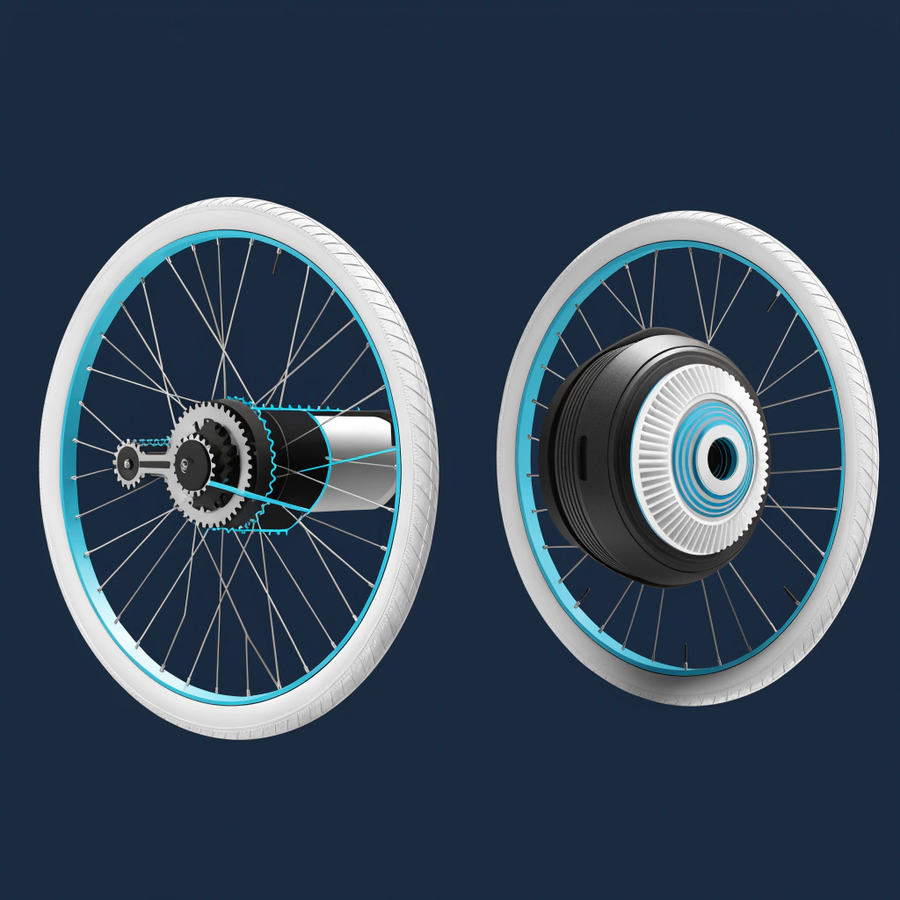
Both kits offer common wheel sizes and two rear-motor variants, one for a 7-speed threaded freewheel and one for 8, 9, 10 or 11-speed cassettes, so identify your gearing before ordering — our freewheel versus cassette guide and sizing page cover it. The added mass of motor and a large battery also changes handling and braking distances, so the donor needs to be sound rather than merely functional. Our torque arm guide and installation mistakes guide cover the fitting side.
Ride Feel Across Different Terrain
Terrain
2000W
2600W
Verdict
Flat private land
Ample
Faster to reach cruising speed
Marginal gain
Rolling terrain
Good
Better recovery after each rise
Worthwhile
Steep hills
Capable
Noticeably stronger starts
The strongest case
Cargo or heavy rider
Adequate
Clearly better
Worthwhile
Technical slow riding
Easier to modulate
Needs a softer app ramp
2000W is friendlier
Both are FOC systems, so smoothness is similar; what changes is how hard each pulls.
On feel, the 2600W kit has more initial punch and stronger mid-speed acceleration, while both share the same FOC smoothness and app control. That extra punch is not always welcome: for slow technical riding, softening the acceleration ramp in the app makes the 2600W kit behave much like the 2000W one, which is a good argument for buying the power and configuring it down rather than the reverse.
Display and buttons. The display model depends on the kit you choose.
Can You Upgrade a 2000W Kit With Just a Controller?
Sometimes, but treat it as a system change rather than a parts swap. Before assuming a 50A controller will drop in, confirm the battery BMS is genuinely rated for 50A continuous, that the motor’s verified current capability supports it, that connectors and cable gauge are rated for the higher current, that the display protocol matches, and that the app configuration can be set safely once fitted.
If two or more of those need changing, replacing the whole matched system is usually the better route — a controller alone that outruns the battery simply relocates the problem. Ask us to confirm the specific combination in writing rather than inferring compatibility from the fact that both are 52V systems. Our controller range lists current ratings, and battery-to-motor matching covers cable gauge.
Connectors. Confirm the connector type and current rating on both sides of any upgrade.
Other High-Power Options
Four routes, listed alphabetically and judged on the same criteria: power delivery, battery demand, configurability and the main limitation. Confirm current specifications on each supplier’s page before buying.
1. Bafang BBSHD Mid-Drive
The alternative worth considering if long climbs rather than hill starts are your problem. A mid-drive sends torque through the bicycle gears, so it climbs efficiently at lower electrical power and keeps weight low and central, which suits sustained ascents better than any direct-drive hub. The trade-offs are real: faster chain and cassette wear because motor torque passes through the drivetrain, a bottom-bracket compatibility requirement, and less outright acceleration than a 50A hub system. Outside EAPC classification at this power level.
2. eBikeling Direct-Drive Kits (1200–1500W)
Direct-drive hub kits listed at 1200W and 1500W, some sold with a battery included, so they sit a step below both kits here. They are a useful price reference if you are deciding whether you need 2000W at all. Check two things before comparing on price: whether a battery is included, since that changes the real cost substantially, and what controller current is actually specified rather than what the motor label says. Documentation depth and UK support vary by seller.
3. KirbEbike 52V 2000W and 2600W
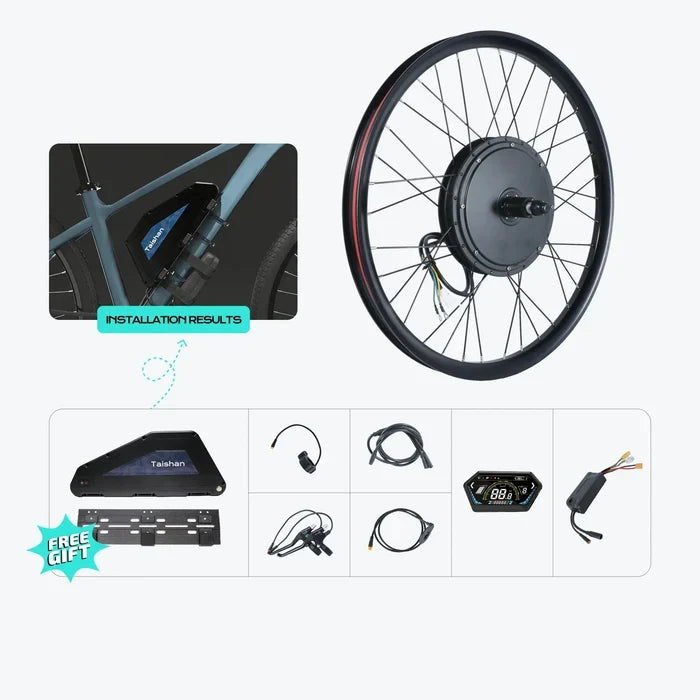
The two kits compared here: a shared 52V platform with a 35A FOC controller on the 2000W kit and a 50A FOC controller on the 2600W kit, both with app tuning, a colour display, a waterproof quick-release harness and a choice of 52V packs. Honest limits: both need open slotted dropouts within the listed range, both demand a sound donor with strong brakes and torque restraint, and both sit outside EAPC classification regardless of any display setting.
Bluetooth controller. Set DC current and acceleration within the limits of the matched system.
4. KirbEbike 60V 2500–3000W
The step up rather than a sideways move, and the option to consider if you are asking whether 2600W is enough. Moving to 60V raises voltage as well as current, which is the change that genuinely lifts speed potential rather than just acceleration. It also raises every requirement with it: a 60V pack, cabling and connectors rated accordingly, stronger braking, and a donor bike properly suited to the mass and performance. Firmly private-land territory.
Option
Delivery
Battery demand
Configurability
Main limitation
Bafang BBSHD
Mid-drive via gears
Moderate
Model dependent
Drivetrain wear; BB fit
eBikeling direct drive
Rear hub, 1200–1500W
Varies by model
Usually limited
Lower power; check battery inclusion
KirbEbike 2000W / 2600W
Rear hub, 35A or 50A
Moderate to high
App tuning
Open dropouts; outside EAPC
KirbEbike 60V 2500–3000W
Rear hub, 50A at 60V
High
App tuning
Whole-system step up
Listed alphabetically. Both compared kits appear as one entry because they share a platform.
Which Should You Choose?
Choose the 2000W kit if your routes are flat to rolling, you want strong performance without maximum 52V current, you value efficiency and lower system stress, you are already happy with your 2000W hill performance, or your battery and donor bike are not specified for a 50A setup.
Choose the 2600W kit if you regularly need stronger hill starts, you are a heavier rider or building for cargo, you want more acceleration while staying on the 52V platform, and you have a verified high-current battery and BMS to support it. That last condition is not optional — it is the one that decides whether the upgrade delivers anything at all.
Legal Position in Great Britain
Neither kit is a road-legal Electrically Assisted Pedal Cycle. An EAPC must have pedals capable of propelling it, a motor with maximum continuous rated power not exceeding 250W, and assistance that cuts off at 15.5mph (GOV.UK EAPC standards). Both kits exceed the power limit by a wide margin, so the completed cycle is treated as a motor vehicle under the Road Traffic Acts (GOV.UK).
💡
A SWITCHABLE MODE DOES NOT CREATE COMPLIANCE
Programmable controllers can cap assisted speed, and that is genuinely useful for controlling a powerful bike or matching a private site’s rules. It is not a legal mechanism. The Department for Transport addresses the feature directly: some electric cycles offer a temporary increase in top speed, often advertised as "off road" mode, and vehicles with that feature "do not, in our opinion, comply with the EAPC regulations and are considered motor vehicles". Continuous rated power is fixed by the motor, not by a display or app setting. Use either kit on private land with the landowner’s permission and subject to site rules, or meet the full motor-vehicle approval, registration, tax, insurance, licence and equipment requirements.
Product touchpoint
Check the battery before you choose the kit
On this comparison the battery decides more than the motor does. Confirm your pack’s continuous and BMS rating against 50A using our BMS amps guide before committing to the 2600W kit. If it is not rated for that draw, the 2000W kit will perform better in practice than an under-fed 2600W system — and if you want more speed rather than more acceleration, the 60V option is the change that actually does it.
The difference between these two kits is 35A against 50A, not 2000W against 2600W. That is a 43% increase in current and available input power, and it shows up as stronger standing starts, better hill starts and quicker recovery on rolling terrain — not as a substantially higher flat-road top speed, because both run at 52V.
So the upgrade makes sense when hill starts, rider weight or cargo are your limiting factor and your battery is genuinely rated for 50A continuous. It makes little sense on flat routes, or on a pack that cannot supply the current, where the 2000W kit will simply work better. Whichever you choose, fit the specified torque restraint, match the charger to the pack (GOV.UK), and ride it where a system of this power belongs.
Current is the difference, and the battery is the gate
Check the BMS rating before choosing between 35A and 50A.
Is a 2600W ebike kit much faster than a 2000W kit?
Not much on flat-road top speed: our pages list 34–38 mph for the 2000W and around 40 mph for the 2600W, because both run at 52V. The 2600W kit accelerates harder and starts on hills better, thanks to 50A of controller current against 35A.
What is the real difference between 35A and 50A controllers?
Input power is voltage times current, so at 52V the gap is roughly 1,820W against 2,600W — about 43%, more than the 30% the motor labels suggest. It shows up as acceleration and hill-start torque.
Can I use my existing 2000W battery on a 2600W kit?
Only if its BMS is genuinely rated for 50A continuous. A pack rated for 40A will cut out under acceleration with a 50A controller, which feels like a fault but is protection working.
Does the 2600W kit have less range?
At the same speed on flat ground, broadly similar. At the same throttle it uses more, because it accelerates harder and reaches speeds where aerodynamic drag dominates.
Does the 2600W kit run hotter?
Yes under the same demand, and the gap widens on long slow climbs. Resistive losses rise with the square of current, so a bigger controller is not automatically a cooler one.
Can I upgrade a 2000W kit to 2600W with just a controller?
Sometimes, but check the battery BMS rating, the motor’s verified current capability, connector and cable ratings, and display compatibility first. If several need changing, a matched system is the better route.
Which is better for steep hills?
The 2600W kit for hill starts and repeated restarts. For long sustained climbs, a mid-drive that uses the bicycle gears beats either direct-drive hub kit.
Do I need a better bike for the 2600W kit?
A sounder one, certainly. Higher current means more torque into the dropouts, faster acceleration and more braking work, so brakes, tyres, dropouts and torque restraint all matter more.
Are either of these kits road legal in the UK?
No. An EAPC needs a motor rated no higher than 250W continuous with assistance cutting off at 15.5mph. Both kits exceed that, and a switchable speed mode does not change the classification.
Should I choose 25Ah or 30Ah?
Choose on continuous current capability first, capacity second. A 30Ah pack gives more range, but only helps if its BMS can supply the current the controller will draw.