FOC Sine-Wave vs Square-Wave E-Bike Controller: Noise, Heat, Efficiency and Ride Feel
The difference is how the controller feeds power to the motor. A square-wave controller switches in six sharp steps, which you can hear and feel; a sine-wave or FOC controller does it smoothly. Here is what that changes on the bike, and what it doesn’t.
KE
KirbEbike Editorial
Reviewed by the KirbEbike conversion-support team
Share
Unlock £10 off today
On this page
RIDE QUALITY, NOT SPEEDSINE-WAVE ≠ FOCUK MARKET
The Quick Answer
A square-wave controller switches power to the motor in six sharp steps, over and over. Each step gives a small jolt, so the motor’s push pulses slightly. You hear this as a hum and feel it most when pulling away. A sine-wave or FOC controller changes the current smoothly instead, so the bike is quieter and smoother, especially at low speed.
Think of it as a comfort upgrade, not a power upgrade. FOC does not make the bike faster, and it is not always more efficient overall. The motor usually runs more efficiently with FOC, but at full speed a square-wave controller can waste less energy in its own electronics, so the winner depends on the motor and controller (EDN).
Set mainly by voltage and motor; can be slightly higher
Set mainly by voltage and motor
Design characteristics, not a ranking. Which suits a build depends on the motor and the riding.
Choose sine-wave or FOC for a quieter, smoother ride, especially at low speed. Choose square-wave when cost matters most. Neither makes a meaningful difference to top speed.
💡
Jargon in plain English
Controller — the box that takes battery power and feeds it to the motor.
Windings (phases) — the three sets of copper coils inside the motor.
Torque ripple — a small pulsing in the motor’s push; you hear it as a hum.
Square-wave (six-step) — switches power between the coils in six sharp steps.
Sine-wave — changes the current smoothly instead of in steps.
FOC (field-oriented control) — a smarter sine-wave method that keeps measuring and correcting the current.
Hall sensors — small sensors in the motor that tell the controller where the magnets are.
BMS — the battery’s built-in protection circuit, which limits how much current it can give.
What the Controller Does, and Why the Terms Differ
What you see. The display shows speed, assist level and battery. The controller does the work behind it.
The controller sits between the battery and the motor. It takes steady DC power from the battery and feeds it to the motor’s three sets of copper coils (the windings) in a rotating pattern, which keeps the motor turning. Despite the name, a brushless “DC” motor actually runs on alternating current: the current in each coil flows one way, then the other (EDN). What changes between controller types is the shape of that current, and how precisely it is controlled.
A square-wave controller (engineers call it six-step or trapezoidal control) powers two of the three coils at a time and moves on to the next pair six times per cycle (arXiv). It is simple, cheap and does the job; its weak point is a pulsing push at low speed. A basic sine-wave controller feeds all three coils with smoothly rising and falling current, which removes most of that pulsing. The simplest versions do not measure the current they deliver, though, so they become less accurate as speed rises (Electronic Design).
💡
EVERY FOC CONTROLLER IS SINE-WAVE, BUT NOT EVERY SINE-WAVE CONTROLLER IS FOC
FOC (field-oriented control) is a way of controlling the motor, not a waveform. An FOC controller measures the current in the motor many times a second, splits it into the part that turns the wheel and the part that doesn’t, and keeps correcting it so the push is aimed at the most effective angle, about 90 degrees ahead of the magnets. A basic sine-wave controller makes a similar smooth current but does not keep checking and correcting it, so it copes less well when speed and load change. Sellers often use the two terms as if they mean the same thing; the specification sheet tells you which you are getting.
Noise: Why Square-Wave Controllers Hum
A simplified illustration, not measured data. With six-step control the motor’s push dips between steps, six times per cycle; smooth sine-wave current keeps it steadier. Real results depend on the motor, the controller and the speed.
That pulsing is the noise. Each step changes the motor’s push slightly, which makes the motor and wheel vibrate. You hear it as a hum or whine that rises and falls with speed. It is strongest at low speed, where each step lasts longest. The motor matters too: most brushless motors are built to work best with smooth, sine-shaped current, and driving them with square-wave steps is exactly what creates the pulsing (EE Times). Feed the same motor smooth current and most of the pulsing, and much of the noise, goes away.
Heat: Where the Energy Actually Goes
Heat works the same way. Square-wave current contains extra ripples (harmonics) that the motor cannot turn into useful power, so they just warm up the coils (EDN). Smooth current avoids most of that, which is why a well-matched FOC system usually keeps the motor cooler at the same power.
There is a catch: heat can build up in two places, the motor and the controller. At full speed a square-wave controller can leave its switches fully on instead of rapidly switching them, which cuts the heat inside the controller. So a square-wave system tends to put more heat in the motor and less in the controller, and an FOC system the other way round. Neither is cooler in every case; what matters is which part of your bike gets hot first.
Efficiency and Range
Expect a small gain, not a big one. Most motors run more efficiently with FOC because the wasted ripple current is gone. But the same engineering source points out that at full speed a square-wave controller can be the more efficient of the two, and concludes that the best choice depends on the motor and controller (EE Times).
So be wary of any claim that FOC alone adds a lot of range. Rider weight, hills, tyre pressure, assist level, wind and battery size all affect range far more. When a new controller does add noticeable range, it is usually because it is better matched to the motor and its current limits, not because of the waveform.
Ride Feel: What Actually Changes on the Bike
Where you feel it. Smooth current matters most when pulling away and riding slowly on rough ground.
This is where you notice the difference most, even if it is hard to measure. Pulling away is smoother, because the push builds without the stepping you get from a square-wave controller at low speed. Slow riding feels more controlled, which helps when filtering through traffic or carrying a load. Changes between assist levels feel less sudden. And the bike is quieter, which changes how a daily commute feels more than most people expect.
What does not change is how much pulling power (torque) the motor has. That depends on the current, the motor design and the gearing; the controller type only changes how smoothly the torque arrives. One detail worth knowing: a controller without motor sensors cannot tell where the magnets are until the wheel is turning, so many start in a simpler step mode and switch to smooth control once moving. That is normal design, not a fault. Our guide to what is inside a hub motor explains how motor type fits into all this.
Which Suits Commuting, Hills and Off-Road?
Use case
Better fit
Why
Watch out for
Urban commuting
Sine-wave or FOC
Quiet running and smooth low-speed control
Cost against benefit on a basic build
Long road rides
Either, well matched
Efficiency difference is modest at steady speed
Current limits and thermal headroom
Steep hills
FOC, marginally
Less wasted heat on slow climbs
Motor heat is still the real limit
Technical off-road
FOC
Fine throttle control at low speed
Total system rating, not waveform
Budget builds
Square-wave
Lower cost, perfectly serviceable
Noise and low-speed coarseness
High-power builds
FOC, usually
Smoother delivery of large currents
Battery BMS current and wiring
Match the controller to how the bike is ridden, then to the rest of the system.
Programmable FOC: Where the Bigger Difference Appears
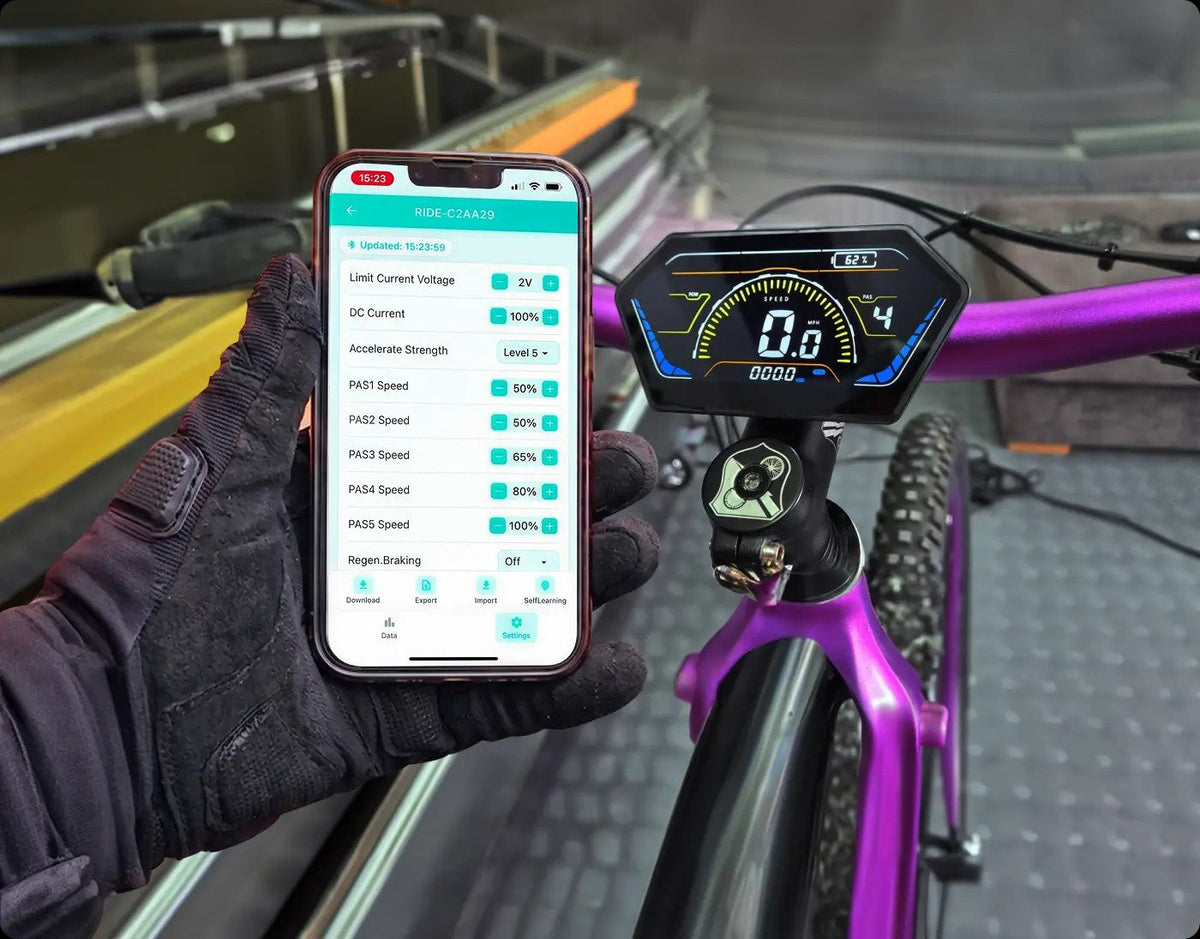
For most riders, the bigger gain comes from being able to adjust the controller, not from the waveform. A programmable FOC controller lets you set the assist levels, how quickly power builds, the current limit and how the throttle responds, and those settings change how the bike feels far more than the waveform does. Our displays and controllers range shows which units can be set up over Bluetooth. Two cautions apply to any tuning. Keep the current limit within what the battery and its BMS (the battery’s protection circuit) can supply continuously; our BMS amps guide explains how to check. And remember that raising the current is the quickest way to overheat things: double the current and the heat in the wires and coils goes up about four times.
Controller and display. Assist levels, how fast power builds and the current limit are set in the Ride Power app; the display shows the result.
Can You Replace a Square-Wave Controller With FOC?
A controller swap is a system job. Voltage, current, sensors, plugs and display all have to match the rest of the bike.
Often, yes, but treat it as a system change, not a simple swap. The new controller has to suit the motor, battery, display and sensors. Get one of those wrong and the bike will run badly, or not at all.
💡
Before swapping a controller: six checks
Voltage — the controller must handle the battery’s fully charged voltage (about 58.8V for a 52V pack), not just the number on the label
Current — its maximum current must stay within what the battery and its BMS can supply continuously
Sensors — whether the motor has hall sensors (small position sensors inside it), and that the sensor plug wiring matches
Plugs — the three thick motor (phase) wires, plus the brake, throttle and pedal-sensor plugs
Display — the display and controller must use the same communication protocol, or they will not talk to each other
Space and airflow — room to mount it securely, with air reaching the case to carry heat away
Two more points. Some FOC controllers need a short self-learn (motor detection) routine before they run properly, so follow the maker’s setup steps instead of expecting it to work the moment you switch on. And if the old controller failed, find out why before fitting a new one: a mismatch or wiring fault will damage the replacement too. Our installation mistakes guide covers the usual causes.
Controller Options Compared
Here are four common routes, listed alphabetically and judged on the same points: control method, how much you can adjust, the wider system and the main limitation. Check each supplier’s current specifications before buying, because features vary by model and firmware.
1. Bafang Integrated Controllers
On the BBS mid-drive series the controller is built into the motor housing rather than being a separate box. That saves you finding a place to mount and cool it, but it ties the controller to the motor: a fault means dealing with the motor unit rather than swapping one part. Settings can be changed with programming tools and some displays, but how much you can change depends on the model and firmware, so check before buying. Best for riders who want a complete, supported system rather than one they plan to tweak.
2. Generic Marketplace Sine-Wave Controllers
Low-cost controllers sold on marketplaces, often labelled “sine wave” or “FOC” and bought to replace a failed unit. They are cheap and easy to find in common voltages and current ratings, which is useful when a controller dies. Take more care here than anywhere else: instructions are often thin or wrong, “sine wave” and “FOC” are used loosely in listings, plugs vary, and help after purchase may be limited. Check the voltage range, current rating and plug types against your bike, not the listing title.
3. KirbEbike Smart FOC Controllers
Separate, fully resin-sealed (potted) FOC sine-wave controllers from 25A to 100A for 36V–72V systems, set up through the Ride Power Bluetooth app: assist levels, acceleration and current limits. The same app runs our Bluetooth-controlled kits, such as the 52V 2000W MTX kit, and the controllers are also sold on their own in the controller range. Honest limits: they are designed to pair with our own compatible motors and displays rather than as a universal replacement; because they are sealed, a fault means replacing the unit rather than repairing it; and as they mount outside the motor, the installer needs to give them airflow.
4. VESC-Based Controllers
An open-source FOC platform with a very detailed setup tool, popular with builders who want to control motor detection, current limits, power ramps and data logging. Hardware from several makers runs the same firmware, and there is a lot of community documentation. It is also the least beginner-friendly option here: you need a computer, a good understanding of the settings and careful motor detection before the first ride. Quality varies between boards built on the VESC design, so judge the specific hardware, not the name.
Option
Control method
Configurability
Ecosystem
Main limitation
Bafang integrated
Check the model’s spec
Programming tools; depends on firmware
Complete drive systems
Tied to the motor unit
Generic marketplace
Varies, often loosely labelled
Usually minimal
Replacement market
Documentation and support
KirbEbike smart FOC
FOC
Bluetooth app
Own kits and motors
Own-brand pairing; potted
VESC-based
FOC
Very deep, PC tool
Open source, multi-vendor
Steep learning curve
Listed alphabetically. Control method is a product specification; verify it rather than trusting a listing title.
Common Myths
“FOC makes the bike faster.” No. Top speed comes from battery voltage, motor winding, wheel size, total load and any programmed limit. If anything, a square-wave controller can squeeze slightly more speed from the same battery voltage (EDN). Our wattage and speed guide explains why hills matter more than either.
“Square-wave always gives more torque.” No. How much torque you get depends on the current and the motor design. Square-wave can give a strong push when starting, but it delivers it less smoothly.
“With FOC the motor can’t overheat.” It cuts some wasted heat, but every motor still has a heat limit, and a long, slow climb with a heavy load will still make it hot.
“Every sine-wave controller is FOC.” No. FOC keeps measuring and correcting the current; simpler sine-wave controllers make a similar smooth current without that checking.
“Any controller with the right voltage will work.” Voltage is only one of six things to match; see the checklist above.
Which Should You Choose?
Choose sine-wave or FOC if you want a quieter bike, smoother pull-away and better low-speed control, if you ride in traffic or on technical ground, or if you are running higher power and want large currents delivered smoothly. Choose square-wave if the priority is lowest cost, if the bike is a simple utility build, or if you are replacing a failed unit cheaply on a system that never bothered you.
Keep it in proportion, too. The controller type changes how the bike feels, not its legal status. In Great Britain a converted bike counts as an EAPC (a legal e-bike) only if it has working pedals, a motor rated at no more than 250W continuous and assistance that stops at 15.5mph (GOV.UK). No controller changes that. Match the battery properly as well, using our battery-to-motor guide.
Common Controller-Choice Mistakes
Mistake
Why it costs you
Buying FOC expecting more speed
Speed comes from voltage, motor winding, wheel size and load
Trusting "sine wave" in a listing title
The term is used loosely; check the specification
Matching voltage only
Current rating, sensors, connectors and protocol all matter
Ignoring the display protocol
A mismatched display leaves the system unusable
Fitting a replacement without finding the cause
A wiring or matching fault will damage the new unit
Skipping the motor-detection (self-learn) step
Some FOC controllers run poorly until set up
Raising current to compensate
Double the current and wire and coil heating roughly quadruples
More on fitting errors in our installation-mistakes guide.
Product touchpoint
Matching a controller to your system
A new controller only helps if it matches the rest of the bike. Check what your battery can supply continuously with our BMS amps guide, check the controller’s voltage range against the battery’s fully charged voltage, then look at the controller and display range, or choose a complete conversion kit where the parts are already matched. If you want the smooth ride without the matching work, a complete kit is the easier route.
Conclusion: A Refinement Upgrade, Not a Power Upgrade
Square-wave controllers switch power in six steps, which creates a pulsing push you hear as a hum and feel when pulling away. Sine-wave and FOC controllers use smooth current instead, so the bike is quieter, easier to control at low speed, and wastes less heat in the motor.
They do not add speed or transform range. Efficiency is a mixed picture: the motor usually does better with FOC, while the controller can do better with square-wave at full speed, so it depends on your parts (EDN). Choose FOC for a smoother, quieter ride, better low-speed control and easy app tuning; choose square-wave when cost matters most. Either way, match voltage, current, sensors, plugs and display first, and use only the charger made for your battery (GOV.UK).
Refinement first, then the rest of the system
FOC changes how the power feels, not how much there is. Match voltage, current and connectors before you buy.
What is the difference between a sine-wave and square-wave e-bike controller?
A square-wave controller powers two of the motor’s three coils at a time and switches in six steps, which makes the motor’s push pulse slightly. A sine-wave controller feeds all three coils with smooth current, so there is less pulsing, noise and vibration.
Is an FOC controller the same as a sine-wave controller?
Not quite. Every FOC controller makes sine-wave current, but not every sine-wave controller is FOC. FOC keeps measuring and correcting the current; simpler sine-wave controllers do not, so they cope less well as speed and load change.
Does an FOC controller make an e-bike faster?
No. Top speed is set by battery voltage, motor winding, wheel size, total load and any programmed limit. FOC changes how smoothly power is delivered, not how much is available.
Are FOC controllers more efficient?
The motor usually runs more efficiently with FOC. At full speed, though, a square-wave controller can waste less energy in its own electronics, so overall it depends on the motor and controller. Expect a small difference in range, not a big one.
Why is my e-bike motor humming?
A hum that rises and falls with speed is often the pulsing push from a square-wave controller, and it is loudest at low speed. Grinding, clicking or rattling is mechanical and should be checked separately.
Can I replace my square-wave controller with an FOC controller?
Often, yes, as long as the voltage, current rating, sensor type, plugs, display protocol and mounting space all match. Some FOC controllers also need a short motor-detection routine before they run properly.
Do FOC controllers run cooler?
The motor usually runs cooler, because less current is wasted as heat. The controller is a separate question: at full speed a square-wave controller switches less, so it may run cooler itself. The heat can simply move from one part to the other.
Is a square-wave controller bad?
No. It is simpler and cheaper, and it works perfectly well. Its drawbacks are audible noise and coarser low-speed delivery, which matter more on a commuter in traffic than on a simple utility build.
Does controller type affect UK legality?
No. In Great Britain a converted bike is a legal e-bike (EAPC) only if it has working pedals, a motor rated at no more than 250W continuous and assistance that stops at 15.5mph, whatever controller it uses.
What should I check before buying a replacement controller?
Six things: voltage (including the battery’s fully charged voltage), maximum current against the battery’s BMS rating, sensor type and wiring, all plugs, the display protocol, and space to mount it with airflow.
A note on safety & legality. General information, not a substitute for the manufacturer’s instructions. Never fit a controller rated below the pack’s full-charge voltage or above what the battery can continuously supply, follow any motor-detection procedure before first use, and find the cause before replacing a failed unit. Use only a charger authorised for your pack. In Great Britain a converted cycle is an EAPC only when it has working pedals, a motor rated no higher than 250W continuous and assistance that stops at 15.5mph; above that it is outside EAPC classification and may be used on private land with the landowner’s permission and subject to site rules, or on roads only with the relevant motor-vehicle approval, registration, tax, insurance, licence and equipment (GOV.UK).
About this guide
Author: KirbEbike Editorial. Technical review: KirbEbike conversion-support team. Last reviewed: October 2026. How we wrote it: the explanations of square-wave and FOC control, torque ripple and efficiency are based on the engineering sources listed above, and the efficiency section gives both sides as they do. The torque chart is a simplified illustration, not measured data. KirbEbike controller details come from our own product pages; details of other controllers come from their makers’ published material, so check the current specification before buying.
Stay in the know
Conversion guides, fitting advice and the deals worth knowing about. No spam.