Matching gear counts prove nothing. A rear hub motor takes either a screw-on freewheel or a cassette — and if it takes a cassette, the freehub standard behind it decides everything. That is why so many conversions arrive with a cassette that will not mount: the buyer counted sprockets when they should have identified the interface. This guide works through 8-, 9-, 10-, 11- and 12-speed compatibility in the order that actually settles it — attachment system first, driver standard second, sprocket count last.
Most 8-, 9- and 10-speed Shimano and SRAM cassettes use the traditional HG freehub, and many 11-speed mountain cassettes use the same body — so those are the straightforward group for a conversion. Road 11-speed often needs the longer road HG body. Shimano 12-speed MTB normally uses Micro Spline. SRAM 12-speed may use HG, XD or XDR: many 10-tooth MTB cassettes use XD, road and gravel 10-tooth cassettes commonly use XDR, and selected 11-tooth cassettes use HG. A threaded freewheel motor accepts a freewheel, not a cassette. So identify freewheel or cassette before you look at motor power — Park Tool treats those as two different attachment systems, not variants of one — then check the freehub standard, not the sprocket count.

Which Gear Counts Fit a Rear Hub Motor?
Likely fit by gear count, checked against KirbEbike’s live product variants on 28 July 2026. Every purchasable rear-motor option is a 7-speed threaded freewheel or an HG cassette body listed for 8–11 speeds; sprockets are not included. This table narrows the candidates — it does not replace confirming your exact cassette model with the supplier in writing.
| Your speed count | Interface required | Common driver body | KirbEbike variant? | Limitations and spacers |
|---|---|---|---|---|
| 7-speed | Threaded freewheel (or cassette on some bikes) | Freewheel thread — not a cassette body | Yes — freewheel variant | Freewheel and cassette are not interchangeable |
| 8-speed | Cassette | HG | Yes — HG cassette variant | 8-speed freewheels also exist; a spacer may be needed on a longer body |
| 9-speed | Cassette | HG | Yes — HG cassette variant | Usually direct |
| 10-speed | Cassette | HG | Yes — HG cassette variant | A spacer may be needed on a longer road body |
| 11-speed mountain | Cassette | HG, shorter mountain length | Yes — HG cassette variant | Many fit; check largest-sprocket and cage clearance |
| 11-speed road | Cassette | HG, longer road length | Usually not — body length differs | Road HG bodies are longer than mountain |
| 12-speed | Depends entirely on the cassette model | Micro Spline, XD, XDR or model-specific HG | Not offered with Micro Spline / XD / XDR | See the 12-speed table below; front hub or mid-drive are the usual routes |
Likely interfaces, not guaranteed fit. An 8-, 9-, 10- or many 11-speed drivetrains can work with an HG cassette hub motor; 12-speed depends on the cassette interface, not the number of sprockets. Verify the exact cassette model — always.
Freewheel vs Cassette: Settle This First
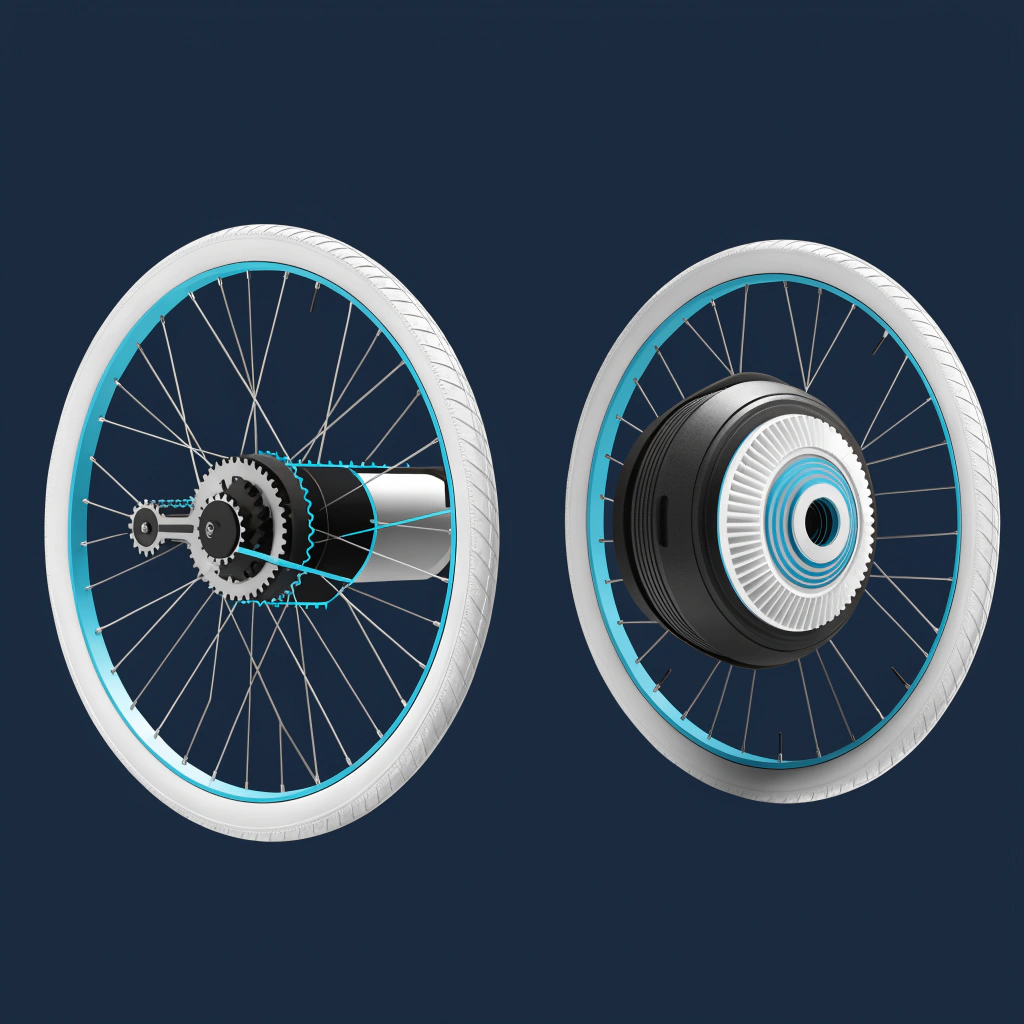
Freewheel and cassette are different attachment systems. A freewheel is one threaded sprocket-and-ratchet unit that screws onto the motor; a cassette slides onto a splined freehub and is held by a lockring. They are not interchangeable, so identify the interface before choosing a rear motor.
✓ Threaded freewheel
- One sprocket-and-ratchet unit that screws onto the motor
- The ratchet mechanism lives inside the freewheel itself
- The 7-speed route on current KirbEbike rear motors
- Simple to identify: the whole cluster unscrews as one piece
✕ Cassette on a freehub
- Sprockets slide onto a splined body and a lockring holds them
- The ratchet lives in the freehub body on the motor
- The driver standard — HG, Micro Spline, XD, XDR — must match the cassette
- No spacer or adapter converts a freewheel motor to take it
No spacer or adapter converts one into the other. If the motor has the wrong interface, the practical fix is a different motor — or a front-hub or mid-drive route that keeps the rear drivetrain exactly as it is.
8, 9 and 10-Speed: One HG Family
Most Shimano and SRAM 8-, 9- and 10-speed cassettes use the traditional HG freehub, which is why this group is the most straightforward for a conversion. But speed count alone does not prove compatibility. A shared HG spline pattern settles only whether the cassette can physically engage the body — it says nothing about total installed width, whether a spacer is needed, chainline, or whether your derailleur and shifter can handle the sprocket range. Establish the cassette model and its interface, and the motor’s verified freehub specification, rather than reasoning from the number of sprockets. Freewheel systems sit outside this group entirely.
Can a 10-speed cassette fit an “8-speed hub”? Usually, when the label means a standard 8/9/10-speed HG body. A 7-speed-specific body is shorter and may not take it at all, so identify the body rather than trusting the label.
Will an 11-Speed Cassette Fit an 8, 9 or 10-Speed Hub Motor?
Often — and the mountain-versus-road split decides it. On SRAM the smallest cog is the quick tell: 10 teeth means XD, 11 teeth usually means HG. That extra road length is real, not nominal: SRAM built XDR 1.85mm longer than XD precisely to occupy the space of an 11-speed road HG body. Before ordering, verify spline type, body length, cassette model, smallest sprocket and lockring engagement.
| Cassette type | Freehub requirement | Chance of fitting a conventional HG motor |
|---|---|---|
| Shimano 11-speed MTB | HG mountain body | Often |
| Selected wide-range road / gravel 11-speed | May fit HG mountain body | Model-specific |
| Standard Shimano road 11-speed | Longer HG road body | May not fit a shorter motor freehub |
| SRAM 11-speed, 11T smallest cog | Often HG | Often, if the exact model matches |
| SRAM 11-speed, 10T smallest cog | XD | Only with an XD driver |
A cassette can also clear the splines and still fail on the bike: wide-range 11-speed brings the biggest cog inboard, where it can foul the motor side cover, spoke elbows or derailleur cage, while the smallest cog can put the chain against the chainstay in top gear.
Will a 12-Speed Cassette Fit a Hub Motor?

Only with the right driver — and 12-speed is where the standards genuinely diverge. There is no single 12-speed interface. Check the current manufacturer compatibility documentation for your exact cassette rather than relying on the speed count:
| 12-speed system | Driver required | Fits a conventional HG motor? | What to check |
|---|---|---|---|
| Shimano MTB (XT, SLX, Deore 12-speed) | Micro Spline — a different spline pattern licensed by Shimano | No | Micro Spline is not an HG variant. Verify the exact model. |
| Shimano road 12-speed (HG and HG-L2 designs) | HG-family road freehub, in the longer road length | Only if body length and cassette spec both match | Confirm the cassette is an HG design and that body length matches. Verify the exact model. |
| SRAM Eagle MTB, 10-tooth smallest | XD | No | A 10-tooth smallest cog cannot sit on an HG body. Verify the exact model. |
| SRAM road 12-speed, 10-tooth smallest | XDR — 1.85mm longer than XD | No | XD and XDR are not interchangeable without the correct spacer. Verify the exact model. |
| SRAM 12-speed, 11-tooth smallest | HG on specific models only | Sometimes — model-specific | Only the cassettes SRAM lists as HG-compatible. Verify the exact model. |
So a 12-speed cassette fits an HG hub only when that exact cassette was designed for HG. Because no current KirbEbike rear motor is offered with Micro Spline, XD or XDR, a 12-speed drivetrain generally needs a purpose-built rear motor from another supplier, a front hub motor that leaves the rear wheel untouched, or a mid-drive.
Why a Cassette Can Fit the Freehub and Still Not Fit the Bike
After the cassette fits the driver, verify installed width, largest-sprocket clearance, chainline, wheel dish, rotor alignment and derailleur travel. Never use axle nuts to pull an incompatible frame together. Open 130/135mm dropouts and 12×142/148 thru-axles are different fit problems again — work through the measurement method on the wheel and dropout size page before ordering anything.
Do You Need All 12 Gears With a Hub Motor?
If you do not, far more motors become available. A hub motor drives the wheel independently of the cassette, so the gears shape only your own contribution: cadence, climbing gear and the ability to ride unassisted. Eight to ten speeds suit strong assistance and flat commuting, with cheaper consumables. Eleven or twelve earn their place for low-power assistance, fitness riding, sustained climbs and adaptive cycles where cadence control is not optional. Range matters more than count: a wide-range 8-speed can cover similar extremes, just with bigger jumps.
Rear Hub vs Front Hub for 11 or 12-Speed Bikes
A rear motor is better when a matching cassette freehub exists, your dropout standard is supported and the cassette clears the motor. It costs more checks and real clearance risk — and the torque arm needs sorting before the first ride. A front motor sidesteps the question entirely:
✓ Front hub — what it sidesteps
- Replaces the front wheel; cassette, derailleur and shifter untouched
- Rear gear count becomes irrelevant to fit
- The sane answer when the rear end is Micro Spline, XD or an internal gear hub
- The EZ Rider 250W and Swytch systems both work this way
✕ Front hub — the trade-offs
- Fork material and dropout compatibility still need checking
- Torque-arm requirements on the steering end of the bike
- Less traction on steep climbs than a rear motor
- Lower practical power ceiling
The EZ Rider 250W front kit is the road-legal example of that route — a 100mm front format with the wheel built to your size, leaving an 11- or 12-speed rear drivetrain exactly as the manufacturer built it.
When Your Rear Drivetrain Needs a Different Route
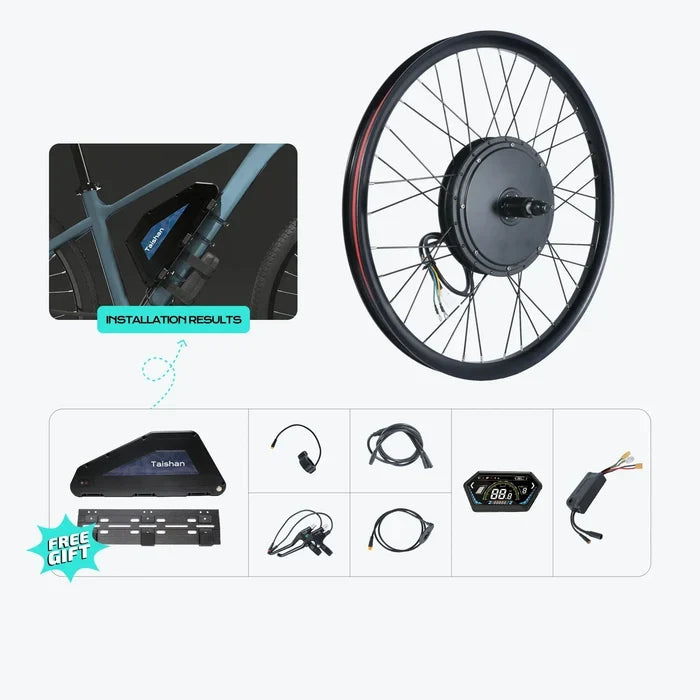
For open-dropout HG builds, KirbEbike’s cassette rear-hub option supports 8-, 9-, 10- and selected 11-speed cassettes; the freewheel option is the 7-speed route. It does not provide Micro Spline, XD or XDR — those drivetrains need a purpose-built rear motor, a compatible front hub or a mid-drive. Once you know your interface, order the matching variant directly: the 500W/750W MTX kit, the 48V 1000W kit and the 52V 2000W MTX rim kit each list the freewheel and cassette versions as separate options at the point of purchase.
Confirm the exact cassette model, dropout width, rotor clearance and wheel size in writing before ordering. If the rear interface is unsupported, preserving the original rear drivetrain is safer than forcing a spacer or adapter.
Common 8–12-Speed Compatibility Mistakes
| Mistake | Why it fails |
|---|---|
| Assuming gear count identifies the freehub | Eight-speed freewheels exist; a count proves nothing |
| Treating every cassette motor as HG | “Cassette compatible” may mean HG, XD, XDR or Micro Spline |
| Assuming 11-speed MTB and road match | Road 11-speed often needs the longer body |
| Assuming one 12-speed standard | Shimano MTB normally means Micro Spline; SRAM may use HG, XD or XDR |
| Using spacers to hide a mismatch | A spacer removes play; it cannot change a spline pattern |
| Ignoring the largest sprocket | It can clear the splines and hit the motor, spokes or cage |
| Forgetting shifter and chain | Mounting a cassette does not make it index |
| Forcing the frame wider to fit a motor | There is no safe universal allowance. Never spread an aluminium or carbon frame; cold-set steel only with the frame maker’s approval and a competent professional. An exact axle and over-locknut match is the default requirement |
Pre-Purchase Fit Checklist
Send five photographs first
The fastest way to settle this is to photograph the bike before you write anything down. Five images answer almost every question a supplier will ask, and they turn a guess into a documented check:
| # | Photograph | What it proves |
|---|---|---|
| 1 | Rear axle and dropout, wheel removed, both sides in frame | Axle interface and retention — open slot with nuts or skewer, or a closed thru-axle bore |
| 2 | Cassette or freewheel side, straight on | Which attachment system you have. This decides which motors are even candidates |
| 3 | Smallest sprocket and lockring, close up | Driver standard. A 10-tooth smallest sprocket points to SRAM XD or XDR; 11 teeth points to HG. The lockring shape and any model markings help confirm it |
| 4 | Brake side — rotor, caliper and mount | Rotor mount type, diameter and caliper clearance against the motor’s flange |
| 5 | Frame label or decal, plus a spacing measurement across the dropouts | Stated frame spacing and model, checked against your own measurement inside face to inside face |
Send these to KirbEbike support with your cassette model and wheel size, and ask for written confirmation of the exact motor variant before ordering — the support FAQ explains what the team needs.
Then confirm the written details
The motor — four separate checks, in this order. (1) Sprocket attachment: freewheel or cassette — different systems, and no adapter converts one to the other. (2) Driver standard: if it is a cassette body, which one — HG, Micro Spline, XD or XDR. Every current KirbEbike rear motor uses HG; none is offered with Micro Spline, XD or XDR. (3) Cassette body length and spacers: whether the body is the shorter mountain HG or the longer road HG, and which spacer the combination needs. (4) Derailleur and chain capacity: the shifter speed count, chain width and derailleur cage range on your bike, which the motor does not change and cannot fix.
- Sprocket count, and freewheel or cassette
- Cassette model, smallest and largest sprocket
- HG, Micro Spline, XD or XDR
- Dropout width; bolt-on, quick release or thru-axle
- Rotor mount, diameter and caliper clearance
- Chainstay and derailleur clearance; frame material
- Shifter speed count, chain and derailleur capacity
- Correct spacer and full lockring engagement
- Written confirmation from the supplier, with your cassette model, dropout measurement, axle type and photos of both sides of the hub
Matching a kit to your drivetrain
Start with the interface, not wattage. KirbEbike rear kits are ordered as a freewheel or HG-cassette version; the cassette option supports 8–11 speed, while the freewheel route is 7-speed. Measure the frame, confirm the cassette model and wheel size, then compare only compatible kits. Micro Spline, XD and XDR are outside the current rear-driver range.
Conclusion: Match the Interface Before the Gear Count

A hub motor can work with 8-, 9-, 10-, 11- or selected 12-speed drivetrains. Sprocket count is not the first check — which is why so many conversions arrive with a cassette that will not mount. Identify freewheel or cassette. For cassettes, identify HG, Micro Spline, XD or XDR, then verify body length, installed width, clearance and indexing. Most 8–10-speed and many Shimano mountain 11-speed setups are easiest to keep with an HG cassette motor; 12-speed needs more care because the interfaces look similar and are not. Where no matching rear motor exists, a front hub or a mid-drive preserves your drivetrain more safely than any spacer stack.
And the legal bookend: in Great Britain, an EAPC needs pedals capable of propelling it, a maximum continuous rated motor output no greater than 250W, and electrical assistance that cannot propel it above 15.5 mph (GOV.UK).
Know Your Interface, Then Pick the Motor
Freewheel or cassette decides which kits are even candidates; the driver standard decides the rest. Send the five photos and get the variant confirmed in writing before you order.
Frequently Asked Questions
Will a 12-speed cassette fit on an 11-speed hub?
Can I fit an 11-speed cassette on an 8-speed hub?
Can I put a 12-speed cassette on an HG hub?
Will a 12-speed cassette fit on a 9-speed hub?
Will an 11-speed cassette fit on a 10-speed hub?
Can I put a 10-speed cassette on an 8-speed hub?
Are 11-speed and 12-speed hubs the same?
What freehub do I need for a 12-speed cassette?
What size spacer fits an 8-speed cassette on an 11-speed hub?
Is a front hub motor easier for a bike with 11 or 12-speed gears?
Sources
- Park Tool — Determining cassette and freewheel type. parktool.com
- Park Tool — Freewheel removal and installation. parktool.com/freewheel-removal
- Park Tool — Wheel removal and installation: axle and retention types. parktool.com/wheel-removal
- SRAM — XD and XDR driver body explained (manufacturer documentation, cited unlinked).
- SRAM — What is XD, and why is it a thing? (manufacturer support article, cited unlinked).
- Shimano — Dealer’s manual: hubs, freehub bodies and cassette fitting, DM-LAHB002 (cited unlinked).
- GOV.UK — Riding an electric bike: the rules. gov.uk/electric-bike-rules