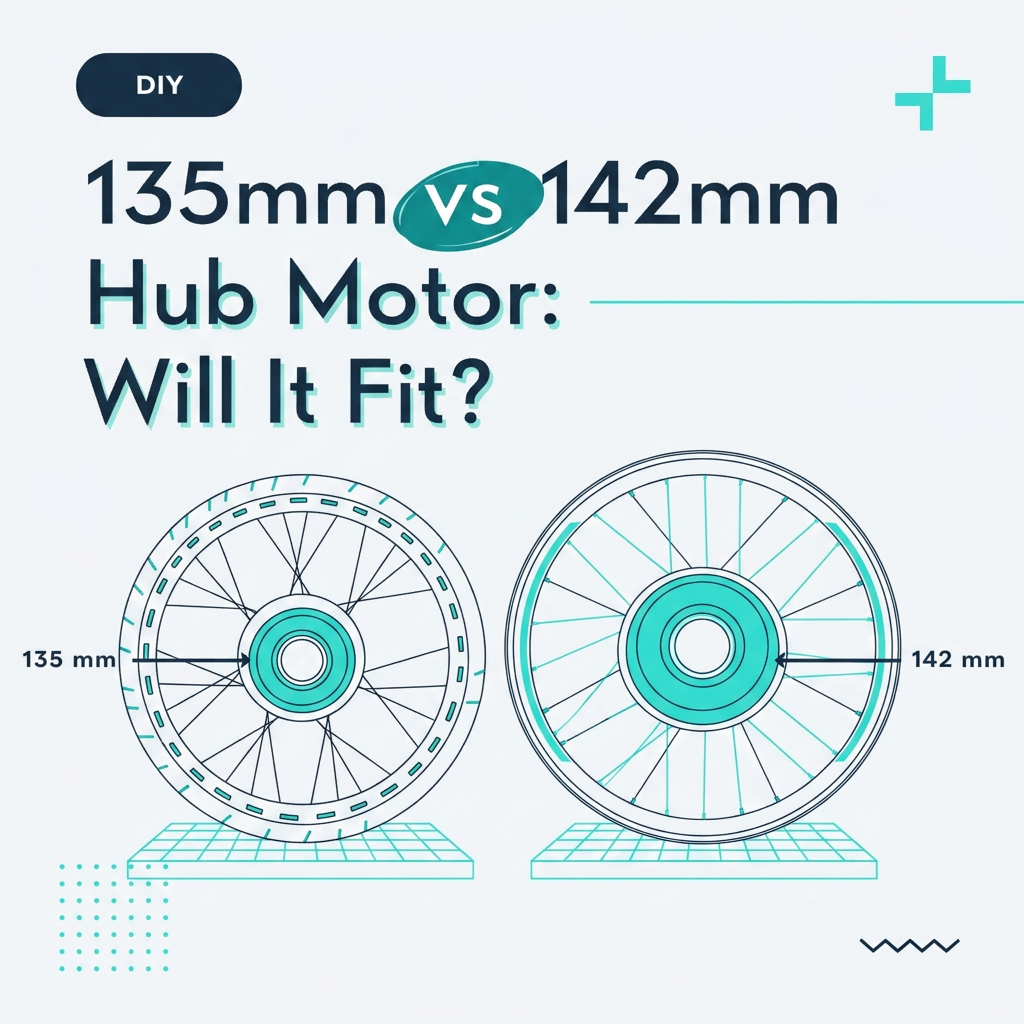
A 135mm rear frame and a 12×142 frame can place the cassette and brake rotor in almost the same position — yet they use completely different wheel-retention systems. So “will a 135mm hub motor fit a 142mm frame?” isn’t a 7mm question; it’s a question of axle diameter, dropout shape and how the wheel is held in. This guide shows what actually decides fit, how to measure it yourself, and when forcing a conversion is unsafe.
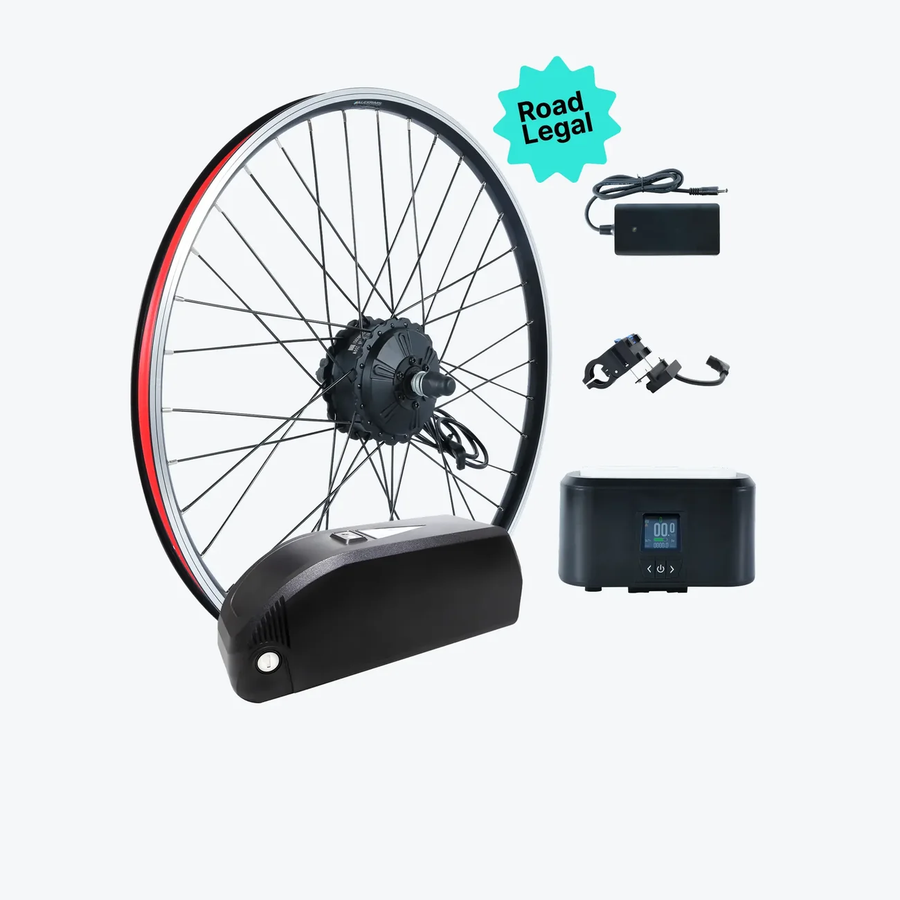
Fit comes down to the axle standard, not the wheel. A hardtail converted with a rear hub motor and frame battery — whether a kit fits is decided by the rear dropout and axle system (open vs thru-axle), not the bike.
The short answer
A conventional 135mm rear hub motor uses a solid or hollow axle that seats in open dropout slots, held by nuts or a quick-release. A 12×142 frame uses closed dropouts and a removable 12mm thru-axle — so the interface is different, not just 7mm wider. Don’t assume a standard bolt-on 135mm motor fits a 142mm frame. It fits only with a manufacturer-approved system that converts the axle interface, locates the hub correctly, restrains motor torque and keeps the rotor and cassette aligned. When those can’t be met, choose a different motor, a front-hub or mid-drive route, or a different donor bike. Never spread a frame around an incompatible axle.
Compatibility depends on the dropout shape, the axle diameter and retention method, the motor’s over-locknut dimension, whether a manufacturer-approved adapter exists, the brake-rotor and cassette alignment, and the frame material. The safety rule underpinning this whole guide: never pull a frame around an incompatible motor axle, and never improvise an adapter that hasn’t been approved for that exact motor and frame.
Why 142mm Is Not Just a Wider 135mm
A conventional 135mm rear hub motor normally fits open dropout slots roughly 10mm wide. A 12×142 frame uses closed holes and a removable 12mm thru-axle, so the axle interface is incompatible with most ordinary bolt-on conversion motors. A 135mm motor may fit a 142mm frame only when all of the following are true:
The motor was engineered for both standards
The manufacturer supplies a dedicated 142mm adapter
The adapter seats correctly in the frame’s thru-axle recess
Axle rotation is securely resisted
Rotor, cassette and wheel-centre positions remain correct
The frame has suitable metal inserts around the dropouts
Fit point
135mm open-dropout system
12×142 thru-axle system
Frame opening
U-shaped slot
Closed hole
Typical axle
10mm solid or hollow axle
12mm removable thru-axle
Wheel retention
Axle nuts or QR skewer
Thru-axle threaded into frame
Nominal rear spacing
135mm
142mm
Locating method
Axle sits in dropout slots
End caps seat in recessed dropouts
Standard hub-motor fit
Common
Purpose-built motor or adapter
Interchangeable automatically
No
No
What Does 135mm Rear Dropout Spacing Mean?
135mm is an over-locknut or hub-interface measurement associated with many older mountain bikes, hybrids and conversion-friendly frames. It describes the internal spacing the hub sits within — but on its own it does not tell you the axle diameter or the retention method.
135mm usually means open dropouts
Most 135mm conversion candidates have U-shaped rear dropouts, and the motor axle drops into these slots from below. Common retention includes a solid threaded axle with external nuts, a hollow axle with a quick-release skewer, and less commonly a 10mm or 12mm thru-bolt. Don’t assume every 135mm frame uses quick-release — 135×10 bolt-on and 135×12 thru-bolt setups also exist.
What a standard rear hub-motor axle looks like
On a typical hub motor, flat sections on the axle sit inside the dropout slots, anti-rotation washers align with those flats, and axle nuts clamp the wheel into the frame. Torque arms transfer the motor’s reaction forces away from the dropout edges, and the motor cable often exits through one side of the axle. The motor-axle dimensions must match both the internal frame spacing and the dropout slot width.
130mm vs 135mm rear spacing
Traditional road frames often use approximately 130mm rear spacing, while many older mountain and hybrid frames use 135mm. A motor sold for “130/135mm” needs exact documentation showing how both widths are achieved, because removing or adding a spacer can shift the rotor, gears and wheel centre. Do not spread a 130mm frame to 135mm without a frame-specific professional assessment.
What Does 12×142 Thru-Axle Mean?
The label breaks into two measurements: 12mm is the thru-axle diameter, and 142mm is the specified hub and frame interface width. Together they describe a system, not just a width.
How a thru-axle holds the wheel
A thru-axle passes through one closed dropout, through the hub, and into a threaded insert on the opposite side. Unlike an open-dropout hub motor, the wheel cannot drop vertically out of a slot, the hub uses end caps that locate inside the frame, and the axle belongs to the frame standard rather than the wheel. Axle length and thread pitch vary between frames — pitches of 1.0, 1.5 or 1.75mm are all in use — so thru-axles are not always cross-compatible even at the same width.
Why 142mm is closely related to 135mm
The cassette and rotor reference positions of non-Boost 12×142 hubs are broadly based on the older 135mm standard; the extra external width comes from the locating portions of the thru-axle end caps and frame recesses. A 142×12 hub and a 135 QR hub share the same flange width, so wheel strength and drivetrain position are effectively the same. That similarity does not make the complete hub or axle interchangeable: the axle diameter, dropout design, end caps and retention method are all different.
Is 142mm Boost spacing?
No. Standard rear Boost spacing is normally 12×148mm, so a 12×142 system is non-Boost.
Why a Standard 135mm Motor Doesn’t Automatically Fit 142mm
It’s easiest to understand the incompatibility by failure point.
The dropout shape is different
A standard hub-motor axle needs open slots. A 142mm frame usually has closed axle holes, so the motor axle cannot simply be dropped into place. Do not cut open a thru-axle frame to force this.
The axle diameter is different
A common rear hub-motor axle may have roughly 10mm flats, while a 142mm frame expects a 12mm axle passing through the hub. A sleeve that reduces a 12mm hole does not, by itself, provide correct wheel retention, anti-rotation control, correct frame seating, or suitable axle-nut surfaces.
Hub-motor torque must be restrained
A normal bicycle hub rotates around its axle; a hub motor also applies reaction torque to the axle. A safe conversion needs axle flats or another engineered anti-rotation system, torque arms or plates, metal load-bearing dropout surfaces, correct fastening torque, and no movement between adapter and frame. This is exactly why a generic bicycle-wheel end-cap conversion cannot automatically be applied to a hub motor.
Brake and cassette alignment can change
Adjusting spacing affects rotor-to-caliper alignment, cassette-to-derailleur alignment, chainline, frame clearance, rim centring and wheel dish. Adding washers until a wheel merely “looks centred” can push the brake rotor or gear cluster out of position.
⚠️
A wheel that sits between the stays is not proof of a safe fit. A motor wheel can physically sit in a frame and still be mechanically incompatible — wrong axle diameter, no anti-rotation, misaligned rotor or an unsupported dropout. Fit is confirmed by measurements and manufacturer approval, not by whether the wheel drops in.
Can an Adapter Make a 135mm Motor Fit a 142mm Frame?
The honest answer is conditional, not a universal yes or no.
When a 142mm adapter may be safe
An adapter may be appropriate only when all of these hold: it was designed by the motor manufacturer for that motor shell and axle; the frame standard appears in the manufacturer’s compatibility list; the adapter correctly fills the frame’s locating recesses; it provides an engineered anti-rotation interface; the frame has suitable aluminium or steel dropout inserts; rotor and drivetrain positions have been verified; and the assembly has undergone a technical safety review. As a real example, one UK motor system publishes compatibility with many 142mm thru-axle frames using a dedicated adapter, but specifies a 19mm frame recess and requires an aluminium insert in carbon dropouts rather than clamping against carbon. Treat third-party spacers as approved solutions only, never as universal ones.
Replaceable end caps on bicycle hubs vs hub motors
Some conventional bicycle hubs can move between 135mm QR and 142mm thru-axle by swapping manufacturer-supplied end caps. A hub motor is different, because its axle also carries motor reaction torque, electrical cabling in many designs, axle flats and clamping hardware, plus torque-arm interfaces. So the fact that some bicycle hubs convert with end caps does not prove a motor hub can be converted the same way.
Why generic tube-style axle adapters are not enough
A hollow tube through a 12mm hub can sometimes adapt an ordinary front wheel to quick-release. It does not necessarily solve rear hub-motor spacing, anti-rotation or cable-exit requirements, so it should not be relied on for a rear motor.
When to reject the conversion
Do not proceed when the motor manufacturer does not approve the frame standard, the adapter relies only on loose washers, dropout contact is incomplete, the frame is carbon without structural metal inserts, the axle nuts cannot seat flat, brake or cassette alignment cannot be restored, the motor cable is pinched, or a torque arm cannot be securely fitted.
How to Measure Your Rear Dropout and Axle Standard
This is a step-by-step fit check. Work slowly and record every figure — the measurements, not the label on the frame, decide compatibility.
Record the axle, not just the width. A rear hub-motor axle up close — capture its diameter, flats, retention method and cable exit, because the axle interface decides fit as much as the frame width.
Step 1 — Remove the rear wheel
On an existing e-bike, switch the battery off and remove it first. Then release the brake if needed, undo the axle, and take the wheel out.
Step 2 — Identify open or closed dropouts
A U-shaped slot is an open dropout; a round closed hole is a thru-axle dropout. This visual check matters more than the stated width alone, because it tells you the retention system.
Step 3 — Measure the inside frame width
Measure between the internal wheel-contact faces, not across the outside of the frame, and record the figure without forcing the stays inward or outward.
Step 4 — Measure the axle or dropout interface
For an open dropout, record the slot width, slot depth, contact-face size and derailleur-hanger shape. For a thru-axle, record the axle diameter, total axle length, thread pitch, thread length, and the frame recess diameter and depth.
Step 5 — Record brake and drivetrain details
Capture the rotor type and diameter, the cassette or freewheel type, the number of rear sprockets, the smallest and largest sprocket, the derailleur clearance and the wheel size. KirbEbike’s wheel and dropout size page supports this step, and it lists common rear motor assembly widths as ranges rather than a single 135mm figure — which is exactly why you confirm the specific variant before ordering.
135mm, 142mm and 148mm Boost Compared
Three common labels get confused constantly. This table keeps them separate.
Rear standard
Typical retention
Dropout type
Boost?
Standard 135mm motor fit
135mm
QR, bolt-on or thru-bolt
Usually open
No
Often, after exact checks
12×142mm
12mm thru-axle
Closed
No
Only with an approved solution
12×148mm
12mm thru-axle
Closed
Yes
No direct fit
141mm QR (Boost)
Quick-release
Open
Boost QR
Not equivalent to 135mm
Is 142mm the same as Boost?
No. Boost moves the hub flanges and the drivetrain and brake interfaces outward compared with non-Boost standards, so a Boost chainring and matching hub are needed.
Can a 142mm motor fit a 148mm Boost frame?
Not automatically. The 6mm width difference is only part of the issue — rotor, cassette and flange positions may also differ, so the wheel can be wrong even if you close the width gap.
Which is better, Boost or non-Boost?
Neither is automatically better for a conversion. Boost offers wider hub geometry for certain modern bikes; non-Boost standards have broader compatibility with many conventional conversion motors. The correct standard is simply the one the frame and motor were engineered to use.
Frame Material Changes What Is Safe
This is a high-safety section. What is acceptable on one material can be dangerous on another.
Steel frames
Steel may sometimes be professionally assessed for small spacing corrections, but that does not solve closed-versus-open dropout incompatibility, a wrong axle diameter, rotor misalignment or missing anti-rotation features. Do not present cold-setting as a routine hub-motor installation step.
Aluminium frames
Do not permanently bend or cold-set an aluminium rear triangle to accept a wider motor. Even when the stays flex temporarily, the dropout faces may no longer stay parallel, placing uneven loads on the axle and frame.
Carbon frames
A rear hub motor should only be used where the motor supplier explicitly supports the frame and there are suitable structural metal inserts for the axle and torque loads. Do not clamp motor-axle nuts or torque arms directly against unsupported carbon.
Full-suspension frames
Check pivot and linkage clearance, chainstay movement, motor-cable movement, suspension compression, torque-arm mounting, and the brake-hose and derailleur-cable paths. A motor that clears the frame at static ride height may contact it when the suspension compresses.
Torque Arms, Axle Washers and Dropout Safety
Dropout width is only one part of a safe fit. Restraining the motor is the other.
What a torque arm does
The motor produces reaction torque at the axle. A torque arm transfers that force to a larger, stronger section of the frame instead of relying only on the dropout slot.
Why high-power motors need more restraint
Greater controller current, hard acceleration, regenerative braking, repeated load reversals, heavy riders or cargo, and steep climbing all increase axle loads. There is no universal wattage threshold, because the safe requirement depends on motor torque, axle design and frame construction — but higher-power builds generally need more restraint.
Correct washer order
Follow the product-specific engineering diagram showing the anti-rotation washer, spacer, torque-arm plate, frame dropout, external washer and axle nut in the right order. Washer order should never be guessed from a generic installation video.
Warning signs after installation
Watch for axle marks moving in the dropout, loose axle nuts, cracked paint around the dropout, rotor alignment changing, the motor cable twisting, new creaking or clicking, torque-arm bolts loosening, or a wheel that is no longer centred.
🔧
Quick tip: re-torque the axle nuts and torque-arm bolts after your first few short test rides, then again after the first longer ride. Most axle-spin problems show up as tiny movement in the first miles — catching it early prevents dropout damage.
Common 135mm vs 142mm Fit Mistakes
Most fit failures come from a few avoidable errors. Run through these before committing.
Assuming the 7mm difference is the only problem — axle diameter, dropout shape and retention method matter more than the headline width.
Forcing a 142mm hub into a 135mm frame — spreading the stays and tightening the axle can cause misaligned dropout faces, bearing side-load, wrong wheel dish, brake rub and frame fatigue.
Installing a bolt-on motor in closed thru-axle dropouts — closed holes don’t provide the open slot and flat contact surface many standard motor axles require.
Using washers as a universal adapter — washers may adjust lateral spacing in approved installs, but can’t convert one retention standard into another.
Filing the frame without an engineering spec — never file closed dropouts, carbon inserts or structural parts.
Ignoring rotor and cassette position — a wheel can sit between the stays and still be incompatible if the rotor or cassette is out of position.
Ordering from wheel size alone — a 26″/27.5″/29″/700C label doesn’t reveal the axle standard.
Hub-Motor Fit Options Compared
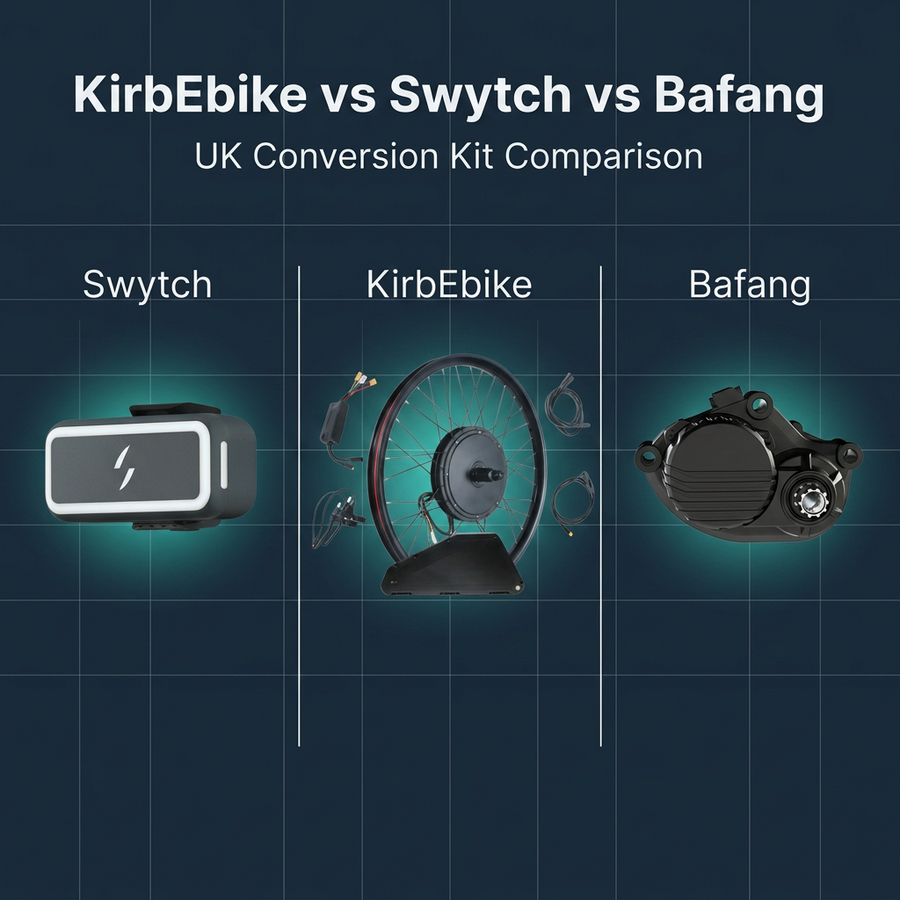
These options solve different fit problems rather than one being a universal winner. Each is judged on the same criteria: supported frame standards, axle design, published dimensions, adapter availability, brake and cassette compatibility, wheel-size choice, torque-reaction solution, documentation and support. Confirm the current specification on each provider’s page before buying.
Match the motor to your frame’s axle standard. A rear hub-motor wheel built into a rim (a Boost 250W unit shown) — whichever brand you choose, the axle standard and torque restraint must match your frame.
Open dropouts ~135–145mm by gearing; 100mm front; 175/190mm fat
Bolt-on axle, anti-rotation washers
Torque arm(s)
Open-dropout frames; fit-check for thru-axle
Boost
130/135mm open + 142mm thru-axle via adapter (19mm recess)
Bolt-on or approved thru-axle adapter
Adapter/torque interface
Riders needing a 142mm thru-axle conversion
Swytch
Front-wheel focus; wheel-size options
Front QR/bolt-on
Front torque restraint
Lightweight, low-power, simple commuting
KirbEbike made-to-order motor-wheel options
KirbEbike builds rear motor wheels to order and suits riders with conventional open-dropout frames, and those who want wheel-size and drivetrain guidance. Its published rear assembly widths sit around 135–140mm for 5–7-speed and 137–145mm for 8–9-speed setups (plus a small increase with spacers), with a 100mm front motor and 175/190mm fat-format options. It is not marketed as a universal 142mm thru-axle solution, so ambiguous or thru-axle frames should go through the wheel and dropout fit check rather than be assumed compatible. Browse options in the kit and battery collection.
Boost — 130/135mm and 142mm conversion approach
Useful specifically when you need a 142mm thru-axle conversion. Boost describes a motor for compatible open-dropout (130/135mm) frames and selected 142mm thru-axle frames using a dedicated adapter, with a required 19mm frame recess, an aluminium insert for carbon dropouts, and a Shimano-compatible freehub up to 11-speed. Its 142mm adapter is designed for its own motor, not other manufacturers’ motors.
Swytch — lightweight wheel-conversion option
Useful when the priority is a light, simple, road-legal build rather than high power — a largely front-wheel conversion with a small removable battery, aimed at 250W road-legal commuting. A front-wheel kit does not resolve a rear thru-axle mismatch.
✅
What to check with any provider.
Your dropout is open or closed, and the exact internal width
The motor’s axle diameter, retention method and over-locknut dimension
Whether an approved adapter exists for your exact frame standard
That rotor and cassette positions stay correct, and a torque arm can be fitted
When a Front Hub or Mid-Drive Is the Better Route
If the rear axle standard blocks a safe conversion, a different motor position is often the right answer.
Front hub motor
A front hub motor may suit riders when the front fork standard has a supported motor option, the rear thru-axle system isn’t compatible, power needs are moderate, the fork material and dropout design are approved, and suitable torque restraint can be installed. Do not fit a conventional front hub motor to an unsupported carbon fork.
Mid-drive motor
A mid-drive may suit riders when the rear wheel and thru-axle must stay unchanged, the bike has a compatible threaded bottom bracket, central weight distribution is preferred, or a specialist rear hub or cassette must be retained. Check the bottom-bracket type and width, frame clearance, chainline, drivetrain strength and suspension pivot layout.
A different donor bike
Sometimes changing the donor bike is safer and cheaper than modifying an incompatible frame — especially when the current bike has carbon thru-axle dropouts, proprietary suspension geometry, no approved motor adapter, damaged dropout areas, inadequate brakes or limited battery space.
Final 135mm vs 142mm Fit-Check Checklist
📋
Pre-purchase fit checklist.
Dropout type identified: open U-slot or closed thru-axle hole
Internal frame width measured between the wheel-contact faces
Axle diameter, length, thread pitch and retention method recorded
Motor over-locknut dimension confirmed for your exact variant
Manufacturer approval for your frame standard (and adapter, if any)
Rotor size/mount and cassette or freewheel type recorded
Frame material checked; no cold-setting of aluminium or carbon
Torque arm can be fitted, and washer order follows the product diagram
Conclusion: Match the Axle System, Not Just the Width
A 135mm versus 142mm hub-motor decision cannot be made from the two width numbers alone. 135mm commonly describes an open-dropout system using a nut, bolt or quick-release axle; 12×142 normally describes a closed thru-axle frame. The cassette and rotor positions may be related, but the wheel-retention systems are different, so a standard bolt-on 135mm motor should not be forced into a 142mm thru-axle frame.
An adapter is acceptable only when engineered for the exact motor and frame interface, and frame material, torque restraint, rotor alignment and axle seating must all pass review. Measure the frame, photograph the dropouts, and obtain written compatibility confirmation before purchasing the motor wheel.
FAQs
Is 142mm Boost spacing?
No. A standard 142mm rear hub normally uses a 12mm thru-axle and non-Boost drivetrain geometry. Rear Boost spacing is usually 12×148mm.
What does 12×142 thru-axle mean?
The axle is 12mm in diameter, while 142mm identifies the rear hub and frame interface width. The axle passes through closed frame dropouts and the hub, and threads into the far side.
Can a 135mm hub motor fit a 142mm frame?
Not directly in most cases. It may fit only with a manufacturer-approved system that converts the axle interface, locates the hub correctly, keeps the rotor and cassette aligned, and safely resists motor torque.
Can a 142mm hub fit a 135mm frame?
A conventional bicycle hub can sometimes be converted with model-specific end caps. A 142mm hub motor should not be forced into a 135mm frame or converted with generic spacers, because its axle also carries torque and often cabling.
How do I know my bike’s rear hub size?
Remove the wheel, check whether the frame has open or closed dropouts, measure the internal spacing between the wheel-contact faces, and record the axle diameter, length and retention method.
What is the most common rear hub width for road bikes?
Older quick-release road bikes commonly use approximately 130mm rear spacing. Many newer disc-brake road and gravel bikes use 12×142mm thru-axles.
What are the disadvantages of a thru-axle?
Thru-axles can reduce compatibility with conventional bolt-on conversion motors, and replacement axles must match the frame’s length and thread pitch. They do, however, provide repeatable wheel positioning and secure retention.
Should I spread my frame to fit a wider hub motor?
Do not use frame spreading as a routine conversion method. Never cold-set aluminium or carbon frames, and do not spread any frame to overcome an axle or dropout-standard mismatch.
⚠️
A note on safety & legality. This guide covers mechanical fit and is not a substitute for professional assessment. Frame modification, high-power motors and thru-axle conversions carry real risk — if any check is uncertain, consult a qualified bike mechanic or the motor manufacturer before riding. In the UK, a converted bike is only a road-legal EAPC when the motor is 250W continuous, assist cuts out at 15.5 mph and it requires pedalling; anything beyond that is for private land only.
About this guide. Author: KirbEbike Editorial. Technical fit review: KirbEbike conversion-support team. Last reviewed: 14 July 2026. Methodology: dimensional and legal claims cross-checked against KirbEbike’s published wheel-and-dropout listings, manufacturer technical data (Boost, Shimano) and the authoritative references cited inline (BikeRadar, Sheldon Brown, Park Tool, GOV.UK). Motor axle widths vary by variant — always confirm your exact motor’s over-locknut dimension, dropout type, rotor offset and torque-arm arrangement before ordering. Specifications can change; verify on the live pages linked above.
Stay in the know
Conversion guides, fitting advice and the deals worth knowing about. No spam.