Will a Surron Throttle Work With an Ebike Conversion Kit? Connector, Voltage and Signal Checks
Sometimes. A plug that fits only proves the plastic matches. Before you connect a Surron or Surron-style throttle, the controller and throttle have to agree on supply, ground, signal, pin order and connector family.
AK
Andy Kirby
Reviewed by the KirbEbike conversion-support team
Share
Unlock £10 off today
On this page
COMPATIBILITY / TROUBLESHOOTINGTHROTTLE = INPUT, NOT POWERUK + US
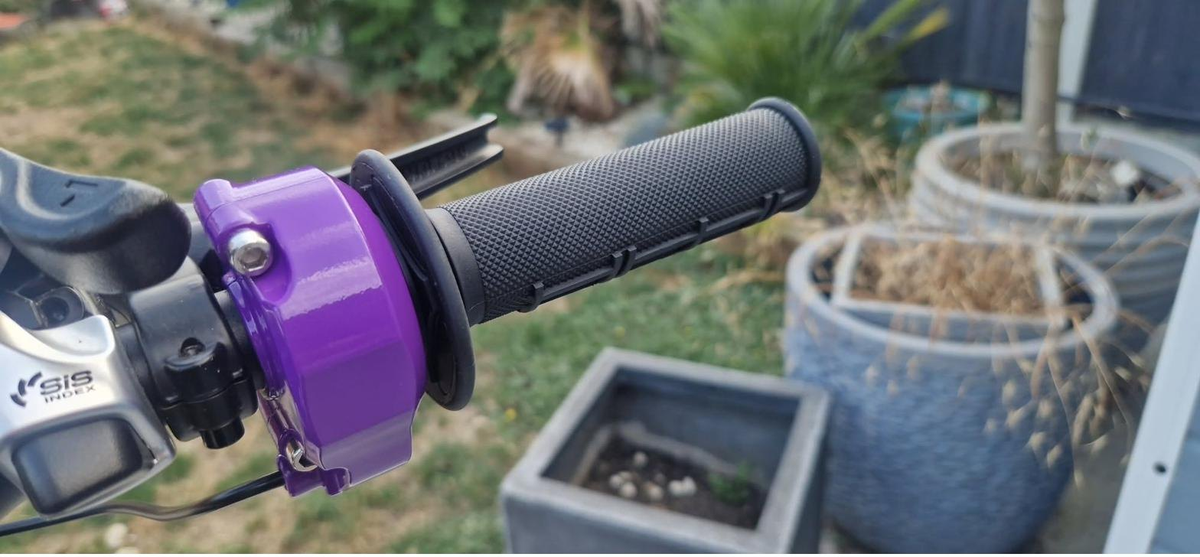
A Surron-style twist on a converted bike. The housing tells you nothing about the wiring inside.
The Quick Answer
A Surron throttle works with an ebike conversion kit only when its electrical connection matches the controller’s throttle input. Most are three-wire Hall-effect throttles, like most kit throttles: about 5V in, and a signal back that rises from roughly 0.84V at rest to about 4.2V at full twist. That shared design is why so many combinations work — and why people assume they all will.
Five things have to match: the supply the controller gives the throttle, the ground, the signal range the throttle sends back, the pin order in the plug, and the connector family. A plug that clicks in proves only the last one. Swap the first two pins and the plug still fits.
Will a Surron Throttle Work With an Ebike Conversion Kit?
Some Surron and Surron-style throttles work with conversion-kit controllers, some do not, and some can be made to work with an adapter or re-pinning. A plug that fits does not make a throttle electrically compatible: the supply voltage, ground, signal behaviour, pin order and connector all have to agree between controller and throttle. When all five match, the throttle is simply a different handle on the same kind of signal. When one does not, the result ranges from no response at all to a motor that runs on its own.
Surron Throttle vs Standard Ebike Throttle
Surron / Surron-style twist
Standard kit throttle
Physical action
Full motorcycle-style twist grip
Thumb lever, half twist or full twist
Sensor type
Usually a three-wire Hall sensor
Usually a three-wire Hall sensor
Connector
Varies: OEM Sur-Ron triangle 3-pin, waterproof 3-pin, JST-SM or bare wires
Set by the kit maker’s harness
Wiring / pin order
Product-specific; set by each maker
Matches its own controller
Controller dependency
Must match the controller’s throttle input
Designed for its own controller
Adapter or rewiring?
Sometimes; 2Fast Ebikes says its "Surron Plug" version needs minimal soldering
Not for its own kit
Plug-and-play?
Only where connector and pinout both match
Yes, with the kit it came with
"Surron-style" describes the grip, not a wiring standard.
Why Matching Connector Shape Is Not Enough
Two plugs can fit together perfectly, but with differing functions for their pins. Each throttle or harness maker determines which wire is used in which housing and connector makers sell the housing, not the wiring rules. So the five checks that drive the rest of this guide are:
Supply voltage — what the controller feeds the throttle (normally 5V)
Ground — the shared reference path
Hall signal — what the throttle sends back, and over what range
Pin order — which function sits in which cavity
Controller throttle input — the signal range the controller accepts
Illustrative example of a pin-order mismatch. Real assignments come from documentation or measurement, never from plug shape.
Key takeaway
same connector ≠ same pinout ≠ confirmed compatibility.
What Does an Ebike Throttle Actually Send to the Controller?
Supply, Ground and Hall Signal Explained
A Hall-effect throttle is a small sensor, not a power switch. Inside many generic throttles is an SS49E-type linear Hall sensor (EDN). Honeywell’s SS49E is rated for a supply of up to 6.5V and draws about 6mA at 5V; its output voltage is set by the supply and varies in proportion to the magnetic field (RS Components). The controller supplies 5V and ground; as you twist, a curved magnet moves past the sensor and the output voltage changes. The controller reads that signal and turns it into a power request. No motor current ever passes through the throttle.
Wire colours are a habit, not a rule. A typical generic throttle uses red for +5V, black for ground and green for signal (EDN), but makers are free to change them, so always measure.
Throttle Signal Voltage vs Battery Voltage
A "52V ebike" does not put 52V on the throttle. The battery feeds the controller; the controller makes a separate 5V supply for the throttle; the throttle returns a low-voltage signal. On a bench test of a generic Hall throttle, the signal read 0.84V at rest and about 4.2V at wide-open throttle with a 5V supply.
Figures from EDN’s bench test of a generic SS49E-type throttle (EDN).
So a listing that says "12V–72V" means the throttle can be fitted to systems with batteries in that range; it does not mean the signal wire handles that range. The SS49E sensor’s maximum rated supply is 6.5V (RS Components), so battery voltage on any throttle wire will destroy it.
Surron Throttle Pinout: What Must Match?
Pin 1 — Supply
The throttle supply should read close to 5V to ground. In EDN’s test, a 4.9V supply ran the throttle normally, and the article recommends at least 4.5V for an off-bike test. A supply far outside that, or one that reads battery voltage, is a stop.
Pin 2 — Ground
Identify ground positively, by continuity to a known ground point or from the controller’s wiring diagram. Do not infer it from its position in the plug or from a black wire. A misidentified ground is the most common way a mismatched throttle ends up with supply where ground should be.
Pin 3 — Hall Signal
The signal should rise smoothly with rotation. Expect about 0.84V at rest and about 4.2V at full twist on a 5V supply. EDN’s own sample read 0.84V to 3.8V, touching 4.0–4.1V when twisted fast, so a full-twist reading between about 3.8V and 4.2V is normal (EDN).
Pin Order Matters Even When All Three Functions Exist
Pin 1
Pin 2
Pin 3
Throttle A
Supply
Ground
Signal
Throttle B
Ground
Supply
Signal
Both use three-pin connectors and both have all three functions, yet they are incompatible without re-pinning or an adapter.
Surron Throttle Wire Colours: Why You Can’t Trust Them
Colour is a habit, not a pinout. The sources below happen to agree on red, black and green, yet the OEM wires carry a white stripe and sit in a different plug, and nothing obliges any other maker to follow either:
Same colours, different plug and markings. Measure, don’t assume.
Our Surron twist throttle. Six colours, each with a waterproof or a normal connector.
Surron Throttle Compatibility Matrix
Every throttle-and-controller pairing falls into one of these five cases. Find yours before you plug anything in.
Connector family
Pin order
Signal range
What to do
Same
Same
Within 0.4–4.2V
Plug in, then confirm the signal at rest and full twist
Same
Different
Within 0.4–4.2V
Re-pin with the right tool, or use a documented adapter
Different
Same
Within 0.4–4.2V
Use an adapter cable with the pin mapping stated
Any
Unknown
Unknown
Treat as incompatible until both pinouts are identified
Any
Any
Rests above ~1V or reads 2.5V
Do not ride: the throttle will command power at rest
Thresholds from EDN: many controllers treat below 0.4V as open circuit and above 4.2V as short circuit; 2.5V at rest indicates a missing magnet (EDN).
How to Check Surron Throttle Compatibility With a Multimeter
The safest method tests the throttle off the bike first, then confirms it on the bike through the controller’s own reading where possible.
Each step has a stop condition. A stop means power down and check documentation, not try a different plug.
Check 1 — Identify the Controller Throttle Input
Write down the exact controller, the harness, the throttle connector and its orientation, and find the controller’s throttle pinout in its wiring diagram. On KirbEbike smart controllers, the Ride Power app’s live data includes throttle voltage, which lets you read the signal without probing a powered connector.
Check 2 — Verify Supply and Ground
With the throttle unplugged and the system switched on, set the meter to DC volts and measure the controller’s throttle supply pin to ground. You want close to 5V. Confirm which pin is positive before going further, then switch off.
Check 3 — Measure the Throttle Signal
Test throttle on the bench: power it from a 5V source with 100mA (4.5V min) and meter between signal and ground; then slowly ramp from zero to full (EDN). The reading should gradually increase from approximately 0.84V to between 3.8V and 4.2V, without any discontinuities or flat spots. After installation, verify the same figures in the Ride Power app (if supported by your controller).
Bench figures for a generic SS49E-type throttle on a 5V supply (EDN).
Check 4 — Compare the Signal With the Controller Input Range
A changing signal is not automatically a compatible one. Many controllers treat a signal below 0.4V as an open circuit and above 4.2V as a short, and refuse to drive. The resting signal must also sit below the point where the controller starts the motor; a throttle resting near 2.5V is reading as half throttle.
Check 5 — Power Down Before Changing Connections
Keep measuring and rewiring as separate jobs. Any re-pinning, adapter fitting or connector change happens with the system switched off and the battery disconnected. Never move pins in a live harness.
Waterproof Connector vs Normal Connector: Are They Interchangeable?
Waterproof connector
Normal-wire connector
Construction
Sealed housing with seals around each pin
Open housing, e.g. JST-SM style
Keying / orientation
Moulded key; mates one way only
Keyed, but unsealed
Pin assignment
Set by the harness maker
Set by the harness maker
Testing access
Harder to reach pins once mated
Easier to identify and measure
Interchangeable?
Only with the same family and pinout
Only with the same family and pinout
Waterproof Connector
Sealed, keyed connectors keep water out and stop the plug going in the wrong way round. KirbEbike's 52V 2000W kit features a 1T4 harness with colour coded connectors for the display, brake sensors and throttle which is rated IP65. Even waterproof 3 pin connectors can look alike but have different pin sizes and/or keying or pin assignment so the family and the pinout are two different facts to verify.
Waterproof-connector version. Sealed and keyed, but the pinout still has to match.
Normal-Wire Connector
Common unsealed plugs such as JST-SM are easier to inspect and test, and a probe reaches the pins without a fight. Sellers that adapt throttles for conversion bikes often rewire them onto plugs like these, and a throttle rewired that way may no longer suit a sealed harness. A good mechanical fit still says nothing about which pin carries supply.
Connector Adapter vs Rewiring
An adapter cable with the pin mapping stated is the clean, reversible option, and it is how Sur-Ron-specific throttles such as the Lekkie Pacemaker are supplied: with a cable for the Sur-Ron plug, not for a kit controller. Re-pinning or splicing is a last resort for someone with the right crimp tool and both pinouts identified. KirbEbike’s 1T4 main cable is the kit’s waterproof main harness, not a throttle adapter.
KirbEbike Surron Throttles: What We Sell and How to Choose
KirbEbike lists the following throttle options on one product page, with UK prices at the time of writing (October 2026):
Kits wired with a waterproof throttle connector, such as the 1T4 harness
Surron Twist Throttle, normal connector
£35
Harnesses with an unsealed throttle plug
Twist Throttle With Key (normal wires)
£20
Builds wanting a keyed twist grip on an unsealed harness
Full Twist Throttle
£15
A lower-cost full-twist grip
Thumb Throttle
£15
Bars with right-hand trigger shifters
Surron Throttle Part only (six colours)
£15–£35
Replacing a worn housing
The page carries 11 customer reviews averaging 4.2 stars. Most report the throttle working well; one buyer received a broken unit, and KirbEbike offered a replacement part or a refund. To match a variant to your kit, send your controller model and a photo of your throttle plug to support.
Surron Throttle vs Generic Twist Throttle vs Thumb Throttle
Surron / Surron-style twist
Generic twist
Thumb throttle
Control method
Full twist
Full or half twist
Thumb lever
Handlebar space
Replaces the right grip
Replaces all or part of the grip
Sits beside the grip
Typical bar fit
22mm (7/8in) where stated
22mm (7/8in) where stated
22mm (7/8in) where stated
Electrical design
Usually 3-wire Hall, 5V
Usually 3-wire Hall, 5V
Usually 3-wire Hall, 5V
Plug-and-play?
Only if connector and pinout match
Only if connector and pinout match
Only if connector and pinout match
Suits
Riders who want motorcycle-style control
Lower-cost twist control
Riders using trigger shifters
Most throttles of all three types are made for 22.2mm (7/8in) bars. None is universally better.
Prices and stock change; confirm with each seller.
Will Upgrading to a Surron Throttle Make an Ebike Faster?
No, not by itself. A throttle is an input device: it sends the controller a signal between roughly 0.84V and 4.2V. It does not change the battery voltage, the controller’s current limit or the motor’s rating, and those set what the bike can do.
Throttle Response vs Motor Power
A new throttle can change how the bike feels: a longer or shorter twist, a different resting point, a smoother response through the travel. On app-tuned systems, the controller’s acceleration setting shapes the response far more than the grip; our ride profiles guide explains it.
Surron Throttle vs Controller Upgrade
Throttle change
Controller change
What changes
Ergonomics and input feel
How the motor is commanded and the current available
Effect on power
None on its own
Can change it, within battery, motor and software limits
Effect on top speed
None on its own
Possible, but also set by voltage, motor and speed limits
Why a Throttle Can Fail Even When the Connector Fits
Throttle Does Nothing
Check, in order: pin order, about 5V on the supply pin, ground continuity, a signal that rises above 0.84V when twisted, a fully seated plug, and whether the controller is in a fault or brake-cutoff state. A signal stuck below 0.4V usually means an open circuit.
Motor Runs as Soon as the System Powers On
Stop testing. Switch off, disconnect the battery and lift the drive wheel. Then bench-test the throttle: a resting signal near 2.5V means the magnet is missing or displaced, and the controller reads it as half throttle (EDN). A swapped pin can produce the same symptom. If you recently replaced the controller, also see our self-learning wires guide.
Throttle Works Only Through Part of Its Travel
If full twist stops short of about 3.8V, the controller may never reach full command; look for a binding grip, restricted rotation or a worn sensor. If the reading rises normally but the motor stops responding partway, the controller’s accepted range is narrower than the throttle’s output.
Throttle Signal Jumps or Drops Out
Inspect the connector for loose or corroded pins, the cable for pinch damage near the bar clamp, and the sensor itself. Repeat the bench test: a healthy throttle rises smoothly with no jumps. Our guide to common conversion kit problems covers connector faults in more depth.
Is a Full-Twist Surron Throttle Legal on an Ebike?
The grip style is not what decides it. Legality depends on how the throttle behaves, the motor’s power, the assisted speed, and where you ride.
UK Throttle Rules
Throttles are not simply banned in Great Britain, but they bring extra rules. An EAPC must have pedals that can propel it, a motor of no more than 250W continuous rated power, and assistance that cuts off at 15.5mph (DfT). "Twist and Go" cycles count as EAPCs only if they meet those rules, and those placed on the market or entering service after 1 January 2016 must also meet technical requirements, normally through type approval or a Motorcycle Single Vehicle Approval. A 2024 proposal to allow throttle assistance up to 15.5mph without type approval was not taken forward (DfT). A build that does not comply is treated as a motor vehicle.
US Throttle Rules
At federal level, 16 CFR § 1512.2 includes in its bicycle definition a two- or three-wheeled vehicle with fully operable pedals and an electric motor under 750W that cannot exceed 20mph on motor power alone with a 170lb rider (LII). That is a product definition, not a riding law. States and cities set their own rules on throttles, classes and where e-bikes may be ridden.
Product touchpoint
Buying a throttle for a KirbEbike kit
Pick the Surron twist throttle variant that matches your harness: the waterproof-connector version for a waterproof throttle plug, the normal-connector version for an unsealed one. After fitting, owners of our smart controllers can check for a healthy 0.84V-to-4.2V sweep in the Ride Power app before the first ride. Unsure which plug you have? Send a photo to support.
Conclusion: Verify the Electrical Match Before You Plug It In
A Surron throttle can work with an ebike conversion kit when its electrical interface matches the controller’s throttle input. Connector shape alone cannot establish that. Work through the sequence in order: connector family, pinout, a 5V supply, ground, a signal that sweeps from about 0.84V to 4.2V, and the controller’s accepted input range.
If anything does not match, stop and identify the pinouts rather than trying other connections. And remember the throttle changes how you ask for power, not how much power the system has, or its legal status.
Check the pinout, not just the plug
5V in, 0.84V to 4.2V out, pins in the right order. Then ride.
Will a Surron throttle work with an ebike conversion kit?
Yes, in some combinations, but only after you confirm the connector, a 5V supply, ground, a signal range of roughly 0.84V to 4.2V, pin order and the controller’s accepted input. Three-wire Hall throttles are not automatically interchangeable.
Are all Surron throttles the same?
No. There are OEM Sur-Ron throttles, OEM throttles rewired for conversion bikes, and aftermarket "Surron-style" throttles. Plugs, pin order and wire colours vary between them.
What voltage does a Surron throttle use?
A Hall throttle runs on about 5V from the controller and sends back a signal of roughly 0.84V at rest to 4.2V at full twist. It never sees battery voltage; the SS49E-type sensor inside many throttles is rated to 6.5V maximum.
What size handlebars does a Surron throttle fit?
Most Surron-style throttles are made for 22.2mm (7/8in) bars, the standard bicycle size. Check the listing for the exact throttle before ordering.
What does upgrading to a Surron throttle do?
It changes ergonomics and feel: a full motorcycle-style twist instead of a thumb lever or small twist. It does not increase the motor’s or controller’s available power.
Will a Surron throttle make an ebike faster?
No, not by itself. Speed is set by battery voltage, controller current, the motor and any programmed speed limit. The throttle only tells the controller how much of that you want.
Can I connect a three-pin Surron throttle to any three-pin controller?
No. Pin count and connector shape are not enough. Pin assignment, supply voltage and accepted signal range must all match, or you need an adapter with the pin mapping stated.
How do I test an ebike throttle with a multimeter?
Power the throttle from a 5V source that can supply 100mA, meter between signal and ground, and turn slowly. A healthy throttle rises smoothly from about 0.84V to 3.8–4.2V. Below 0.4V suggests an open circuit; 2.5V at rest suggests a missing magnet.
Is a full-twist throttle legal on an ebike?
It depends on where you ride and how the bike is classed. In Great Britain, twist-and-go cycles must meet the EAPC rules plus approval requirements; in the US, state and local rules decide. Grip style alone does not decide legality.
Are Surron throttles good for high-power conversion kits?
They can be, if you like a full-twist grip and the electrical match is confirmed. A high-power kit does not need a Surron-style throttle; the signal is the same 5V Hall signal whatever the motor’s wattage.
Sources
Sources
[1]EDN —Hall Sensor Throttle: bench test of a generic e-bike throttle, signal range and fault thresholds.
A note on safety & legality. General information, not a substitute for the manufacturer’s instructions. Bench-test throttles from a 5V source where possible, and rewire only with the battery disconnected. Never connect a throttle wire to battery voltage, and stop at any unexpected motor movement, heat, smell or fault code. Throttle rules differ between Great Britain (DfT) and US states. KirbEbike kits above 250W are for private land with the landowner’s permission; see our UK legal kit guide and road-legal kits.
About this guide
Author: Andy Kirby. Last reviewed: October 2026. Electrical figures come from EDN’s bench test of a generic SS49E-type Hall throttle and Honeywell SS49E component data; they describe typical three-wire Hall throttles, and individual throttles vary slightly. Product details and prices were read from each seller’s live listing in October 2026 and are their own claims.
Stay in the know
Conversion guides, fitting advice and the deals worth knowing about. No spam.