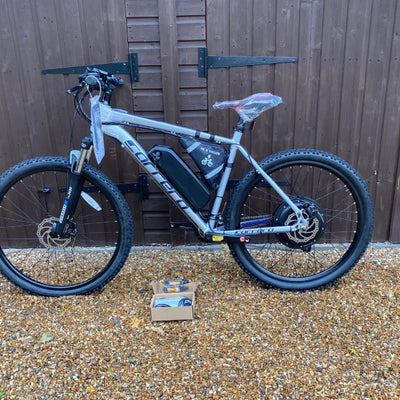
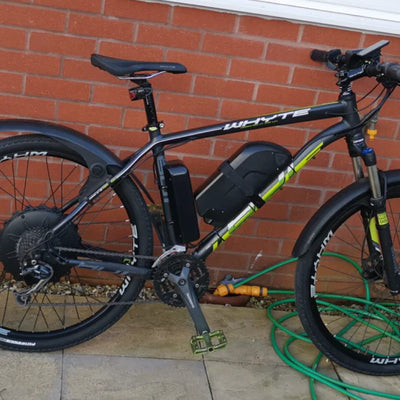
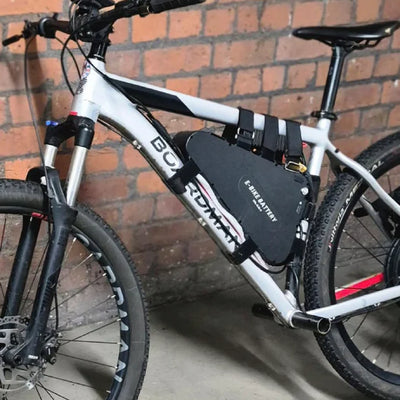
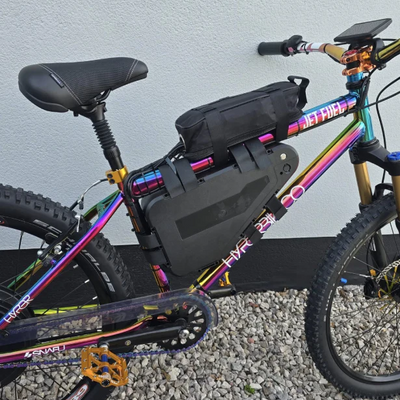
A motor-only kit wins on the advertised price and loses on everything that has to be true before the bike moves. The battery, the charger, the mount, the connectors and the sensors decide the real total — and whether the finished machine is safe to ride. A motor-only mid-drive appears on the marketplaces from about £256; a bundled 250W kit with the battery in the box starts at £390. That gap decides a lot of purchases, right up to the moment the cheaper box turns out to need a pack, a charger, a mount and a pair of sensors that fit your cranks. This guide prices both routes to the point where the bike actually rides.
Choose a kit with battery when this is your first conversion, you don’t already own a suitable pack, and you want one warranty and one phone number — its voltage, controller current, BMS rating, connectors and charger arrive already matched. Choose motor-only when you already hold a verified compatible battery, or need a pack shape no bundle offers, and can check the whole electrical path yourself. In one sentence: the correct comparison is never box price against box price — it is the total cost of a complete, compatible, safely installed system. Kits sold without a battery push buyers to source a pack and charger elsewhere, and that is the pattern the fire service links to incompatible chargers and fires.
Separately sourced packs and chargers need particular care: government guidance for e-cycle users is explicit that batteries and chargers should be genuine items authorised by the manufacturer, and that mixing unrelated components is where failures begin (GOV.UK). Compare conversion kits with batteries as complete systems, then price what each one still needs.
The Quick Comparison
| Decision factor | Kit with battery | Motor-only kit |
|---|---|---|
| Upfront advertised price | Higher | Lower |
| True completed-build cost | More predictable | Depends on the missing parts |
| Electrical matching | Usually completed by the seller | The buyer must verify it |
| Battery choice | Limited to the bundle options | Greater flexibility |
| Installation complexity | Lower | Higher |
| Warranty responsibility | Often one seller | May be split across sellers |
| Best for | First-time and convenience-focused buyers | Experienced builders or battery owners |
| Main risk | An unsuitable bundle for the bike | Mismatched battery, controller, connectors or charger |
The short version
| If this is you | Buy | Because |
|---|---|---|
| First conversion, or no pack owned | Kit with battery | One seller has settled voltage, current, connectors and charger — one warranty covers the result |
| You own a battery and can document its voltage, full-charge ceiling, BMS output, connector and health | Motor-only | The only case where the saving is real rather than deferred |
| You need a custom pack shape, cell type or discharge rating | Motor-only | No bundle offers it — and you accept the integration burden |
| You want a predictable total and a single support contact | Kit with battery | The ride-ready cost is knowable before you order |
| Road-legal UK commuting | A documented 250W bundle | Anything above 250W is outside EAPC classification whatever the display shows |
True Cost: Two Worked Carts
This is the section that decides most purchases. Advertised prices are not comparable, because the two routes buy different amounts of the finished bike. Below are two carts for the same job — a 48V 1000W KirbEbike build — priced to the point where the bike is rideable. Verified figures come from the live product pages; cost lines shown as bands are planning estimates, not quotations.
| Line | Matched bundle | Motor-only build | Note |
|---|---|---|---|
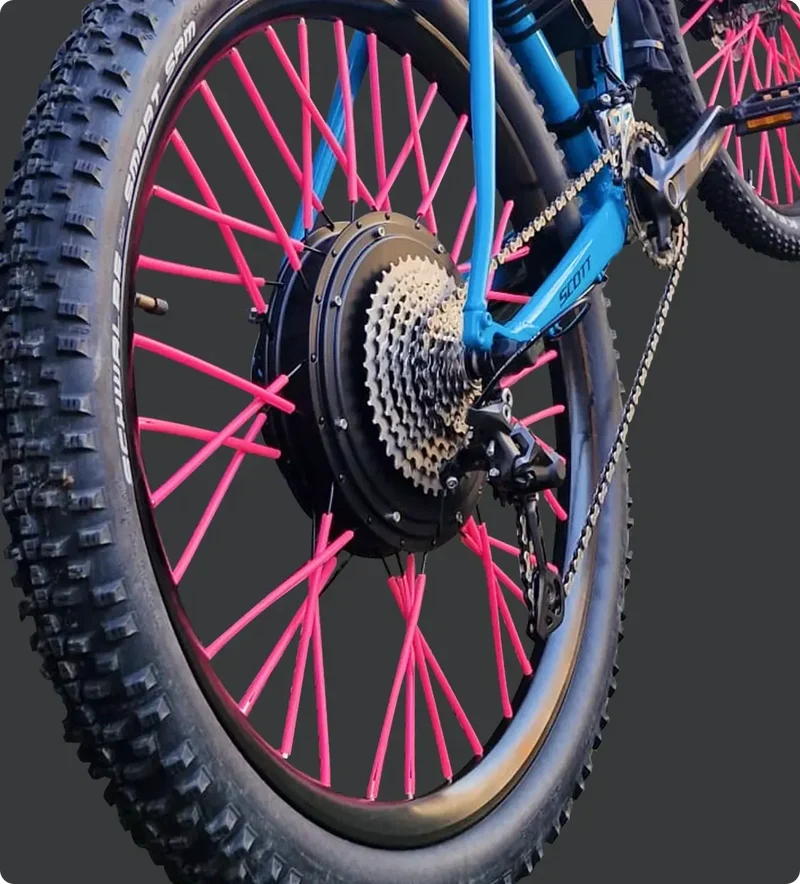
| Motor system (wheel, controller, display, PAS, throttle, e-brake levers, harness) | Both start from the same 48V 1000W kit at £365.25 | The entry price is the no-battery variant on both routes | |
| Battery | Priced option added at checkout | Sourced separately | The biggest single line either way |
| Charger | Supplied with the battery option | Must be bought and matched to the pack | A spare from a drawer is not a match |
| Battery mount or bracket | Included with the pack | Often extra | Cable ties are not a mount |
| Connectors and adapters | None expected | £0–£40, plus soldering | Or a shop charge to do it properly |
| Cable gauge and inline fuse | Specified by the seller | £10–£25 | Sized to the controller’s current, not the plug |
| Torque arm | Free accessory on KirbEbike kits — required at this power either way | ||
| Drivetrain parts | £20–£70 — applies equally, depends on wear | ||
| Brake work | £25–£150 — assess at the finished weight | ||
| Tools | £0 — included with KirbEbike kits | £0–£40 elsewhere | Bottom-bracket and cassette tools are the usual gap |
| Shipping | Free UK; the battery ships separately | Free on the kit; a separate pack may carry its own lithium charge | Lithium travels under its own rules |
| Import duty or tax | Check at checkout | Payable per shipment — two shipments, two exposures | A real cost of splitting the build |
| Professional fit, if used | £80–£200 | £120–£300 | Shops charge more to integrate parts they didn’t supply |
| Compatibility-return risk | Low — one seller, one return | Return postage twice; a pack may not be returnable at all | The line buyers discover last |
Ride-ready cost comparison for the same build. Collect current prices from the same market on the same date before deciding — and compare like with like: a 250Wh commuter bundle against a motor-only system later paired with a 1,000Wh pack is not a comparison, it’s two different bikes.
The pattern is consistent: the motor-only route wins on the checkout price and loses ground on every line after it. It genuinely costs less when you already own a documented, tested, compatible pack — and stops being cheaper the moment you must buy a battery, a matched charger, a mount and the connector work to join them.
What Does Each Kit Actually Include?
“Complete kit” is not a standardised phrase, and nobody polices it. Two listings using the same words can arrive as very different parcels — the component list decides what you’re buying, not the product name.
A genuine kit-with-battery should include: the motor (or a motor laced into a wheel in your size), the controller, the battery plus its mounting base, the charger built for that pack, a display, a pedal-assist sensor, brake cut-off sensors or levers, the wiring harness with axle hardware, a torque arm where the power calls for one, and instructions. Check that list against the exact variant: on the KirbEbike range, the battery is a priced option on most kits — the EZ Rider is the model that ships with its pack as standard. That flexibility is useful, and it’s also a reason to read your selected configuration rather than assuming what arrives.
What “motor-only” may leave out: depending on the seller it can mean a bare motor, a motor laced into a wheel, motor plus controller, motor with controller and display — or nearly everything with only the battery and charger excluded. That last case is the common one on mid-drives: a typical Bafang-style kit arrives with the display, throttle, chainring, sensors and harness, and no pack at all.
Battery Compatibility: the Main Motor-Only Risk
Voltage must match the controller — at full charge. Nominal voltage is a nickname: what the controller has to survive is the pack’s fully charged voltage. A 48V pack tops out near 54.6V, a 52V near 58.8V, a 72V at 84V. So the question is never “is this a 48V battery” — it’s whether the controller is rated for the full range that battery will present. 48V and 52V are not automatically interchangeable, and 60V/72V builds need components designed for those ranges throughout. Use the manufacturer’s published tolerance, not a forum consensus.
BMS current matters more than capacity. One rule carries the weight: the controller’s maximum battery current must fall within the pack’s safe continuous output. Capacity and discharge current are separate specifications — a 20Ah battery with a 30A BMS will cut out feeding a controller that asks for 45A on a climb, however much energy it stores. Choosing a battery from motor wattage alone skips the step that matters.
Matching connectors do not mean matching systems. Seven things must line up, and plug shape is only the first: connector family (XT60 and XT90 among them), polarity, voltage rating, current rating, wire gauge behind the plug, waterproofing, and anti-spark provision on high-current systems. Swapping a plug changes the plug — it doesn’t fix a voltage mismatch, an insufficient BMS or a charger built for a different pack.

The charger must be made for the battery. Government guidance tells e-cycle users to buy only genuine items authorised by the manufacturer, and the fire service’s ChargeSafe campaign warns specifically against universal or multi-plug chargers unless the battery maker has approved them (London Fire Brigade). Pushing too much power into a pack is how thermal failures start.
Safety and Warranty Risk
One matched supplier vs several. A bundle doesn’t prove compatibility just because the parts arrive in one box — selling components together is a commercial arrangement, not an engineering verification. What a bundle should demonstrate, on request, is six things: the controller’s exact voltage range including its full-charge ceiling; its maximum battery-current limit; the battery’s continuous BMS rating and charge-current limit; connector type and polarity on both discharge and charge sides; the charger’s output confirmed as matched to that pack; and a clear statement of who carries responsibility if the combination proves incompatible. Ask for those in writing before paying — a seller who answers quickly has done the work.
Split the build across sellers and the support picture changes: the motor seller may not cover battery faults, the battery seller can reject a claim if the controller drew more than the pack was rated for, changing a connector may affect returns — and whoever assembled the bike carries more responsibility for how it behaves.
Does a conversion void the donor bike’s warranty? Often, yes — frames were never designed or tested for motor loads, so most manufacturers exclude conversion damage, and some void the warranty outright on fitting. Check the terms first.
Will the Kit Fit Your Donor Bike?
An electrically perfect system can still be mechanically wrong for the bike in your shed. These checks take five minutes and prevent the most expensive mistake in conversion — a wheel that will not go into the frame.
- Hub-motor checks: wheel diameter and the ETRTO number on the tyre sidewall; front or rear position; axle diameter and flats; freewheel or cassette and gear count; rim or disc brake, rotor mount and clearance; and whether a torque arm is required. Dropout width is the single most common conversion question — and it’s really an axle-standard question. The wheel and dropout reference carries the measurement method.
- Mid-drive checks: bottom-bracket width alone doesn’t decide fit. Confirm the shell type (BSA threaded vs press-fit or eccentric, which most kits won’t accept), internal diameter, internal obstructions such as cable guides, motor-body to chainstay clearance, chainline and lockring engagement — against the manual for the exact model.
- Battery checks: pack dimensions against the frame triangle; bottle-boss positions; clearance to lift the pack out; suspension movement through full travel; cable exit direction; weight distribution and mounting security.
- Donor-bike condition: frame and fork cracks or corrosion (especially at dropouts, head tube and bottom bracket); dropout thickness; wheel bearings, rim and spokes; brake pads, rotors and hoses; tyre wear and load rating; chain and sprockets; headset and BB play. A conversion multiplies every existing weakness.
Which Route, by Buyer Type
First-time converter: take the matched kit. Clear fit guidance, a supplied charger and one support contact are worth the premium — they buy away the compatibility work you’re least equipped to do. Fire-service advice for anyone buying a conversion kit is to get a complete set with a matched battery and charger, professionally fitted if you’re not confident.
Already own a battery: motor-only can pay — after you’ve confirmed all eight: nominal voltage, full-charge voltage, BMS continuous output, connector and polarity, charger condition and match, pack age and health, physical mounting, and controller compatibility. Any unknown on that list means guessing with a lithium pack — the one component where guessing has consequences beyond your wallet.
Custom high-power build: motor-only gives real control over pack shape, current capability and controller choice — and transfers the engineering responsibility to you. Anything from 1000W to 4000W needs a fresh look at dropouts, brakes, torque restraint, cable ratings and where you’re permitted to ride.
Road-legal UK commuter: buy a documented 250W pedal-assist system that stops assisting at 15.5 mph and requires pedalling, and keep the paperwork — a stated continuous rating, a documented cut-off, working pedals, and a seller who will confirm the specification in writing. A bundle from the road-legal range is usually the safer route here, because the compliance evidence and the components arrive together.
Complete-Kit and Motor-Only Options, Compared Fairly
Assessed on the same criteria — battery inclusion, motor type, bundled energy, fit checks, installation level and support route — and not ranked, because they don’t all target the same job.
KirbEbike — kit with battery
Worth considering for a motor wheel built to your stated size, battery and charger options in the same purchase, and waterproof plug-in wiring. The EZ Rider 250W kit is the road-legal end — 36V dual pack (792Wh), 50 Nm, colour display. Higher up, the 48V 1000W (from £365.25) and 52V 2000W MTX (from £357.85) are off-road propositions. Honest limitations: most of the range sits well above 250W and cannot be used on public roads; the kits are heavier than premium UK 250W systems; and on most listings the battery is a priced option — those two entry prices are no-battery variants.
Boost — full-size kit, battery included
A UK-engineered rear-hub system with the battery included: 250W, 42 Nm, a 252Wh 7Ah pack on LG cells, roughly 35 miles claimed, about 4 kg added. Two things stand out — a single cable between battery and motor, and configuration for 142mm thru-axle frames as well as 130/135mm open dropouts, with 7–11-speed cassette options. Your bike needs bottle-cage mounts, and the display is a paid extra.
Swytch GO and MAX — lightest bundled route

The lightest mainstream route and the benchmark for a fast install: a 250W front hub with 40 Nm, batteries included, in the 3 kg class. The GO and MAX range offers 180Wh, 280Wh and 378Wh packs, so range is the trade-off, and a front hub has less grip on steep climbs. Reviews have noted strap-and-pad mounting rather than engineered brackets, and order timings slipping during pre-order waves.
Bafang and Tongsheng — motor-only mid-drives
A Tongsheng torque-sensing mid-drive sells from around £280 and a Bafang BBS-series from around £330, both needing a 68–73mm threaded bottom bracket and, in almost every case, a battery bought separately. You gain torque-sensed feel, low central weight and free pack choice; you accept a harder installation, more drivetrain wear, a split warranty and the whole compatibility burden. Bafang sells 250W, 750W and 1000W variants of similar-looking units — the wrong version puts you outside UK road law.
Yose Power — the honest without-battery range
Front and rear hub kits at 250W and 350W from roughly €219–€269 in a clearly named without-battery range, alongside bundled kits with 36V 13Ah and 18Ah packs. The catch is documented on its own pages: the supplied pedal sensor doesn’t suit Hollowtech II or Octalink cranks, and the included brake levers don’t work with hydraulic brakes — so a modern bike may need extra parts before the kit is finished.

| Option | Battery in the box? | Voltage / capacity | Energy | Charger | Is the entry price a no-battery variant? |
|---|---|---|---|---|---|
| KirbEbike EZ Rider (from £390) | Yes — dual pack | 36V 7Ah + 15Ah (22Ah) | 792Wh | 4A | No — included at the starting price |
| KirbEbike 48V 1000W (from £365.25) | Optional | 48V, several Ah options | Varies | Varies by battery | Yes — no-battery variant |
| KirbEbike 52V 2000W MTX (from £357.85) | Optional | 52V 25Ah or 30Ah | 1,300–1,560Wh | 5A | Yes — no-battery variant |
| Boost full-size kit | Yes | 7Ah pack | 252Wh | Supplied | No — display is the paid extra |
| Swytch GO / MAX | Yes | Three pack sizes | 180–378Wh | Supplied | No |
| Yose Power without-battery (from ~€219) | No — named as such | n/a | n/a | Not supplied | Yes — explicitly labelled |
| Bafang / Tongsheng mid-drives (from ~£280) | No | n/a | n/a | Not supplied | Yes — battery bought separately |
Bundled energy and what the advertised entry price includes, from each seller’s live product pages in July 2026. The 252–792Wh span runs from Boost’s pack to the EZ Rider’s dual pack — both 250W-class road-legal bundles, which is why the spread is so wide. Bundle contents change often; re-check before ordering.
Hidden Risks That Erase the Motor-Only Saving
Each of these is recoverable on its own. Together they are how a £150 saving becomes a £300 overspend:
| Mistake | What you notice | What it costs |
|---|---|---|
| Wrong nominal voltage | Error codes, dead display, refuses to power on | Controller, sometimes the motor |
| Full-charge voltage above the controller rating | Works at first, fails later | Controller |
| BMS current below controller demand | Cut-outs on hills, heavy sag | Range, and pack life |
| Unapproved charger | Heat while charging | Fire risk |
| Matching plug, different polarity | An immediate short | Controller and pack |
| Underestimated labour | A longer bill than quoted | Diagnosis time nobody documented |
Price the Comparison Properly
KirbEbike sells each side of this decision: the EZ Rider 250W bundle at the road-legal end — fitted in about 20 minutes and reversible — and bare 48V–52V motor wheels at the motor-only end, where you supply the pack. Compare both against the bundled alternatives before deciding.
Conclusion: Compare Complete Systems, Not Box Prices
Three decisions carry this purchase. Compare the final ride-ready cost, including the battery, charger, mounting parts and labour. Confirm voltage, BMS current, controller demand, connector and charger compatibility before combining components from different sellers. Then choose the support model that matches your experience: one matched supplier for simplicity, or separate components for controlled customisation.
First-time buyers are usually better off with a documented matched system, where the compatibility work is already done and one company answers the phone. Experienced builders gain real flexibility from the motor-only route — and the saving is real for them, because they can verify the whole electrical path themselves.
Check Fit Before You Check Price
Wheel size, dropout width and brake type decide what will physically go on your bike. Power is the second question, not the first.
Frequently Asked Questions
Do e-bike conversion kits come with a battery?
Is a kit with battery better than a motor-only kit?
What battery do I need for a conversion kit?
How much does a complete conversion kit cost?
Can I use any 48V battery with a 48V motor kit?
Is it cheaper to buy the battery separately?
What should I avoid when buying a conversion kit?
Sources
- GOV.UK — Riding an electric bike: the rules. gov.uk/electric-bike-rules
- GOV.UK — EAPCs: standards and legal requirements. gov.uk
- GOV.UK — Battery safety for e-cycle users. gov.uk
- OPSS — Statutory guidelines on lithium-ion battery safety for e-bikes. gov.uk
- London Fire Brigade — e-bike conversion kits and ChargeSafe. london-fire.gov.uk
- The Bicycle Association and the Association of Cycle Traders — retailer guidance on conversion kits (cited unlinked).
- Grin Technologies — bike compatibility: dropouts, axles and frame standards (technical reference, cited unlinked).