Can a 52V Battery Really Power a 2000W Ebike? BMS Amps, Voltage Sag and Cut-Outs
Yes, a correctly specified 52V battery runs a 2000W system comfortably. But the voltage on the pack and the wattage on the motor prove nothing on their own — the BMS continuous rating is what decides whether it keeps up.
Start with the arithmetic: 2,000W ÷ 52V is about 38.5A. That is a starting point, not a specification, because what the battery actually sees is set by the controller’s DC current limit, not the motor label. The rule that matters is simple: the BMS continuous rating must comfortably exceed the controller’s maximum draw, with headroom for acceleration peaks and a partly discharged pack.
So a 52V pack with a 60A continuous BMS runs a 35A or 50A controller comfortably, while a 40A pack is marginal behind 35A and unsuitable behind 50A. Cut-outs under acceleration are almost always this mismatch rather than a faulty controller. Our BMS amps guide covers the checks in detail.
Direct Answer: What Decides Compatibility
Specification
What it tells you
What it does not tell you
Where to find it
Motor wattage
Rough power class
Nothing about battery current
Motor label
Battery voltage
System compatibility
Nothing about current capability
Pack label
Controller DC current
What the battery will be asked for
Nothing about how long
Controller datasheet
BMS continuous current
What the pack can sustain
Nothing about capacity
Battery specification
Amp-hours
Capacity, within one voltage
Nothing about current
Pack label
Watt-hours
Stored energy, comparable
Nothing about current
Voltage × Ah
Controller draw against BMS continuous rating decides it. The rest is context.
The battery is almost always the binding limit on a 2000W build. Match the BMS to the controller, not the motor label.
The Arithmetic, and Why 38.5A Is Only a Start
Dividing 2,000W by 52V gives roughly 38.5A, a useful sanity check and nothing more. Three things make the real figure different: the motor rating describes the motor rather than what the controller draws, the controller has its own maximum DC current which may sit well below or above that estimate, and acceleration peaks are short bursts higher than any steady-state figure.
There is also a voltage question hiding in the division. A 52V pack is 52V nominal but 58.8V fully charged, and it falls through the ride toward the low-voltage cut-off. The same power demand therefore needs more current from a nearly empty pack than a full one, which is why cut-outs so often appear late in a ride rather than at the start. Our battery-to-motor matching guide works through the voltage side.
Motor Wattage, DC Current and Phase Current
Three different numbers, routinely confused. Motor wattage is a rating for the motor, usually continuous, and it says nothing about what your particular controller will draw. DC or battery current is what actually flows out of the pack, and it is the only figure worth comparing against a BMS rating. Phase current is what flows in the motor windings, and it can be considerably higher than battery current at low speed.
That last point surprises people. At low speed the motor generates little back-EMF, so the controller can supply high phase current for torque while drawing comparatively modest current from the battery. It is what makes a hill start possible, and it is why a high phase-current figure on a spec sheet does not mean your battery is being asked for more. Our guide to hub motor internals explains the mechanism.
Worked Example: 52V With a 35A Controller
Condition
Voltage
Current
Electrical input
Fully charged
58.8V
35A
About 2,058W
Nominal
52V
35A
1,820W
Part discharged
48V
35A
1,680W
Near cut-off
44V
35A
1,540W
Input power at a fixed 35A limit falls as the pack discharges. Electrical input is also not the same as mechanical output.
Our 52V 2000W kit lists a 35A FOC controller, so at 52V nominal the electrical input is about 1,820W rather than a flat 2,000W — which is normal and not a shortfall. Electrical input and motor rating are different measurements, and some input is always lost as heat in the controller and windings. The practical consequence is the last row of that table: as voltage falls, the same current delivers less power, so acceleration late in a ride is genuinely weaker than at the start.
35A, 45A or 50A on a 52V Build
More controller current buys acceleration and hill-start torque, not top speed, which is governed by voltage, winding and wheel size — unchanged across these three. What changes is what the battery is asked for: 35A is a moderate demand on a 52V pack, 45A significantly higher, 50A a genuine high-current requirement.
The controller sets the draw. Its DC current limit, not the motor label, is what the battery is asked for.
Which is why a controller upgrade is frequently a battery upgrade in disguise. Fitting a 50A controller to a pack rated at 40A continuous does not give 50A of performance; it gives 40A of performance punctuated by cut-outs. Our 2600W kit draws 50A, and it is specified alongside packs that can supply it for exactly that reason.
BMS Amps: The Specification That Decides It
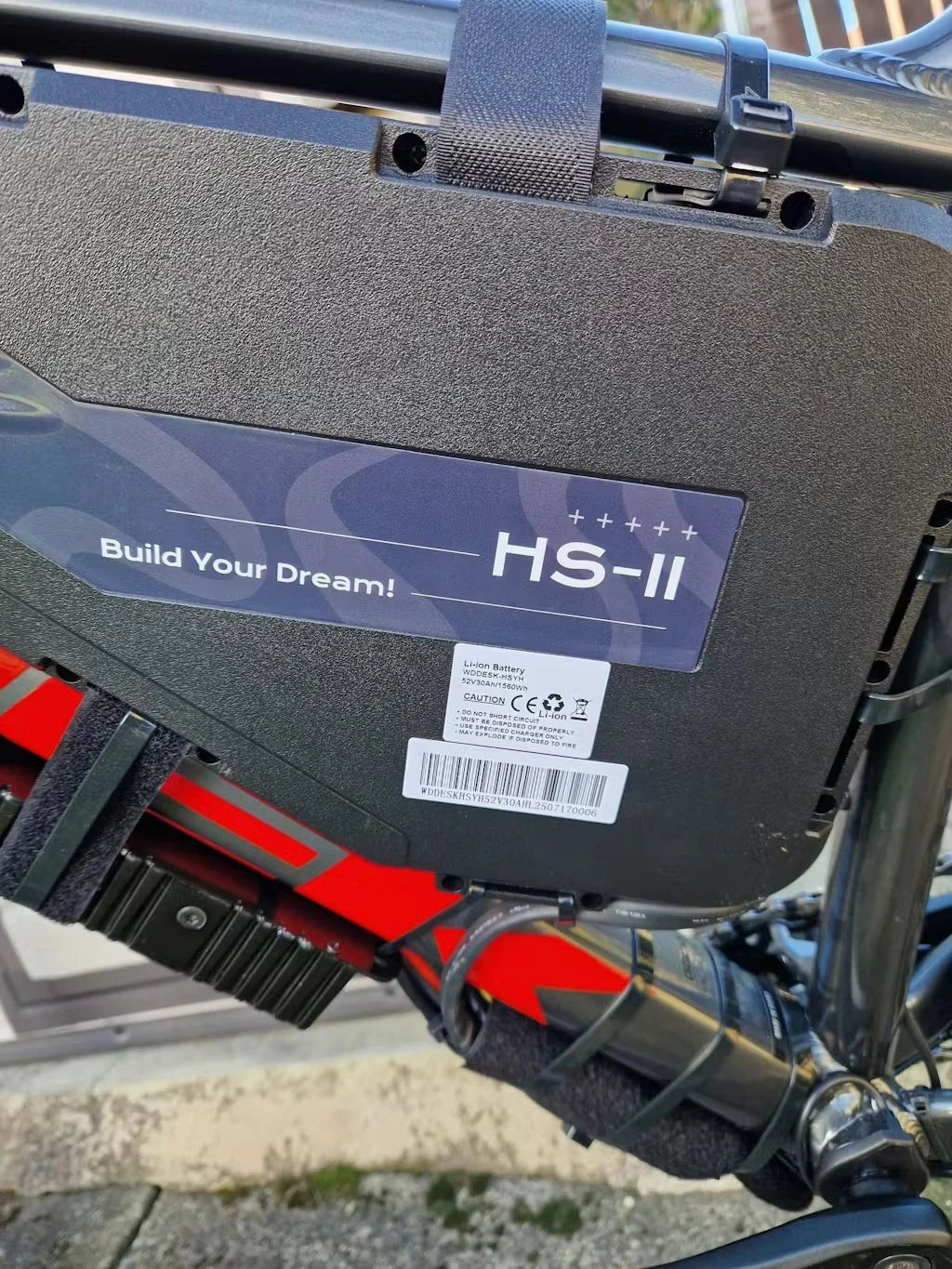
Headroom is the BMS continuous rating minus the controller’s maximum draw, using our own published figures: 40A continuous on the entry 52V pack, 60A on Taishan and HS-II. Peak ratings are short-duration and should not be used for this calculation.
The battery management system protects the pack: it balances cells, prevents over-discharge, and cuts current when demand exceeds its limit. That last function is what riders experience as a cut-out. Its continuous rating is the one that matters, because a peak rating applies for seconds and cannot be relied on for a sustained climb. Our Taishan and HS-II packs use a 60A BMS, while the entry range publishes 40A continuous at 52V 20Ah — which is why the entry pack suits a 35A controller and not a 50A one.
Two things a BMS is not. It is not a performance upgrade: a higher-rated BMS on cells that cannot sustain the current moves the failure point from a controlled cut-out to cell stress. And it is not a substitute for cell quality — the pack delivers only what the cells behind it can supply, which depends on cell model and parallel count.
Taishan pack. 60A BMS and LG 21700 cells on the 52V model, so a 35A or 50A controller has headroom.
Voltage Sag, and Why the Bike Cuts Out
Voltage sag is normal physics, not a fault. Every cell has internal resistance, so drawing current causes a temporary voltage drop, proportional to the current and that resistance. Release the throttle and voltage recovers almost immediately. That recovery is the diagnostic: a pack that snaps back is behaving normally, while one that recovers slowly or not at all is telling you something.
What you see
What it means
What to do
Voltage dips, bike keeps pulling
Normal sag
Nothing; this is expected
Acceleration noticeably weakens
Excessive sag
Check cells, age, temperature, state of charge
Power cuts, returns after a moment
BMS overcurrent or low-voltage trip
Compare controller draw against BMS rating
Cut-outs at the same hill every time
Reproducible current limit
Reduce the controller limit or upgrade the pack
Worse when cold or nearly empty
Higher internal resistance
Expected; plan around it
Sag that recovers is normal. Sag that trips protection is a mismatch.
Sag worsens in three predictable conditions: at low state of charge, in cold temperatures, and as cells age. All three raise internal resistance, so the same current produces a bigger drop — which is why the same hill that was fine in July on a full pack causes cut-outs in January at 30%. Beyond sag, the other common causes of cut-outs are weak or aged cells, loose or corroded connectors, undersized wiring, and a controller current setting raised beyond what the pack supports.
Connectors and Cable: The Hidden Bottleneck
At high current, small resistances stop being trivial. Power lost in a connection is current squared times resistance, so a joint that is unnoticeable at 10A becomes a heat source at 40A. Loose contacts, corrosion and poor crimps all add resistance exactly where you cannot see it, and a long or undersized harness does the same along its whole length. Check connector ratings against your real continuous load rather than the peak, and treat any warm connector as a fault rather than a quirk — government guidance is explicit that damaged or poorly assembled components raise fire risk (GOV.UK). Our installation mistakes guide covers crimping and routing.
Connectors carry the full current. Check the rating against your continuous load, and treat any warm plug as a fault.
Capacity Is Not Current: 20Ah, 25Ah and 30Ah
Amp-hours measure capacity, watt-hours measure stored energy, and neither says anything about current capability. At 52V, a 20Ah pack holds about 1,040Wh, a 25Ah pack 1,300Wh and a 30Ah pack 1,560Wh. Those figures tell you how far, not how hard.
This is why two 52V 20Ah packs can perform completely differently. One with a 40A BMS and modest cells will cut out behind a 50A controller; another with a 60A BMS and high-discharge cells will not, despite identical labels. Cell model and parallel count set what the cells sustain, and the BMS caps it. For a high-power build, check current capability first and capacity second.
How to Match a 52V Battery to a 2000W System
💡
Six checks before you buy
Controller voltage range — it must accept 58.8V fully charged, not merely 52V nominal
Controller maximum DC current — the actual figure from the datasheet, not the motor wattage
BMS continuous rating — comfortably above that draw — peak ratings do not count
Cell capability — cell model and parallel count able to sustain the current
Connectors and cable — rated for the continuous load, with sound crimps
Watt-hours for your route — capacity chosen after current capability, not before
Then two things to do once fitted. Check loaded voltage before raising any current setting, because a pack that already sags heavily has no headroom to give. And monitor battery, connector and controller temperature after sustained load rather than after a short burst. Keep the whole build inside its mechanical limits too — brakes, tyres and torque restraint — and inside its legal ones: a 2000W system is outside EAPC classification in Great Britain (GOV.UK).
52V or 60V for a 2000W Motor?
At the same 2,000W, a 60V system draws less current than a 52V one, because power is voltage times current. Lower current means less resistive heating in cables and connectors and slightly less sag for a comparable pack. Higher voltage also raises top-speed potential, which extra current alone does not.
That does not make 52V inadequate. A 52V pack with a 60A BMS runs a 2000W system with real headroom, and 52V components are more widely available and cheaper. Moving to 60V is a whole-system decision rather than a battery swap: the controller, display and charger must all suit it, and our 60V 2500–3000W kit is sold as a matched system for that reason. Choose 60V when you want more speed potential and lower current losses, and stay at 52V when the current demand is already comfortably supported.
52V Battery Options for 2000W Builds
Four routes, listed alphabetically and judged on the same criteria: published current capability, cell transparency, support and the main limitation. Ask every supplier for BMS continuous rating and cell model before buying.
1. EM3ev 52V Packs
A long-established battery maker, and the reference point for specification transparency on high-current builds. Its standard 52V range is built with named Samsung cells and lists the BMS rating, which is precisely the evidence this article recommends demanding when your controller draws 45A or more. Custom builds are mainly for business customers, so individual buyers usually choose from the standard range. The trade-offs are lead time, international shipping and support across borders.
2. Grin (ebikes.ca) 52V Triangle Batteries
Canadian specialist Grin Technologies sells large 52V triangle packs, including UL 2271-certified models, for frames with a big open triangle but no room for a down-tube case. Large triangle packs leave room for more cells in parallel, which helps current capability as well as capacity. The trade-offs are strap mounting rather than a locking plate, shipping from Canada, and harder returns than with a domestic seller. Confirm the BMS continuous rating against your controller before ordering.
3. KirbEbike Taishan, HS-II and Entry Range
Our 52V options publish their current capability, which is the figure that matters here: the Taishan and HS-II use a 60A BMS (LG 21700 cells on the Taishan 52V, LG or Samsung on the HS-II), and the entry range a 40A BMS. Honest limits: the entry pack is marginal behind a 35A controller and unsuitable behind 45A or 50A, so it is not the right choice for a high-power build, and the packs are matched to our own systems rather than universal.
4. Unbranded Marketplace 52V Packs
Generic 52V packs sold on marketplaces, often with a 20Ah or larger label at a low price. Some are fine; many publish a peak rather than a continuous BMS figure, or none at all, which is exactly the gap this article is about. Ask for the BMS continuous rating, the cell model and the connector type in writing, and buy from a seller you can return to — government guidance on buying e-bike batteries is worth reading first.
Option
Format
Published BMS
Best for
Main limitation
EM3ev
Cased and triangle
Stated, named cells
Documented high-current needs
Lead time and shipping
Grin (ebikes.ca)
Triangle
Stated, certified models
Large open triangles
Strap mounting; ships from Canada
KirbEbike
Cased, plate-mounted
40A entry, 60A Taishan/HS-II
Matched to our kits
Entry pack unsuitable above 35A
Unbranded marketplace
Cased
Often peak only
Lowest price
Verify BMS, cells and seller
Listed alphabetically. Compare continuous BMS ratings, never peak figures.
Troubleshooting a 2000W Build That Cuts Out
Check state of charge first — sag and cut-outs are far more likely on a part-empty pack
Read resting voltage, then reproduce the cut-out on the same hill at the same throttle
Watch loaded voltage during acceleration if your display or app shows it
Check the controller DC-current setting and compare it against the BMS continuous rating
Inspect every connector for heat marks, discolouration or corrosion
Retest at room temperature, since cold cells sag more, and check for fault codes or app data
Stop immediately if the battery, cable or any connector becomes abnormally hot
Product touchpoint
Ask for these four figures before you buy
Whatever pack you choose, request the BMS continuous current, the cell brand and model, the parallel count, and the connector rating — those four decide whether a battery can run a 2000W system. Check them against your controller’s maximum DC current using our BMS amps guide, then compare the battery range. If you would rather not do the matching yourself, a kit with a specified battery removes the question entirely.
A 52V battery powers a 2000W system perfectly well when its BMS continuous rating comfortably exceeds the controller’s maximum draw. The rough 38.5A estimate from dividing watts by volts is a sanity check, not a specification — what the pack actually sees is set by the controller, and it rises as voltage falls through the ride.
So check the controller’s DC current limit, then the BMS continuous rating, then the cells behind it, then the connectors and cable, and choose capacity last. Cut-outs under acceleration are almost always that chain failing somewhere rather than a defective controller. Use only a charger authorised for your pack (GOV.UK), stop riding if anything runs abnormally hot, and remember that a system at this power level belongs on private land with permission (GOV.UK).
BMS continuous rating decides it
Compare it against the controller draw before you compare capacity.
Yes, when the pack’s BMS continuous rating comfortably exceeds the controller’s maximum DC current. A 60A continuous BMS runs a 35A or 50A controller with headroom; a 40A pack does not suit a 50A controller.
How many amps does a 2000W 52V motor draw?
Roughly 38.5A as a rough estimate, but the real figure is set by the controller’s DC current limit, not the motor label. Acceleration peaks are higher and current rises as pack voltage falls.
What BMS do I need for a 2000W ebike?
One whose continuous rating exceeds your controller’s maximum draw with headroom. For a 35A controller that means comfortably above 35A; for 50A, a 60A continuous BMS is the sensible choice.
Why does my ebike cut out when I accelerate?
Usually the BMS reaching its overcurrent limit or low-voltage protection triggering after sag. Compare the controller current setting against the BMS continuous rating before suspecting the controller.
What is voltage sag on an ebike battery?
A temporary voltage drop under load caused by cell internal resistance. It recovers when you release the throttle, and it worsens at low state of charge, in cold weather and as cells age.
Is voltage sag normal or a sign of a bad battery?
Some sag is normal physics. It becomes a warning when acceleration noticeably weakens, protection trips repeatedly, or voltage recovers slowly after the load is removed.
Does a bigger Ah battery stop cut-outs?
Not by itself. Amp-hours measure capacity, not current capability. A large pack with a weak BMS will still cut out, while a smaller pack with a stronger BMS may not.
Is 52V or 60V better for a 2000W motor?
A 60V system draws less current for the same power, reducing wiring losses and sag, and raises speed potential. A 52V pack with a 60A BMS is entirely adequate, and 60V is a whole-system change.
Why do my battery connectors get warm?
High current through any resistance produces heat, so warm connectors indicate loose contacts, corrosion, poor crimps or undersized cable. Treat it as a fault and investigate before riding.
Does a higher-amp controller make a 2000W ebike faster?
It improves acceleration and hill-start torque rather than top speed, which depends on voltage, winding and wheel size. It also demands more from the battery, so check the BMS first.
A note on safety & legality. General information, not a substitute for the manufacturer’s instructions. Never set a controller current limit above what the battery can continuously supply or its BMS allows, never rely on a peak BMS figure for sustained load, and size connectors and cable for the continuous current involved. Stop riding and investigate if the battery, cable or any connector becomes abnormally hot, or if you find discoloured or melted insulation, swelling or a burning smell, and do not recharge a damaged pack. Use only a charger authorised for your battery. In Great Britain a converted cycle is an EAPC only when it has working pedals, a motor rated no higher than 250W continuous and assistance that stops at 15.5mph; a 2000W system is outside that classification and may be used on private land with the landowner’s permission and subject to site rules, or on roads only with the relevant motor-vehicle approval, registration, tax, insurance, licence and equipment (GOV.UK).
About this guide
Author: KirbEbike Editorial. Technical review: KirbEbike conversion-support team. Last reviewed: October 2026. Methodology: safety and legality cross-checked against GOV.UK, OPSS, the Department for Transport and London Fire Brigade, cited inline. Current, voltage and input-power figures are arithmetic from published controller and battery specifications, not measured tests; the headroom chart uses our own published BMS continuous ratings of 40A on the entry 52V pack and 60A on Taishan and HS-II, against published controller ratings. We do not publish standardised load, sag or temperature testing for these combinations, so no measured sag figures, cut-out thresholds or temperatures are claimed; voltage sag is explained by mechanism and readers are shown how to observe it on their own bike. Competitor details are the suppliers’ own published claims. Confirm BMS continuous rating, cell model, parallel count and connector rating before ordering.
Stay in the know
Conversion guides, fitting advice and the deals worth knowing about. No spam.
Door je aan te melden ga je akkoord met ons Privacybeleid.