52V 25Ah vs 30Ah Battery: Range, Weight, Charge Time and Frame Fit
Both packs run at the same nominal voltage, so the difference is stored energy: 1,300Wh against 1,560Wh. The 20% more energy comes with more weight, more charging time and a larger case that has to fit your frame.
KE
KirbEbike Editorial
Reviewed by the KirbEbike conversion-support team
Delen
Unlock £10 off today
Op deze pagina
FIT BEFORE CAPACITYCOMPARE WH, NOT AHUK MARKET
The Quick Answer
Choose 25Ah for the better range-to-weight balance, a smaller case and a shorter charge, which suits most commuting and mixed riding. Choose 30Ah when you regularly need the extra 260Wh — long routes, few charging opportunities, high-power riding or heavy loads — and your frame can genuinely take the larger pack.
The rule underneath both: buy the capacity your routes need that your frame can securely accommodate, not the largest number available. Measure the space with a full-size template before you order, because a pack that will not mount safely is worth nothing at any capacity. Our battery range lists both.
Direct Answer: 25Ah or 30Ah?
Factor
52V 25Ah
52V 30Ah
Which wins
Stored energy
1,300Wh
1,560Wh
30Ah, by 20%
Typical pack weight
About 6.2kg
About 7.55kg
25Ah, by about 1.35kg
Energy per kilogram
About 210Wh/kg
About 207Wh/kg
Effectively level
Charge time at 5A
Roughly 5 hours plus taper
Roughly 6 hours plus taper
25Ah
Frame space needed
Smaller case
Larger case
25Ah
Long routes without charging
Adequate
Better
30Ah
High-power riding
Shorter sessions
Longer sessions
30Ah
Carrying up stairs
Easier
Noticeably heavier
25Ah
Both packs share a 52V platform, so stored energy and physical size are the real variables.
Compare watt-hours, not amp-hours. And confirm the case fits your frame with removal clearance before you compare anything else.
1,300Wh vs 1,560Wh: What the Extra Capacity Buys
Watt-hours are voltage times amp-hours, so at 52V nominal a 25Ah pack holds 1,300Wh and a 30Ah pack 1,560Wh. That is 260Wh more, or 20%. Amp-hours alone are only comparable within the same voltage, which is why watt-hours are the figure to use whenever you are weighing one pack against another.
In practical terms, 260Wh is worth roughly 10 to 26 extra miles depending entirely on how you ride — nearer the top of that band at low assist on flat ground, nearer the bottom when riding hard, climbing or carrying load. That is a useful margin for someone whose current pack leaves them anxious near the end of a route, and close to irrelevant for someone who arrives home with 40% remaining.
Range: What Each Pack Actually Delivers
Riding style
Consumption
25Ah (1,300Wh)
30Ah (1,560Wh)
Efficient pedal assist, flat
About 10Wh per mile
Around 130 miles
Around 156 miles
Mixed commuting
About 20Wh per mile
Around 65 miles
Around 78 miles
Brisk riding, some hills
About 30Wh per mile
Around 43 miles
Around 52 miles
High power or off-road
About 45Wh per mile
Around 29 miles
Around 35 miles
Arithmetic from watt-hours divided by consumption, not measured tests. Your figures depend on weight, terrain, wind, tyres and assist level.
Illustrative nominal-energy calculations, before reserve and losses. These figures are not product range promises.
Two honest qualifications. First, the 30Ah pack does not guarantee 20% more real-world miles: the extra 1.35kg costs a little energy on every climb and acceleration, so the gain is slightly less than the arithmetic suggests. Second, usable energy is always below nominal energy, because the battery management system reserves headroom to protect the cells. For context, our kit pages quote 40–70km for the Taishan 52V 25Ah and 55–85km for the HS-II 30Ah, both as riding figures rather than laboratory results.
Weight: Is the Extra Range Worth Carrying?
Published figures for our own two packs. The 30Ah holds 20% more energy and weighs about 22% more, so energy per kilogram is essentially level — you are buying more energy, not lighter energy.
Energy and pack weights used in this article. Confirm the exact battery variant before purchase.
That flat energy density is the useful finding. Neither pack is more efficient per kilogram in any meaningful way, so the weight question becomes purely practical: 1.35kg is barely noticeable while riding, and clearly noticeable when you lift the bike onto a rack, carry it up stairs, or wheel it around a station.
Where the weight sits matters as much as how much there is. A pack low on the down tube behaves close to the bike’s original handling; the same mass higher up or behind the seatpost changes steering and braking more than the extra kilogram alone would suggest. If your only mounting option is a rear rack, the lighter pack is the more comfortable choice.
Charge Time With a 5A Charger
The arithmetic is simple and the reality is longer. A 25Ah pack at 5A needs roughly 5 hours of bulk charging and a 30Ah pack roughly 6 — so about an hour more for the larger pack. Both then take additional time in the constant-voltage phase, where current tapers as the pack approaches full, so real charge times run beyond the simple division.
Ah divided by charge current is a planning baseline. Charge taper and starting state of charge change the actual duration.
💡
OUR PUBLISHED FIGURE VS THE ARITHMETIC
Our product pages quote about 4–5 hours on the 5A charger, which matches a typical recharge: most packs are not completely empty when you plug them in. From empty, the arithmetic says roughly 5 hours of bulk charging for the 25Ah and 6 for the 30Ah, plus the taper. If you regularly run the pack flat, plan around the longer figure.
When does turnaround matter more than capacity? Delivery riders and anyone charging between shifts often prefer the faster-charging pack, and two smaller batteries can be more practical than one large one if you can charge one while riding the other. For overnight charging at home, the extra hour is irrelevant.
Will It Actually Fit Your Frame?
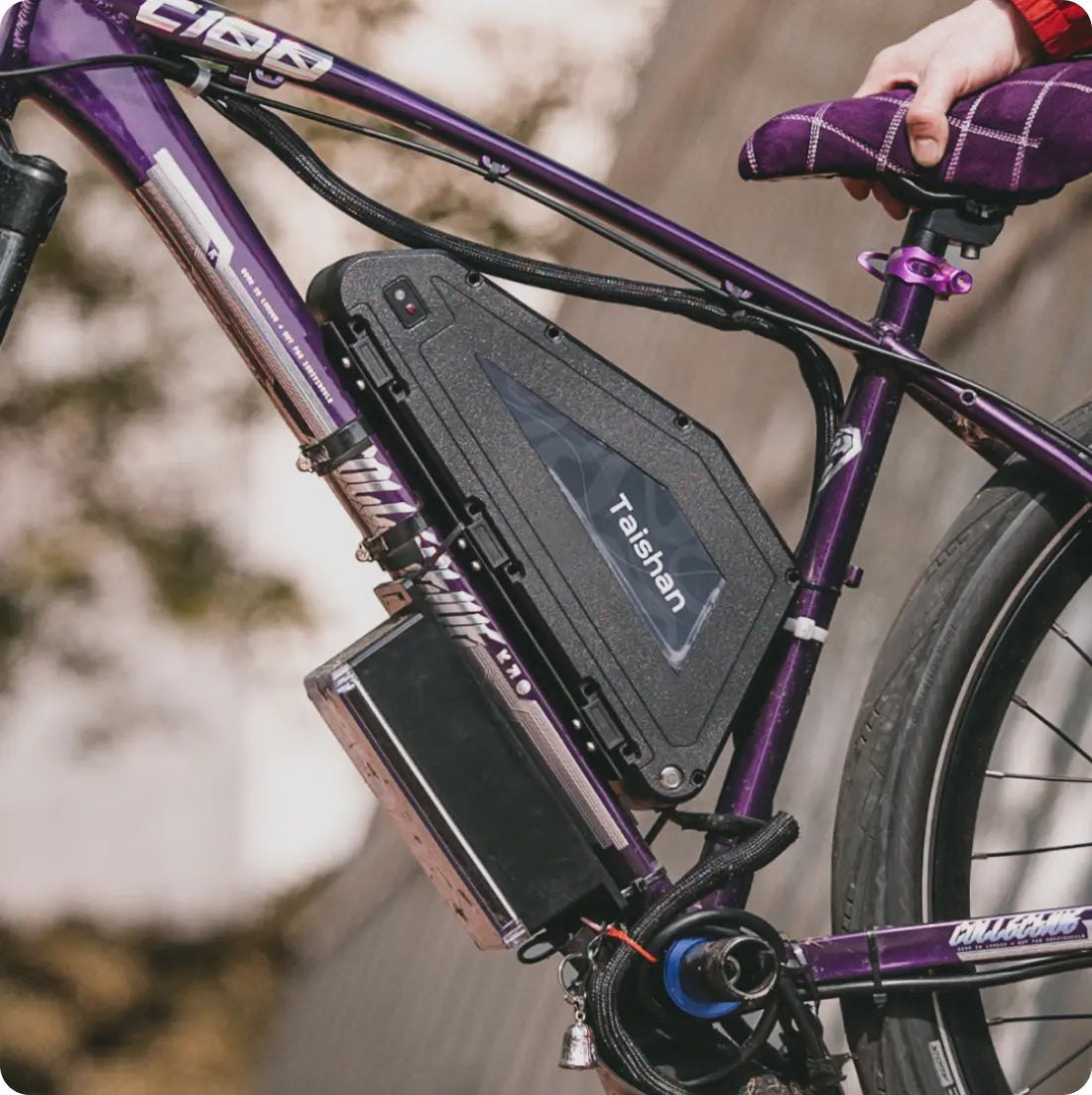
This decides more purchases than range does. Measure the usable space inside your frame triangle, then compare it against the manufacturer’s case dimensions plus the mounting plate — not the case alone. Our Taishan packs share one footprint, 386.2 × 97 × 157.4mm, across the range. The HS-II is a larger triangle-shaped case with four published dimensions — 360.6, 281.3, 195.4 and 131.6mm — so check all four against your frame pocket, or send us a photo of the frame.
💡
Frame fit: six checks before ordering
Real dimensions — case size plus mounting rail, from the manufacturer rather than a photo
Full-size template — a cardboard cut-out offered up to the actual frame
Removal clearance — the pack slides fully out, not merely unlocks
Down tube, top tube, seat tube — clearance to all three, and to bottle bosses
Dynamic clearance — cranks, front tyre and any suspension at full lock and full compression
Rated mounting — bosses, clamp or rack specified for the load
Suspension frames need particular care, because the shock and linkage occupy the space a large pack wants and clearance changes through the travel. On a smaller frame the 25Ah pack is frequently the better choice simply because it fits properly, and a securely mounted smaller battery beats a marginal larger one every time. Our compatibility checklist walks through the template method, and the alloy mount is the rated option where bottle bosses alone are not enough.
Mounting hardware. Check the case, the plate and removal clearance together, not the case alone.
Cells, BMS and Verifying Real Capacity
Two packs with the same 52V and 30Ah label can perform very differently, so look past the headline. Cell brand and model determine capacity, discharge capability and cycle life. Our Taishan 52V packs use LG 21700 cells and the HS-II uses LG or Samsung cells — a specification you can check rather than a claim about quality. Do not assume two capacities in the same range use identical cells or an identical BMS; verify per variant. Our BMS amps guide covers what to ask for.
The BMS matters as much as the cells. It manages charging, balances cells, and protects against over-discharge, over-current and short circuits — and its continuous current rating is what determines whether a pack can feed a demanding controller. Amp-hours say nothing about current capability: a 30Ah pack with a modest BMS will cut out under acceleration where a 25Ah pack with a stronger BMS will not. Both our series use a 60A BMS.
To verify advertised capacity is real, ask for the cell model, the BMS continuous and peak ratings, the pack’s measured weight, and any discharge-test evidence. Government guidance is explicit that poor-quality, damaged or modified battery systems can fail rapidly (GOV.UK). A pack far lighter than comparable packs of the same claimed capacity is a warning sign, because cells have mass.
Pairing Either Pack With a High-Power Kit
Capacity and current are different specifications, and this is where they get confused. A 30Ah pack does not make a 2600W kit faster — acceleration and torque come from controller current and motor design, while capacity determines how long you can sustain that output. What a larger pack does give is longer high-power sessions and, usually, less voltage sag late in a ride. Our 52V 2600W kit draws 50A and the 2000W kit 35A, so check the BMS continuous rating against those figures rather than the capacity.
Choose 25Ah for shorter high-power rides where you will recharge between sessions, and 30Ah for longer ones. At the same riding pace both deliver similar efficiency, so the larger pack simply runs longer rather than performing better. Note the legal position too: high-power kits of this class are outside EAPC classification in Great Britain and belong on private land with the landowner’s permission, whichever battery you fit.
Battery Options to Compare
Four routes, listed alphabetically and judged on the same criteria: format, published specification depth, support and the main limitation. Confirm current specifications on each supplier’s page before buying.
1. EM3ev 52V Packs
A long-established battery maker, and one of the originators of the triangle pack. Its standard 52V range comes in rectangle and triangle cases built with named Samsung cells, which is the kind of specification this article recommends asking for. Custom builds are mainly for business customers, so individual buyers usually choose from the standard range. The trade-offs are build lead time, international shipping and support across borders.
2. Grin (ebikes.ca) 52V Triangle Batteries
Canadian specialist Grin Technologies sells large 52V triangle packs, including UL 2271-certified models, for frames with a big open triangle but no room for a down-tube case. The triangle format fits more cells into an open frame than a conventional case. The trade-offs are that triangle packs usually fix with straps through slots rather than a locking plate, they ship from Canada, and returns are harder than with a domestic seller.
3. KirbEbike Taishan and HS-II
Our two 52V options at these capacities: the Taishan 25Ah at 1,300Wh and about 6.2kg, and the HS-II 30Ah at 1,560Wh and about 7.55kg, both with a 60A BMS and a 5A charger. Honest limits: the HS-II case is larger and needs all four of its dimensions checked against your frame, and the packs are matched to our own systems rather than universal.
HS-II case. Larger than the Taishan; check all four published dimensions against your frame.
4. Unbranded Marketplace 52V Packs
Generic 52V packs sold on marketplaces in both capacities. They are usually the cheapest route and often arrive quickly. The cautions are the usual ones: confirm the exact cell model rather than accepting a brand claim, check the BMS continuous rating against your controller’s draw, verify the case dimensions against your frame, and buy from a seller you can return to. Government guidance on buying e-bike batteries safely is worth reading first.
Option
Format
Specification depth
Best for
Main limitation
EM3ev
Rectangle or triangle
High, named Samsung cells
Riders who want named cells
Lead time and shipping
Grin (ebikes.ca)
Triangle
High, certified models
Large open triangles
Strap mounting; ships from Canada
KirbEbike
Cased, plate-mounted
Cells, BMS and dimensions published
Matched to our kits
HS-II needs a larger frame pocket
Unbranded marketplace
Cased
Often thin
Lowest price
Verify cells, BMS and seller
Listed alphabetically. Ask every supplier for cell model, BMS continuous rating and measured dimensions.
Which Should You Choose?
Rider
Better choice
Reason
Daily commuter, under 20 miles
25Ah
Better weight balance and faster charge
Longer routes, few charge points
30Ah
The extra 260Wh is genuinely used
Smaller or suspension frame
25Ah
Fit is the binding constraint
Heavier rider or cargo
30Ah
Higher consumption per mile
Carries the bike regularly
25Ah
1.35kg matters on stairs
High-power private-land riding
30Ah
Longer sessions at high draw
Do not choose 30Ah until frame fit is confirmed.
Charging and Care
Use only the charger supplied or authorised for the battery, charge in a dry ventilated place away from escape routes, and unplug once complete. Do not leave a pack charging unattended overnight — the fire service advises charging where you can monitor it, and warns against universal or multi-plug chargers unless the battery maker has approved them (London Fire Brigade). Government guidance identifies modification or repair with non-compatible parts as a factor that raises fire risk (GOV.UK).
Before and after charging, check the case for damage, the connector for heat marks and the pack for unusual warmth. Stop using and replace any battery showing swelling, deformation, unusual smell, hissing or abnormal heat, and do not attempt to recharge it. For storage between rides, keep the pack at a partial charge in a cool dry place rather than fully charged or fully empty, and top it up periodically if it will sit unused for months.
Conclusion: Buy the Capacity Your Frame Can Take
The 30Ah pack holds 260Wh more than the 25Ah, worth roughly 10 to 26 extra miles depending on how you ride. It also weighs about 1.35kg more, takes around an hour longer to charge, and needs a larger space in the frame. Energy per kilogram is effectively identical between them, so you are buying more energy rather than better energy.
So the decision is genuinely simple. If your routes leave you comfortable on 1,300Wh, the 25Ah pack is the better-balanced buy. If you regularly finish rides near empty, ride long routes without charging opportunities, or run a high-power kit for extended sessions, the extra capacity earns its weight. Either way, confirm the case and rail fit your frame with removal clearance first, check the BMS continuous rating against your controller, and use only an authorised charger (GOV.UK).
Measure first, then choose capacity
A securely mounted 25Ah pack beats a marginal 30Ah every time.
It holds 1,560Wh, so at roughly 20Wh per mile in mixed commuting that is around 78 miles, and around 35 miles at high power. Terrain, weight, wind and assist level change the result substantially.
How far can a 52V 25Ah battery go?
It holds 1,300Wh, giving around 65 miles at roughly 20Wh per mile in mixed riding and around 29 miles ridden hard. Our kit pages quote 40–70km for it as a riding figure.
Is a 30Ah battery better than a 25Ah battery?
Only if you use the extra 260Wh. It weighs about 1.35kg more, charges about an hour longer and needs more frame space, and energy per kilogram is effectively the same for both.
How long does a 52V 30Ah battery take to charge with a 5A charger?
From empty, roughly six hours of bulk charging plus additional time as current tapers near full; a 25Ah pack takes roughly five hours plus taper. Our product pages quote about 4–5 hours for a typical recharge.
Does a 52V 30Ah battery make an ebike faster than a 25Ah?
No. Speed and acceleration come from controller current, motor design and voltage. Capacity determines how long you can sustain that output, not how much output there is.
Is 30Ah good for an ebike?
It is a lot of capacity, well suited to long routes, high-power kits and heavier loads. On a smaller frame or a bike you carry regularly, 25Ah is often the more practical choice.
How long will a 52V battery last before replacement?
Cycle life depends on charging habits, temperature, depth of discharge and how hard the pack is worked. Capacity fades gradually rather than failing suddenly, so plan on replacement after several years.
Can I leave my ebike battery charging overnight?
Avoid it. Charge where you can monitor it, in a dry ventilated place away from escape routes, and unplug once complete rather than leaving it connected unattended.
Which is better for an ebike, 48V or 52V?
A 52V system offers slightly more voltage headroom, but only if the controller, display and motor are documented for it. Compare watt-hours rather than voltage when judging range.
How do I know the advertised capacity is real?
Ask for the cell brand and model, the BMS continuous and peak current, the measured pack weight and any discharge-test evidence. A pack much lighter than comparable ones is a warning sign.