How Much Range Does Regenerative Braking Add to a Hub-Motor Ebike?
On a direct-drive hub with a regen-capable controller, regenerative braking typically returns a few per cent of your energy: about 9–13 Wh per 100 m descended on a 5% hill in our worked example, and under 1 Wh per stop. Geared hubs with a freewheel clutch recover nothing.
AK
Andy Kirby
Reviewed by the KirbEbike conversion-support team
Delen
Op deze pagina
MOTORS & CONTROLLERSRECOVERY IN WATT-HOURS, NOT PROMISESUK + US
A direct-drive rear hub has no freewheel clutch inside it, so the wheel can always turn the motor. That is what makes regenerative braking possible.
The Short Answer
On a direct-drive hub motor with a controller that supports it, regenerative braking usually gives back a few per cent of the energy you use, not a third of your range. Grin Technologies puts it at roughly 3 to 8% on a typical ride with its direct-drive setups, close to zero on flat roads where you rarely brake, and higher on hilly or stop-start routes (Grin).
In watt-hours, our illustrative calculation below gives about 9 to 13 Wh back for every 100 m (328 ft) you descend on a 5% gradient, and well under 1 Wh for each stop from 25 km/h (15.5 mph). A geared hub with a freewheel clutch recovers nothing, because the wheel cannot drive the motor.
What Regenerative Braking Actually Does on a Hub-Motor Ebike
When you ask the controller to brake, it runs the hub motor as a generator. The wheel turns the motor, the motor makes current, and the controller pushes that current back into the battery. The resistance you feel is the braking force. Energy that would have gone into your brake pads as heat goes partly back into the pack instead.
Two things must be true first: the wheel has to be able to drive the motor, and the controller has to support regen and be set up for it.
When Is Regen Available? Motor Type Decides First
Motor layout
Can it regenerate?
Why
Direct-drive hub
Yes, with a regen-capable controller
Motor and wheel are one rotating part; nothing lets them turn separately
Geared hub with freewheel clutch
No
The clutch lets the wheel overrun the motor, so the wheel cannot drive it
Geared hub with a locked clutch
Yes, but it no longer coasts freely
Specialist motors and modified hubs remove the clutch on purpose
Mid-drive
Essentially no
The motor drives through the chain and the rear freehub, which freewheels
A geared hub is a small, fast motor driving the wheel through a planetary reduction. Between the gears and the hub shell sits a one-way clutch. It lets the shell overrun the gears, which is why a geared hub coasts with almost no drag, and why it cannot regenerate: braking means the wheel driving the motor, exactly the direction the clutch lets slip. Grin, who build a geared hub with the clutch locked for this reason, say the usual clutch prevents regenerative braking and reverse running (Grin). The trade is that a locked-clutch geared hub has more drag when you pedal unpowered: Grin quotes 1.0 to 1.5 Nm for theirs against 0.6 to 1.0 Nm for a typical direct-drive hub.
The Controller Has to Support It, and Has to Be Told When
Grin point out that many budget controllers do not support regen, or do it poorly. The controller also needs a brake signal. The commonest is an e-brake lever switch, which gives a fixed amount of regen; other systems use a second throttle, part of the throttle signal, or a speed limit that brings regen in on descents.
On KirbEbike’s smart controller, the Ride Power app lists “Regen.Braking” among its settings, and the product page FAQ says that on braking the motor feeds charge back to the pack, most noticeably on long descents. The 52V, 60V and 72V MTX kit pages each list regenerative braking among the app settings, and each kit ships with e-brake levers. As our app settings guide says, confirm it for your exact motor and controller pairing.
The Regen.Braking setting in the Ride Power app, from the smart controller’s product page. The screen shows Level 1 selected.
How Much Energy Is There to Recover? The Physics in Watt-Hours
Regen cannot return more than your brakes would otherwise have turned into heat. That energy has two sources: height you lose on descents and speed you scrub off before stops.
Descents: Potential Energy, Minus What the Air Takes
Potential energy is mass × gravity × height (m × g × h). For 120 kg all-up (rider, bike, kit and battery) dropping 100 m, that is 120 × 9.81 × 100 = 117,720 joules, or 32.7 Wh (joules ÷ 3,600).
Not all of it reaches the brakes. Air drag and rolling resistance absorb part of it; the brakes only take the surplus above the speed you want. The worked examples below hold 25 km/h (15.5 mph) and use these stated assumptions: frontal drag area (CdA) 0.6 m² for an upright rider, air density 1.225 kg/m³, rolling resistance coefficient 0.008. At 25 km/h that gives about 17.7 N of air drag and 9.4 N of rolling resistance, 27.1 N in total.
Illustrative descent, 120 kg, 25 km/h
2% gradient
5% gradient
10% gradient
Distance to lose 100 m
5.0 km (3.1 miles)
2.0 km (1.2 miles)
1.0 km (0.6 miles)
Gravity force along the slope
23.5 N
58.9 N
117.7 N
Braking force needed (gravity minus 27.1 N drag)
None
31.7 N
90.6 N
Energy into the brakes
0 Wh
17.6 Wh
25.2 Wh
Braking power while descending
0 W
220 W
629 W
Back in the battery at 74% / 50% chain efficiency
0 Wh
13.0 / 8.8 Wh
18.5 / 12.6 Wh
Illustrative calculation, not a KirbEbike test. Braking energy = (m·g·grade − drag − rolling resistance) × distance. Small-angle approximation used; 32.7 Wh of potential energy in every column.
Look at the 2% column. Gravity is weaker than drag at 25 km/h, so you never touch the brakes and regen has nothing to collect. Shallow hills feed your speed, not your battery. On a 10% hill, more of the same 32.7 Wh reaches the brakes because you lose less to the air over a shorter distance.
Stops: Kinetic Energy, Which Is Smaller Than You Expect
Kinetic energy is ½ × m × v². At 25 km/h (6.94 m/s), 120 kg carries 0.5 × 120 × 6.94² = 2,890 J, or 0.80 Wh. That is the most a full stop can give you, before losses. At 40 km/h (25 mph) it is 2.06 Wh, because speed is squared. At 150 kg and 25 km/h, 1.00 Wh.
The Losses on the Way Back Into the Pack
Braking energy passes through the motor as a generator, the controller and the cells, losing some at each step. For the examples I have assumed 80% for the motor, 95% for the controller and 97% for the battery, which multiply to about 74%. Battery University gives about 97% energy efficiency for lithium-ion charged at 0.5C, which is where the battery figure comes from (BU-808c). The motor and controller figures are planning assumptions, not measurements, so I have also shown a pessimistic 50% case.
Regen also weakens as the wheel slows. A 2021 bench study of an ebike hub motor (Candan and Mamur) spun the motor up, applied regen and measured the energy returned to the battery. It recovered 6.37% at 320 rpm, 5.15% at 237 rpm, 0.57% at 160 rpm, and nothing at 84 or 45 rpm. Those percentages describe that rig and its lead-acid battery, not a road ride, but the trend suggests the slow end of every stop returns little.
Terrain and Stop Frequency: What That Means for Real Routes
Put the two sources together and Grin’s pattern falls out of the arithmetic. These use the figures above, plus an assumed consumption of 20 to 25 Wh per mile (about 12 to 16 Wh/km).
Illustrative ride, 120 kg
Braking energy available
Recovered (50–74%)
Share of ride energy
Flat, steady, 20 miles (32 km), few stops
Close to 0 Wh
Close to 0 Wh
Close to 0%
10-mile (16 km) city commute, 20 stops from 25 km/h
Up to 16 Wh
8–12 Wh
4–6% of 200 Wh
20-mile (32 km) hilly loop, 300 m descended at 5%
53 Wh
26–39 Wh
5–8% of 500 Wh
Long descent, 500 m down a 10% road
126 Wh
63–93 Wh
Depends on the climb that preceded it
Illustrative calculation. Stop energy assumes every stop is fully braked from 25 km/h, which overstates it. Consumption figures are assumptions for the example; measure your own.
The commute and the hilly loop both land inside Grin’s 3 to 8% band. Grin also note that heavier vehicles that brake a lot do better: one of their staff gets about 20% back on a recumbent trike.
The trap is the round trip. Climbing 100 m at 120 kg takes at least 32.7 Wh from your battery and legs combined, plus motor losses and drag on the way up. Coming back down returns 9 to 13 Wh of it in our 5% example. Regen softens the cost of a hill. It never refunds it.
Turning Watt-Hours Into Miles, and Why Our Calculator Ignores Regen
Divide recovered Wh by your consumption. At 25 Wh per mile, 13 Wh is about half a mile (0.8 km) of extra riding. The 26 to 39 Wh from the hilly loop is roughly 1 to 1.6 miles (1.7 to 2.5 km). Useful, but no reason to buy a smaller battery.
That is why the KirbEbike range calculator does not add any regen credit. Its published methodology lists modifiers for terrain, weight, speed, tyres, wind, temperature, stop-start riding and drive type, and it applies a small consumption penalty to direct-drive hubs (×1.05, or ×1.12 on hilly and off-road routes). Plan your battery on that band. Treat whatever regen returns as margin at the end of the ride.
Grin call range the smallest reason to use regen. The bigger gains are mechanical:
Pads last longer. When the motor does most of the slowing, the friction brakes barely work. Grin’s trike rider reports no pad change in over 8,000 km.
Consistent braking. Electronic braking does not fade on a long descent or change feel as pads wear.
Speed control downhill. Light regen holds a steady pace on a long hill without dragging the mechanical brakes the whole way.
Regen is not your emergency brake. It fades to nothing at walking pace, and on a 2000W to 4000W build the mechanical brakes must still stop the bike from full speed on their own. Our brake and wheel upgrade guide covers what those builds need.
Setting Up Regen on a Direct-Drive Kit
Start Low and Test Somewhere Quiet
Connect the Ride Power app, find Regen.Braking under Settings, and start at the lowest level. Try it somewhere quiet first: a strong setting on a rear hub can step the back tyre out on loose or wet ground, like grabbing the rear brake. Save a known-good profile; our 2000W tuning guide explains why.
Check the Torque Arm
Regen reverses the torque on the axle. Grin designed a no-play splined torque arm for their regen motor for exactly this reason. All three KirbEbike MTX kits include a torque arm. Fit it with no slack, and recheck the axle nuts after the first rides. See our torque arm guide.
Leave Room in the Battery
A full pack has nowhere to put recovered charge. Battery University is plain that lithium-ion cannot absorb overcharge, and charge current must stop at full (BU-409). A KirbEbike 52V Taishan pack is full at 58.8V. If you live at the top of a long hill, expect little or no regen on the first descent of the day, and ask support how your controller and BMS handle it.
Product touchpoint
Direct-drive kits with regen in the app
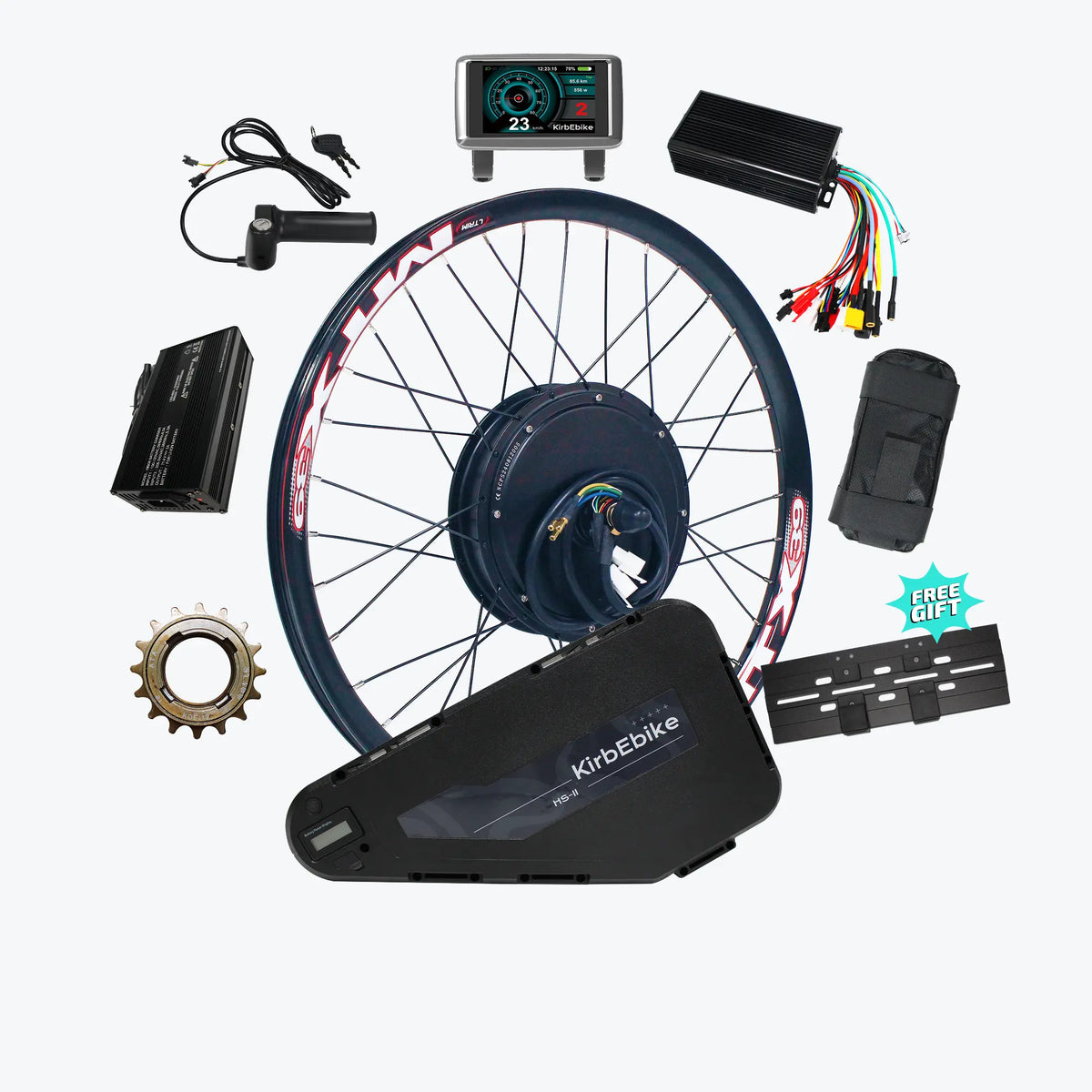
The 52V 2000W, 60V 2500W–3000W and 72V 4000W MTX kits use direct-drive rear hubs and list regenerative braking among their Ride Power app settings, with e-brake levers and a torque arm in the box. Already have a direct-drive hub? The smart controller comes in ratings from 25A to 100A.
Conclusion: Count Regen in Watt-Hours, Plan Without It
Regen needs a hub the wheel can drive and a controller that supports it. On a direct-drive kit it returns a few per cent on most rides: nothing on the flat, about 9 to 13 Wh per 100 m descended on a 5% hill in our worked example, and under 1 Wh per stop.
Plan your battery on the range calculator with no regen at all. Then use regen for what it does best: saving pads and holding speed downhill.
Size the battery first, then add regen
Motor type → controller support → route → watt-hours.
How much range does regenerative braking add to an ebike?
Typically a few per cent. Grin estimate 3 to 8% of energy on a typical ride with their direct-drive systems, near zero on flat steady roads, and more on hilly or stop-start routes and heavy vehicles.
Do geared hub motors have regenerative braking?
Not normally. A geared hub’s freewheel clutch lets the wheel overrun the motor, so the wheel cannot drive it as a generator. A few specialist geared hubs have the clutch locked to allow regen, at the cost of drag when coasting.
How many watt-hours does one stop recover?
At 120 kg and 25 km/h (15.5 mph) the bike carries 0.80 Wh of kinetic energy. After losses, expect roughly 0.4 to 0.6 Wh at best, and less in practice because regen fades at low speed.
Does regen damage the battery?
The practical limit is a full pack. Battery University notes that lithium-ion cannot absorb overcharge, so charging must stop at full voltage. Do not count on regen at the start of a ride on a freshly charged pack, and ask support how your controller and BMS handle it.
Does the KirbEbike range calculator include regen?
No. It has no regen credit, and it applies a small consumption penalty to direct-drive hubs. Treat any recovery as a bonus.
A note on safety and the rules. Regen supplements your mechanical brakes; it does not replace them, and it fades to nothing at low speed. Set it up and test it away from traffic. In Great Britain a converted bike counts as an EAPC only with a motor of no more than 250W continuous rated power that stops assisting at 15.5mph (GOV.UK). The 2000W, 3000W and 4000W kits in this guide are for private land or off-road use with the landowner’s permission.
About this guide
Author: Andy Kirby. Last reviewed: November 2026. KirbEbike has not run its own regenerative braking test. Every recovery figure here is either published by the source named beside it or an illustrative calculation shown in the text, using the stated assumptions (120 kg all-up, CdA 0.6 m², rolling resistance 0.008, 74% or 50% recovery chain). Product details come from KirbEbike’s live smart controller and MTX kit pages, November 2026.
Stay in the know
Conversion guides, fitting advice and the deals worth knowing about. No spam.
Door je aan te melden ga je akkoord met ons Privacybeleid.