Taishan vs HS-II Ebike Battery: Capacity, Dimensions, Mounting and Best Use
Neither pack is the better battery. Same 60A BMS, same 5A charging, same 97 mm thickness. They differ in voltage options, case shape, weight and how much energy fits at 52V. Your controller and your frame decide which one is right.
AK
Andy Kirby
Reviewed by the KirbEbike conversion-support team
Delen
Unlock £10 off today
Op deze pagina
BATTERY COMPARISONCONTROLLER FIRST, CAPACITY LASTUK + US
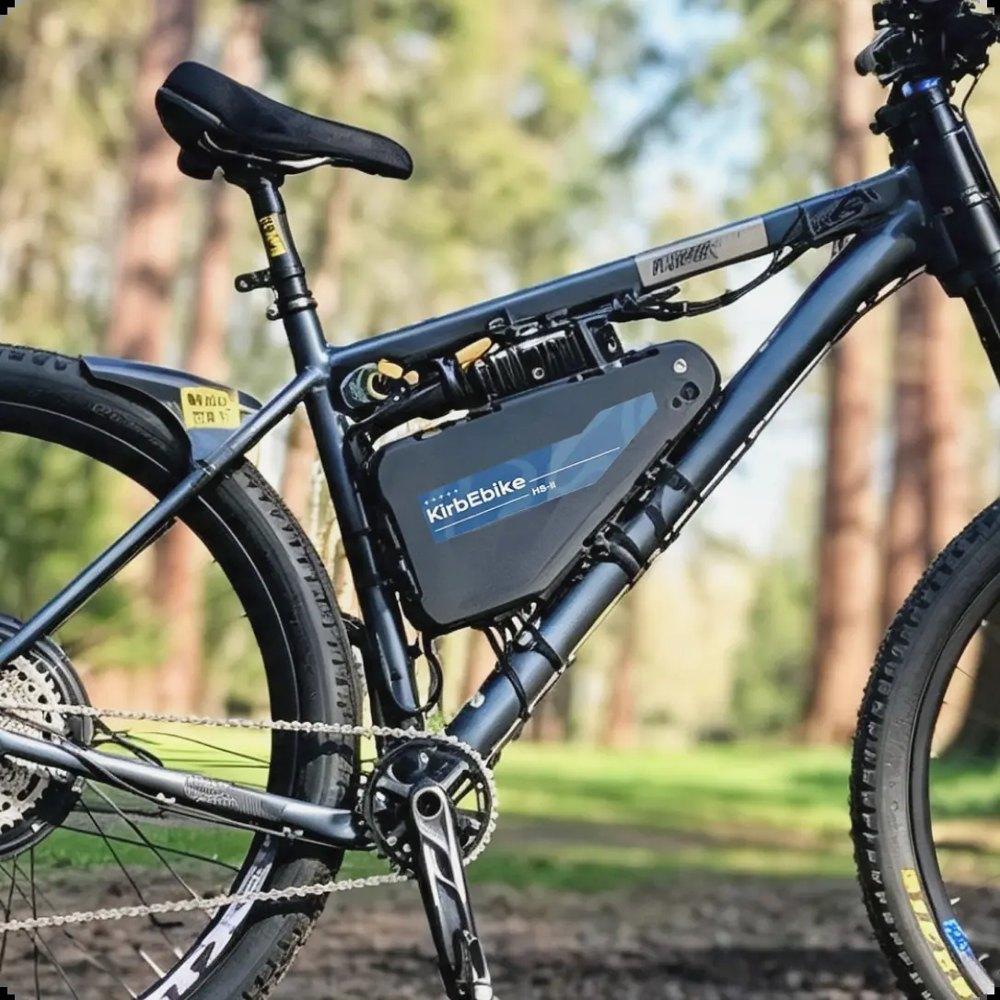
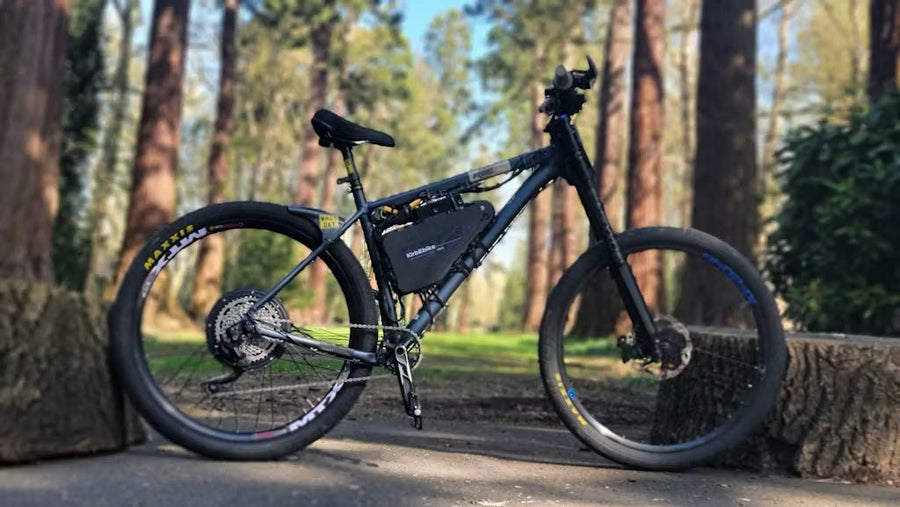
An HS-II mounted in a hardtail’s main triangle. Its tapered case follows the top tube; whether that suits your frame is the real question.
The Quick Answer
Choose Taishan if you need 48V, if height under your top tube is tight, or if 1,300 Wh at 52V is enough. Its 386.2 × 97 × 157.4 mm case is the same for all four voltages.
Choose HS-II if you run 52V, your triangle has the height and the removal clearance, and you will use the extra energy: 1,560 Wh against 1,300 Wh, for 7.55 kg against 6.2 kg.
At 60V and 72V both families offer 20Ah, a 60A BMS and the same connectors, so case shape and weight decide.
Taishan vs HS-II Ebike Battery: What Is the Main Difference?
Both are 97 mm thick lithium-ion packs from the same KirbEbike battery range, with a 60A BMS and a matched 5A charger. They differ in four ways: voltage options (only Taishan comes in 48V), capacity at 52V (HS-II stores 20% more), case shape (Taishan is a lower wedge, HS-II a taller tapered triangle) and weight. Pick in this order: controller voltage, controller current, frame fit, then energy.
Taishan vs HS-II at a Glance
Specification
Taishan
HS-II
Nominal voltages
48V / 52V / 60V / 72V
52V / 60V / 72V
Capacities by voltage
30Ah / 25Ah / 20Ah / 20Ah
30Ah (52V) / 20Ah / 20Ah
Full-charge voltages
54.6V / 58.8V / 71.4V / 84V
58.8V / 71.4V / 84V
Maximum listed energy
1,440 Wh (48V 30Ah, 72V 20Ah)
1,560 Wh (52V 30Ah)
BMS
60A
60A
Cells
LG 21700 (48/52/60V); Samsung 50S 21700 (72V)
LG 21700; Samsung 50S 21700 (72V)
Discharge connector
XT60 (48/52V); XT90 (60/72V)
XT60 (52V); XT90 (60/72V)
Charger
5A, voltage-matched
5A; 58.8V / 71.4V / 84V outputs, 100–240V input
Case
386.2 × 97 × 157.4 mm, all voltages
Edges 360.6 / 281.3 / 195.3 / 131.6 mm, 97 mm thick
Published weight
6.2–6.8 kg
6.4–7.55 kg
Mount
Plate + clamps, slide-on, key lock; top or down tube
Plate + clamps, slide-on, key lock; top or down tube
Water resistance
Listed IP65
Listed IP65
Extras
—
USB-C (1A) output, 0–100% gauge, 3-pin charge port
Taishan vs HS-II Capacity: Which Stores More Energy?
Stored energy is nominal voltage × amp-hours. On the current variants, HS-II only stores more at 52V; at 60V and 72V the two match.
Nominal energy by variant. The only capacity difference between the families is at 52V.
48V Options: Taishan Has the Clearer Use Case
Only Taishan offers 48V (30Ah, 1,440 Wh, 54.6V at full charge). If your controller is 48V-only, that settles it. Do not move to a 52V pack just to get a different case: a 52V battery reaches 58.8V off the charger, and a controller rated for 48V may not accept it. Our 48V vs 52V compatibility guide explains the check.
52V 25Ah Taishan vs 52V 30Ah HS-II
Taishan 52V 25Ah
HS-II 52V 30Ah
Nominal energy
1,300 Wh
1,560 Wh (+260 Wh, +20%)
Published weight
6.2 kg
7.55 kg (+1.35 kg, +22%)
Energy per kg
210 Wh/kg
207 Wh/kg
Case
386.2 × 97 × 157.4 mm
360.6 / 281.3 / 195.3 / 131.6 mm, 97 mm thick
Charge floor at 5A
5 hours
6 hours
Published range claim
30–70 km (family figure)
55–85 km
Charge floor = Ah ÷ 5A from empty; real charging takes longer (see the charging section). Range claims are KirbEbike’s and depend on load, speed and terrain.
The extra 260 Wh is about a fifth more energy for about a fifth more weight, so the packs are almost identical per kilogram. The question is whether you use the extra energy. At 25 Wh per mile, 260 Wh is roughly 10 more miles; at 40 Wh per mile on a hard-ridden high-power build, about 6. Run your own figures in our range calculator, and see the full 25Ah vs 30Ah comparison.
60V 20Ah Taishan vs 60V 20Ah HS-II
On paper these are the same: 20Ah, 71.4V at full charge, 60A BMS, LG 21700 cells, XT90. A full charge of 71.4V means 17 cells in series (17 × 4.2V), which is why KirbEbike lists the 60V packs at 1,260 Wh rather than the 1,200 Wh you get from 60 × 20. With electrics equal, case shape decides it; KirbEbike does not publish separate 60V weights, so check with support if weight matters.
72V 20Ah Taishan vs 72V 20Ah HS-II
Both 72V packs reach 84V at full charge (20 cells in series), store 1,440 Wh and use Samsung 50S 21700 cells. The 50S is a 5,000 mAh-class cell, so a 20Ah pack is four cells in parallel per group (20S4P). Published weights differ: about 6.8 kg for Taishan and about 7.2 kg for HS-II. Matching voltage and Ah does not guarantee identical behaviour, because case layout and heat paths differ, but nothing published separates them electrically. See our 72V battery guide.
Taishan vs HS-II Dimensions: Which One Fits Your Frame?
Taishan Battery Dimensions
Taishan uses one case for every voltage: 386.2 mm long, 97 mm thick and 157.4 mm at its tallest point, tapering at one end. Measure once and every Taishan variant fits the same space.
Taishan with its published dimensions; the box includes the battery, charger and mount holder.
HS-II Battery Dimensions
HS-II is a tapered triangle, so one height figure is meaningless. KirbEbike’s dimensioned drawing gives each edge: 360.6 mm along the long straight edge, 281.3 mm along the sloped edge, 195.3 mm across the base and 131.6 mm up the short end, at 97 mm thick (frame-fit guide). Some listings round the base to 195.4 mm; make your template from the drawing.
Taishan vs HS-II Dimension Comparison
Schematic, not to scale. Both cases are 97 mm thick, so height in the triangle usually decides between them.
Taishan is 25.6 mm longer than HS-II’s long edge, but its 157.4 mm height is lower than HS-II’s 195.3 mm and 281.3 mm edges. In practice, Taishan suits frames with a long, low triangle; HS-II suits frames with a taller, more open triangle.
Why Case Dimensions Alone Do Not Confirm Fit
Fit is three checks: the case envelope clears the tubes, the mounting rail lines up with your bottle bosses without pushing the pack into a tube, and the removal path stays clear for the whole slide-off distance (frame-fit guide). Make a full-size cardboard template of the case plus rail and test all three.
Taishan vs HS-II Mounting: Rail, Position and Removal Clearance
Taishan Mounting and Removal Direction
The Taishan is installed in four steps: fixing the base plate to the frame; fastening it with the clamps; sliding the battery onto the base, so that it locks; tightening and locking with the key. Capable of both top and down tube mounting. Since the battery slides on, it will slide off the same way, along the rail, so measure the clearance along the rail, rather than around the seated pack.
HS-II Mounting and Removal Direction
HS-II uses the same four-step bracket system: base plate, clamps, slide-on, key lock. It is also designed to fit in the top tube or down tube. The taller tapered case requires clearance throughout the entire length of the slide path and might still be obstructed by the top tube, which is clear of the seated pack, when it is part way out.
HS-II with its 5A charger and slotted mounting plate. Neither family’s rail-hole spacing or minimum slide-off distance is published; ask support for your variant.
Which Battery Fits Smaller or Tighter Frame Triangles?
Where height under the top tube is the limit, Taishan’s 157.4 mm case has the advantage over HS-II’s taller edges. Where length along the down tube is the limit, HS-II’s 360.6 mm long edge is shorter than Taishan’s 386.2 mm. Neither is a small-frame battery by default; your frame’s tightest dimension decides.
Full-Suspension Frames vs Hardtails
When using a full suspension frame, verify clearance to the rear shock and linkage during full travel (not at rest). Examine bottle-boss position, cable and hose routing, and top and down tubes along the slide path as well. A pack that clears a stationary shock can still meet moving suspension hardware.
Taishan vs HS-II Weight: Does the Difference Matter?
Weight by Variant
Battery
Voltage
Ah
Nominal Wh
Published weight
Wh/kg
Taishan
48V
30Ah
1,440
6.72 kg
214
Taishan
52V
25Ah
1,300
6.2 kg
210
Taishan
72V
20Ah
1,440
≈6.8 kg
≈212
HS-II
52V
30Ah
1,560
7.55 kg
207
HS-II
72V
20Ah
1,440
≈7.2 kg
≈200
Battery only, rail excluded. KirbEbike does not publish separate weights for the 60V packs; the family ranges are 6.2–6.8 kg (Taishan) and 6.4–7.55 kg (HS-II).
Energy density is close across all variants, between about 200 and 214 Wh/kg.
More Capacity vs More Weight
At 52V the trade is clean: HS-II adds 260 Wh and 1.35 kg. That buys fewer charging stops on long days. If you rarely use more than 1,000 Wh in a ride, the extra mass and larger case give you little back.
Why Battery Position Matters as Much as Battery Weight
Both packs mount in the main triangle, which keeps their mass low and central rather than high or over the rear wheel. Where you place the plate within the triangle, closer to the bottom bracket or up under the top tube, changes how the weight feels more than the 0.4–1.35 kg difference between the families.
Taishan vs HS-II BMS: Can Both Support the Same Controller?
60A BMS vs Controller Current
Both families list a 60A BMS. The rule is simple: the controller’s maximum battery current must not exceed the battery’s continuous rating. Choose from the controller, not the motor wattage. KirbEbike’s 52V 2000W kit uses a 35A controller, which leaves wide headroom; a 60A controller on a high-power 72V build sits right at the limit. Our BMS amps guide covers the full method.
60A BMS Does Not Mean the Battery Always Outputs 60A
The controller draws the current; the BMS only sets the point at which it cuts the pack off. A 35A controller on a 60A pack draws at most 35A. Keep four figures apart: the BMS continuous rating for sustained load, any short-peak rating, the overcurrent trip point at which the BMS disconnects, and what the cells themselves can deliver. KirbEbike publishes the 60A rating; for anything beyond it, ask support.
Cell Model Matters Alongside the BMS
On the 72V packs the cell model is named, but cell-level current ratings for the 50S differ between sources, so do not add up cell figures to get a pack rating. On the LG 21700 variants KirbEbike names the cell family, not the exact model. Either way, the 60A BMS rating is the number to design to.
Taishan vs HS-II Cells: LG vs Samsung and What Actually Matters
Compare Exact Cell Models, Not Brand Names
“Samsung” or “LG” alone tells you little; both make cells for very different jobs. What matters is the exact model, its capacity and current rating, how many sit in series and parallel, and the finished pack’s current limit. Series count follows directly from full-charge voltage at 4.2V per cell:
Nominal
Full charge
Cells in series
Families
48V
54.6V
13S
Taishan
52V
58.8V
14S
Taishan, HS-II
60V
71.4V
17S
Taishan, HS-II
72V
84.0V
20S
Taishan, HS-II
72V Variants and Samsung 50S
KirbEbike specifies Samsung 50S 21700 cells for its 72V packs in both families: a 21700-size, 5,000 mAh-class, 3.6V nominal cell. Twenty in series and four in parallel gives 72V × 20Ah = 1,440 Wh.
Taishan vs HS-II Charging: Is 5A Charging an Advantage?
Both Batteries Support a Matched 5A Charger
Both ship with a 5A charger matched to the pack’s full-charge voltage: 54.6V, 58.8V, 71.4V or 84V. The HS-II charger accepts 100–240V AC input. Replacement units are listed as chargers for KirbEbike batteries only.
HS-II features: 1A USB-C output, 0–100% gauge, 3-pin charge port and stainless power switch.
20Ah vs 25Ah vs 30Ah Charge Time
Capacity
Floor at 5A (Ah ÷ 5)
KirbEbike published time
20Ah (60V, 72V)
4.0 h
≈4 h
25Ah (Taishan 52V)
5.0 h
4–5 h (Taishan page)
30Ah (Taishan 48V)
6.0 h
≈6 h
30Ah (HS-II 52V)
6.0 h
Not separately published
From empty, a 5A charger cannot finish faster than Ah ÷ 5. Lithium-ion chargers switch to constant voltage near full and the current tapers, so expect a little longer than the floor.
The HS-II page quotes 4–5 hours for “most versions”. The arithmetic rules that out for the 52V 30Ah from empty: allow at least 6 hours. Partial top-ups are proportionally quicker.
Why Charger Connector Fit Is Not Enough
A charger is compatible only if its output voltage, charging profile, polarity and connector all match the pack and its BMS. A plug that fits proves none of those. Use the charger supplied for your pack; UK government guidance and the US CPSC both warn against mismatched chargers (GOV.UK; CPSC).
Taishan vs HS-II for Commuting, Hills, Delivery and High-Power Use
Taishan vs HS-II for Daily Commuting
Work out the energy you use. A 20-mile round trip at 25 Wh per mile is 500 Wh, well inside either pack. Taishan’s lower weight, single case size and easier fit in many frames often matter more here than HS-II’s extra 260 Wh. If you charge at work, smaller still may be fine: see the entry down-tube range.
Taishan vs HS-II for Long-Distance Riding
This is where the 52V HS-II earns its place: 1,560 Wh against 1,300 Wh, if your frame takes the taller case. If it does not, the Taishan 52V 25Ah is the longest-range pack that fits.
Taishan vs HS-II for Hills and Heavy Riders
Hill performance comes from controller current, BMS continuous rating, cell capability and voltage sag, not amp-hours. Both families share the 60A BMS, so neither climbs better on that count. More energy only means you can keep climbing for longer. See can a 52V battery power a 2000W ebike.
Taishan vs HS-II for Delivery and Cargo Bikes
For delivery work, plan around daily distance, charging between shifts and downtime. The HS-II 52V stores the most energy, and its 30Ah needs at least 6 hours at 5A from empty. A pack you can remove makes indoor charging easier, and service matters: within the one-year warranty KirbEbike repairs batteries free of charge in the UK, the US and the Netherlands.
Taishan vs HS-II for 72V High-Power Systems
At 72V the two are electrically matched: 1,440 Wh, Samsung 50S, 60A continuous. On a 60A controller there is no BMS headroom, so heat and sustained full-throttle use deserve care. A 3,000–4,000W build is for private land with the landowner’s permission in the UK; see our 72V battery guide.
Two lessons sit in that table. First, packs that look alike can carry very different ratings: Grin states a 60A continuous BMS, names the exact cell and lists UL 2271 certification. Read the continuous figure and the cell model, not the headline. Second, many unbranded triangle packs quote only a peak or “max” current. When a listing gives no continuous figure, or two figures that disagree, use the lower one and ask the seller before you buy.
Criterion
What to compare
Nominal voltage
Must match the controller
Full-charge voltage
Must stay inside the controller’s input limit
Capacity
Ah and Wh
Cell model
Exact manufacturer and model
BMS
Continuous rating first
Dimensions
Full case envelope plus rail
Removal clearance
Direction and travel
Weight
Battery plus rail where published
Charger
Output voltage and current
Connector
Discharge and charge
Water resistance
Rating and its limits
Warranty and service
Duration, exclusions and where repairs happen
Which Should You Buy: Taishan or HS-II?
Choose Taishan When...
You need a 48V pack, or a 52V, 60V or 72V pack in a low case
Height under your top tube is the tight dimension
HS-II’s taller outline hits your top tube, shock or slide path
1,300–1,440 Wh covers your riding
Your controller’s maximum battery current is 60A or less
Choose HS-II When...
Your triangle has the height and the removal clearance
You will use 1,560 Wh at 52V on long days or delivery shifts
The extra 1.35 kg is acceptable
You want the USB-C output and built-in 0–100% gauge
Your controller’s maximum battery current is 60A or less
Choose Neither When...
Neither case passes the case, rail and removal checks
Your controller needs a voltage neither family offers (36V, for example)
Your controller draws more than 60A continuously
Your rides use well under 1,000 Wh: a lighter down-tube pack may suit better
Your frame has no safe central space; a rack format is the answer
Send support a side-on photo of your frame with its triangle measurements, plus your controller’s voltage and maximum battery current. We will confirm whether the Taishan or the HS-II fits, or tell you if neither does.
Conclusion: Choose by Fit and System Demand, Not Battery Name
Neither Taishan nor HS-II is the better battery. Work through the choice in order: controller voltage, controller current, frame dimensions, rail and removal clearance, the energy you actually use, weight, then charging and service.
The 52V comparison shows the trade clearly. HS-II stores 1,560 Wh against Taishan’s 1,300 Wh, for 1.35 kg more and a taller case. Taishan’s lower 157.4 mm profile is the deciding advantage when height is tight. Measure your frame and check your controller before you order.
Measure first, then choose the pack
Controller voltage → current → frame → removal path → energy.
Neither universally. Both list a 60A continuous BMS and 5A charging. Taishan offers 48V and a lower 157.4 mm case; HS-II stores more energy at 52V (1,560 Wh vs 1,300 Wh). Choose by controller voltage and current, then frame fit and the energy you use.
Which ebike battery has more capacity, Taishan or HS-II?
At 52V, HS-II: 30Ah and 1,560 Wh against Taishan’s 25Ah and 1,300 Wh. At 60V and 72V both list 20Ah. Taishan’s 48V 30Ah (1,440 Wh) has no HS-II equivalent.
Which is better, a 48V or 52V ebike battery?
Neither is better in general; your controller decides. A 48V pack reaches 54.6V when full and a 52V pack 58.8V. Only fit a 52V pack if the controller is rated for 58.8V input.
Can I install a stronger battery on my ebike?
It depends what “stronger” means. More Wh at the same voltage gives more range. Higher voltage needs a controller rated for it. A higher BMS rating only matters if the controller draws that much. Physical fit and connectors must also match.
How can I tell whether an ebike battery will fit my frame?
Make a full-size template of the case and rail. Check it clears the tubes, that the rail lines up with your bottle bosses, and that the pack can slide fully off without hitting the top tube or shock.
How many years should an ebike battery last?
KirbEbike rates these packs at 800–1,000 charge cycles. Actual life depends on depth of discharge, temperature and storage; Battery University notes that heat and high charge voltage speed up ageing.
Should I charge my ebike battery after every ride?
Charge according to what you used and the supplied instructions. Avoid leaving the pack empty or stored full for long periods, and store it cool and dry.
How do I know if an ebike battery is good quality?
Look beyond Ah: the exact cell model, the BMS continuous rating, a voltage-matched charger, the case and water-resistance rating, safety standards such as UL 2271, and a warranty with local repair.
Does a higher-capacity ebike battery make the bike faster?
No. More Wh stores more energy for longer rides. Top speed depends on voltage, controller current and the motor.
Which ebike battery lasts the longest?
For range per charge, the one with the most Wh: here the HS-II 52V 30Ah at 1,560 Wh. For service life, cell quality, temperature and charging habits matter more than capacity.
A note on safety & legality. Charge only with the charger supplied for your pack, in a dry, ventilated place away from escape routes, and stop using any pack that is damaged, swollen, hot or smells unusual (GOV.UK; London Fire Brigade). IP65 covers rain and splashes, not submersion or pressure washing. Never force a pack into a frame or drill a frame to fit one. In Great Britain a converted bike is an EAPC only with a motor of no more than 250W continuous and assistance cutting off at 15.5mph; battery voltage does not change that (GOV.UK). High-power builds belong on private land with permission.
About this guide
Author: Andy Kirby. Last reviewed: November 2026. Specifications come from KirbEbike’s live Taishan and HS-II product pages, the battery collection guide and the frame-fit guide. Energy, energy density, series counts and charge floors are calculated from those figures; weights marked ≈ are KirbEbike’s approximate figures. Grin’s details are from its own listing.
Stay in the know
Conversion guides, fitting advice and the deals worth knowing about. No spam.
Door je aan te melden ga je akkoord met ons Privacybeleid.