500W/750W vs Z16 1000W Mid Drive Conversion Kit With Battery
1000W is not automatically the better buy. Start with your bottom bracket and your hills, then compare torque, gearing, weight, drivetrain wear and battery energy.
AK
Andy Kirby
Reviewed by the KirbEbike conversion-support team
Delen
Unlock £10 off today
Op deze pagina
MID-DRIVE COMPARISONPRIVATE LAND IN THE UKUK + US
The Quick Answer
KirbEbike sells two mid-drive motors as options of one mid-drive kit: the Tongsheng TSDZ8 (36V 500W or 48V 750W, up to 140 Nm, about 4.8 kg) and the Z16 48V 1000W (up to 160 Nm, about 6 kg). Both fit 68/73 mm threaded bottom brackets, both come with or without a battery, and none of them is road legal in Great Britain: they are for private land.
Pick the 500W for moderate hills and lighter builds, the 750W for steeper hills and heavier loads, and the Z16 when you need the most torque and accept more weight and drivetrain wear. Gearing matters as much as the motor: a lower gear multiplies the torque the motor delivers.
500W vs 750W vs 1000W Mid-Drive: Quick Comparison
TSDZ8 500W
TSDZ8 750W
Z16 1000W
Rated voltage
36V
48V
48V
Motor power
500W
750W
1000W
Published maximum torque
Up to 140 Nm (family figure)
Up to 140 Nm
Up to 160 Nm
Motor weight
About 4.8 kg
About 4.8 kg
About 6 kg
Sensing (as listed)
Torque sensor
Torque sensor
Torque, cadence and speed
Bottom bracket
68/73 mm threaded
68/73 mm threaded
68/73 mm threaded
Battery options
36V 15Ah
48V 20Ah or 48V 30Ah
48V 20Ah or 48V 30Ah
Battery energy
540 Wh
960 Wh or 1,440 Wh
960 Wh or 1,440 Wh
Published range
30–50 km
35–70 km (20Ah)
50–80 km (30Ah)
Charger
42V 2A
54.6V 2A (20Ah) or 5A (30Ah)
54.6V 2A (20Ah) or 5A (30Ah)
Throttle in the box
Yes, thumb throttle
Yes, thumb throttle
Yes, thumb throttle
UK public roads
Not an EAPC
Not an EAPC
Not an EAPC
US federal definition
Under 750W; qualifies only if under 20mph on motor alone
750W is not under 750W
Above 750W
From the mid-motor collection and the mid-drive kit page (TSDZ8 and Z16 options), November 2026. Range figures are KirbEbike estimates for pedal-assisted mixed riding.
Why Wattage Alone Does Not Tell You Which Mid-Drive Is Better
Motor Power vs Torque
Watts are the rate of work; newton-metres are turning force. Up a steep hill you need force at low speed, which is torque. What makes the mid drive interesting is that it drives the chainring and increases the torque of the bike before it reaches the wheel. Hence 500W, 750W and 1000W are not just good, better and best.
Torque at the Crank vs Torque at the Wheel
Quoted mid-drive torque is measured at the crank. Torque at the rear wheel equals crank torque × rear-cog teeth ÷ chainring teeth. Wheel size then turns that into pushing force at the ground, and cadence decides how fast.
Arithmetic, motor maximum only. The 160 Nm line uses a 44T ring for comparison; KirbEbike does not list the Z16’s chainring size.
The numbers make the point. On a 51T rear cog, 140 Nm through a 44T chainring gives 162 Nm at the wheel; through KirbEbike’s optional 38T chainring it gives 188 Nm, slightly more than 160 Nm through a 44T ring (185 Nm).
Why Climbing Cadence Matters
Change down before the climb, not half way up the climb. A motor geared up too high will be slow, work hard and get hot; a motor geared at an appropriate cadence in a lower gear will climb higher. For a fair comparison, have the same rider, bike, hill, gear and battery charge and have similar cadence.
TSDZ8 500W vs 750W: Who Needs the Extra Power?
500W for Lighter and Lower-Demand Conversions
The 500W kit runs at 36V with a 36V 15Ah battery: 540 Wh, 2.5 kg, 278 × 96 × 102 mm. It suits everyday riding, moderate hills and riders who still put in some effort. One TSDZ8 owner in a hilly area reports a 23 km ride at assist level 1 finishing with 80% left on the gauge.
750W for Steeper Hills and Higher Loads
The 750W runs at 48V, with a 48V 20Ah battery (960 Wh, 4.5 kg, 368 × 125 × 95 mm) or a 48V 30Ah Taishan (1,440 Wh, 6.72 kg, 386.2 × 97 × 157.4 mm). Choose it for steeper climbs, heavier riders, trail use or loads, where the extra power gives margin on long or repeated climbs.
What Does Not Change Between 500W and 750W?
Both are the same TSDZ8 motor (about 4.8 kg) with torque sensing, a built-in controller, a 68/73 mm threaded bottom-bracket fit, crank arms and chainring, and the same kit contents. KirbEbike quotes up to 140 Nm for the TSDZ8; the 36V 500W version runs at lower voltage, so expect less from it on the steepest climbs than from the 48V 750W.
KirbEbike’s 48V 20Ah down-tube battery: 368 × 125 × 95 mm, 4.5 kg.
TSDZ8 750W vs Z16 1000W: Where the Real Differences Appear
140 Nm vs 160 Nm Torque
160 Nm is 14% more than 140 Nm. That margin matters most on steep starts, long sustained climbs, heavy rider and cargo loads, and slow technical ground. On moderate terrain, choosing a lower gear on the 750W closes much of the gap, as the chart above shows.
4.8 kg vs 6 kg Motor Weight
The Z16 is about 1.2 kg heavier. You notice it lifting the bike, loading it onto a car rack, and in slow technical riding. It sits low and central, so on the move it affects handling less than the same mass on a wheel.
Torque Sensing on Both Platforms
A torque sensor measures how hard you press the pedals; a cadence sensor measures how fast you turn them; a speed sensor reads wheel speed. Both motors are torque-sensing, and both kits include a wheel speed sensor. KirbEbike’s Z16 listing names torque, cadence and speed sensing.
48V 20Ah vs 48V 30Ah Battery Options
48V × 20Ah = 960 Wh; 48V × 30Ah = 1,440 Wh, 50% more energy. The 30Ah Taishan weighs 6.72 kg against 4.5 kg and is a larger case. It uses LG 21700 cells, a 60A continuous BMS, an XT60 plug and a 54.6V 5A charger. See the battery collection.
Motor-only configuration: everything except the battery and charger.
Which Mid-Drive Climbs Better?
Why Mid-Drives Use Bicycle Gears to Their Advantage
A mid-drive’s power path is motor → chainring → chain → cassette → rear wheel. A hub motor turns the wheel directly and cannot use the bike’s gears. See our rear hub vs mid-drive guide.
Comparing 500W, 750W and 1000W on the Same Hill
To compare the kits yourself, make sure all other factors are the same: bike, rider and load, tyres and pressure, climb, starting charge, gear and cadence. Record climb time, slowest speed and the battery energy used. Change only the motor.
When Better Gearing Beats More Wattage
A 1000W motor in a tall gear at low cadence may perform worse and be hotter than a 750W motor at the proper gear and cadence. Installing a smaller chainring or simply moving the chainring up is often an easier and less costly solution.
Mid-Drive Power vs Drivetrain Wear
Why Mid-Drives Wear Chains and Cassettes Faster
Rider force and motor force both go through the chain, chainring and cassette. KirbEbike’s own product pages say to expect faster chain and cassette wear. No fixed percentage, wear is dependent on power, shifting, dirt, part quality and maintenance.
500W vs 750W vs 1000W Drivetrain Stress
More motor torque means more chain load, but rated wattage is not a reliable guide to part life. Gear choice, shifting under load, chainline, chain condition, cassette quality, rider weight and trail grit all matter. One TSDZ8 owner notes that you will most likely need a new, longer chain when fitting the kit.
Why Shifting Under Full Motor Load Matters
Ease off the pedals for a second when you change gear. Shifting under full motor load drags the chain across tensioned teeth and wears the chain, cassette, chainring and derailleur. One TSDZ8 owner found a gear-change sensor in the kit; if yours has one, ask support how to connect it.
How to Monitor Chain Wear on a High-Torque Mid-Drive
Measure, don’t count miles. Park Tool’s guideline is to replace 11-to-13-speed chains at or just before 0.5% wear and 5-to-10-speed chains at or just before 0.75% (Park Tool). A worn chain wears the cassette and chainring faster, and those cost more to replace (Park Tool).
Product touchpoint
One kit page, both motors
The Z16 1000W is £520 motor only, £720 with the 48V 20Ah battery and £790 with the 48V 30Ah battery and 5A charger. The TSDZ8 750W is £350 motor only, £620 with 20Ah and £650 with 30Ah; the 36V 500W with its 15Ah battery is £580. The 38T chainring is a £40 option. Not sure about fit? Send support a photo of your bottom bracket and its shell width.
Any stop means the kit will not fit that bike as it stands.
Measure the Bottom-Bracket Shell
Remove the cranks and bottom bracket, then measure the shell width face to face. Both KirbEbike platforms are designed for 68 mm or 73 mm threaded shells. Fitting takes about 45–60 minutes for the TSDZ8 and about 60 minutes for the Z16, and needs a crank puller and a bottom-bracket tool.
68 mm and 73 mm shells look similar. Measure the width with the cranks removed.
Threaded vs Press-Fit Bottom Brackets
“68 mm” alone does not prove compatibility. Threaded shells have internal threads; press-fit shells are a smooth bore, and Park Tool notes that press-fit shells such as the PF46 family also range from 68 to 86 mm wide (Park Tool). KirbEbike’s mid-drive kits are designed for threaded 68/73 mm shells in steel or aluminium frames.
Check Motor-to-Frame Clearance
Check the down tube shape, chainstays, cable guides and any suspension pivots around the shell. The motor must sit tight against the frame without touching a pivot or cable. Steel or aluminium frames only; do not fit either kit to a carbon frame.
Check Chainring Clearance and Chainline
Chainline is how far the chainring sits from the frame’s centre line. A poor chainline causes noise, rough shifting, dropped chains, faster wear and lost use of the extreme rear gears. One owner reports KirbEbike’s 38T TSDZ8 chainring gave a perfect chainline on a Trek mountain bike; another notes some bikes need a few extra spacers.
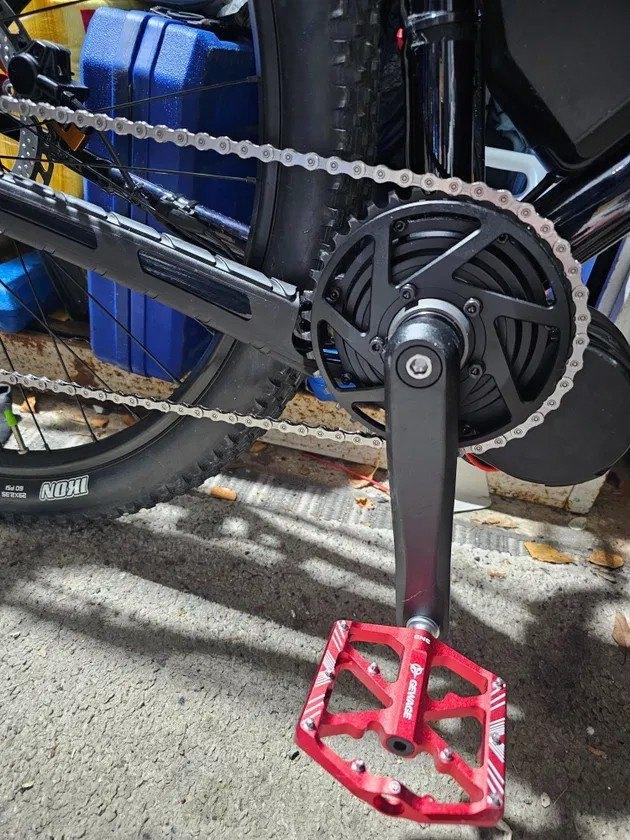
An installed mid-drive. The chainring’s line to the cassette decides how smoothly the gears shift.
Battery Choice: 36V vs 48V and 15Ah vs 20Ah vs 30Ah
Compare Batteries in Watt-Hours, Not Ah Alone
Energy and weight scale together; all three packs store about 213–216 Wh per kg.
Battery
Energy
Weight
Charger
Charge floor (Ah ÷ A)
Published range
36V 15Ah
540 Wh
2.5 kg
42V 2A
7.5 h
30–50 km
48V 20Ah
960 Wh
4.5 kg
54.6V 2A
10 h
35–70 km
48V 30Ah Taishan
1,440 Wh
6.72 kg
54.6V 5A
6 h
50–80 km
Charge floor = time from empty at the charger’s full current; real charging takes a little longer as current tapers near full.
Battery Capacity vs Real-World Range
Battery size never guarantees a distance. Assist level, rider and cargo weight, gradient, cadence and gearing, speed, wind, temperature and tyre pressure all change it. KirbEbike notes sustained full-throttle riding can roughly halve its range figures. One TSDZ8 owner weighing 123 kg reports 54 km, mostly at assist 4–5, with 10–30% charge left; estimate your own with our range calculator.
Battery Fit Can Rule Out a Kit
A mid-drive kit is only as usable as the battery space on your frame. Check the case size, mounting position and removal path before ordering; our frame-fit guide covers the three checks.
Which Mid-Drive Kit Suits Which Rider?
Rider
Start with
Why
Everyday rider, moderate hills
TSDZ8 500W + 36V 15Ah
Lowest weight and cost; 540 Wh covers shorter rides
Trail rider or heavier rider
TSDZ8 750W + 48V 20Ah
More power for repeated climbs; 960 Wh
Steep terrain, cargo, high demand
Z16 1000W + 48V 30Ah
160 Nm and 1,440 Wh; expect more drivetrain maintenance
Low maintenance above all
Consider a hub motor
No motor load through the chain
Everyday Rider With Moderate Hills
Lean to the 500W where the bike, route and local rules suit it. Priorities: lower system demand, a light battery, natural torque-sensing assistance and moderate climbing.
Trail Rider or Heavier Rider
Compare the 750W against the 500W. Priorities: repeated climbs, higher loads, a 48V battery and a drivetrain in good condition.
Steep-Terrain, Cargo or High-Demand Rider
Look at the Z16. Priorities: the highest published torque, the 30Ah battery, sustained climbing, a strong drivetrain on the donor bike and a willingness to replace chains more often.
Rider Who Values Low Maintenance Above Climbing Performance
A mid-drive may not be the right motor at all. If your routes are mostly flat or rolling and you want minimal chain wear, a hub motor keeps motor force off the drivetrain. See our mid-drive vs hub comparison.
KirbEbike TSDZ8 vs Z16: Published Specifications
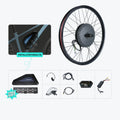
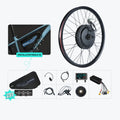
A mid-drive kit with battery: motor with chainring, down-tube battery, colour display and control pad, brake levers, crank arms, spacers and tools
Published figures, November 2026: Bafang from Golden Motor’s kit listings, CYC from its Photon 2 page. Battery is optional with most Bafang and CYC kits.
The main split is sensing. Bafang’s BBS02B and BBSHD use cadence sensors, which give assistance as soon as you pedal; the TSDZ8, Z16 and CYC Photon 2 use torque sensors, which scale assistance to how hard you push. CYC is the only one here listing press-fit (BB92) compatibility. Pick by your bottom bracket, the feel you want and parts support where you live.
Mid-Drive vs Hub Drive: When a Mid-Drive Is Worth It
Mid-Drive Advantages
Uses the bike’s gears to multiply torque on climbs
Strong steep-climb potential
Motor weight low and central
Torque-sensing options
Keeps your standard wheels
Mid-Drive Trade-Offs
More load on the chain, cassette and chainring
More fit checks: shell standard, width, clearance, chainline
Longer installation with special tools
Correct shifting matters more
Who Should Choose a Hub Motor Instead?
Riders who want simple maintenance, ride mostly flat or rolling roads, have a press-fit or otherwise incompatible bottom bracket, or do not want motor torque in the drivetrain. See rear hub or mid-drive and our conversion kits with battery.
A rear hub-motor conversion keeps motor force off the chain.
UK vs US Road Legality: Keep Power Choice Separate From Legal Use
Great Britain
An electrically assisted pedal cycle must have a motor of no more than 250W continuous rated output and assistance that cuts off at 15.5mph (GOV.UK; DfT). None of the 500W, 750W or 1000W kits here meet that, and KirbEbike sells them for off-road use only. A lower display setting does not change the motor’s rating. For public roads, choose a 250W road-legal kit.
United States
The federal definition of a low-speed electric bicycle covers a bike with fully operable pedals and an electric motor of less than 750W whose top speed on motor power alone, with a 170 lb rider, is under 20mph (15 U.S.C. § 2085; 16 CFR § 1512.2). A 750W-rated motor is not less than 750W, and 1000W is above it. State and local rules decide where any e-bike may be ridden.
Choosing Between 500W, 750W and Z16 1000W
Choose by bike fit first: a 68 or 73 mm threaded shell, motor clearance, chainline and battery space. Then match the kit to your terrain and load. Compare torque and gearing rather than wattage, plan for chain and cassette wear, and size the battery in watt-hours for your real rides.
Treat the Z16 1000W as a tool for high-demand riding, not an automatic upgrade; the TSDZ8 750W with the right gearing covers a lot of steep ground. Check road-use rules separately from performance.
Measure the shell before you choose the motor
Threaded, 68 or 73 mm, clear of the frame. Then pick 500W, 750W or 1000W.
Yes. KirbEbike’s TSDZ8 comes with a 36V 15Ah, 48V 20Ah or 48V 30Ah battery, and the Z16 with a 48V 20Ah or 30Ah battery; both also come motor-only. Check voltage, BMS current, frame space and connectors either way.
Is a 500W, 750W or 1000W mid-drive better?
None universally. Match the kit to your terrain, rider and cargo weight, gearing, drivetrain condition, battery needs and where you will ride.
Is a mid-drive e-bike worth it?
For hills, varied terrain and riders who want the motor to use the bike’s gears, yes. If simplicity and low drivetrain maintenance matter most, a hub motor is often the better buy.
Which is better, a hub motor or mid-drive motor?
Mid-drive for gearing, climbing and central weight; hub motor for mechanical simplicity and no motor load on the chain and cassette.
How long does a mid-drive conversion-kit battery last per charge?
It depends on energy and riding. KirbEbike quotes 30–50 km for 540 Wh, 35–70 km for 960 Wh and 50–80 km for 1,440 Wh with pedal assist on mixed terrain; sustained throttle use can roughly halve these.
Is 48V better than 36V for a mid-drive e-bike?
Not on its own. The battery must match the motor’s voltage: the TSDZ8 500W runs at 36V, the TSDZ8 750W and Z16 at 48V (54.6V full charge).
Does a mid-drive e-bike wear out the chain faster?
It can, because motor and rider force both pass through the chain. Shift off-load, keep a good chainline, clean the drivetrain and measure chain wear: replace at 0.5% for 11–13-speed chains and 0.75% for 5–10-speed.
Does a mid-drive conversion kit have a throttle?
It depends on the kit. Both KirbEbike mid-drive motors come with a thumb throttle. In Great Britain none of these kits is an EAPC at any setting, so ride them on private land with the landowner’s permission.
How fast is a 750W mid-drive e-bike?
There is no single figure. KirbEbike lists 30–50 km/h for its mid-drive kit, for private-land use; gearing, wheel size, controller limits, battery charge, load and terrain all affect it.
Will a mid-drive conversion kit fit any bicycle?
No. It needs a compatible bottom-bracket standard and width, clearance around the shell and chainstays, a workable chainline, battery space and a suitable steel or aluminium frame.
A note on safety & legality. Fit a mid-drive only to a sound steel or aluminium frame with a compatible threaded shell; never to carbon. Torque all bolts to the stated values, keep brakes in top condition (KirbEbike recommends disc brakes for the Z16) and charge only with the supplied charger (GOV.UK). In Great Britain these kits are for private land with the landowner’s permission.
About this guide
Author: Andy Kirby. Last reviewed: November 2026. Specifications and prices come from KirbEbike’s live mid-drive kit page (Z16 and TSDZ8 options), its TSDZ8 specifications and the mid-motor collection. Wheel torque, watt-hours, Wh per kg and charge floors are calculated from those figures. Owner experiences are from reviews on the product page. Competitor figures are each maker’s or retailer’s published claims.
Stay in the know
Conversion guides, fitting advice and the deals worth knowing about. No spam.
Door je aan te melden ga je akkoord met ons Privacybeleid.