Are Ebike Conversion Kits Legal in the USA? Federal Rules and State E-Bike Classes
Converting a bike is not illegal in itself. Whether you may ride the finished bike depends on two different sets of rules: a federal product definition, and the state, city and land-manager rules for where you actually ride.
AK
Andy Kirby
Reviewed by the KirbEbike conversion-support team
Delen
Unlock £10 off today
Op deze pagina
US LEGAL GUIDEFEDERAL PRODUCT RULES ≠ STATE RIDING LAWSNOT LEGAL ADVICE
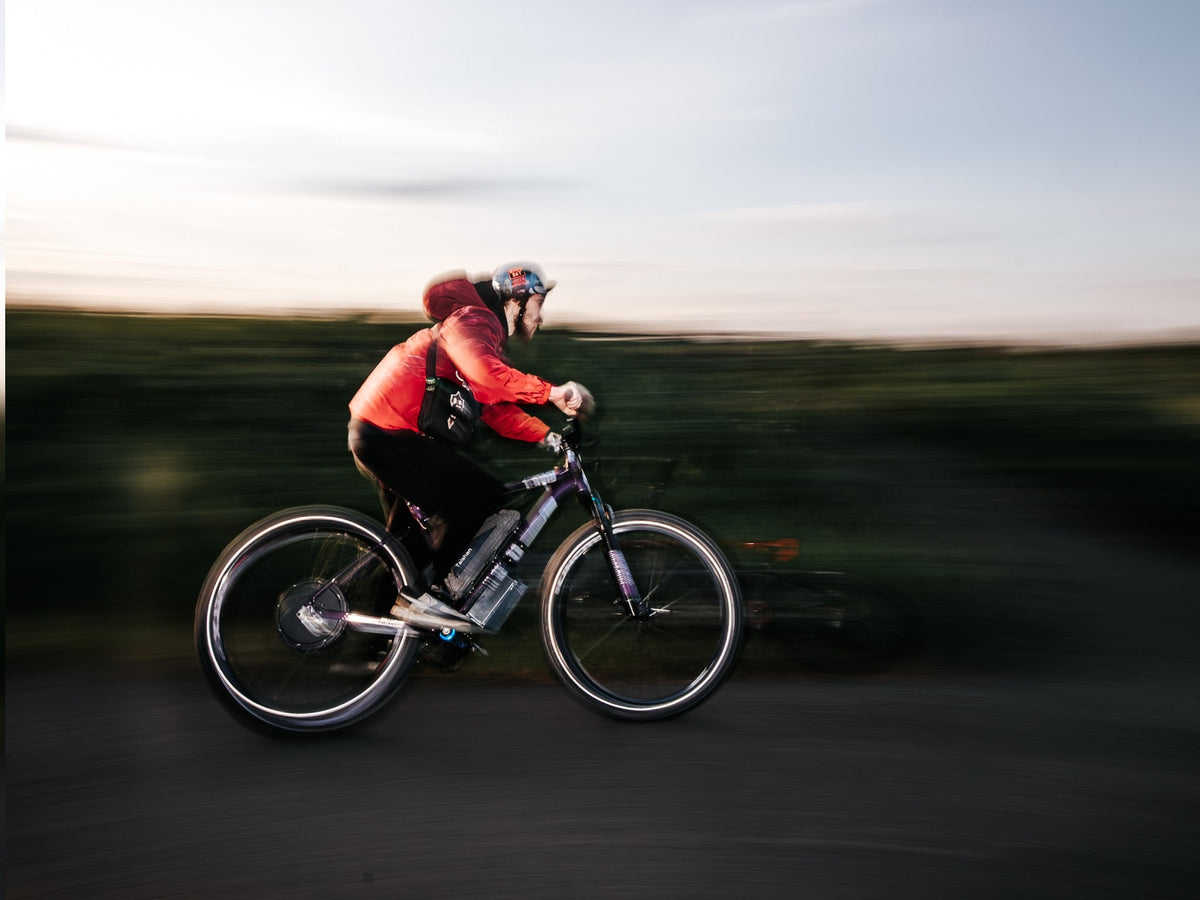
A converted hardtail. Whether it may be ridden on a given road depends on the finished bike and the state, not the kit box.
The Short Answer
Buying and fitting a conversion kit is not illegal in the USA. Federal law defines a low-speed electric bicycle as a two- or three-wheeled vehicle with fully operable pedals, an electric motor of less than 750 watts, and a top speed of less than 20 mph on the motor alone with a 170 lb rider (15 U.S.C. § 2085). That definition covers the product; it does not give permission to ride anywhere.
Where and how you may ride is set by your state’s vehicle code, then by city and county rules, then by whoever manages the trail or park. New Jersey, Washington and New York all changed or restated their rules in 2026, so check the current rules for the places you ride.
Are Ebike Conversion Kits Legal in the USA? The Short Answer
A Bicycle Is Not Automatically Illegal When it Gets Converted
Federal law does not ban buying or fitting a conversion kit. What counts is the finished bike: its motor rating, the top speed the motor alone can reach, whether it has a throttle, and where you ride it. The same kit can build a bike that is an e-bike in one state and a motor vehicle in another.
Federal Product Rules vs State Riding Laws
Question
Federal product rules
State and local riding laws
What do they mainly address?
Consumer-product definition and safety
Operation and access
Who regulates?
CPSC, under federal law
States, cities, counties, land managers
Motor power relevant?
Yes: less than 750 W
Often, but the wording varies
Speed relevant?
Yes: under 20 mph on motor alone
Yes: usually assisted-speed limits by class
E-bike classes?
Not created by the federal definition
Used by most states
Helmet and age rules?
Not covered
State and local
Bike path and trail access?
Not granted
State, local and land manager
Registration or license?
Not covered
State-specific
The CPSC chair has said the Class 1, 2, 3 framework is not part of the CPSC’s statutes (Bicycle Retailer).
Each layer answers a different question. A bike can pass the first and still be barred by the last.
What Does Federal Law Actually Say About Electric Bicycles?
The Federal Low-Speed Electric Bicycle Definition
Federal law defines a low-speed electric bicycle as a two- or three-wheeled vehicle with fully operable pedals and an electric motor of less than 750 watts (1 h.p.), whose top speed on a paved level surface, powered only by the motor with a 170 lb rider, is less than 20 mph (15 U.S.C. § 2085; the same wording is in 16 CFR § 1512.2). Two details matter. The motor must be under 750 W, not at 750 W. And the 20 mph test is for the motor alone; pedalling faster than 20 mph does not change it.
Federal Definition vs Permission to Ride
Meeting the federal definition makes the bike a consumer product regulated as a bicycle. It does not give permission to ride on roads, sidewalks, trails, parks or bike paths; that comes from the state, local and land-manager layers below.
CPSC Bicycle Safety Requirements Still Matter
Since 2002, federal law has made low-speed e-bikes subject to the CPSC’s bicycle rule, 16 CFR Part 1512 (Federal Register, 2024). It sets requirements for manufacturers and sellers covering brakes, steering, pedals, drive chain, wheels, frame, seat and reflectors. Those are also the basics to check on a converted bike, because the motor adds speed and weight.
Federal Rules vs State E-Bike Laws: Why the Difference Matters
What States Can Define Differently
States set their own motor-power wording, assisted-speed limits, throttle rules, class definitions, minimum ages, helmet rules, labels, licensing and registration, and where e-bikes may be ridden (sidewalks, paths, trails).
A 750 W motor is not “less than 750 W” under federal and Texas wording but is “no more than 750 W” under Washington wording.
State Law vs Local Rules
The chain runs from federal to state to city or county, then to the park, trail or land manager. A bike that counts as an e-bike under state law may still be barred from a particular path or trail. Local governments can add their own rules: the Town of Prosper, Texas, for example, requires a town permit to ride an e-bike and registers them through its police department (Town of Prosper).
Use a State-Law Tracker Before Riding
PeopleForBikes keeps a state-by-state e-bike law guide. In January 2026 it put the number of states using the three-class system at 46 (PeopleForBikes), and NCSL’s legislative primer explains the split between federal product rules and state operating rules. Find your state there, then open the statute or agency page it points to before you ride.
📅
Last reviewed: November 2026. The state examples in this guide were checked against official sources. E-bike laws, agency rules and local ordinances change; check the current rules where you ride.
Class 1 vs Class 2 vs Class 3 E-Bikes
Class 1 vs Class 2
Class 1 assists only while you pedal and stops at 20 mph. Class 2 can also be driven by a throttle without pedalling, again up to 20 mph. Texas uses exactly this wording (Texas § 664.001). Throttle bikes are often treated differently on trails, so a Class 2 bike may be barred where Class 1 is allowed.
Class 1 vs Class 3
Class 3 usually means pedal assist beyond 20 mph, often with extra conditions such as a minimum age, a speedometer or path restrictions. Texas defines Class 3 as pedal assist only, with a top assisted speed of more than 20 but less than 28 mph, requires a speedometer, and sets a minimum rider age of 15 (Texas § 551.107). Do not assume another state copies that.
Does a Conversion Kit Follow the Same Rules as a Factory E-Bike?
The Finished Bicycle Matters More Than the Box the Motor Came In
Statutes describe the vehicle, not the kit. Once fitted, your bike is judged on its pedals, motor rating, top assisted speed and how the motor engages. Do not assume a DIY conversion gets the same treatment as a factory e-bike in every state.
Motor, Controller, Throttle and Speed Settings
The motor’s rating, the controller’s current and speed settings, and whether a throttle is fitted all shape how the finished bike behaves, and so which category it falls into.
Display and controller settings change how the bike behaves, but a setting does not change the motor’s rating.
Labels and Documentation
Keep the motor’s documented rating, the controller specification, your assist-speed and throttle settings, receipts and product documents. Many three-class states require a class label. Texas requires a permanent label showing class, top assisted speed and motor wattage, and anyone who changes the motor-powered speed capability or engagement must replace it with accurate information (Texas § 664.002). Washington has a similar re-labelling rule (final bill report), and New York requires a permanent label on every e-bike sold (NY AG).
Is a 250W vs 500W vs 750W Conversion Kit Legal?
250W vs 500W Conversion Kits
Lower power alone does not make a bike legal. A 250 W or 500 W kit still needs working pedals, a motor-only speed and assist speed inside the state’s limits, and a throttle setup the state allows.
500W vs 750W Conversion Kits
750 W is not a nationwide legal line. A motor’s marketed rating, the statute’s wording and how the bike is set up are three different things. Federal law and Texas say less than 750 W; Washington says no more than 750 W (2026 c 159).
750W Kit vs State Class Limits
Even under the power limit, the bike must also fit a state class. Read your state’s definition before choosing from our conversion kits with battery.
Product touchpoint
Which KirbEbike kits are under 750 W?
Our 250W kits, including the EZ Rider, are set to 15.5 mph for UK rules. The 500W/750W MTX kit is listed at 22–28 mph, above the federal 20 mph motor-only test. Kits from 1000W up are outside every e-bike definition; the 2000W kit is sold for off-road use only. US delivery is $100 on complete kits; batteries and accessories ship free. Check your state’s rules first, and ask support if you are unsure which kit fits them.
What About 1000W, 2000W and 3000W Conversion Kits?
750W vs 1000W Conversion Kit Legality
A 1000 W motor is outside the federal low-speed electric bicycle definition. What it is instead depends on the state, which may class it as a moped, motorcycle or another motor vehicle. New Jersey now defines an “electric motorized bicycle” as having pedals, a motor capable of more than 750 W and a top speed above 28 mph, and bans its online advertising and sale (PeopleForBikes).
1000W vs 2000W Conversion Kits
Both sit outside the e-bike definitions above. The higher figure does not change the legal question; it only makes it harder to argue the bike is a bicycle.
Where Higher-Power Systems May Fit
Possible places include private property with the owner’s permission, designated off-highway vehicle areas where that vehicle type is allowed, or registration under another vehicle category where the state permits it. The land manager’s rules still decide. KirbEbike’s 52V 2000W MTX kit is a good example: its own product page describes it as an off-road kit, with its top-speed figure stated for private land.
A high-power rear hub. Availability for sale says nothing about public-road status.
State E-Bike Laws Compared: Real 2026 Examples
Dated events from official state sources.
Texas: A Three-Class Example
Texas defines an electric bicycle as one with fully operable pedals, an electric motor of fewer than 750 watts and a top assisted speed of 28 mph or less, split into Classes 1, 2 and 3. Sellers must fit a permanent label, the bike must meet the CPSC bicycle requirements, and Class 3 must have a speedometer (Texas ch. 664).
New York: Why You Cannot Copy Another State’s Classes
New York’s Class 3 is throttle-assisted to 25 mph and may be ridden only in New York City. Riders must be at least 16. A bike that assists above 25 mph in the city, or above 20 mph elsewhere in the state, is not an e-bike under New York law, and converting a vehicle for illegal use is itself illegal (NY AG, 31 July 2026).
New Jersey: A 2026 Example of Rules Changing
New Jersey’s law (P.L.2025, c.285) was signed on 19 January 2026. It limits “low-speed electric bicycle” to Class 1 and treats Class 2 and 3 e-bikes as motorized bicycles (PeopleForBikes). The NJMVC began licensing and registration appointments on 26 June 2026: every e-bike must be registered, riders must be at least 15 and hold either an e-bike license or a driver license, and motorized bicycles need insurance (NJMVC).
Washington: Why Configurability Can Matter
Washington’s SB 6110 was signed on 23 March 2026 as Chapter 159 and took effect on 11 June 2026 (Washington Legislature). It keeps the “no more than 750 W” limit and three classes, but now excludes any vehicle capable of exceeding 20 mph on the motor alone, and any vehicle designed or intended by the manufacturer or seller to be easily configured beyond e-bike limits, whether by a switch, a software setting or an app (2026 c 159; final bill report).
Why We Are Not Publishing a Static 50-State Legal Table
As the examples above show, state laws change, and local access rules change separately, so a static 50-state table goes stale quickly. For your state, start from PeopleForBikes’ state-by-state guide and then read the statute or agency page it links to.
Road Legal vs Trail Legal: They Are Not the Same Question
Public Roads and Bike Lanes
Check the state classification and local operating rules, including speed limits and bike-lane access.
Sidewalks and Shared-Use Paths
Being legal to ride does not guarantee sidewalk or path access. In Washington, for example, Class 3 e-bikes may not be ridden on a sidewalk unless there is no alternative or the local jurisdiction allows it (final bill report).
Parks, Trails and Federal Land
In national parks, e-bikes may be allowed only where traditional bicycles are allowed, never in wilderness areas, and each park superintendent decides which roads and trails are open to them, and to which classes. State law covers matters such as age, helmets and registration, but it does not decide where e-bikes may go inside a park (NPS). The NPS reaffirmed superintendents’ case-by-case authority in August 2024 (NPS).
Trail access is set by the land manager, separately from road rules.
Throttle vs Pedal Assist: Does It Change Legality?
Pedal Assist vs Throttle Under State Class Systems
In most class systems, a throttle that moves the bike without pedalling makes it Class 2. That can change where it is allowed, even at the same top speed.
A Throttle Can Change the Applicable Class
Texas’s Class 2 is a motor that may propel the bike without pedalling; its Class 3 assists only when pedalling. New York’s Class 3, by contrast, is throttle-assisted. The same throttle means different things in each state.
Fitting a throttle can change a bike’s class under many state systems.
Can You Ride an E-Bike Without Pedaling?
Some kits can move the bike on the throttle alone. Whether you may ride that way depends on the class the bike falls into and the rules where you ride. Keep two questions apart: what the system can do, and what you are allowed to do with it here.
Speed-Limited vs High-Power: Does a Software Limit Make It Legal?
750W Motor vs 1000W Motor Limited to 20 MPH
Speed is only one test. A 1000 W motor capped at 20 mph still has a 1000 W motor, and many definitions are written around the motor’s power as well as its speed.
Controller Limits vs Motor Rating
A controller can limit current and speed, but it does not change what the motor is rated for. Statutes generally describe the motor and the bike’s capability, not a menu setting.
Switchable or App-Based Modes
Do not rely on a “legal mode”, display setting or app profile to change a bike’s legal category. Washington’s 2026 law excludes vehicles designed or intended by the manufacturer or seller to be easily configured beyond e-bike limits, including by a software setting or app (2026 c 159), and New York says converting a vehicle for illegal use is illegal (NY AG). KirbEbike’s Limit Mode caps speed on our higher-power kits, but it does not make them e-bikes.
Conversion Kit Options to Compare Before a US Build
Each seller’s published figures, November 2026. Bimotal from its product page and FAQ. No option here is “more legal”; apply the law where you ride.
KirbEbike EZ Rider 250W
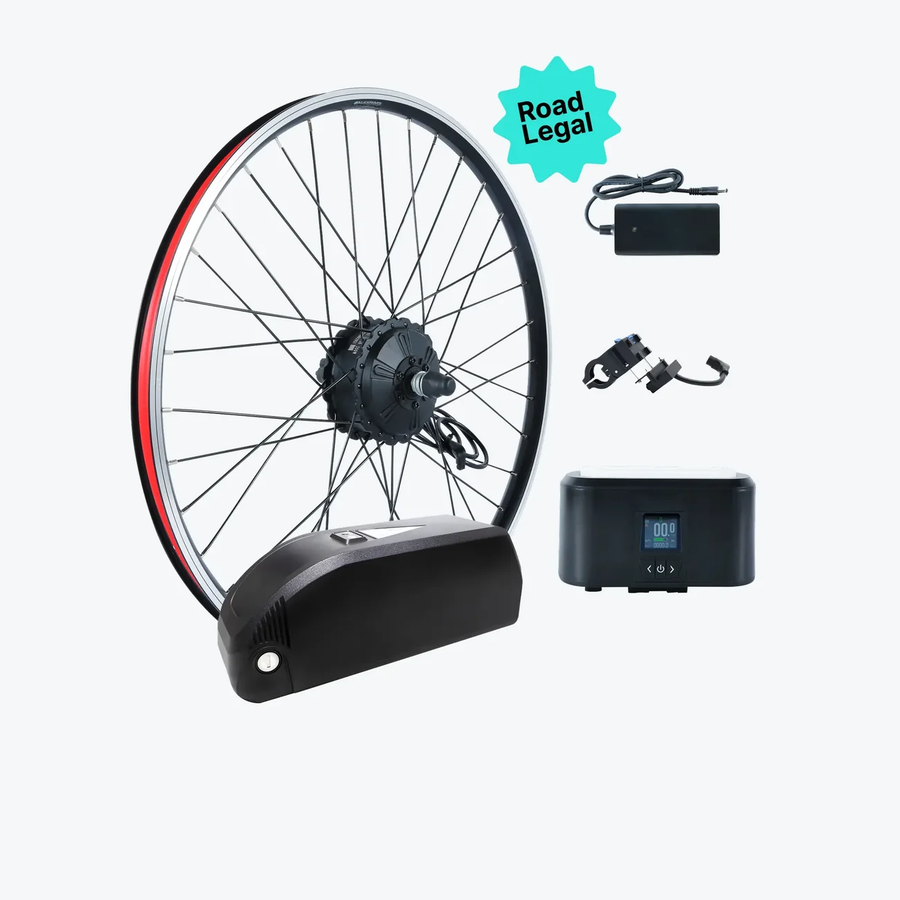
The EZ Rider is a 250 W front-hub kit. Its “road legal” label refers to UK rules; in the US, check it against your state’s definition and class rules like any other kit.
Bimotal Elevate Standard 750W
Bimotal limits the Elevate to 20 mph and describes it as meeting US Class 2 rules. Its MAX upgrade to 1250 W is, in Bimotal’s own words, above the US e-bike power limit and meant for private land or OHV trails (Bimotal). Note that the Standard’s 750 W figure meets “no more than 750 W” wording but not “less than 750 W”.
Higher-Power KirbEbike 2000W MTX
The 52V 2000W MTX kit shows why availability and road status are separate questions. Its product page marks it for off-road use only and gives its top speed, up to 37 mph (60 km/h), for private land. It is outside every e-bike definition in this guide.
A high-power build: a different legal category from a 250 W conversion.
Pre-Build Legal Checklist for a US E-Bike Conversion
Before Buying the Kit
Identify your state
Identify your city or county
List the roads, paths and trails you will actually use
Check the state’s current e-bike definition
Check its motor-power wording (less than, fewer than, no more than)
Check its assisted-speed limits
Check its throttle and pedal-assist rules
Check age and helmet rules
Check license, registration and insurance requirements
Check the finished bike, not the listing: its motor rating, how fast the motor alone can push it, whether a throttle works without pedalling, and whether any required label is accurate.
Before Riding Somewhere New
Recheck the state, local and land-manager rules for that place.
Last reviewed: November 2026. Rules change; this guide is educational information, not legal advice. Check your state and local rules before you ride.
Common US E-Bike Legality Myths
“750W Is Legal Everywhere in America”
No. Federal law says less than 750 W, states word it differently, and states and localities decide where a bike may be ridden.
“Under 20 MPH Means Any Motor Is Legal”
No. Speed is one test; motor rating, pedals and throttle setup are others.
“Private Land Means There Are No Rules”
You still need the owner’s permission, and the site’s own rules apply.
“Class 3 Means 28 MPH in Every State”
No. In New York, Class 3 is throttle-assisted to 25 mph and allowed only in New York City (NY AG).
“If a Conversion Kit Is Sold in the US, It Must Be Street Legal”
No. Availability is not permission. New Jersey has even banned the online advertising and sale of pedal-equipped vehicles capable of more than 750 W and 28 mph (PeopleForBikes).
Conclusion: How to Check Whether Your E-Bike Conversion Is Legal
An ebike conversion kit is not illegal in the USA, but whether you may ride the finished bike depends on where you ride it. The federal definition covers the product: pedals, a motor under 750 W and a motor-only speed under 20 mph. State, local and land-manager rules decide operation and access.
Work out the finished bike’s motor rating, assisted speed and throttle setup, then check your state’s current rules, local ordinances and the rules for each trail or park. Use PeopleForBikes and your state agency as the starting points. This guide is educational information, not legal advice.
Choose the kit by where you will ride
Check your state’s definition first, then compare documented power and speed settings.
No. Owning and fitting a kit is not illegal under federal law; riding the finished bike is governed by your state, city and the land manager where you ride.
Is a 750W e-bike conversion kit legal in the USA?
There is no universal 750 W rule. Federal law and Texas say less than 750 W, while Washington says no more than 750 W, and each state sets its own speed and class rules.
Is a 1000W e-bike conversion kit legal in the USA?
It falls outside the federal low-speed electric bicycle definition. How it is classed, and where it may be used, then depends on the state and the venue.
Are 2000W or 3000W e-bike conversion kits legal?
Being sold is not the same as being road legal. These sit outside e-bike definitions; use may be possible on private land with permission, in designated OHV areas, or under another vehicle category where a state allows it.
How fast can a legal e-bike go in the USA?
There is no single answer. The federal test is a motor-only speed under 20 mph; states set assisted-speed limits by class, commonly 20 mph for Classes 1 and 2 and higher for Class 3 (28 mph in Texas, 25 mph in New York).
Can an e-bike legally go 40 mph?
A bike that can be motor-assisted to 40 mph is outside the usual three-class e-bike system. Check your state’s moped, motorcycle or other vehicle rules.
Can I ride a converted e-bike without pedaling?
It depends on whether a throttle is fitted, the class that puts the bike in, and the rules where you ride. Many states treat throttle bikes as Class 2.
Does limiting a 1000W motor to 20 mph make it legal?
Not automatically. The motor’s rating still matters under most definitions, and Washington’s 2026 law excludes vehicles designed or intended by the maker or seller to be easily configured beyond e-bike limits.
Do I need a license, registration or insurance for a converted e-bike?
It depends on the state. Under New Jersey’s 2026 law every e-bike must be registered, riders need an e-bike license or a driver license, and motorized bicycles (Class 2 and 3) need insurance; the NJMVC began appointments in June 2026. Many other states exempt e-bikes from these requirements, so check yours.
Can I ride my converted e-bike on bike paths and trails?
Classification and access are separate. Check state and local rules and the specific land manager; national parks, for example, let each superintendent decide.
A note on safety & legality. This guide is educational information, not legal advice. Laws change; check the current statute, agency guidance and local rules before riding, and ask a qualified attorney if you need advice on your situation. Keep a converted bike’s brakes, frame and battery in safe condition, and never alter a controller or display to get around a legal limit.
About this guide
Author: Andy Kirby. Last reviewed: November 2026. Federal wording is from 15 U.S.C. § 2085 and 16 CFR § 1512.2. State examples come from official Texas, New York, New Jersey and Washington sources. Product details are each seller’s published figures. This guide is educational information, not legal advice; check your state and local rules before you ride.
Stay in the know
Conversion guides, fitting advice and the deals worth knowing about. No spam.
Door je aan te melden ga je akkoord met ons Privacybeleid.