Brompton 74mm E-Bike Conversion Kit: Fit, Fold, Added Weight and Real Range
KE
KirbEbike Editorial
Reviewed by the KirbEbike conversion-support team
Delen
Unlock £10 off today
Op deze pagina
A Brompton needs a Brompton-specific kit. The front fork is 74mm rather than the usual 100mm, the wheel is 16-inch, and anything that survives the fold has to be designed around it. On a bike that is carried, lifted and rolled as much as it is ridden, added weight and honest range matter more than peak power — so this guide works through fork fit, the fold, battery position, real-world range and UK legality in the order they should be checked.
⚖️
Scope and legality, checked 5 August 2026. This guide covers the classic 16-inch Brompton platform only — not the 20-inch G Line. In Great Britain a 250W conversion may form part of an EAPC only if the completed bicycle meets every requirement: working pedals, assistance that stops at 15.5mph, and the rest of the current rules.
The Quick Answer
On a classic 16-inch Brompton — C Line, P Line, A Line and their predecessors — a conversion kit fits when four things are true: the front motor is built for a 74mm fork, the wheel matches the 16-inch 349 bead-seat standard, the battery mounts clear of the hinges and swing arm, and the bike still folds, latches and rolls afterwards. Solve the fit first and the power question second. A 250W system is the road-focused route in Great Britain, and it only forms part of an EAPC if the completed bicycle meets every other requirement. None of this applies to the 20-inch G Line — confirm your exact model and fork specification before ordering.
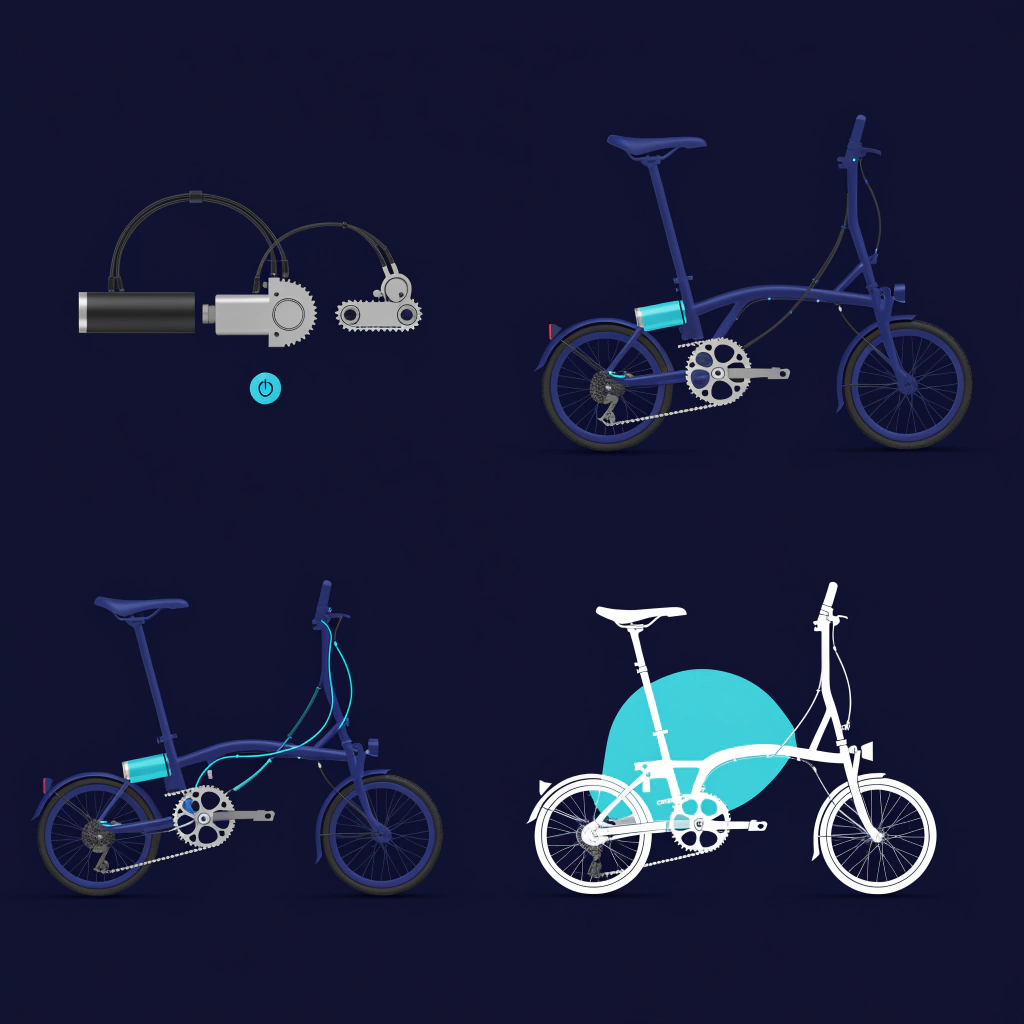
A front-hub Brompton conversion in the wild. The fold, the luggage block and the 74mm fork are what decide the build — the motor is the easy part.
Quick Answer: What Makes a Brompton Conversion Kit Fit?
Requirement
The classic 16-inch Brompton standard
Why it matters
Verify before ordering
Model family
C Line, P Line, A Line and predecessors — not the 20-inch G Line
The G Line is a different platform and this fit logic does not transfer
Your exact model, confirmed with the kit maker
Front fork spacing
74mm, not the usual 100mm
A standard front motor will not seat
Kit states 74mm explicitly
Wheel and tyre
16-inch, 349 bead seat
Rim and tyre must match, not just “16 inch”
ETRTO on your tyre sidewall
The fold
Must still close and latch
It is why you own the bike
Whether the pack comes off first
Battery position
Clear of hinges and swing arm
Can block the fold or luggage block
Exact mounting location
Legality
250W continuous, cut-off at 15.5mph
Public-road use in Great Britain
The completed bike, not the motor
Checks in the order they should be made.
A Brompton conversion is a fit problem before a power problem. Solve the fork, the wheel and the fold, and the rest is a normal 250W commuter build.
Why 74mm Matters, and the 16-Inch Wheel Standard
⚠️
Which Bromptons this guide covers. Covered: the classic 16-inch platform — C Line, P Line, A Line and earlier equivalents, with a 74mm front fork and 349 bead-seat wheels. Not covered: the G Line, a 20-inch platform with different fork and wheel specifications — a kit sold as “for Brompton” is not automatically a G Line kit. Do not infer compatibility from the Brompton name alone: confirm your exact model and fork specification with the kit maker before ordering.
Almost every front hub motor sold for conversions is built for a 100mm fork — our own standard 250W front-wheel kit included. A classic Brompton’s fork is 74mm, so a standard motor is roughly 26mm too wide to seat at all. That is a geometry problem, not a tolerance problem: do not spread the fork, file the dropouts or pack the axle out. Either the kit publishes 74mm compatibility for your model or it is not a kit for your bike. The EZ Rider lists a Brompton-specific 74mm front motor alongside its standard 100mm version for exactly this reason.
The wheel is the second half of the same check. A Brompton runs a 16-inch wheel, and “16 inch” is a loose label rather than a measurement — Park Tool is explicit that the inch designation carries no actual inch dimension and is only a rough code for outside tyre diameter. Read the ETRTO figure on your sidewall and match the motor wheel to it, because 16-inch tyres exist in more than one bead diameter. Our wheel and dropout size reference covers how to read it.
Will the Brompton Still Fold Normally?
This is the question that should decide your purchase, and the answer varies by kit. Four things can interfere:
Battery. Some packs must come off before the bike folds; others stay on. Ask which, because unclipping a pack every time changes how the bike feels to own
Cables. The fold rotates the fork and swings the rear triangle, so any cable crossing a hinge needs slack and strain relief or it chafes through
Controller. It must sit clear of the hinge, the swing arm and the folded package
Luggage block. A big part of why people buy Bromptons. Confirm it stays usable
💡
Two checks people forget. A folded Brompton is often rolled along a platform on its rear wheels — confirm the folded package still rolls and does not sit on a cable. And confirm the fold still latches: a fold that closes but will not lock is a fold that failed.
Front-Hub vs Rear-Hub Brompton Conversion
Factor
Front hub
Rear hub
Availability for Brompton
The common route
Fewer options
Drivetrain
Rear hub gears untouched
Must work around the gearing
Weight distribution
Adds to the front and the steering
Keeps mass where a bike normally drives
Traction
Less weight over the driven wheel
Better under acceleration
Both layouts are used; the trade-off is real either way.
Front hubs dominate because the Brompton’s rear hub carries its gears and the rear triangle folds, so the front wheel is the simpler place for a motor. There is a genuine caveat, and it applies to our own kit: when BikeRadar tested front-wheel Brompton conversions it reported traction and handling anomalies from driving the front wheel, which is part of why newer systems moved the drive rearward to preserve weight balance and light steering. On a small wheel with little weight over the front tyre, that shows up as slip on wet or steep starts.
Rear-hub Brompton systems exist if that bothers you. Boost drives the rear wheel and, per its published design, mounts a compact battery on the swing arm so the fold and swing-arm movement are unaffected. Treat that as a manufacturer claim and test the fold yourself.
How Much Weight a Conversion Adds, and What It Changes
⚠️
Why there is no weight ranking here. The added-weight figures suppliers publish do not share a boundary: one is a complete rear-drive system, one is a motor-only figure, one is a range, and the KirbEbike figure currently differs between two places on its own product page — 3.8kg in the specification list and 6.0kg described as all-in with both batteries. Plotting those together would produce a ranking the evidence does not support, so the table below states what each supplier actually publishes and marks the rest unavailable rather than normalising it. Ask any supplier — us included — to confirm ride-ready weight in writing before ordering.
System
Ride-ready system weight
Boundary of the published figure
Source
Boost for Brompton
About 2.5kg claimed
Described as a complete system; components included not itemised
Supplier claim
Byqee F23
Unavailable
Motor only — about 2.4kg. Not comparable with a complete system
Supplier claim
Cytronex for Brompton
About 3.2–3.65kg claimed
Published as a range; exact inclusions vary by model
Supplier claim
KirbEbike EZ Rider, Brompton variant
Unavailable — see note above
Live page conflicts: 3.8kg in the spec list, 6.0kg all-in
Unreconciled
Same-boundary comparison. A valid ride-ready figure must cover motor wheel, controller and display, sensors and cables, mounts, battery or batteries and required hardware. Published specifications only, checked 5 August 2026.
What can be said without a ranking: every one of these systems lands somewhere between roughly 2.5kg and 4kg on a bike that typically weighs 11.5 to 12.5kg unassisted, so expect something in the region of a fifth to a third more to carry. It changes four things — lifting the fold onto a train, carrying it up steps, rolling it along a platform, and riding unassisted if the battery is flat. Most packs come off, and removing the battery before you lift makes the biggest single difference to how the folded bike feels.
Battery Placement, Charging and Lifespan
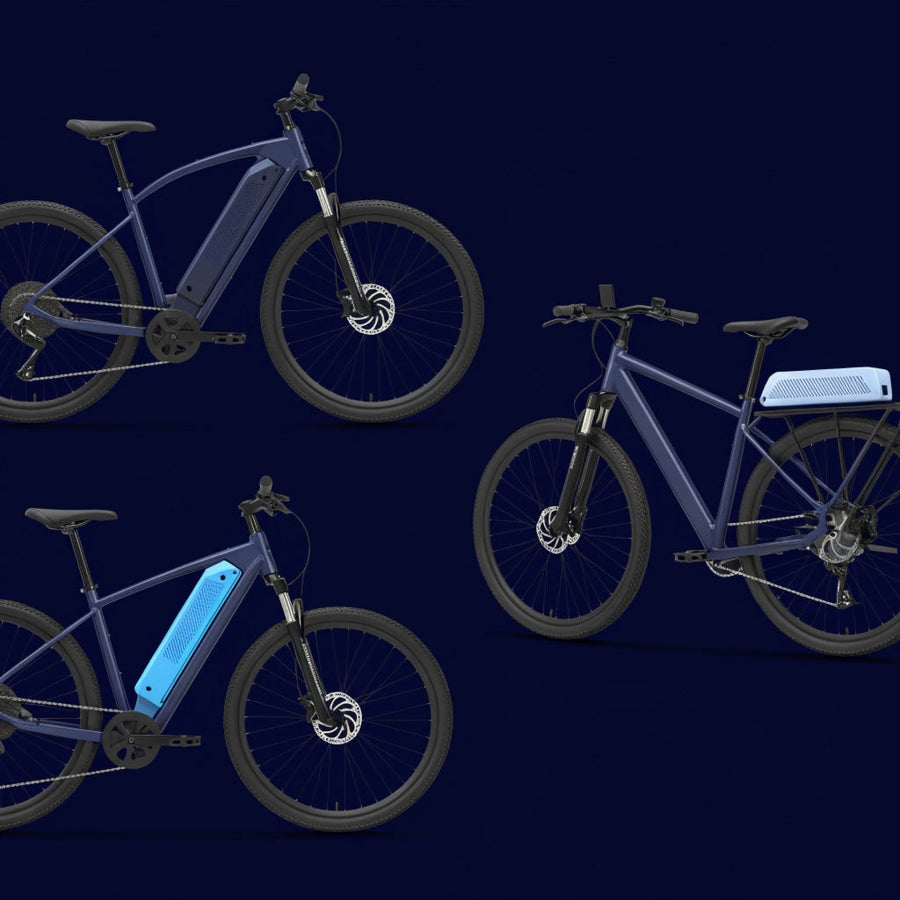
A removable pack on a KirbEbike build. Shown on a larger frame for clarity — Brompton packs are smaller, but the same principles apply: approved mount, clear of moving parts, easy to remove before lifting.
Brompton kits use one of three approaches: a front-mounted pack near the frame or luggage block, a bottle-style holder, or a compact pack against the rear swing arm. Each has a different consequence for the fold, which is why placement matters more than capacity. Cytronex uses a patented bottle holder and states it does not interfere with the fold or luggage mount; Byqee mounts a compact removable pack at the front of the frame. Both are manufacturer positions worth checking against your own luggage habits.
On charging and lifespan, the rules are the same as any lithium pack but the stakes are higher because a Brompton lives indoors. Use only the charger supplied or authorised for your battery, charge in a dry, ventilated place away from escape routes, and never charge a damaged, swollen, wet or unusually hot pack (GOV.UK battery safety guidance). Government guidance also expects packs sold for conversion kits to include a battery management system (statutory lithium-ion battery guidelines), and the London Fire Brigade links kits bought without a battery to riders sourcing a mismatched charger elsewhere. Ours are listed as chargers for KirbEbike batteries only for exactly that reason.
Real Range: Replacing the Headline Figure
Claimed ranges sit between roughly 30km and 60 miles depending on pack size, and they are not comparable because they rest on different assumptions. Convert the claim into watt-hours, then divide by a realistic consumption figure.
The arithmetic gives label energy, not verified range. Watt-hours equal nominal voltage times amp-hours, so a 36V 6.6Ah pack holds about 238Wh nominal and a 36V 22Ah dual pack about 792Wh nominal. Neither figure is what reaches the road: the BMS stops the pack above empty, a reserve should be kept before low-voltage cut-off, and voltage sag, temperature, tyre pressure, rider mass and assist level all move consumption. On a dual-pack system the sharing behaviour matters too — packs drawn simultaneously and packs drawn in sequence do not behave identically.
238Wh
Nominal energy of a 36V 6.6Ah pack — the typical compact Brompton battery
792Wh
Nominal energy of a 36V 22Ah dual pack — the long-range configuration
10–24 mi
Planning band for a 238Wh pack at realistic consumption — not a promise
Low assist, flat
10–15 Wh/mile
Gentle pedal assist on level ground in still air
Mixed commuting
15–25 Wh/mile
Stop-start city riding, moderate assist, everyday loads
Hills, wind or load
25+ Wh/mile
Climbing, headwinds or luggage — plan for the worse end
📊
Ride-test results not yet published. The figures above are planning arithmetic from label energy, not a verified test. KirbEbike has not yet published a ride test of the Brompton variant, so treat every range figure on this page — ours and every competitor’s — as a manufacturer claim, and plan from your own measured consumption over a few typical rides.
Two Brompton factors push consumption up: small wheels carry a slightly higher rolling penalty on rough surfaces, and city riding is stop-start, the least efficient way to use a motor. Plan for the worse end of the band.
Small Wheels, Torque and Hills
A 16-inch wheel is an advantage here. For the same axle torque a smaller wheel produces more force at the tyre, because tractive force is roughly axle torque divided by loaded radius. That is why a 250W Brompton motor feels surprisingly capable on a short, sharp hill. The same geometry gives a lower road speed per motor revolution, which matters little when assistance is capped at 15.5mph anyway — and on a climb it is gradient, not wattage, that dominates the power demand.
The limit is heat, not torque. A small geared hub climbing slowly under load has little airflow and a small case, so heat builds faster than on a larger wheel. No universal hill-duration limit should be inferred from that: how quickly temperature rises depends on gradient, total mass including luggage, rider input, controller current, motor winding, ambient temperature and how much recovery there is between climbs. A light rider pedalling actively up a short rise and a loaded bike crawling up a long one are different problems.
KirbEbike has not published a thermal limit for this motor, so this guide does not state one. In practice: avoid prolonged low-speed, high-load climbing, keep pedalling to share the load rather than relying on the motor alone, and use a lower gear to raise wheel speed where you can. Stop and let the system cool if you notice abnormal heat at the hub or controller, any smell, unusual noise, or the system reducing power on its own — that last one is often the controller protecting itself, and it is a signal to ease off rather than to push on.
UK Road Legality for a Brompton Conversion
The UK EAPC test — all three, on the completed bike
Working pedals + 250W continuous rating + assistance stops at 15.5mph = road-legal EAPC
Rider aged 14 or over. Outside those conditions the bike becomes a moped or motorcycle in law.
A converted Brompton is treated as an ordinary pedal cycle in Great Britain only when it meets the conditions above (GOV.UK electric bike rules). Outside them it requires registration, insurance, licensing and a helmet, as set out in the official EAPC information sheet. Throttles are the usual trap: one that drives the bike beyond walking pace without pedalling can remove EAPC status, so pedal assist is the compliant route. Every Brompton-specific kit worth considering — and everything in our road-legal kit range — is 250W for this reason.
Brompton Conversion Kits to Compare
The comparison below covers published specifications only. Unavailable or non-equivalent figures are marked rather than normalised into a ranking, and each cell is labelled by source. Confirm current specifications, price and availability on each supplier’s own page before buying.
KirbEbike EZ Rider, Brompton Variant
KirbEbike · Road-focused · 74mm variant
EZ Rider Kit — Brompton 74mm Variant
£587.99 complete with 792Wh dual battery · confirm the 74mm variant on the product page
Brompton-specific 74mm front motor, 16 × 1 3/8 wheel
36V 250W system with TFT display and 4A charger
Dual pack: 36V 7Ah + 15Ah — the longest claimed range here, and the heaviest option
Sold for DIY installation, reversible in about 20 minutes
Being straight about the trade-off: it is a front hub, so the traction caveat above applies, and the dual pack that gives it the longest claimed range also makes it the heaviest option in this comparison.
⚠️
Fold behaviour not yet published for this variant. Whether the bike still folds is the main reason anyone reads this page, and for the EZ Rider Brompton variant the following is not yet published: where each of the two packs mounts, whether both stay attached through the fold or one must come off first, cable clearance at the fork and rear triangle, whether the luggage block stays usable, and whether the folded bike still latches and rolls. Ask KirbEbike support to confirm fold behaviour in writing for your exact model — C Line, P Line or A Line — before ordering.
Boost for Brompton
The rear-drive alternative and the lightest claimed system at around 2.5kg. Its published design puts a compact battery on the swing arm between swing arm and seat tube, leaving the fold unaffected, with a claimed range around 30km and the option of piggybacking a larger pack on a rear rack. Rear drive preserves weight balance and steering feel better than a front hub. UK-built and the newest of these systems, so check availability and which exact Brompton models are supported.
Cytronex for Brompton
The established premium route: a narrower, lighter front hub made for Brompton forks, a patented bottle-style battery holder and a sensor adapted to the frame. Cytronex states it fits every standard Brompton except the G Line, builds each kit to order, and offers full-fit, self-fit and shop-fit options. Claimed added weight is around 3.2 to 3.65kg. It is the most expensive option here, and that model exclusion matters, so check yours first.
Byqee F23
A front-hub kit designed around the Brompton with published 74mm compatibility. Reported figures: a 250W motor of about 2.4kg with 350W peak and up to 45Nm, a 36V 6.6Ah pack of about 1.2kg giving up to 40km claimed, recharging in roughly three hours, pack at the front of the frame and controller on the bar. The open question is support — verify UK availability, warranty handling and replacement parts, which matter more than the specification on a bike you rely on.
System
Motor
Fork / wheel fit
Battery format
Claimed range and its basis
Ride-ready weight
Boost for Brompton
Rear hub
Confirm exact model
Swing-arm pack
About 30km — test conditions not published
About 2.5kg claimed
Byqee F23
Front hub
Published 74mm compatibility
Compact front pack
About 40km — test conditions not published
Unavailable — motor-only figure published
Cytronex for Brompton
Front hub
Brompton-specific; not the G Line
Bottle holder
Model dependent — not stated per model
About 3.2–3.65kg claimed
KirbEbike EZ Rider, Brompton variant
Front hub
74mm variant, 16 × 1 3/8
Dual pack, 7Ah + 15Ah
40–60 miles — test conditions not published
Unavailable — page conflicts
Listed alphabetically. Every range figure is a manufacturer or publisher claim made under undisclosed and differing test assumptions — they are not comparable with one another. Price, availability and installation support are not published on an equivalent basis and are therefore not tabulated. Published specifications only, checked 5 August 2026.
Conversion Kit vs Factory Brompton Electric, and What It Costs
A factory Brompton Electric arrives engineered around its battery with one warranty and dealer support, and BikeRadar reports the newer 20-inch Electric G Line at £3,499 with a rear-hub motor and disc brakes. A conversion keeps the bike you own for a fraction of that, at the cost of doing the compatibility work yourself and holding two warranties.
Factor
Conversion kit
Factory Brompton Electric
Uses your existing Brompton
Yes
No
Upfront cost
Much lower
Highest
Fold integration
Depends on the kit
Designed in
Warranty
Split between bike and kit
One product
Converting suits an owner; buying suits a newcomer.
Budget the whole project: kit, battery and charger, any fitting charge if you send the bike away, and a follow-up check once fasteners settle. Professional fitting is more common on Brompton conversions than on standard bikes, and worth the labour cost if you are unsure about any step.
Common Brompton Conversion Problems
Problem
Cause and fix
Motor will not seat in the fork
A 100mm motor on a 74mm fork. Only a Brompton-specific kit fits
Tyre will not mount the motor wheel
Wrong 16-inch bead diameter. Match the ETRTO, not the inch label
Fold will not close or latch
Pack, controller or cable fouling a hinge. Reposition, do not force
Cable chafing through
No slack or strain relief where it crosses the fold. Re-route with a service loop
Luggage block unusable
Front pack occupying the mount. Check before ordering, not after
Front wheel slipping on wet starts
Front-drive on a small wheel. Ease off the assist, or choose rear drive
Range far below the claim
Stop-start city riding and a headline figure from ideal conditions
Pre-Purchase Brompton Fit Checklist
Kit states 74mm front fork compatibility explicitly, in writing
Motor wheel matches the ETRTO on your tyre sidewall, not just “16 inch”
Battery mounting position confirmed, and whether it stays on through the fold
Luggage block still usable, and the folded package still rolls and latches
Cable runs have slack and strain relief at every hinge
Fork material and condition suitable for a front motor, with torque restraint fitted as the manufacturer specifies
Brakes serviceable and a motor cut-off fitted; charger matched to the pack
Completed weight and realistic watt-hours known, and the build legal where you ride
Product touchpoint
Checking a Brompton fit before you order
The Brompton variant of the EZ Rider uses a 74mm front motor built for the 16-inch wheel — the standard 250W front kit is 100mm and will not fit, and neither variant is a G Line kit. This is a front-hub, dual-battery configuration: if rear drive or minimum carry weight is non-negotiable for you, it may not suit. Read your tyre sidewall, then ask us to confirm completed weight and fold behaviour for your exact model before ordering.
A Brompton conversion is a narrow, well-defined problem. The fork is 74mm, the wheel is 16-inch, and the fold has to survive intact. Get those three right and you have a genuinely useful bike; get one wrong and no amount of power compensates.
Judge kits on completed weight, where the battery sits, whether the fold and luggage block survive, and watt-hours converted into a realistic range for your commute. Keep it at 250W with assistance cutting off at 15.5mph on public roads, use only the charger authorised for your pack, and get any uncertain measurement confirmed in writing before ordering. On this bike more than most, the lightest kit that fits properly beats the most powerful one that nearly does.
74mm, 16-inch, and a fold that still works
Those three checks settle a Brompton conversion. Weight and honest range settle which kit.
Which e-bike conversion kit is best for a Brompton?
The one that publishes 74mm fork compatibility, matches your 16-inch wheel standard, preserves the fold and luggage block, and stays at 250W for road use. Weight matters more than power here.
Can you upgrade a Brompton to electric?
Yes, with a Brompton-specific kit. A generic 100mm front hub will not fit the 74mm fork, and no spacer or fork spreading makes it fit safely.
How much does it cost to convert a Brompton to electric?
Cost the kit, battery and charger, any fitting charge and a follow-up check. Conversion is typically a fraction of a factory electric Brompton, which BikeRadar reports at £3,499 for the newer G Line.
Will my Brompton still fold with a conversion kit?
Usually, though it varies by kit. Some batteries must come off first and cables need slack at every hinge. Confirm the fold, the latch, the luggage block and whether the folded bike still rolls.
How much weight does a Brompton conversion add?
Suppliers claim somewhere between roughly 2.5kg and 4kg, but those figures do not share a boundary — some are complete systems, one is motor-only — so they should not be ranked against each other. Expect roughly a fifth to a third more than the bike weighs now. Removing the pack before lifting makes the biggest difference to how it feels to carry.
What is the real range of a converted Brompton?
Convert the claim into nominal watt-hours, then plan on roughly 10 to 15Wh per mile on low assist, 15 to 25Wh mixed, and 25Wh or more when climbing or loaded — keeping a reserve before low-voltage cut-off. Those are planning bands from label energy, not verified range. Stop-start city riding uses the most.
Is a front or rear hub better on a Brompton?
Front hubs are the common route because the rear hub carries the gears. Rear drive preserves weight balance and traction better, and BikeRadar has reported handling anomalies from front-wheel Brompton conversions.
Are Brompton conversion kits road-legal in the UK?
They can be. The completed bike needs working pedals, a motor rated no higher than 250W continuous and assistance that stops at 15.5mph. A throttle beyond walking pace can remove that status.
What are common problems with a Brompton conversion?
Wrong fork width or wheel standard, a fold that will not latch, cables chafing at a hinge, a blocked luggage block, front-wheel slip on wet starts, and range below the headline claim.
Can a converted Brompton move without pedalling?
Only with a throttle, and on public roads in Great Britain a throttle that drives the bike beyond walking pace without pedalling can remove its EAPC status. Pedal assist is the compliant route.
A note on safety & legality. General information, not a substitute for the kit or frame manufacturer’s instructions. Never spread a fork, file dropouts or pack an axle out to make a motor fit, and fit the torque restraint the manufacturer specifies. Use only the charger supplied or authorised for your pack, and charge in a dry, ventilated place away from escape routes. In Great Britain a converted bike is a road-legal EAPC only when the motor is 250W continuous, assistance cuts off at 15.5mph and it requires pedalling.
About this guide. Author: KirbEbike Editorial. Technical review: KirbEbike conversion-support team. Last reviewed: 5 August 2026. Methodology: legality and battery safety cross-checked against GOV.UK and London Fire Brigade guidance, and wheel and tyre sizing against Park Tool, all cited inline. Competitor weights, ranges, prices and fold claims were read from each manufacturer’s live page or from published cycling-press reporting on 5 August 2026 and are labelled as claims rather than independently tested results. Watt-hour figures are arithmetic and the range bands are planning assumptions. Confirm any uncertain measurement with the supplier in writing before ordering.
Stay in the know
Conversion guides, fitting advice and the deals worth knowing about. No spam.
Door je aan te melden ga je akkoord met ons Privacybeleid.