Een 700C ombouw draait vooral om het opmeten van je fiets voordat je koopt. Het wiel zelf is het makkelijke deel — een 700C velg is de ETRTO 622 mm standaard, dezelfde diameter als een 29″ wiel, dus een enorm scala aan kits past erop. Wat de pasvorm uiteindelijk bepaalt, is je vorkafstand, de breedte van je achterpadden, het remtype en de bandenspeling. Deze gids doorloopt elke controle met echte cijfers, en vergelijkt vervolgens de 700C kits die Nederlandse fietsers daadwerkelijk kunnen kopen — zodat je één keer bestelt en het meteen goed is.
Een 700C ombouwset past op de meeste racefietsen, gravelfietsen, hybride fietsen en toerfietsen, omdat een 622 mm ETRTO velg dezelfde diameter heeft als een 29″ wiel. De details die de pasvorm bepalen zijn je vorkafstand (meestal 100 mm voor), breedte van de achterpadden (130/135 mm quick-release of 142 mm steekas), je remtype en je bandenspeling. Meet deze op voordat je bestelt. In Nederland betekent legaal op de weg een 250 W set die ondersteunt tot 25 km/u en trapondersteuning vereist; alles krachtiger is voor privé-terrein.
Wat betekent 700C op een ebike ombouwset?
700C is geen diameter, het is een wielstandaard: een ETRTO 622 velg, ongeveer 622 mm breed op de hielzitting waar de band zit. Het is de dominante wielmaat op drop-bar en flat-bar fietsen, en precies daarom zijn er zoveel kits voor gebouwd. Je vindt 700C wielen op racefietsen, gravelfietsen, hybride fietsen, stadsfietsen, toerfietsen en cyclocrossfietsen — als je fiets een van deze is, is een kit die "700C" (of "29″/700C") compatibiliteit vermeldt, vrijwel zeker de juiste velgdiameter.
Om een pasvorm daadwerkelijk te laten werken, moet het motorwiel aan vier dingen voldoen: velgdiameter, bandbreedte, asafstand en remsysteem. Als de diameter goed is, ben je op de goede weg; de andere drie worden in de rest van deze gids gecontroleerd. Meet je liever stap voor stap? Zie de KirbEbike gids voor het opmeten van een 700C fietswiel.
700C vs 28-inch vs 29-inch wielen: Zijn ze hetzelfde?
Dit is waar de meeste beginnende kopers in de war raken, en het antwoord is geruststellend: 700C, 28-inch en 29-inch wielen zijn bijna altijd dezelfde 622 mm velg. Het verschil zit in marketingconventie en bandentype — 29″ is het MTB-label voor brede noppenbanden, 700C het race-/gravellabel voor smallere banden, en "28-inch" een oudere Europese term voor dezelfde 622 mm velg.
De praktische conclusie: een 29-inch motorwiel en een 700C motorwiel zijn mechanisch dezelfde velg. Wat verschilt is de breedte — een smallere velg voor gladde racebanden, een bredere MTX-achtige velg voor dikke gravel- of trailbanden. Controleer altijd het ETRTO-nummer op de zijkant van je band in plaats van alleen op het inch-label te vertrouwen.
| Wiel label | Velg diameter (ETRTO) | Typische banden | Hetzelfde als 700C? |
|---|---|---|---|
| 700C | 622 mm | Weg, gravel, hybride | — |
| 29-inch (29er) | 622 mm | Brede MTB / trail | Ja |
| 28-inch | 622 mm | Stads- / toerfiets (EU term) | Ja |
| 27.5″ / 650B | 584 mm | Gravel / MTB | Nee — andere kit |
Hoe controleer je of een 700C kit op je fiets past?
Een 700C wiel is slechts het startpunt. Doorloop de checklist hieronder voordat je bestelt – bijna elk pasprobleem is terug te voeren op een overgeslagen meting. Als de pasvormnotities van een kit onduidelijk zijn, vraag dan de verkoper schriftelijk voordat je koopt.
- Wielmaat — bevestig een echte 700C / 622 mm velg (controleer de zijkant van de band)
- Bandbreedte — de velg van het motorwiel moet passen bij je bandbreedte en ondergrond
- Vorkafstand — kits voor voornaven hebben meestal 100 mm nodig; meet tussen de vorkpadden
- Breedte van de achterpadden — 130/135 mm quick-release, of 142 mm steekas
- Remtype — velg (V/klauwrem) of schijf; rotormaat & bevestiging
- Banden- & framevrijheid — ruimte voor het motorwiel, kabels en spatborden
- Batterijmontageruimte — bidonhouders of driehoekruimte voor het accupakket
Stap 1 — Bevestig je wielmaat met ETRTO-markeringen
De gemakkelijkste, meest betrouwbare methode vereist geen rekenwerk – lees gewoon de zijwand van de band. Naast de inch-markering zie je een ETRTO-code zoals 700 × 35C of 622 × 35. Het belangrijke nummer is 622: dit bevestigt een ware 700C velgdiameter. Het tweede nummer (35) is de bandbreedte, wat aangeeft of een smalle wegvelg of een bredere gravelvelg bij jou past.
| Markering op zijwand | Velg diameter | Typisch gebruik | 700C kit compatibel? |
|---|---|---|---|
| 700 × 23C / 25C | 622 mm | Weg / racen | Meestal ja |
| 700 × 35C | 622 mm | Hybride / lichte gravel | Meestal ja |
| 700 × 40–45C | 622 mm | Gravel / avontuur | Ja — controleer vrije ruimte |
| 650B / 27.5 × 1.5–2.1 | 584 mm | Gravel / MTB | Nee — andere kit |
Match het getal 622 en de diameter is correct. Omdat KirbEbike elk motorwiel op bestelling bouwt in alle 13 standaardmaten (20″–29″ en 700C), lees je de zijwand af en kies je de overeenkomstige optie bij het afrekenen – het wiel wordt klaar om te monteren geleverd. Als op de zijwand 584 of 650B staat, heb je een 27.5″ wiel en heb je een kit met een andere diameter nodig.
Stap 2 — Meet de vork- of achterpadenafstand
Het motorwiel vervangt je bestaande wiel, dus de asafstand moet overeenkomen met je frame of vork. Dit is de meting die het vaakst wordt overgeslagen – en de meest voorkomende reden dat een ombouw vastloopt. Haal het wiel eruit, meet tussen de binnenkanten van de uitvaleinden en noteer of je fiets een snelspanner of een vastgeschroefde steekas gebruikt.
Ombouw van voornaven (meeste 700C kits die legaal zijn op de weg)
De meeste racefietsen, hybride fietsen en toerfietsen gebruiken een 100 mm voorvorkafstand met een 9 mm quick-release — de standaard waar de meeste voornaafkits omheen zijn gebouwd, inclusief KirbEbike's 250W voorwielkit. Bij elke voormotorconstructie, en vooral bij aluminium of carbon vorken, moet een torsiearm worden gemonteerd om te voorkomen dat de as in het uitvaleinde draait.

Ombouw van achternaaf (gravel, hybride, hoger vermogen)
De afstand achter varieert meer, dus meet zorgvuldig. Een wiel kan de juiste diameter van 622 mm hebben en toch niet passen als de asafstand verkeerd is.
| Achterafstand | Astype | Typisch gevonden op | Opmerking over pasvorm |
|---|---|---|---|
| 130 mm | Quick-release | Weg & oudere gravel | Algemene wegstandaard |
| 135 mm | Quick-release | Hybrides, touring, oudere MTB | Breedste keuze aan kits |
| 142 mm | Steekas | Moderne gravel & trail | Heeft een steekas-geschikte kit/adapter nodig |
Veel betaalbare achternaafkits zijn gebouwd rond 135 mm quick-release, sommige overbruggen 130–142 mm. Als je gravelfiets een 142 mm steekas gebruikt, bevestig dan expliciet dat de kit dit ondersteunt (of een adapter levert) voordat je bestelt – niet elke kit doet dat. KirbEbike's achternaafkits zijn gericht op 135–142 mm dropouts; controleer je afstand, vooral bij frames met steekas, en stem dit af bij het afrekenen.
Stap 3 — Controleer de remcompatibiliteit
Het motorwiel moet werken met de remmen die al op je fiets zitten, dus controleer je remtype voordat je koopt. Er zijn twee families:
- Velgremmen (V-brakes, klauwremmen) grijpen het remoppervlak van de velg. Veel motorvelgen die alleen geschikt zijn voor schijfremmen hebben geen bewerkt remoppervlak, dus op een fiets met velgremmen moet je bevestigen dat het motorwiel er wel één heeft.
- Schijfremmen (mechanisch of hydraulisch) grijpen een rotor. Controleer de rotormaat (gewoonlijk 140, 160 of 180 mm) en het montagetype (6-bout of Center Lock) zodat je remklauw nog steeds uitlijnt.
EZ Rider 250W Kit
De legale, dual-battery voorwielkit die past op 700C met 100 mm vorken — tot 96 km bereik en een natuurlijk gevoel voor dagelijks woon-werkverkeer.
Voorwielnaaf versus achterwielnaaf versus middenmotor voor een 700C fiets
Als de vragen over wiel en afstand zijn beantwoord, is de volgende beslissing waar de motor geplaatst wordt. Elke indeling past bij een andere fiets en rijstijl – het juiste antwoord hangt af van je ondergrond, je versnellingen en hoeveel vermogen je wilt.
Ombouw naar voornavmotor voor 700C racefietsen
Een voornavmotor drijft het voorwiel aan en is meestal de eenvoudigste installatie: je achterwielaandrijving blijft onaangeroerd, dus er hoeft geen cassette of vrijloop te worden afgestemd. Zo zijn de meeste legale 250W kits gebouwd, en het is geschikt voor eenvoudig woon-werkverkeer op asfalt.
- Eenvoudigste installatie — achterwielaandrijving onaangeroerd gelaten
- Geen afstemming van cassette/vrijloop nodig
- Behoudt je originele versnellingen; goed voor vlak woon-werkverkeer
De nadelen: de tractie aan de voorkant kan slippen op losse of natte ondergrond, en de vork moet geschikt zijn voor het motorkoppel – monteer altijd een torsiearm.
Ombouw naar achternaafmotor voor 700C Gravel- en Hybridefietsen

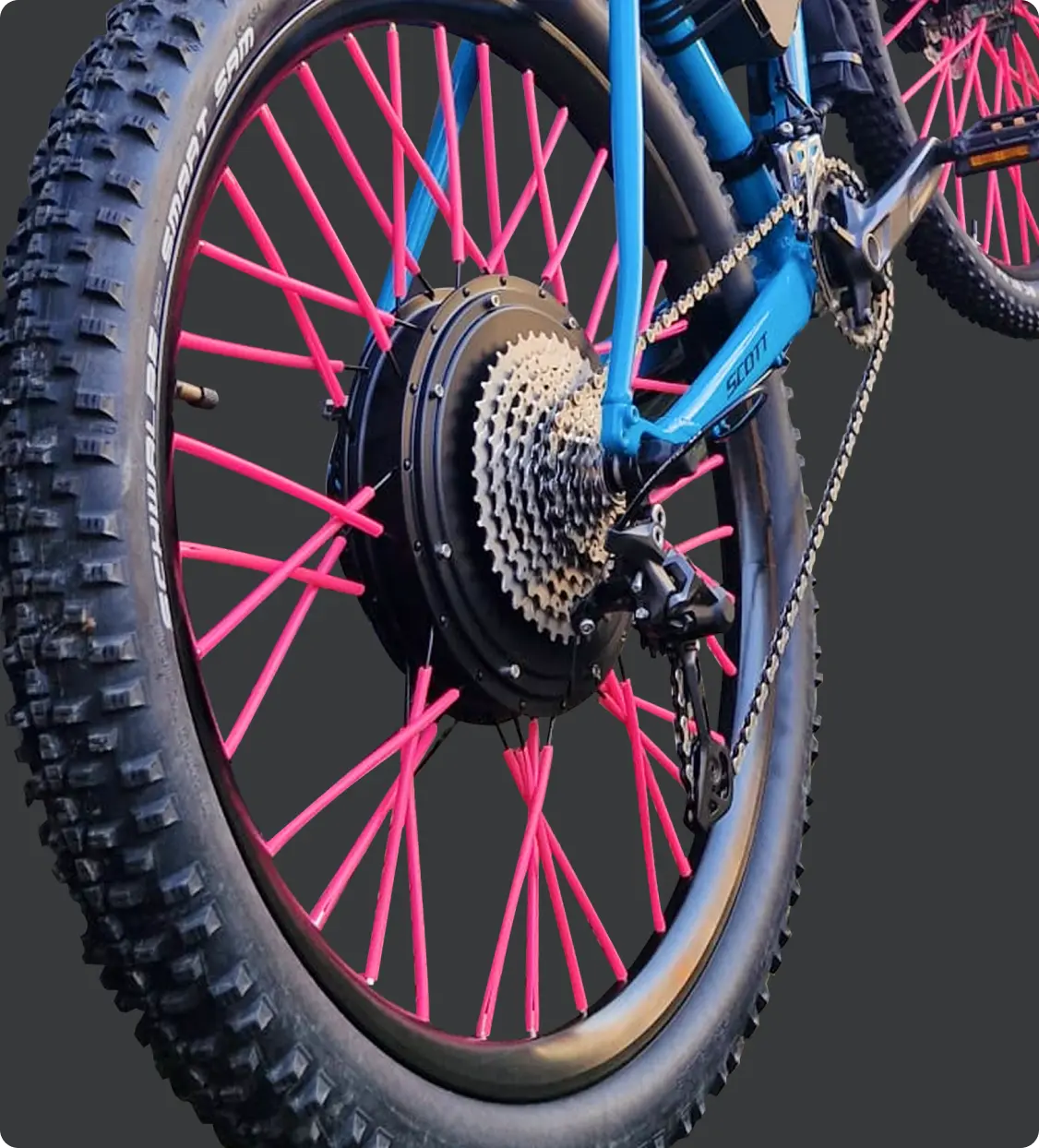
Een achternaaafmotor drijft het achterwiel aan, waardoor de kracht wordt geleverd waar je gewicht al zit. Dit zorgt voor een betere tractie en een natuurlijker rijgevoel, en presteert beter op heuvels — de gebruikelijke keuze voor gravel, touring en krachtigere builds.
- Betere tractie bij het klimmen en op losse gravel
- Natuurlijker, evenwichtiger rijgevoel onder vermogen
- Geschikt voor gravel, touring en langere woon-werk afstanden
- Gebruikt je bestaande cassette/freewheel versnellingen
De meeste van KirbEbike's krachtigere 700C-compatibele kits zijn achterwielkits — waaronder de 48V 1000W kit en de 52V 2000W MTX — op bestelling gebouwd in jouw wielmaat met ondersteuning voor 6- tot 12-speed vrijloop.
Mid-Drive conversie voor prestatiegericht gravelrijden
Een middenmotor wordt bij de trapas gemonteerd en drijft de ketting aan, waardoor deze de versnellingen van je fiets gebruikt. Dit zorgt voor een sterke klimefficiëntie en een gebalanceerd gewicht — ideaal voor steil, technisch of beladen gravelrijden — ten koste van meer slijtage aan de aandrijving en een complexere installatie.
- Gebruikt de versnellingen van de fiets voor efficiënt klimmen
- Gebalanceerde centrale gewichtsverdeling
- Het beste voor steil terrein, avontuur en hoger koppel
De afweging: meer slijtage aan de aandrijflijn en een complexere installatie. Overweeg je een middenmotor ten opzichte van een naafmotor voor gebruik buiten de asfalt? KirbEbike's gids voor het opzetten van gravel- en avonturenfietsen behandelt de motorkeuze, batterijplaatsing en slijtage van de aandrijflijn.
| Functie | Voornav | Achternav | Middenmotor |
|---|---|---|---|
| Installatie | Eenvoudigst | Matig | Moeilijkst |
| Tractie | Lager | Hoger | Hoog |
| Klimmen | Afhankelijk van vermogen | Goed | Best (gebruikt versnellingen) |
| Slijtage aandrijving | Geen | Laag | Hoger |
| Het beste voor | Vlak woon-werkverkeer | Gravel / heuvels | Steil / beladen |
Beste 700C Kit Vermogensniveaus voor Nederlandse Rijders
Kies het vermogen op basis van hoe en waar je rijdt, niet op basis van het grootste getal. Op een 700C race- of gravelframe vraagt meer wattage ook om sterkere wielen, remmen en frameconditie – dus stem de kit af op de fiets én op het terrein. Cruciaal is dat alleen 250W kits legaal zijn op de openbare weg in Nederland; een hoger vermogen is voor privé-terrein.
250W 700C Kits voor legaal Nederlands weggebruik
Een 250W kit met een maximumsnelheid van 25 km/u is de legale keuze voor dagelijks woon-werkverkeer, fitnessritten en vlakkere routes. Het houdt de ondersteuning natuurlijk, voegt het minste gewicht toe en vereist geen configuratie. KirbEbike's 250W voorwielkit past op 700C met 100 mm vorken, en de legale, dual-battery EZ Rider kit (tot 96 km bereik) is een sterke eerste keuze voor forenzen bij koud weer. Swytch, Cytronex en Boost vallen ook stevig in dit 250W-kamp – allemaal hieronder vergeleken.
500W–1000W Kits voor privé-terrein & off-road gebruik
Kits van 500W tot 1000W zijn geschikt voor steiler terrein, gravelpaden, zwaardere rijders en veeleisendere routes. Op vol vermogen overschrijden deze de Nederlandse openbare weg limieten en moeten ze worden gebruikt waar toegestaan – hoewel slimme kits kunnen worden teruggebracht tot 250W voor de weg. Achternaafconfiguraties zijn hier de norm voor tractie en heuvelklimmen.
High-Power 2000W+ Kits
2000W en hoger is extreem-bouwgebied: privé-terrein, performance-projecten en e-moto-achtige opstellingen. Deze vereisen sterkere wielen, remmen die geschikt zijn voor de snelheid en een zorgvuldige afstelling. Bij KirbEbike's slimme high-power kits begrenst een Limit Mode met één knop de fiets tot een legale 250W / 25 km/u, en ontgrendelt vervolgens het volledige vermogen off-road – een handige manier om één fiets voor beide werelden te gebruiken. Controleer altijd wat je frame en remmen veilig kunnen verwerken.
Batterijselectie voor een 700C conversie
De motor is slechts de helft van het systeem. Bij een complete set is de batterij inbegrepen, maar de capaciteit moet overeenkomen met je werkelijke ritten – en het pakket moet fysiek vrij zijn van je 700C frame, wat belangrijker is bij slanke racefietsframes dan bij ruime gravelframes.
Wat telt: spanning (moet overeenkomen met de motor/controller – 36–52V voor kits van forensenklasse, 60–72V voor hoog vermogen), ampère-uren (Ah) en watt-uren (Wh = V × Ah, de ware maatstaf voor bereik), celkwaliteit, en montagestijl. Druk het bereik uit als een band, nooit als één gegarandeerd cijfer.

De kernkits van KirbEbike delen één batterij-ecosysteem, dus pakketten zijn uitwisselbaar binnen het 500W–4000W-bereik en je kunt er later een tweede aan toevoegen. De Taishan en HS-II batterijen gebruiken genaamde LG 21700 en Samsung 50S cellen, een IP65 afgedichte behuizing en een 5A lader. Welk merk je ook koopt, beoordeel een pakket op celtype, BMS-rating, capaciteit en pasvorm – in die volgorde – en bevestig dat het in je framedriehoek past. Vergelijk de volledige ebike batterijcollectie.
Veelvoorkomende 700C-conversiefouten om te vermijden
De meeste aankoopspijt komt voort uit een paar vermijdbare fouten. Lees deze door voordat je een beslissing neemt.
Ervan uitgaan dat elk 700C-wiel past
Alleen de wielmaat garandeert geen compatibiliteit. Een kit kan correct als 700C gelabeld zijn en toch niet passen als de afstand van je voorvork of achterpat, de remstandaard of de speling anders zijn. Stem de hele checklist af, niet alleen de diameter.
Banden- en framevrijheid negeren
Een motorwiel kan de afstand enigszins veranderen, en een brede MTX-velg past mogelijk niet op een smal raceframe of spatborden. Controleer de vorkbreedte, framevrijheid en spatbordpasvorm ten opzichte van de door jou gekozen bandbreedte voordat je bestelt.
Te veel vermogen kiezen voor een lichtgewicht raceframe
Racefietsen zijn anders gebouwd dan mountainbikes. Hoog vermogen vereist sterke wielen, goed functionerende remmen en een stevig frame — het aanbrengen van veel wattage op een slank, vermoeid raceframe verplaatst het zwakke punt, het verwijdert het niet. Op lichtgewicht frames is een bescheiden 250–750W kit meestal verstandiger.
Vergeten van de Britse E-Bike Regels
Houd weglegale en off-road constructies mentaal gescheiden. In het VK is een kit alleen een weglegale EAPC als deze 250W continu vermogen levert, de assistentie stopt bij 15,5 mph en trapondersteuning vereist. Kits met een hoger vermogen zijn voor privéland. Raadpleeg de GOV.UK e-bike regels en rijd binnen deze.
Racefiets vs. Grindfiets Conversie: Wat is gemakkelijker?
Beide gebruiken 622 mm wielen, maar ze converteren anders. Grindfietsen bieden meestal meer ruimte om mee te werken; racefietsen vragen om meer zorg.
| Kenmerk | Racefiets | Grindfiets |
|---|---|---|
| Bandenspeling | Lager | Hoger |
| Remconfiguratie | Velg of schijf | Meestal schijf |
| Batterijmontage | Beperkt (slanke driehoek) | Meer opties |
| Off-road capaciteit | Beperkt | Beter |
| Dropout afstand | Vaak 130 mm QR | 130–142 mm (sommige steekassen) |
| Conversieflexibiliteit | Matig | Hoog |
Conclusie: grindfietsen bieden meestal meer conversieflexibiliteit dankzij sterkere frames, bredere banden, schijfremmen en meer bevestigingspunten. Racefietsen converteren ook goed, maar geven de voorkeur aan een lichtere, minder krachtige kit en zorgvuldige aandacht voor remmen en speling.
Top 700C conversiekit opties (VK)
Hieronder staan 700C-compatibele kits, gecontroleerd in juli 2026 en onderworpen aan dezelfde kritische blik – pasvorm, aandrijving, batterij en ondersteuning. De vijf bestrijken de twee uitersten van de markt: lichtgewicht weglegale 250W-systemen (Swytch, Boost, Cytronex) en krachtigere complete kits met een grotere batterij (ElectroCity Bikes, en KirbEbike's achterwielnaaf-reeks). Prijzen en voorraden veranderen – bevestig op de pagina van elke verkoper, en onthoud dat kits met een hoger vermogen alleen voor off-road/privéterrein zijn.
| Verkoper (domein) | Voorbeeld 700C kit | Batterij incl. | Vermogen / legaliteit | Prijs (vanaf) |
|---|---|---|---|---|
| swytchbike.com | Swytch GO (voornaaf) | Tot 378 Wh | 250W · weglegaal | £499 |
| boostbike.uk | Boost achternaaf kit | 36V 6Ah bidon | 250W · weglegaal | £522 |
| cytronex.com | Cytronex C1 (700C) | Bidon batterij | 250W · weglegaal | £982.99 |
| electrocitybikes.co.uk | 2000W 45A MTX (700C) | 48–60V driehoek | 2000W · off-road | £529.99 |
| kirbebike.com | 250W voor / 1000W MTX achter | LG/Samsung + lader | 250W legaal · tot 4000W | £237.70 |
Alle cijfers zijn geverifieerd op de live pagina van elke verkoper, juli 2026, en onder voorbehoud van wijzigingen — bevestig dit voordat u bestelt.
Swytch is de lichtste, snelst te monteren weglegale optie (250W voornaaf, kleine verwijderbare batterij) maar is alleen voor het voorwiel en heeft een korter bereik in de goedkopere pakketten. Boost is een net 250W achternaafsyteem (36V bidon, ~40 mijl, app-besturing) dat voornamelijk via fietsenwinkels wordt verkocht. Cytronex is de premium keuze — slechts 3,6 kg toegevoegd en sterke Britse ondersteuning — maar de duurste hier en alleen 250W.
ElectroCity Bikes is een voordelige manier om echte 700C-kracht te krijgen (een 2000W 45A MTX achterkit vanaf £529.99), maar strikt off-road op vol vermogen en alleen met een achtercassette. KirbEbike bestrijkt beide kampen, met een weglegale 250W voor-kit en EZ Rider naast op bestelling gemaakte krachtige achternaafkits — motorwielen gebouwd op jouw exacte maat, 6- tot 12-speed freewheels, een LG/Samsung-celbatterij en 1 jaar service in het VK/VS/Nederland — hoewel het meer gewicht toevoegt dan de lichtgewicht wegkits. De eerlijke samenvatting: voor absolute lichtheid op een racefiets zijn Swytch of Cytronex leidend; voor krachtige 700C met een beperkt budget zijn ElectroCity of KirbEbike logischer; Boost zit er tussenin voor eenvoudig montage door een fietsenwinkel.
Dit is een representatieve steekproef, niet de hele markt — Bafang-gebaseerde kits, plus bouwers zoals Skarper en Pendix, bedienen ook 700C-fietsen. Van wie je ook koopt, beoordeel elke kit aan de hand van dezelfde checklist: 700C/622 mm pasvorm, vork en achtervorkafstand, rem- en aandrijvingscompatibiliteit, accucellen en BMS, en after-sales ondersteuning.
Waarom kiezen voor KirbEbike voor een 700C conversie?

KirbEbike's aanbod voor 700C rijders draait om compatibiliteit en ondersteuning, in plaats van een harde verkoop. Omdat elk motorwiel op bestelling wordt gemaakt in jouw exacte maat, is de 700C pasvorm afgestemd op jouw fiets — je controleert de zijwand, kiest de maat, en hij past. Kits worden compleet geleverd met een volledig ingegoten controller, kleurendisplay, sensoren en een waterdichte snelkoppelbare kabelboom, plus een batterij met benoemde LG of Samsung cellen met een 5A lader.
- Pasvorm geverifieerde maatvoering — alle 13 standaardmaten (20″–29″, 700C), ondersteuning voor schijf- en velgremmen, 6- tot 12-speed freewheels
- Ride Power App afstemming — PAS-niveaus, stroom-/snelheidslimieten, acceleratiesterkte en een éénknops weglegale Limietmodus op slimme kits
- Menselijke ondersteuning & garantie — 1 jaar dekking met UK/US/Nederlandse service, en gratis verzending vanuit voorraad binnen het VK
Niets daarvan maakt het automatisch de juiste kit voor jou – de juiste kit is altijd degene die past bij je frame, aandrijving en doelen. Maar als je een op maat gemaakte 700C pasvorm wilt met een meegeleverde batterij en echte after-sales ondersteuning, is het een sterke kandidaat om te vergelijken met de alternatieven hierboven.
52V 2000W MTX velgkit
KirbEbike's achternaaf MTX kit gebouwd op jouw 700C wielmaat — 6- tot 12-speed freewheel, ingegoten controller en een LG/Samsung-cel batterij met lader. Off-road op vol vermogen, met een éénknops weglegale 250W Limietmodus.
Conclusie
Een succesvolle 700C-conversie hangt af van veel meer dan alleen de wielmaat. De 622 mm velg brengt je in aanmerking – maar de pasvorm wordt bepaald door de afstand tussen je voorvork en achterpat en het type as, je remsysteem, je banden- en framevrijheid, en het kiezen van een motor en batterij die passen bij jouw rijstijl. Meet die eerst en de installatie is snel; sla er één over en je bent een retourzending aan het herverpakken.
Stem de kit af op je fiets en rijgedrag: een 250W-voorwielnaafset (of de weglegale EZ Rider) voor eenvoudig, legaal woon-werkverkeer, een achterwielnaafset voor grip op grind en heuvels, of een middenmotor voor steile, beladen beklimmingen. Vergelijk KirbEbike op merites met Swytch, Boost, Cytronex en ElectroCity Bikes, bevestig de pasvorm op de pagina van de verkoper, rijd binnen de Britse wet — en geniet van de fiets die je al hebt, nu geëlektrificeerd.
Klaar om je 700C fiets om te bouwen?
Stem een complete 700C-kit af op je voorvork, pat en remmen — batterij, lader en ondersteuning inbegrepen.
Veelgestelde vragen
Hoe snel is een 700C elektrische fiets?
Past een 700C ebike ombouwkit op elke 700C fiets?
Hoeveel kost een ebike ombouwkit?
Is een 1000W e-bike legaal in het VK?
Is het beter om een ebike te kopen of mijn bestaande fiets om te bouwen?
Wat zijn de nadelen van ebike conversie?
Hoe snel is een 5000W ebike ombouwkit?
Wat is de krachtigste ebike ombouwkit?
Hoe meet ik mijn fiets voor een 700C ombouwkit?
Maakt de politie zich zorgen over e-bikes in het VK?
Bronnen
- GOV.UK — Regels voor elektrische fietsen (EAPC's): wat als weg legaal telt. gov.uk/electric-bike-rules
- GOV.UK — Elektrisch ondersteunde fietsen (EAPC's): informatieblad. gov.uk
- Sheldon Brown — Bandenmaatsystemen en ETRTO uitgelegd. sheldonbrown.com
- Park Tool — Onderhoudsgidsen voor wielen, naven, assen en rotoren. parktool.com
- Cycling UK — Elektrische fietsen en Britse fietsrichtlijnen. cyclinguk.org
- Bicycle Rolling Resistance — Bandenmaat en rolweerstandgegevens. bicyclerollingresistance.com