Triangle vs Downtube vs Rear-Rack Battery: Which Placement Suits Your Bike?
AK
Andy Kirby
Reviewed by the KirbEbike conversion-support team
Share
Unlock £10 off today
On this page
Placement is a fit decision before it is a capacity decision. The space inside your frame, the mounting points it actually has and where the weight ends up all matter more than the watt-hours printed on the case.
The Quick Answer
Downtube keeps weight lowest and suits most conversions. Triangle holds the most energy but needs a large open frame and a rated mount. Rear rack is the fallback when nothing fits centrally, at the cost of a rear-heavy feel. Decide by measuring: template the pack and its rail, check the removal path, and confirm the mounting points are rated for the load. A pack that does not fit is not a bargain at any capacity.
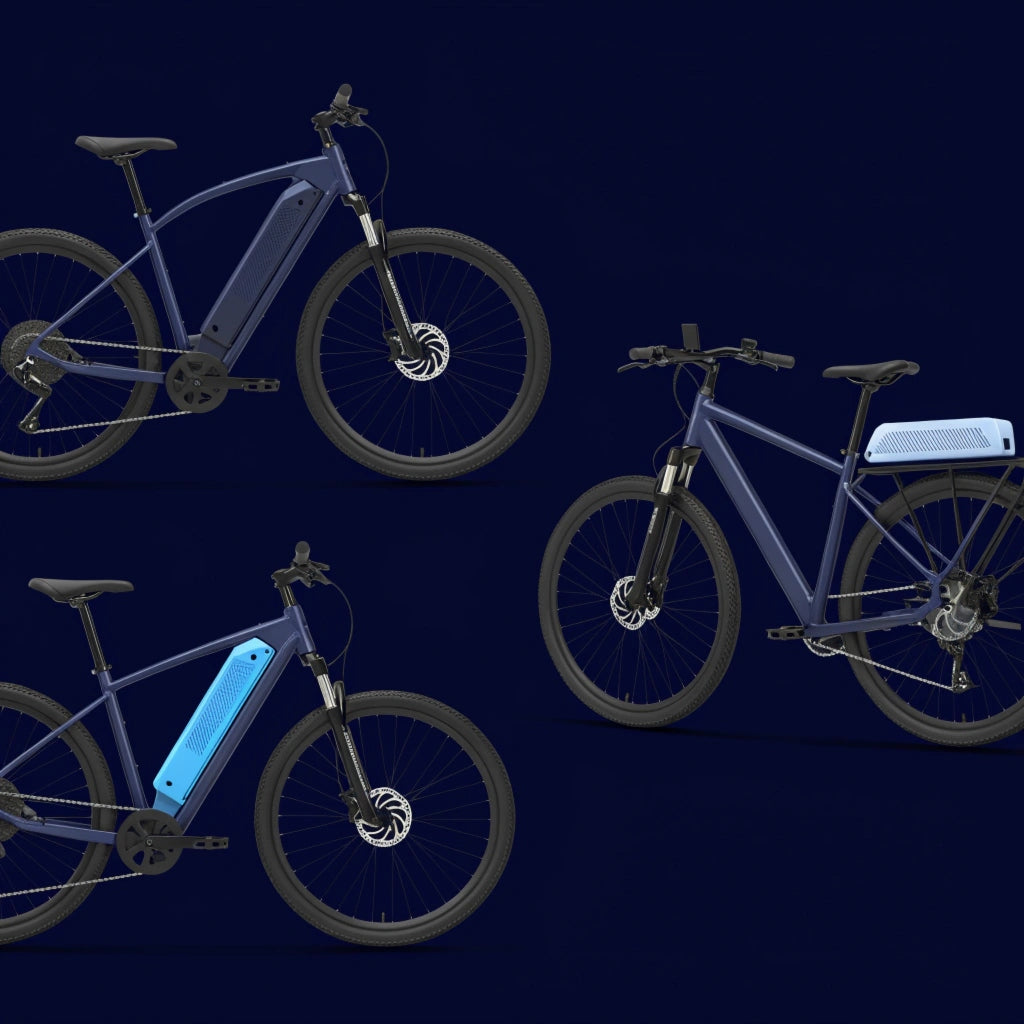
A triangle pack filling the frame space. The format that most often fails on measurement rather than price. Shown for format only — this HS-II case has no confirmed outline (see below).
Which Placement Suits Your Situation?
Your situation
Placement
Why
Verify before ordering
Standard diamond frame
Downtube
Low, central, uses bottle bosses
Bosses rated, and removal clearance
Large frame, want maximum Wh
Triangle
Most capacity for the space
Internal triangle dimensions
Step-through or small frame
Rear rack
Often the only usable position
Rack load rating for pack plus cargo
Full suspension
Case by case
Shock and linkage occupy the triangle
Clearance at full compression
Folding bike
Manufacturer-specific
The fold dictates the position
Whether the pack clears the hinge
Read down to your situation. The last column is where conversions fail.
Measure the space, confirm the mounting points, then choose capacity. Doing it the other way round is the most common and most expensive mistake on this page.
Triangle vs Downtube vs Rear Rack: Core Differences
Factor
Triangle
Downtube
Rear rack
Weight position
Central, mid-height
Low and central
High and rearward
Typical capacity
Highest for the space
Moderate to high
Moderate
Frame requirement
Large open triangle
Bosses or rated clamp
A rated rack
Handling effect
Small
Smallest
Most noticeable
Rack availability
Left free
Left free
Occupied
Removal
Often a zipped bag or rail
Usually a slide-off rail
Usually easy
Best suited to
High-capacity builds
Most conversions
Frames with no central space
Three formats, three constraints. None is universally best.
How Placement Changes Handling, and How Motor Position Interacts
The real trade-off: capacity against where the weight sits
Typical usable capacity plotted against approximate height of the battery mass above the ground — lower is better for handling. Indicative figures for a typical commuter build, not a measurement of any specific product. Teal = best handling for the capacity carried.
Downtube · ~34 cm least handling effect
~800 Wh
Triangle · ~46 cm small effect
~1,300 Wh
Rear rack · ~72 cm most noticeable effect
~620 Wh
Weight low and near the bottom bracket behaves closest to the bike’s original design, so steering, braking and balance stay predictable. Raise it or move it rearward and the bike turns more slowly and the front wheel carries less weight — most noticeable when walking or lifting it. The exact result depends on battery mass, fore-aft position, motor location, rack stiffness, frame geometry, cargo and rider position.
Motor position interacts with this, so plan them together. A rear-rack pack with a rear hub motor concentrates nearly all the added mass at the back; pairing a rack pack with a front hub balances the ends better, and a mid-drive keeps its own weight low so it tolerates a rack pack more gracefully.
Triangle Battery: What It Offers and What It Requires
A triangle pack fills the space inside the frame, which is why it carries the most energy for the room available — often 1,300Wh or more where a downtube position tops out lower. It is the format for high-voltage and long-range builds.
What it requires is a genuinely large open triangle — the constraint most buyers underestimate. Measure the usable rectangle inside the frame, not the triangle’s outer dimensions, and account for bottle bosses, cable routing and the shock on a full-suspension bike.
Downtube Battery: What It Offers and What It Requires
A downtube pack sits lowest and most central, which is why it disturbs handling least for the capacity it carries. It usually mounts on a slide-off rail bolted to the frame, and it is the default for most conversions. Our entry lithium packs with charger are the commuter-oriented option here.
What it requires is enough clear length along the downtube and, critically, room to take the pack off its rail once the rail is installed. KirbEbike packs are removable; what varies is whether the frame leaves enough travel to slide one off. The case may fit inside the frame outline and still lack that clearance, so check the rail’s removal direction and the travel it needs before drilling or clamping anything.
Taishan case — verified dimensions
Length 386.2 mm
Width 97 mm
Height 157.4 mm
Identical across 48V 30Ah, 52V 25Ah, 60V 20Ah and 72V 20Ah
Add the mounting rail beneath the case before templating
The clearance people forget
Batteries are removable — what varies is whether the frame leaves room
Rail-mounted packs slide off along the rail axis
Budget roughly the full case length again as slide-off travel
A case can fit inside the frame and still lack room to come off
Check the removal direction before drilling or clamping
📏
Two light-duty bottle bosses are not automatically a battery mount. Use a rated clamp or load-spreading plate where the frame’s bosses are not specified for it — our alloy battery mount is the rated hardware for KirbEbike packs. Check clearance to cranks, front tyre and any suspension fork at full compression.
Rear-Rack Battery: What It Offers and What It Requires
A rear-rack pack solves what the other two cannot: a frame with no usable central space — small frames, full-suspension bikes, folders and some step-throughs. It also frees the triangle for a bag or bottles.
What it requires is a rack rated for the load, counting the battery plus everything else you carry. Check the frame’s own rack-mount rating too, keep the pack as low and far forward as the mount allows, and expect the bike to feel rear-heavy when steering slowly or lifting it.
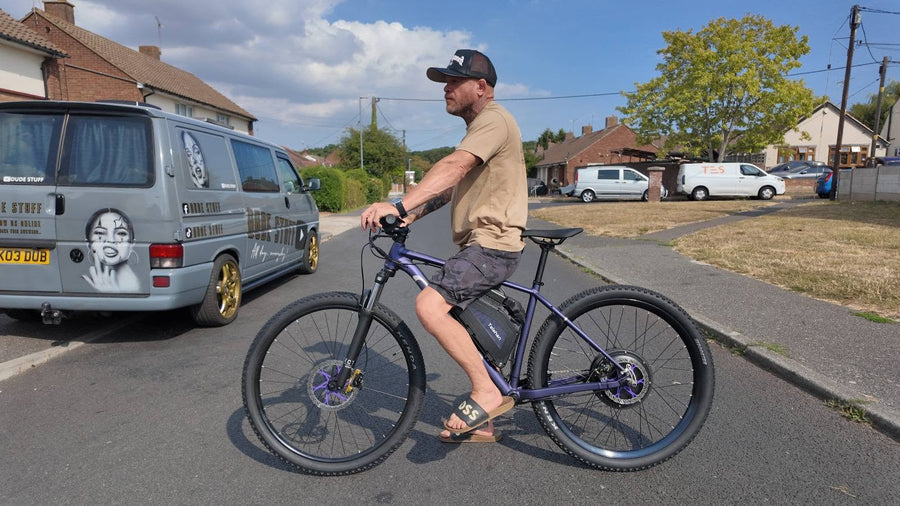
A Taishan pack mounted low and forward. Where a frame allows it, keeping the mass down and ahead of the axle preserves more of the bike’s original handling than a rack position.
Fit Comes Before Capacity
This is the gate. Work through it before comparing watt-hours, because the largest pack that fits is rarely the one you measured for.
Real dimensions — the manufacturer’s case size plus the mounting rail, not the photo
Template test — a full-size cardboard cut-out offered up to the frame
Removal clearance — the pack slides fully off, not just unlocks
Rated mounting — bosses, clamp or rack specified for the load including cargo
Dynamic clearance — cranks, tyre, fork and shock at full lock and full compression
Electrical match — voltage, continuous current, connector and charger confirmed
On hardware: a slide-off rail bolted to rated bosses is cleanest; a load-spreading plate or rated clamp is the alternative where the frame’s bosses are not specified for a battery. Factory-integrated batteries show the value of matched rails, sealing and charging designed around one frame, but proprietary packs are not conversion options — compare only batteries designed for your controller and frame. Check dynamic clearance at full steering lock and full suspension compression, and re-check fasteners after the first rides.
Does Placement Change Range?
Barely, and not directly. Range comes from watt-hours divided by consumption, so a 700Wh pack delivers roughly the same energy wherever it is bolted. Placement changes the bike’s balance, not its efficiency in any way you would notice.
What placement really changes is how much capacity you can fit at all. A large triangle may take 1,300Wh where a downtube position tops out lower, and that dwarfs any handling-related efficiency effect.
Compare watt-hours, not amp-hours
36V × 15Ah = 540Wh but 48V × 15Ah = 720Wh
Both are labelled “15Ah”. Amp-hours alone tell you nothing about stored energy until you know the voltage.
For illustration only, range can be estimated as usable battery Wh ÷ observed Wh per mile, where usable energy is roughly 85% of nominal once a charge reserve and conversion losses are allowed for. The consumption figures often quoted — 10 to 15Wh per mile on low assist, 15 to 25Wh mixed, 25Wh or more when fast, hilly or loaded — are planning arithmetic, not test results, and “low assist” and “mixed” are not reproducible categories. Measure consumption on your own route: speed, rider input, total mass, wind, temperature, tyre pressure and gradient all move the result.
Match Voltage, Current and BMS to the Kit
Placement decides where a pack goes; the electrical specification decides whether it should be connected at all. Match nominal voltage to the controller’s approved range, remembering that full-charge voltage sits higher — a 48V pack tops out near 54.6V, a 52V pack near 58.8V — so the controller must be rated for the range the pack actually presents. Then match current: the controller’s maximum battery current must fall inside the pack’s continuous discharge and BMS rating, with headroom. A large pack with an under-rated BMS will cut out on a climb however much energy it stores.
⚠️
Describe batteries correctly. There is no such thing as a “1000W battery”. Batteries are specified by voltage, amp-hours and watt-hours, plus continuous and peak discharge capability. What you want is a battery suitable for a given system load, confirmed against the controller’s current limit, the connector type and polarity, and the charger output.
Removal, Charging, Security and Safety
Removability is worth prioritising whatever the placement: it lets you charge indoors and store the pack separately. Check the lock is a real lock rather than a catch, the key is replaceable, and the connector is protected when the pack is off.
On charging, use only the charger supplied or authorised for the pack, charge in a dry ventilated place away from escape routes, and never charge a damaged, swollen, wet or unusually hot battery. Government guidance is explicit that batteries and chargers should be genuine items authorised by the manufacturer, and the statutory guidelines expect packs sold for conversion kits to include a battery management system. The fire service’s ChargeSafe guidance warns against universal or multi-plug chargers unless the battery maker has approved them, and its conversion-kit page covers the mismatched-charger risk specifically.
Battery Options to Compare
What to look for on the case itself. A real lock rather than a catch, a protected connector when the pack is off, and a charge port you can reach once the pack is mounted.
KirbEbike Range: Verified Fit Data
Case dimensions, mass and electrical specification for the variants we can state with confidence, checked against the battery parameter sheet on 7 August 2026.
Variant
Case L × W × H
Mass
Nominal V
Ah
Wh
Cont. BMS
Connector
Charger
Taishan 48V 30Ah
386.2 × 97 × 157.4
6.72 kg
48V
30Ah
1,440Wh
60A
XT60
5A
Taishan 52V 25Ah
386.2 × 97 × 157.4
6.2 kg
52V
25Ah
1,300Wh
60A
XT60
5A
Taishan 60V 20Ah
386.2 × 97 × 157.4
6.2 kg
60V
20Ah
1,260Wh
60A
XT90
5A
Taishan 72V 20Ah
386.2 × 97 × 157.4
6.8 kg
72V
20Ah
1,440Wh
60A
XT90
5A
Entry DP 52V 20Ah
Per variant
5.1 kg
52V
20Ah
1,040Wh
40A
Confirm
2A
Entry DP 48V 20Ah
Per variant
4.5 kg
48V
20Ah
960Wh
40A
Confirm
2A
Entry TS 48V 16Ah
Per variant
4.0 kg
48V
16Ah
768Wh
30A
Confirm
2A
Entry XS 36V 15Ah
Per variant
2.5 kg
36V
15Ah
540Wh
30A
Confirm
2A
Taishan dimensions are identical across all four models, so one outline covers the series — see the case and clearance figures above. Entry-line dimensions are published per variant. Browse the Taishan range for the full series.
⚠️
HS-II excluded from this guide until its fit data is confirmed. The HS-II series is deliberately not listed above. Capacities are clear — 52V 30Ah, 60V 20Ah and 72V 20Ah — but the case outline is not. The product page gives four figures (360.6 / 281.3 / 195.4 / 131.6 mm) without stating which edges they describe and without publishing the case width, while the product image labels a fifth figure of 97 mm for width and gives 183.3 mm where the page says 195.4 mm. A placement guide that tells you to measure first cannot then ask you to plan around numbers that disagree with each other. If HS-II is the pack you want, ask us for the confirmed case outline in writing before ordering.
Two external reference points, for context rather than ranking. EM3ev builds custom triangle packs to a template you supply — highest capacity for the space, with lead times and the measuring burden on you. Unit Pack Power is the budget benchmark for generic Hailong-style cases, where tolerances and cell provenance vary between batches.
Common Battery-Placement Mistakes
Mistake
Why it costs you
Choosing capacity before measuring
The largest pack that fits is not the one you measured for
Templating the case without the rail
The rail adds height and its own fixing centres
Forgetting the removal path
A pack that fits but will not slide off is a pack you cannot charge easily
Treating bottle bosses as a battery mount
They are rated for a bottle, not kilograms under vibration
Ignoring rack load rating
Battery plus panniers plus shopping exceeds it quickly
Matching voltage but not current
A pack that sags or cuts out under load was never the right pack
Final Check Before Ordering
Frame
Measured. Template of case plus rail offered up. Removal clearance confirmed. Mounting points rated for the load including cargo. Dynamic clearance checked at full lock and full suspension compression.
Electrical
Nominal and full-charge voltage inside the controller’s range. Continuous BMS current covers its demand. Connector and polarity confirmed. Charger authorised for the pack.
Installation
Cable runs protected with strain relief. Fasteners re-checked after the first rides. Lock and key verified. Connector protected when the pack is off.
Product touchpoint
Getting the placement right first time
Template the space before you shop, then match the pack to it. Our battery and charger range covers downtube-style and slim-profile packs with matched chargers, and the alloy mount is the rated option where bottle bosses alone are not enough. Send us your frame measurements and we will confirm the exact case size for the variant you are considering — and if your frame has no usable central position, we will tell you a rack pack or a different format is the better answer.
The downtube position generally disturbs handling least for the capacity it carries, which is why it suits most conversions — though the exact result depends on the complete build. A triangle pack carries the most energy for the space and asks for a large open frame and a rated mount. A rear-rack pack is the answer when the frame offers no usable central position.
So measure the real space, template the pack with its rail, confirm the mounting points are rated for the load, and only then compare watt-hours. Fit decides the format; capacity is the last decision, not the first.
Fit decides the format, capacity comes second
Template the frame, check the mounting points, then compare watt-hours.
They change it noticeably rather than badly. Weight sits high and behind the axle, so the bike feels rear-heavy when steering slowly or lifting it. Keep the pack as low and far forward on the rack as the mount allows, and count it against the rack’s rated load.
How do I know if a battery will fit my frame?
Take the case dimensions, add the rail, and cut a full-size card template of both. Offer it into the frame, then check the removal path — most rail-mounted packs need roughly the case length again in clear space to slide off.
Can I mount a battery using only bottle-cage bosses?
Only where the frame maker and the battery maker both specify it for that load. Two light-duty bosses are designed for a bottle, not kilograms of battery under vibration. Otherwise use a rated clamp or load-spreading plate.
Will a battery fit a full-suspension frame?
Often not in the main triangle, because the shock and linkage occupy it. Check clearance through the full suspension travel, not just at rest. A rear rack or a smaller downtube pack is the usual answer.
What voltage and BMS current do I need?
The pack’s nominal and full-charge voltage must sit inside the controller’s approved range, and its continuous BMS discharge current must cover the controller’s maximum battery current with margin. Match connector and polarity too. Capacity is the last decision, not the first.
Is it safe to charge an e-bike battery indoors?
Charge in a dry, ventilated place away from escape routes, using only the charger supplied or authorised for the pack, and not unattended or overnight. Stop using a pack that has been damaged, dropped or has swollen.
A note on safety & legality. General information, not a substitute for the frame, rack or battery manufacturer’s instructions. Never exceed a rack’s stated load, never mount a pack on unrated fittings, and use only a charger supplied or authorised for your battery. Charge in a dry, ventilated place away from escape routes and never charge a damaged, swollen, wet or hot pack. In Great Britain a converted cycle is an EAPC only when it has working pedals, a motor rated no higher than 250W continuous and assistance that stops at 15.5mph; above that it is outside EAPC classification and may be used on private land with the landowner’s permission and subject to site rules, or on roads only with the relevant motor-vehicle approval, registration, tax, insurance, licence and equipment.
About this guide. Author: KirbEbike Editorial. Technical review: KirbEbike conversion support. Last reviewed: 7 August 2026. Methodology: battery safety and legality cross-checked against GOV.UK and London Fire Brigade guidance, all cited inline. The capacity-versus-height chart uses indicative figures for a typical commuter build to illustrate the trade-off and is not a measurement of any specific product. Watt-hour figures are arithmetic and the consumption bands are planning assumptions. Product formats, capacities and mounting requirements were read from each supplier’s live pages on 7 August 2026 and are published claims; where our own dimension data is still being confirmed internally it is not published here. Confirm the exact case size, mounting rating and electrical specification in writing before ordering.
Stay in the know
Conversion guides, fitting advice and the deals worth knowing about. No spam.