Why a 2000W Ebike Cuts Out Under Load: BMS, Voltage Sag, Connectors and Heat
Start with the pattern of the cut-out, not the part you suspect. Whether the display goes dark, whether power returns on its own, and whether it happens only uphill, only when hot or only over bumps will narrow the cause faster than any replacement part.
AK
Andy Kirby
Reviewed by the KirbEbike conversion-support team
Share
Unlock £10 off today
On this page
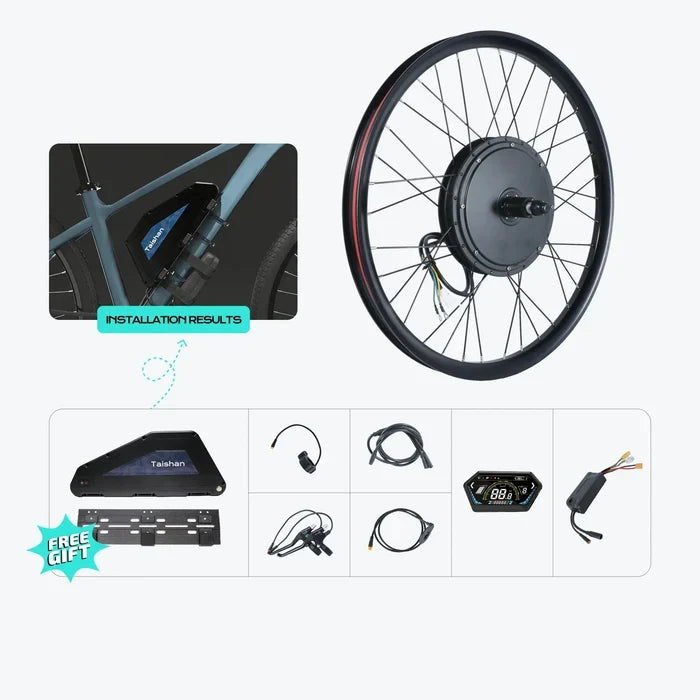
Motor-kit overview from KirbEbike. Battery selection and included components depend on the chosen variant.
DIAGNOSE BEFORE REPLACINGCLEAR STOP POINTSUK MARKET
💡
THE SHORT ANSWER
A 2000W system cutting out under load is usually the battery reaching a protection limit — either the BMS tripping on overcurrent, or voltage sagging far enough to hit the low-voltage cut-off. The other common causes are connector resistance, thermal protection and signal faults.
Work from the pattern rather than the part. The single most useful observation is whether the display goes off: if it does, power to the whole system was interrupted, which points battery-side. If the display stays lit and only the motor stops, the battery is still delivering and the problem is more likely controller-side or a signal fault. Everything below refines that first split.
Direct Answer: What the Pattern Tells You
What you observe
Usually points to
Why
Next safe check
Display goes dark, needs a reset
Battery-side interruption
Whole system lost power
Resting voltage, rail contact
Display stays on, motor stops
Controller or signal side
Battery still delivering
Error code, brake and throttle
Only uphill or hard acceleration
Current demand exceeding supply
Peak draw reaches a limit
BMS rating vs controller draw
Only once the system is hot
Thermal protection
Heat accumulates over minutes
Component temperatures after load
Over bumps or with cable movement
Intermittent connection
Contact breaks momentarily
Connectors, rail, cable exits
Diagnostic starting points, not confirmed causes. Two patterns can overlap, so record what you actually see.
Replacing a part without matching the pattern usually reproduces the fault. The most expensive mistake in this list is fitting a new controller for a battery-side problem.
Diagnostic Tree
Work top to bottom. The display question splits the problem in half; the pattern questions narrow it from there.
Six questions get most riders to the right half of the system. Did the display turn off? Did power return without power-cycling the battery? Does it happen only at high load? Does temperature change the fault? Do bumps or cable movement trigger it? Is there an error code — and did you record it before resetting anything?
BMS Trip, Controller Protection and Voltage Sag
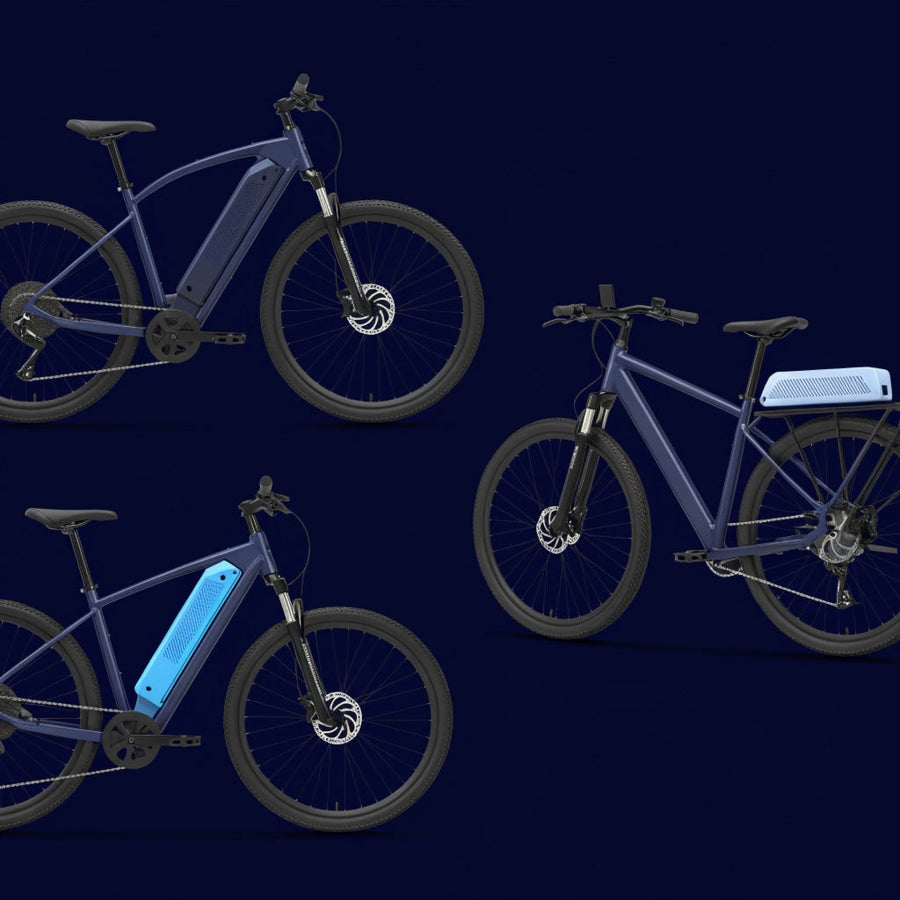
Battery example for the supply-side checks. The case appearance does not establish its BMS rating or condition.
A BMS trip interrupts the battery’s output, so the whole system loses power and the display goes dark. Some packs recover on their own; others need the battery switched off and on. Controller protection is different: the battery keeps supplying, so the display usually stays lit while the motor stops or power reduces. A fault requiring a battery power-cycle therefore suggests battery-side protection, and a display that stays on suggests the controller or a signal. Neither clue is absolute proof — treat them as strong hints that direct the next check. Our BMS amps guide covers the ratings involved.
Voltage sag is the third mechanism and the one most often misread as a flat battery. Every cell has internal resistance, so drawing current causes a temporary voltage drop that recovers when you release the throttle. Sag worsens at low state of charge, in the cold and as cells age, because all three raise internal resistance. One weak cell group can drag the pack to the protection threshold early even when the others are healthy, which is exactly why battery bars can look normal moments before a cut-out — the display is showing an unloaded estimate, not what the pack does under 35A.
A Worked 52V Current Check
Use the arithmetic as a starting point, not a specification. Dividing 2,000W by 52V gives roughly 38.5A, which is a sanity check only — what the battery actually sees is set by the controller’s DC current limit. Our 52V 2000W kit lists a 35A FOC controller, so that is the figure to compare against a pack rating, not the motor label.
Pack BMS continuous
Against a 35A controller
Verdict
40A
5A headroom
Marginal — cut-outs likely under sustained load
50A
15A headroom
Adequate
60A
25A headroom
Comfortable
Compare continuous ratings only. A peak or short-duration figure cannot be relied on for a climb.
So a 40A BMS is not automatically a safe match for a 2000W setup, and that mismatch is one of the most common causes of load-dependent cut-outs we hear about. Separate continuous from peak in every specification you check: peak ratings apply for seconds and tell you nothing about a two-minute climb.
Uphill-Only Cut-Outs
Hills raise torque demand and therefore current, and they hold it high for far longer than a flat-road acceleration. The timing of the failure is informative. Failing early on the climb points to peak current demand meeting a BMS or controller limit. Failing only after a long climb points to heat — in the motor, controller or battery. Working again after cooling confirms thermal protection rather than a hard fault, though it is a clue and not a fix.
Direct-drive hub motors deserve a specific note here. At low speed under heavy load they operate at their least efficient point with little airflow, so a slow grind up a steep hill generates more heat than the same power on the flat. That makes long low-speed climbing the hardest thing you can ask of this kind of build — our guide to hub motor internals explains why.
Throttle Cut-Outs Under Acceleration
If a full-throttle start causes a cut-out but a gentle roll-on does not, the demand is reaching a limit — check the BMS and controller ratings before suspecting the throttle itself. If PAS works normally and only the throttle cuts out, that pattern points instead at the throttle signal, its connector or its wiring, because a system-wide power problem would affect both.
💡
DO NOT KEEP REPEATING FULL-POWER TESTS
Once you have reproduced a cut-out once or twice, stop. Repeatedly forcing a high-power system into protection stresses cells, connectors and the controller, and can turn a diagnosable fault into a damaged component. Record what happened, then move to the lower-load checks below.
Connector Resistance: Fine at Low Power, Failing at 2000W
Official connector reference for one controller configuration, not a universal wiring guide. Match the exact model and pinout.
Power lost at a connection is current squared times resistance, so a joint that behaves perfectly at 10A can become a heat source at 35A. That is why connectors fail specifically under load, and why a bike can be fine around the car park and cut out on the first hill. Check the battery-to-controller connection, the battery rail and contact pins, the main power connectors, the motor phase connections, and every crimp, solder joint and cable strain point. Our installation mistakes guide covers crimping and routing.
Signs of a high-resistance connection are consistent: warmth at the plug after a ride, discolouration or browning of the housing, a loose or recessed pin, green or white corrosion on contacts, or a connector that feels different to insert from its pair. A warm connector is a fault, not a quirk. As an A-versus-B check: cut-outs triggered by bumps favour an intermittent connection, while heat or discolouration at a contact favours resistance there. Load-dependent voltage collapse can still be battery-side, so those clues narrow the search rather than closing it.
Heat-Related Cut-Outs
Controller housing example. Follow the model-specific mounting and cooling requirements; a photograph cannot diagnose overheating.
Where the heat is
Typical behaviour
What it suggests
Battery / BMS
Cut-out after sustained high draw
Thermal protection in the pack
Controller
Gradual power reduction, then cut-out
Thermal rollback protecting the unit
Motor
Fade on long climbs, recovers when cool
Motor thermal limit or protection
A single connector
Localised heat, discolouration
Resistance at that contact, not thermal protection
A hot connector is a different problem from thermal protection, and a more urgent one.
"It works again after cooling" tells you the system protected itself, which is useful information and not a repair. Something is producing more heat than the design intends, and that cause is still present when the bike cools down.
A Safe Test Sequence
💡
Six checks, in this order
Record the symptom first — what happened, where, at what load, and any error code, before changing anything
State of charge and resting voltage — sag and cut-outs are far more likely on a part-empty pack
Inspect connectors with the power off — battery, main power, phase and accessory plugs for heat marks or corrosion
Confirm the ratings match — battery continuous and BMS against the controller’s DC current limit
Reproduce at lower load on flat ground — gentler throttle, level surface, somewhere safe to stop
Record voltage under load and temperatures — only where your system provides a safe readout
Then record any error codes exactly as displayed, along with what you were doing when they appeared, before resetting. Generic error-code lists found online frequently mislead, because the same number means different things across controller families — record the code, the controller model and the display model together. If the fault repeats, stop and contact support with that evidence rather than continuing to test. Government guidance is explicit that a device showing overheating, deformation, smoke or unusual smell should be taken out of use (GOV.UK).
What Not to Do
Do not
Why
Bypass the BMS
It is the pack’s primary protection; removing it risks fire
Fit a higher-amp BMS without verifying the cells
The cells set the real limit; a bigger BMS just removes the warning
Bridge a fuse or main connector
You remove protection and create a high-current fault path
Repeat full-throttle hill tests
Stresses cells, connectors and controller into damage
Open the battery pack as a first step
Not a first diagnostic step; risk of short circuit and fire
Raise controller current to push through
Makes an overcurrent problem worse, not better
Assume a new controller fixes it
A battery-side fault will do the same to the new one
If a check requires bypassing a protection device, it is the wrong check.
Stop Riding Immediately If You See These
Swelling or case deformation on the battery
Smoke, hissing or crackling from the pack or any component
A strong chemical or burnt smell
Melted or charred connector housings
Rapid or abnormal temperature rise in the battery, controller or cabling
Fluid leakage from the battery, or electrical faults following a crash or water ingress
In any of those cases, stop using the bike, do not recharge the battery, move it somewhere safe away from anything combustible and from escape routes, and seek professional advice. Conversion kits are specifically associated with incompatible component combinations in fire-service guidance (London Fire Brigade), and government guidance identifies modification or repair with non-compatible parts as a factor that raises risk (GOV.UK).
If a Replacement Is Genuinely Needed
Four routes, listed alphabetically and judged on the same criteria: what they cover, configurability and the main limitation. Match the system rather than upsizing blindly — a larger part fitted to an unchanged system usually relocates the fault.
1. Fardriver ND Series
Programmable FOC controllers covering this power class and above, configured through a computer interface with battery-side and motor-side current limits both exposed. Useful if you have established that the controller is genuinely at fault and you want deeper parameter control than a phone app provides. The limitations are that setup expects a PC, documentation is technical rather than consumer-facing, and the range is oriented toward scooter and light electric-motorcycle applications, so confirm bicycle-appropriate sizing and connectors before ordering.
2. KirbEbike Components
Matched replacements across the system: the 52V 2000W MTX kit as a complete unit, smart controllers with Ride Power configuration and live diagnostics, batteries published with their BMS rating, plus main cables and connectors. Honest limits: these pair with our own systems rather than universally, controllers are potted so a fault means replacement, and a replacement part only helps once the diagnosis points at that part.
3. Sabvoton Programmable Controllers
Established programmable FOC sine-wave controllers spanning roughly 36V to 72V with app or PC parameter setting and self-learning motor matching. Battery and phase currents are separately adjustable, which is genuinely useful when a cut-out investigation has shown the current limits need setting differently rather than the hardware replacing. The cautions are reseller variability in listing accuracy and support, and an ecosystem oriented toward higher-power scooter builds than bicycles.
4. VESC-Based Controllers
An open-source FOC platform with the deepest configuration of these four, including separate battery-side and motor-side current limits and built-in data logging. That logging is the relevant feature here: it records voltage and current through a fault, which is the evidence a cut-out investigation most often lacks. It is also the least beginner-friendly option, requiring a computer, careful motor detection and genuine understanding of the parameters, and board quality varies between vendors.
Option
Covers
Configuration
Diagnostics
Main limitation
Fardriver ND
Controller
PC interface
Limited
Technical setup; confirm sizing
KirbEbike
Kit, controller, battery, cables
Bluetooth app
Live data
Own-system pairing; potted
Sabvoton
Controller
App or PC
Varies
Reseller variability
VESC-based
Controller
PC tool
Built-in logging
Steep learning curve
Listed alphabetically. Diagnose first; a replacement part is the last step, not the first.
Battery, Controller or Wiring: Which to Replace
Replace this
Only when
The battery
Load testing or BMS evidence supports it, not just age
The controller
Input power is stable and the evidence points controller-side
Connectors or harness
Physical or resistance evidence supports it
When the evidence is ambiguous, a professional load test is the better next step than a guess.
UK Safety and Legal Note
Two things worth stating plainly. On safety, use only a charger supplied or authorised for your pack, and never continue riding a system showing the warning signs above (GOV.UK). On legality, a 2000W build is outside Electrically Assisted Pedal Cycle classification in Great Britain: an EAPC needs working pedals, a motor rated no higher than 250W continuous and assistance cutting off at 15.5mph (GOV.UK), and a cycle exceeding that is treated as a motor vehicle (GOV.UK EAPC standards). Such builds belong on private land with the landowner’s permission and subject to site rules.
Product touchpoint
Check the ratings before you buy anything
Most load-dependent cut-outs we see are a matching problem rather than a failed part. Compare your pack’s continuous and BMS rating against the controller’s DC current limit using our BMS amps guide before replacing anything. If the pack is genuinely under-rated, the battery range publishes continuous and peak figures, and a complete kit removes the matching question entirely. If you have the warning signs listed above, stop and contact us rather than testing further.
Conclusion: Diagnose the Pattern Before Replacing Parts
A 2000W system cutting out under load is telling you something specific, and the pattern is the message. A dark display points battery-side; a lit display with a stopped motor points controller-side or at a signal. Uphill-only failures point at current demand or heat; bump-triggered failures point at an intermittent connection; failures that worsen as the pack empties point at sag.
So record the symptom, check state of charge and resting voltage, inspect connectors with the power off, and compare the BMS continuous rating against the controller’s actual draw before buying anything. Never bypass protection, never raise current to push through a cut-out, and stop immediately on any of the warning signs above (GOV.UK). If the fault repeats after those checks, a professional load test is worth more than a replacement part bought on a guess.
The pattern names the part
Display behaviour, load dependence and temperature narrow it faster than any replacement.
Most often the battery reaching a protection limit — a BMS overcurrent trip or voltage sagging to the low-voltage cut-off. Connector resistance, thermal protection and signal faults are the other common causes.
Why does my ebike motor cut out when I go uphill?
Hills raise current demand and hold it high. Failing early on a climb suggests peak current meeting a limit; failing only after a long climb suggests heat in the motor, controller or battery.
Why does my ebike keep cutting in and out?
Intermittent cut-outs, especially over bumps, usually indicate a connection breaking momentarily — a battery not fully locked to its rail, worn or contaminated contacts, a loose main connector or a wire breaking near a bend.
Why does my throttle cut out when I accelerate?
If gentle roll-on works and full throttle does not, demand is reaching a limit. If PAS works normally and only the throttle cuts, suspect the throttle signal, connector or wiring instead.
What are the symptoms of a bad ebike battery?
Rapid voltage drop under load, cut-outs that worsen as the pack empties, reduced range, slow charging or refusal to charge, unusual heat, and any swelling or deformation — which means stop using it.
How do I know if the BMS is cutting power?
A BMS trip interrupts the battery output, so the display goes dark and power may need a battery power-cycle to return. If the display stays lit while the motor stops, the battery is still delivering.
Why does my ebike stutter when I accelerate?
Stuttering under acceleration often points at hall sensor or phase connection faults, or a controller reaching a protection limit. Record any error code before resetting, and check phase connectors.
How can I tell whether the battery or controller is causing it?
Start with the display. Dark display suggests battery-side power interruption; lit display with a stopped motor suggests controller or signal. Then compare the BMS continuous rating against the controller draw.
Is voltage sag the same as a low battery?
No. Sag is a temporary drop under load that recovers when you ease off, and it worsens at low charge, in cold weather and as cells age. Battery bars can look normal moments before a sag-triggered cut-out.
When should I stop riding and get it inspected?
Immediately on swelling, deformation, smoke, hissing, a burnt or chemical smell, melted connectors, abnormal heat, fluid leakage, or electrical faults after a crash or water ingress. Do not recharge the pack.