10 Electric Bike Conversion Kits Compared for 2026
KE
KirbEbike Editorial
Reviewed by the KirbEbike conversion-support team
Share
Unlock £10 off today
On this page
An electric bike conversion kit adds a motor and battery to a bike you already own, for a fraction of the price of a complete e-bike. The catch is that “which kit?” is really several smaller questions about how your bike is built and where you will ride. This guide compares ten kits across four practical groups — road-legal commuting, lightweight and removable systems, mid-drive hill-climbing builds, and high-power private-land builds — and assesses every product against the same criteria, including our own. Start by browsing the conversion kit and battery options, but read the fit and legal notes before you buy anything.
The short answer
For UK public-road use as an EAPC, the bike must have usable pedals, a motor rated no higher than 250W continuous, and assistance that stops at 15.5 mph. Anything outside those limits is not an ordinary bicycle on the road — it may need motor-vehicle approval, registration, tax, insurance, a licence and an approved helmet, and belongs on private land with permission. Match the kit to your wheel size, dropouts, brakes, drivetrain, battery space and legal use — not to the wattage on the box.
How we assessed every kit · methodology. This is a use-case comparison, not a universal league table. Every product — including the two KirbEbike entries — is checked against the same fields: bicycle compatibility, included components, installation difficulty, safety documentation, support and replacement parts, warranty route, evidence source and legal-use classification. The KirbEbike entries are manufacturer-verified against our own product data; all other kits are desk-researched from each brand’s live product pages and were not hands-on tested for this article. Prices, stock and configurations were checked in July 2026 and can change — confirm the exact model before ordering.
10 Conversion Kits at a Glance
Kit
Motor type
Power
Best suited to
Install
UK road status
Bafang BBS02B
Mid-drive
250W–750W+
Configurable hill-climbing
Advanced
Not an EAPC (rated above 250W)
KirbEbike EZ Rider
Front hub
250W
Bundled first conversion
Easy
Road-legal
Swytch Go
Front hub
250W
Simple commuting
Easy
Road-legal config
Boost
Rear hub
250W class
Bespoke rear-wheel fit
Medium
Road-legal config
Rubbee X
Friction (seatpost)
250W
Tool-free removable
Easy
Road-legal config
Swytch Air
Front hub
250W
Portable, removable pack
Easy
Road-legal config
Cytronex C1
Front / rear hub
250W
Lightweight premium
Easy–medium
UK/EU version
Pendix eDrive
Mid-drive
250W
Dealer-fitted premium
Dealer
Road-legal config
Skarper DiskDrive
Disc-driven clip-on
250W
Easiest on / off
Easy
Road-legal config
KirbEbike high-power
Rear hub (DD)
1000–4000W
Private-land performance
Medium–adv.
Not an EAPC — private land
Each kit is included for a defined rider or use case rather than presented as a universal winner. Choose the system that matches your bike, riding conditions and legal use.
How We Compared the Same Criteria for All Ten
To keep the comparison fair, each kit was checked against an identical list rather than a personal favourite:
Bicycle compatibility — wheel sizes, open dropout or thru-axle, front/rear spacing, rim or disc brakes, freewheel or cassette, and bottom-bracket fit for mid-drives
Complete-kit value — whether the price includes motor, battery, controller, display, sensors, charger and torque arms, or leaves some as separate buys
Installation difficulty — easy (wheel swap and wiring), medium (rear gearing and brake alignment) or advanced (bottom-bracket work or high-current systems)
Support and parts — manuals, technical support, spare controllers and displays, replacement batteries, warranty and UK servicing
Legal use — stated neutrally: a private-land kit is not penalised for exceeding EAPC limits, but its use is never presented as road-legal commuting
Kit
Fit range
Battery
Protection
Support / warranty
Road use
Evidence · checked
Bafang BBS02B
68–73mm BB; most wheels
Optional extra
Config-dependent
Community + retailers; varies
Not an EAPC (>250W)
Desk-researched · Jul 2026
KirbEbike EZ Rider
100mm front QR; 20–29″
Included
Sealed controller, keyed plugs
KirbEbike UK; 1-yr warranty
Road-legal
Manufacturer-verified · Jul 2026
Swytch Go
100mm front; disc/V-brake
Included
Sealed pack + connectors
Order delays reported
Road-legal config
Desk-researched · Jul 2026
Boost
Rear hub; check OLN
Optional
Sealed controller
UK-based
Road-legal config
Desk-researched · Jul 2026
Rubbee X
Seatpost friction; most bikes
Included
Self-contained unit
EU-based
Road-legal config
Desk-researched · Jul 2026
Swytch Air
100mm front; disc/V-brake
Included
Handlebar pack + connectors
Swytch support
Road-legal config
Desk-researched · Jul 2026
Cytronex C1
100mm QR front; 142×12 rear
Included
Bottle battery, sealed
UK-based; premium
Road-legal (UK/EU)
Desk-researched · Jul 2026
Pendix eDrive
Mid-drive; dealer fit
Included
Dealer-fitted, sealed
Dealer network; premium
Road-legal config
Desk-researched · Jul 2026
Skarper DiskDrive
Disc-mount clip-on
Included
Clip-on sealed unit
Skarper support
Road-legal config
Desk-researched · Jul 2026
KirbEbike high-power
135–142mm open dropout
Bundled or kit-only
Potted controller + sealed harness
KirbEbike UK; 1-yr warranty
Not an EAPC; private land
Manufacturer-verified · Jul 2026
Evidence status: the two KirbEbike entries are manufacturer-verified against our own product data; all other kits are desk-researched from each brand’s live product pages. None of the non-KirbEbike kits was hands-on tested for this article.
The 10 Kits, Reviewed
1. Bafang BBS02B Mid-Drive — Best for Configurable Hill-Climbing
The tinkerer’s favourite. Bafang’s crank-mounted BBS02B drives through your gears — hugely configurable, but the battery is usually a separate purchase and the install is the biggest job here.
Bafang’s crank-mounted mid-drive is the best-known name in DIY conversions, and for one clear reason: it drives the chain through your existing gears. Drop into a low gear and the motor spins in its efficient band while the bike climbs slowly — which is why a mid-drive out-climbs a hub motor of the same rated power. The feel is natural, the weight sits low and central, and the ecosystem is enormous: wheel size doesn’t matter, displays and batteries are chosen to suit, and community firmware knowledge runs deep.
The honest costs are threefold. First, the install is the most demanding in this guide — both crank arms, the chainring and the bottom bracket come off, and cable routing, speed-sensor alignment and chain line all need to be right. Second, all that torque runs through your chain and cassette, so the drivetrain wears faster, especially if you shift under full power. Third, the battery is usually a separate purchase, so the real project cost is well above the motor price once a quality pack, tools and possibly a professional fit are added.
Fit & legal: needs a 68–73mm threaded bottom bracket. The BBS02B’s continuous rated output is above the 250W EAPC ceiling, so it does not qualify as a road-legal EAPC in Great Britain — limiting it to 250W/15.5 mph in the controller does not change the motor’s rated output, and GOV.UK’s detailed guidance treats products with a switchable off-road mode as motor vehicles. Treat it as a private-land build with the landowner’s permission, or choose a genuinely 250W-rated kit for road use.
2. KirbEbike EZ Rider 250W — Best for a Bundled First Conversion
The EZ Rider exists for the rider who wants one box, one price and no drivetrain surgery. The front wheel arrives pre-built with the 250W motor laced in, and the kit bundles everything a first conversion actually needs: a 36V dual battery, charger, colour display, sensors and mounting bracket. Because it’s a front-wheel fit, the cassette, chain and gears are never touched — a typical install is around twenty minutes with basic tools. There’s even a dedicated Brompton version for folder commuters.
Where it stands out against other 250W kits is the battery: the 22Ah dual pack stores 792Wh, which is why its 40–60 mile estimate is longer than many single-battery rivals. The trade-offs are those of any front hub — a little extra steering weight, and grip that runs out sooner than a rear hub on steep, wet starts. For flat-to-rolling UK commutes, that limit rarely shows up.
Manufacturer-verified · road legal
EZ Rider Ebike Conversion Kit
£587.99 · complete kit + 22Ah dual battery
250W front hub, 50 Nm geared — 15.5 mph cut-off set from the factory
36V 22Ah (792Wh) LG dual battery — 40–60 mile estimate
Wheel sizes 20″–29″ and 700C, plus a Brompton version
Colour display, keyed connectors, charger and bracket in the box
UK support with a 1-year warranty and spare parts stocked
Fit & legal: needs a 100mm front dropout; check fork material and condition, and fit the included torque arm. Road-legal at the 15.5 mph cut-off when the completed bike meets EAPC rules.
3. Swytch Go — Best for Simple Frame-Mounted Commuting
Clean and frame-mounted. The Go pairs Swytch’s 250W front wheel with a frame-mounted pack — a tidy fit for city bikes, in about an hour.
Swytch made its name making conversion feel unthreatening, and the Go is the frame-mounted version of that promise: a 250W front motor wheel, a pedal sensor, and a power pack that straps to the frame where a bottle cage would sit. Installation is genuinely beginner-friendly — about an hour for most people — and the different battery tiers let you trade range against weight at order time.
Its limits are worth knowing. The front hub fits standard 100×9/10mm axles only, so thru-axle forks are out; the pedal sensor gives cadence-based rather than torque-based assist, which feels more on/off than a mid-drive; and delivery has historically run on campaign cycles, so order timing matters. As a matched, low-power system it’s deliberately not a platform you upgrade later.
Fit & legal: 100×9/10mm front axle, rim or disc versions; confirm wheel size when ordering. Road-legal in its UK configuration.
4. Boost — Best for a Bespoke Rear-Wheel Fit
Built to your spec. Boost laces its rear motor into a wheel made for your exact bike — traction where your weight already is.
Boost takes the opposite approach to the one-size wheel swap: it builds a rear motor wheel to your bike’s exact specification — rim size, spoke count, freewheel or cassette — and pairs it with a bottle-style battery with a lockable on/off. Because the motor drives the rear wheel, where most of your weight sits, the traction feels natural and secure, particularly on damp tarmac and gentle climbs where front hubs can scrabble.
The rear-wheel format brings the usual homework: your drivetrain type and over-locknut width must be confirmed before ordering, punctures take longer to fix than on a front hub, and a display is an optional extra rather than standard. The bespoke build and UK shop-fitting network offset that for riders who want the wheel done properly rather than cheaply.
Fit & legal: rear fitting needs drivetrain and dropout compatibility confirmed. Road-legal in its 250W configuration.
5. Rubbee X — Best for Tool-Free Removable Assist
Assist in seconds. The Rubbee X clamps to the seatpost and drives the rear tyre directly — on and off in moments, no tools.
The Rubbee X is the only kit here that touches neither wheel nor drivetrain. The whole system — motor, battery and electronics — lives in one unit that clamps to the seatpost and presses a roller against the rear tyre. Clip it on for the commute, lift it off for the weekend club ride; it moves between bikes in seconds and adds app control and regenerative braking for good measure.
Friction drive has natural physics limits: the roller can slip in heavy rain or on worn tyres, tyre wear increases slightly, and the base battery module is short-range unless you add modules. It rewards smooth tarmac riding on a bike whose tyres you keep in good condition — and it is easily the least-commitment way to try electric assist at all.
Fit & legal: fits most 22–35mm seatposts and 16–29″ wheels. Road-legal at 250W with the 25 km/h cut-off.
6. Swytch Air — Best for a Portable, Removable Battery
The pocketable pack. The Air’s handlebar battery clips off in a second — but “removable” is not the same as “flight-approved”.
The Air uses the same front motor wheel as the Go but moves the battery to a handlebar pack that clips off in a second. That single change defines who it’s for: flat-dwellers who carry the bike upstairs, commuters who park in public racks and take the battery with them, and anyone who values the smallest possible pack over range. Handlebar weight changes the steering feel slightly, and the smallest pack is honest short-commute territory.
One caution matters for travellers: removable is not the same as flight-approved. Swytch quotes the AIR pack at roughly 98Wh and the larger MAX at around 180Wh. Under IATA rules, batteries of 100–160Wh generally need airline approval and anything over 160Wh is normally not permitted in passenger baggage — so the ~180Wh MAX is typically not allowed, and even the smaller pack should be cleared in writing with your carrier before travel.
Fit & legal: same 100mm front-axle and brake checks as the Go. Road-legal in its UK configuration.
7. Cytronex C1 — Best for a Lightweight Premium Conversion
Light and nearly invisible. Cytronex hides its battery in a bottle and its motor in a slim hub — one of the lightest conversions available.
Cytronex is the conversion for riders who don’t want their bike to feel — or look — converted. The 250W front-hub system with its bottle-style Bluetooth battery adds so little weight that the bike still rides like a bicycle with the power off, and the app diagnostics, boost button and factory-fitting option give it a polished, almost OEM character. A rear thru-axle version now covers modern 142×12mm hubs, which no other lightweight kit here manages.
You pay for the engineering: it’s a premium price for modest range, and the detailed ordering process (exact fork, brake and wheel specs) is thorough rather than quick. For a good road or hybrid bike that deserves a sympathetic conversion, it’s the benchmark.
Fit & legal: front kit fits 100mm quick-release forks (disc or V-brake); the rear option covers 10/11/12-speed 142mm hubs. UK/EU version road-legal at 25 km/h.
8. Pendix eDrive — Best for a Dealer-Fitted Premium Mid-Drive
Pendix answers the mid-drive question differently from Bafang: instead of a DIY project, it’s a German-engineered, torque-sensing system sold and installed through a dealer network. The torque sensor is the point — assistance rises with how hard you pedal, so the delivery is smooth and quiet rather than switch-like, and the weight sits low at the cranks. It fits most threaded bottom brackets, including Brompton and Tern folders, which makes it a favourite for premium folder conversions.
Dealer fitting removes the DIY risk and gives you a human to go back to, but it adds cost, and the system itself is relatively heavy for a 250W unit. Think of it as buying a finished e-bike drivetrain for the bike you already love, rather than a box of parts.
Fit & legal: requires a compatible threaded bottom bracket and professional fitting. Road-legal 250W in its EU/UK configuration.
9. Skarper DiskDrive — Best for the Easiest On/Off Conversion
Skarper’s idea is the cleverest here: replace your rear brake rotor with its patented DiskDrive rotor once, and after that a single self-contained 250W unit clicks on and off in seconds. No wiring lives on the bike; take the unit off and your bicycle is exactly a bicycle again. Fast charging and a Dynamic Climb sensor round out a genuinely premium product for riders who want an e-bike on Monday and a light bike on Sunday.
The requirements are specific: you need a disc-brake bike (160mm rotor, with adaptation for 140mm or rim-brake setups), the unit price is firmly premium, and a kickstand won’t coexist with it. Built for tarmac, gravel and light trails rather than hard off-road.
Fit & legal: disc-brake bikes; check rotor size compatibility. Road-legal at the 15.5 mph cut-off.
10. KirbEbike High-Power Rear-Hub Range — Best for Bundled Private-Land Performance
At the opposite end of the legal spectrum from everything above sits KirbEbike’s high-power range: rear direct-drive kits from the 48V 1000W through the 52V 2000W MTX to the 72V 4000W, all built around reinforced MTX rims, waterproof harnesses and fully potted FOC controllers with app tuning. The rare thing at this power level is the bundling — a matched Taishan or HS-II battery with a 60A BMS can ship in the same box, so the motor, controller and pack are engineered together instead of assembled from guesswork.
These kits demand respect and a proper donor bike: a strong frame, torque arms, upgraded brakes and correctly rated wiring are requirements, not suggestions. They are also unambiguously not road bikes — above 250W/15.5 mph they are private-land machines in the UK, ridden with the landowner’s permission.
Manufacturer-verified · off-road
52V 2000W MTX Rim Kit
From £357.85 · kit-only, or bundled with a 48V–52V battery
Rear direct-drive on a reinforced MTX rim — 26″–29″/700C variants
Freewheel and cassette fittings; 135mm open dropout
Waterproof harness, potted FOC controller, Ride Power App tuning
Optional Taishan / HS-II packs with 60A BMS and 5A charger
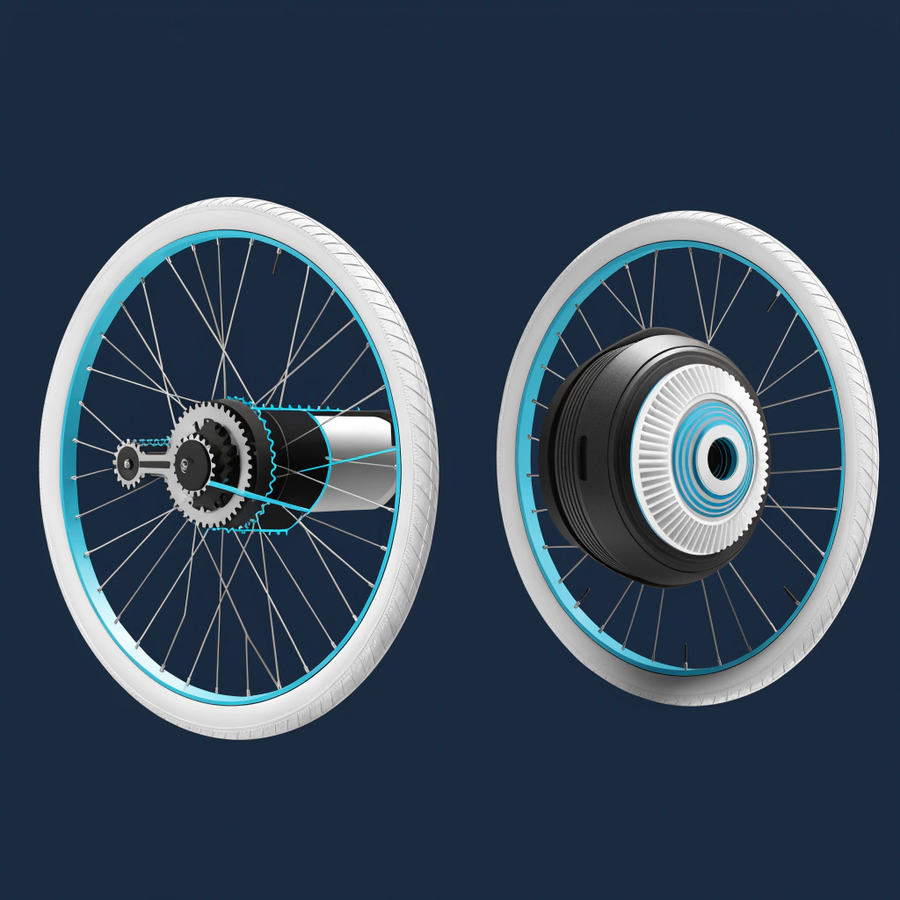
Hub motors drive the wheel independently of your gears — simpler to fit (especially at the front) and gentler on the chain. Mid-drives drive through the chain and cassette, so they climb efficiently in low gears but wear the drivetrain faster. Front hubs are the easiest fit; rear hubs feel the most natural; mid-drives climb best. If your rides are flat, that ranking is also your buying order.
250W vs 1000W vs 2000W
250W is the UK road category — when the whole system also meets the speed and pedal-assist rules. 1000W and 2000W are performance categories for private land, not automatically better for commuting: more power needs a higher-current battery, stronger torque restraint and better brakes. And wattage never sets your range — stored energy in watt-hours does.
Five Checks Before Buying Any Kit
Five minutes with the bike saves an expensive return. Wheel size: read the tyre sidewall (26″, 27.5″, 29″, 700C or a folder size) and match it exactly. Dropout standard: record the internal spacing, open dropout vs thru-axle, and axle diameter — 100mm front and 135mm rear are clues, not guarantees. Freewheel vs cassette: confirm which your rear wheel uses before any rear-hub order. Brakes: rim or disc, rotor size and pad condition. Battery space: measure the frame triangle or rack, and compare packs in watt-hours (volts × amp-hours), never amp-hours alone. Work through your exact figures on the wheel and dropout size guide, and have any bike with cracked dropouts, corrosion or damaged carbon professionally inspected first.
📋
Pre-install fit & safety checklist. Installation differs materially between front hubs, rear hubs and mid-drives — one generic sequence is not sufficient for all three. Confirm these before any spanner comes out:
Wheel size, axle type (open dropout vs thru-axle) and over-locknut width confirmed against the kit
Rear hubs: freewheel vs cassette, sprocket count and derailleur capacity identified
Mid-drives: bottom-bracket shell width, diameter and thread, plus chainstay clearance
Brake type and rotor clearance checked — plan an upgrade if the finished bike is faster or heavier
An approved torque arm on any powerful hub build; never spread aluminium or carbon frames
Controller wiring matched to the diagram; battery on structural bolts; brake cut-off tested with the driven wheel off the ground
🚫
Installation mistakes that damage bikes.
Buying by motor power before checking fit — a 2000W kit is useless if the axle or wheel doesn’t match
Skipping torque arms — axle spin-out can wreck dropouts on any powerful hub build
Forcing the frame or fork — never spread aluminium or carbon to make a motor fit
Under-specified batteries — the BMS must support the controller’s continuous and peak current
Keeping weak brakes on a faster, heavier build
Guessing controller connections by wire colour across brands
Riding before testing the brake cut-off
Assuming a power-limit button makes a kit road-legal — status depends on the whole vehicle, not one setting
UK Conversion Law in 2026, Briefly
A converted bicycle rides as an EAPC in Great Britain when it has usable pedals, a motor with a continuous rated output no higher than 250W, and assistance that stops at 15.5 mph, ridden by someone 14 or over (GOV.UK). The bike should carry the required markings: manufacturer, continuous rated power, and battery voltage or maximum assisted speed.
A system exceeding those limits is treated as a motor vehicle in public — registration, insurance, tax, licensing and a motorcycle helmet can all apply (Cycling UK). Higher-power kits are private-land products used with the landowner’s permission — “off-road” does not make public trails, bridleways or cycle paths lawful for an unregistered high-power vehicle. Road riders should shop the Road Legal Kits collection and nothing else.
Conversion Kit vs Complete E-Bike
Factor
Conversion kit
Complete e-bike
Initial cost
Often lower if the donor bike suits
Usually higher
Fit
Needs measuring and matching
Designed as one system
Installation
DIY or workshop
Ready to ride
Appearance
More visible wiring
Greater integration
Repairability
Modular parts
Can be proprietary
Warranty
Separate kit and bike cover
Whole-bike cover
Best for
A good bike you already like
Wanting an integrated package
Conversion is the weaker choice when the donor bike is worn, the brakes would need costly upgrades, the frame uses incompatible thru-axles, the battery can’t be mounted safely, or professional labour cancels out the saving.
Conclusion: Choose by Fit, Use and Support — Not Wattage
This comparison covers different riders rather than crowning one universal winner. Bafang and Pendix suit mid-drive hill-climbers; Swytch, Cytronex and the EZ Rider suit road-legal commuters; Rubbee and Skarper suit riders who want assist that clips on and off; Boost builds a rear wheel around your bike; and KirbEbike’s high-power kits are bundled private-land performers.
So decide where the bike will be ridden, measure the donor bicycle, choose front hub, rear hub or mid-drive, match the battery to the motor and the range you need, and confirm installation support before ordering. The correct kit is the one that matches your wheel, axle, brakes, drivetrain, battery space and legal use.
Start With the Fit, Not the Wattage
Measure your wheel size, dropouts and brakes, decide where you’ll ride, then match a kit to the complete bike — road-legal for the road, high-power for private land.
Reliability depends more on correct fit, battery quality, weather sealing, controller matching, installation and spare-part support than on one brand name. Choose a supplier that publishes dimensions and stocks replacement controllers, displays and batteries.
What is the best conversion kit for UK roads?
A compliant 250W pedal-assist kit that stops assisting at 15.5 mph is the right category. The best individual option depends on your fork, wheel size, brakes and desired range — the EZ Rider, Swytch, Cytronex and Boost are all road-legal starting points.
What is the easiest kit to install?
A front-hub kit (Swytch, EZ Rider) or a friction drive (Rubbee) is usually easiest because it avoids rear gears and bottom-bracket removal. Fork strength, axle seating and torque-arm fitting still need care.
How fast does a 2000W conversion kit go?
There is no fixed figure — voltage, controller current, wheel size, motor winding, rider weight, terrain and battery condition all affect speed. A 2000W system exceeds UK EAPC limits and is not a road-legal bicycle configuration.
How fast is a 48V 2000W kit in mph?
Voltage and wattage alone cannot predict a precise speed. Treat published figures as system-specific private-land estimates, not guarantees — and this power level is off-road only in the UK.
Which kit is best for long distances?
Compare battery watt-hours, riding efficiency and support availability rather than motor watts. A larger battery adds range but also cost and weight, so match capacity to the distance you actually ride.
What is the fastest legal e-bike in the UK?
For an EAPC, motor assistance must stop at 15.5 mph regardless of kit. You can pedal faster under your own power, but the motor must not assist beyond that.
What should I avoid when buying a kit?
Unverified batteries, unclear axle dimensions, missing torque arms, unsupported frame modifications, vague warranties, and sellers who can’t confirm motor-battery-controller compatibility or who claim any voltage suits any controller.
Can any bicycle be converted?
No. The frame, fork, dropouts, brakes, wheels and battery-mounting area must be suitable. Carbon frames, thru-axles and unusual suspension designs need particularly careful checks.
Is a 1000W or 2000W hub motor better?
Neither is automatically better. A 1000W system is lighter and easier to manage; a 2000W system gives more private-land performance but demands a stronger battery, frame, torque restraint and brakes.
⚖️
A note on safety & legality. This guide is general information, not a substitute for each manufacturer’s fitting instructions or a professional assessment of your bike. Buy batteries and chargers only from reputable sources and never modify a pack (Electrical Safety First; see also the London Fire Brigade’s charging guidance). In the UK, a converted bike is only a road-legal EAPC when the motor is 250W continuous, assist cuts off at 15.5 mph and it requires pedalling; anything beyond that is for private land only.
London Fire Brigade — e-bike and e-scooter fire safety. london-fire.gov.uk
Park Tool — bicycle repair help library. parktool.com
IATA — Lithium batteries in passenger baggage. iata.org
About this guide. Author: KirbEbike Editorial. Technical review: KirbEbike conversion-support team. Last reviewed: July 2026. Methodology: every kit was assessed on identical criteria (compatibility, included components, installation, support and legal use); the two KirbEbike entries are manufacturer-verified, all other kits are desk-researched from each brand’s live product pages and were not hands-on tested. Prices, stock and legal configuration were checked in July 2026 and can change — confirm current details before ordering. We sell KirbEbike kits, so competitor entries are kept factual and unlinked, with their genuine strengths stated plainly.
Stay in the know
Conversion guides, fitting advice and the deals worth knowing about. No spam.