When you're investing in an e-bike conversion, one question dominates: "How far will it actually take me?" While manufacturers provide estimated ranges, real-world performance depends on variables most riders don't initially consider.
A 52V 20Ah battery doesn't deliver the same distance for a 200-pound rider climbing hills as it does for a 150-pound rider on flat terrain. Understanding these factors helps you choose the right battery capacity and avoid the frustration of running out of power mid-ride.
The 52V 20Ah ebike battery represents a sweet spot for many riders—enough capacity for serious distance without excessive weight or cost. Meanwhile, 72V 20Ah batteries power extreme applications where raw performance matters more than efficiency. Let's examine what each battery actually delivers in different riding scenarios.
Understanding Battery Capacity: The Mathematics Behind Range
![]()

Watt-Hours: The True Measure of Energy Storage
Battery capacity appears deceptively simple—voltage multiplied by amp-hours equals watt-hours (Wh). This figure represents total energy storage and directly impacts range.
52V 20Ah battery calculation:
- 52V × 20Ah = 1,040 Wh (approximately 1 kWh)
- Usable capacity: ~936 Wh (accounting for 90% depth of discharge)
72V 20Ah battery calculation:
- 72V × 20Ah = 1,440 Wh (1.44 kWh)
- Usable capacity: ~1,296 Wh (accounting for 90% depth of discharge)
The 72V battery contains roughly 38% more energy than the 52V version, but this doesn't automatically translate to 38% more range. Power consumption varies dramatically based on system voltage, motor efficiency, and riding style.
Energy Consumption Rates
Different power levels consume energy at vastly different rates:
|
Motor Power
|
Average Consumption
|
Typical Application
|
|
250-500W
|
15-20 Wh/km
|
Commuting, light assistance
|
|
1000-1500W
|
20-30 Wh/km
|
Mixed terrain, moderate hills
|
|
2000-2600W
|
30-45 Wh/km
|
Off-road, steep climbs, cargo
|
|
3000-4000W
|
45-65 Wh/km
|
Extreme performance, racing
|
These figures represent averages. Actual consumption fluctuates constantly based on acceleration, terrain, and rider input.
52V 20Ah Battery: Real-World Range Scenarios
![]()

Urban Commuting (Flat Terrain, Moderate Assistance)
Riding conditions:
- Flat to gently rolling terrain
- Moderate pedal assistance (PAS level 2-3)
- Average speed: 30-35 km/h
- Rider weight: 75-85 kg
- Frequent stops for traffic
Expected range: 50-60 km
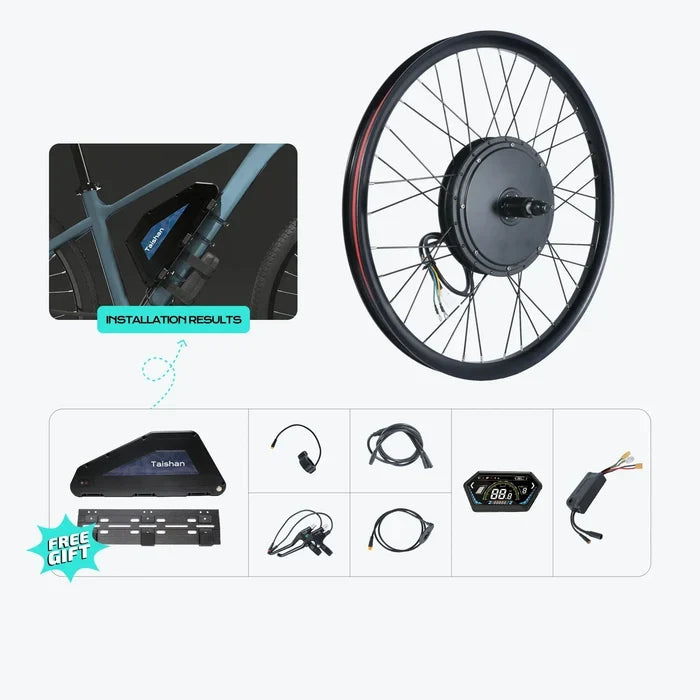
The 52V 2000W MTX rim kit with a 20Ah battery handles daily commutes exceptionally well. Riders typically use 15-18 Wh/km in these conditions, allowing the 936 Wh usable capacity to deliver solid distance. Conservative riders using lower assistance levels can stretch this to 65-70 km.
Mixed Terrain (Hills and Flats, Variable Assistance)
Riding conditions:
- Rolling hills with occasional steep sections
- Variable assistance (PAS level 3-4 on climbs, lower on flats)
- Average speed: 25-30 km/h
- Rider weight: 75-85 kg
- Mix of pavement and light trails
Expected range: 40-50 km
Energy consumption increases to 20-25 Wh/km as the motor works harder on inclines. Hills significantly impact range—a 10% grade doubles or triples energy consumption compared to flat riding. Smart riders reduce assistance on flats to conserve battery for climbs.
Aggressive Off-Road (Steep Hills, Maximum Power)
Riding conditions:
- Mountainous terrain with sustained climbs
- High assistance (PAS level 4-5)
- Frequent throttle use
- Average speed: 20-25 km/h
- Rider weight: 75-85 kg plus gear
Expected range: 30-40 km
Hard riding pushes consumption to 25-30 Wh/km or higher. The motor continuously delivers peak power, draining the battery faster. However, for riders tackling serious terrain, 30-40 km represents a full day of riding with breaks.
Maximum Performance (Speed-Focused Riding)
Riding conditions:
- Flat terrain, maximum speed runs
- Full throttle, minimal pedaling
- Average speed: 45-55 km/h
- Rider weight: 75-85 kg
- Continuous high-power draw
Expected range: 25-35 km
Sustained high-speed riding consumes 30-35 Wh/km. Wind resistance increases exponentially with speed—going from 40 km/h to 50 km/h doesn't just require more power, it requires dramatically more power. Riders focused on maximum speed sacrifice range.
72V 20Ah Battery: Real-World Range Scenarios
High-Performance Trail Riding
Riding conditions:
- Challenging off-road terrain
- High power output (3000-4000W)
- Variable assistance based on obstacles
- Average speed: 25-35 km/h
- Rider weight: 75-85 kg
Expected range: 40-55 km
The 72V 4000W extreme performance kit paired with a 20Ah battery delivers incredible power but consumes energy aggressively. Consumption averages 25-32 Wh/km depending on terrain. The extra capacity compared to 52V systems extends range despite higher power draw.
Extreme Speed Applications
Riding conditions:
- Flat terrain, maximum velocity
- Sustained 70-80 km/h speeds
- Minimal pedaling, throttle-focused
- Rider weight: 75-85 kg
- Aerodynamic position
Expected range: 20-30 km
Running at maximum speed consumes 45-65 Wh/km. At these velocities, wind resistance dominates energy requirements. The battery drains rapidly, but for applications requiring extreme speed, this represents adequate range.
Cargo Hauling and Heavy Loads
Riding conditions:
- Mixed terrain with cargo or trailer
- Moderate to high assistance
- Total weight (rider + cargo): 120-150 kg
- Average speed: 25-30 km/h
Expected range: 35-50 km
Additional weight increases energy consumption by 20-40% depending on terrain. The 72V battery's extra capacity proves valuable when hauling loads. Riders regularly carrying cargo appreciate the headroom.
Conservative Riding (Extended Range)
Riding conditions:
- Flat terrain, lower power settings
- Moderate assistance (PAS level 2-3)
- Rider actively pedaling
- Average speed: 30-35 km/h
- Rider weight: 75-85 kg
Expected range: 60-80 km
Using a 72V system conservatively delivers exceptional range. Consumption drops to 16-22 Wh/km, allowing the 1,296 Wh capacity to cover impressive distances. This represents the best-case scenario for 72V batteries.
Factors That Significantly Impact Range
Rider Weight and Cargo
Total system weight directly affects energy consumption. Physics doesn't negotiate—moving more mass requires more energy.
Weight impact on consumption:
- Rider + bike: 90 kg baseline
- +10 kg: ~5-8% range reduction
- +20 kg: ~10-15% range reduction
- +30 kg: ~15-22% range reduction
Heavier riders or those carrying cargo should consider higher-capacity batteries or adjust range expectations accordingly.
Terrain and Elevation Changes
Climbing consumes vastly more energy than level riding. The relationship isn't linear—steeper grades require exponentially more power.
Gradient impact:
- 0% (flat): baseline consumption
- 3-5%: 50-80% increase
- 5-10%: 100-150% increase
- 10%+: 150-250% increase
A route with 500m total elevation gain might consume 30-40% more energy than a flat route of identical distance. Riders in mountainous areas should reduce range estimates by 25-35%.
Wind Resistance and Speed
Aerodynamic drag increases with the square of velocity. Doubling your speed quadruples wind resistance.
Speed vs. efficiency:
- 25 km/h: optimal efficiency, minimal drag
- 35 km/h: 30-40% higher consumption
- 45 km/h: 80-100% higher consumption
- 55+ km/h: 150-200%+ higher consumption
Riders seeking maximum range should maintain moderate speeds. Those prioritizing speed must accept reduced distance.
Temperature Effects on Battery Performance
Lithium batteries perform optimally between 15-25°C. Temperature extremes reduce capacity and efficiency.
Temperature impact:
- -10°C to 0°C: 20-30% capacity reduction
- 0°C to 10°C: 10-15% capacity reduction
- 10°C to 30°C: optimal performance
- 30°C to 40°C: 5-10% capacity reduction
- 40°C+: accelerated degradation
Cold weather riders should store batteries indoors before rides and expect reduced range. Hot weather riders should avoid leaving batteries in direct sunlight.
Riding Style and Assist Level
How you ride matters as much as what you ride.
Conservative riding (maximum range):
- Smooth acceleration
- Lower assist levels on flats
- Anticipating stops to reduce braking
- Active pedaling contribution
Aggressive riding (reduced range):
- Hard acceleration
- High assist levels constantly
- Frequent full-throttle bursts
- Minimal pedaling
The difference between these styles can be 30-50% in total range on identical routes.
Maintaining Battery Health for Consistent Range
Range gradually decreases as batteries age. Proper maintenance extends usable lifespan.
Charging Best Practices
- Avoid complete discharge; recharge at 20-30% remaining
- Don't leave batteries at 100% for extended periods
- Use manufacturer-recommended chargers only
- Charge in moderate temperatures when possible
Following these guidelines helps maintain capacity through 800-1000+ charge cycles.
Storage Recommendations
For batteries stored longer than two weeks:
- Charge to 50-60% capacity
- Store in cool, dry location (10-20°C)
- Check voltage monthly and top up if needed
- Avoid freezing temperatures
Proper storage prevents capacity degradation during off-seasons.
Frequently Asked Questions
How accurate are manufacturer range estimates?
Manufacturer estimates typically represent best-case scenarios—flat terrain, moderate speeds, light riders, optimal conditions. Real-world range usually runs 20-30% lower than advertised maximums. Use manufacturer figures as upper limits rather than typical expectations.
Can I increase range by pedaling harder?
Absolutely. Active pedaling significantly extends range by reducing motor load. Riders contributing 100-150W of pedal power can extend range by 25-40% compared to throttle-only operation. The motor assists rather than replaces your effort.
Does using throttle vs. pedal assist affect range?
Yes, substantially. Throttle-only riding typically consumes 30-50% more energy than comparable pedal assist levels because the motor provides all power rather than amplifying your pedaling. PAS promotes efficiency by encouraging rider contribution.
How much does cold weather reduce my range?
Cold temperatures reduce battery capacity and increase energy consumption from higher rolling resistance. Expect 20-30% range reduction at freezing temperatures, with additional losses below -5°C. Keep batteries warm before rides when possible.
Will a 52V 30Ah battery give me 50% more range than 20Ah?
In theory yes, but practical range increases depend on riding style. If you typically use 70% of a 20Ah battery, a 30Ah battery extends range proportionally. However, the extra weight (approximately 1.5 kg) slightly increases consumption, so actual gain might be 45-48% rather than pure 50%.
Can I carry a spare battery for extended rides?
Many riders carry secondary batteries for tours or long rides. This doubles available capacity while maintaining balanced weight distribution. Swapping batteries takes minutes and transforms range limitations into mere inconvenience.
How do I know my actual consumption rate?
Most quality displays track watt-hours consumed. After several rides, divide total Wh used by distance traveled to calculate your average consumption rate. This personal baseline helps predict range more accurately than generic estimates.
Conclusion
Understanding real-world range helps you select appropriate battery capacity without over-investing in unnecessary amp-hours. A 52V ebike battery 20Ah configuration satisfies most riders' daily needs, while 72V 20Ah systems serve performance applications where power matters more than efficiency.
The key insight: range depends less on battery specifications than on how you ride. Conservative riders extract 60+ km from 52V 20Ah batteries, while aggressive riders drain the same capacity in 30 km.
For riders still uncertain about capacity needs, starting with proven configurations like the 52V 20Ah battery ebike systems provides excellent versatility. You can always add a secondary battery later if your riding evolves to demand more range.
: invalid url input)
usmile
Liquid error (snippets/blog-best-product line 36): product form must be given a product
Liquid error (snippets/blog-best-product line 59): product form must be given a product