3000W e-bike conversion systems represent extreme specialized capability—delivering 75-85 km/h top speeds, conquering any gradient regardless of rider weight or load, providing effortless climbing 20%+ sustained hills heavy riders (120kg+) or loaded touring (100kg rider + 30kg cargo), and operating comfortable thermal margins where 2000W motors reach capacity limits—but requiring substantial technical expertise (frame stress assessment, torque arm installation critical, electrical system understanding essential).
mandatory private property operation (illegal public roads virtually all jurisdictions worldwide, no registration possible conversion kits), premium component investment (60V or 72V battery systems 20-30Ah minimum, 60-80A continuous discharge BMS, heavy-duty controllers, reinforced frames potentially), and honest needs assessment separating genuine specialized requirements (very heavy riders 120kg+, extreme sustained grades 20-25%, heavy cargo regular, private property exclusive use) from aspirational desires disconnected from actual cycling patterns where 1000-2000W serves 95% of riders excellently.
Understanding what makes choosing the best ebike kit at 3000W power level appropriate versus excessive requires examining physics fundamentals extreme power creates, Kirbebike 60V 2500-3000W system specifications, legitimate specialized applications, critical safety considerations frame stress and braking demands, legal compliance absolute requirements, thermal management advantages high-power motors, and honest self-assessment preventing expensive regret purchasing capability unnecessary actual needs while creating legal exposure and safety risks disproportionate benefits delivered.
Understanding 3000W Power Reality

What 3000W Actually Delivers
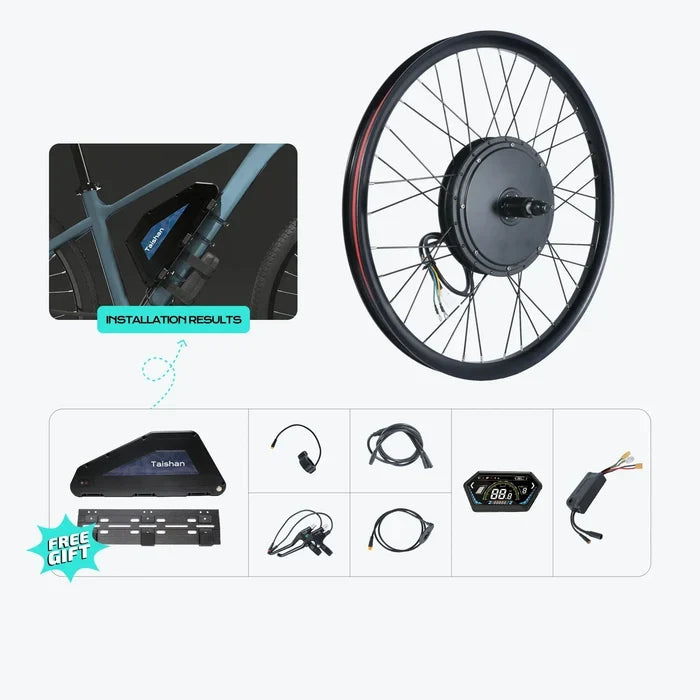
Kirbebike 60V 2500-3000W System:
Motor Specifications:
- Power: 2500-3000W rated continuous
- Voltage: 60V system
- Type: Brushless direct-drive rear hub
- Weight: 6.8kg (maximum heat capacity)
- Application: Extreme capability specialized needs
- Torque: Overwhelming any gradient
Performance Capabilities:
Flat Terrain (85kg Rider):
- Top speed: 75-85 km/h (wind resistance limited)
- Acceleration: 0-50 km/h in 2-3 seconds (extremely rapid)
- Cruising: 60-70 km/h comfortable sustained
- Power utilization: 40-50% capacity cruising (massive reserves)
Steep Hills (18-20% Grade, 85kg Rider):
- Speed: 35-45 km/h sustained (effortless)
- Power utilization: 60-70% capacity
- Thermal: Warm, comfortable headroom
- Experience: Conquers any grade any condition
Very Heavy Applications (120kg Rider, 15-18% Grade):
- Speed: 30-38 km/h sustained
- Power utilization: 70-80% capacity
- Thermal: Hot but adequate margins
- Experience: Confident comfortable climbing
Loaded Touring (100kg Rider + 30kg Cargo, 15% Grade):
- Total weight: 130kg + 15kg bike = 145kg
- Speed: 28-35 km/h sustained
- Power utilization: 75-85% capacity
- Experience: Adequate reserves heavy loads
Performance vs 2000W Comparison
Where 3000W Provides Meaningful Advantage:
|
Scenario
|
2000W Performance
|
3000W Performance
|
Advantage
|
|
Flat Speed (85kg)
|
52-60 km/h
|
75-85 km/h
|
+40-50% (wind resistance diminishing returns)
|
|
20% Hill (85kg)
|
20-26 km/h
|
35-45 km/h
|
+70-75% (substantial climbing advantage)
|
|
20% Hill (120kg)
|
16-22 km/h (struggling)
|
30-38 km/h (comfortable)
|
+90% (transformative heavy riders)
|
|
Heavy Load (130kg+, 15%)
|
18-24 km/h (maxed)
|
28-35 km/h (adequate)
|
+55% (loaded touring viable)
|
|
Acceleration 0-50
|
2-2.5 seconds
|
1.5-2 seconds
|
+25-30% faster (rapid response)
|
|
Thermal Headroom
|
85-95% capacity steep
|
60-70% capacity steep
|
Comfortable margins vs near-limit
|
Critical Observation:
3000W advantage most pronounced extreme conditions (very steep hills 20%+, very heavy riders/loads 120kg+, sustained maximum demand)—modest 20-30% flat speed increase versus 2000W doesn't justify investment most riders, but 70-90% climbing improvement extreme scenarios makes difference between adequate and inadequate for specialized applications.
Legitimate 3000W Applications
![]()

When 3000W Genuinely Necessary
Scenario 1: Very Heavy Riders (120-140kg)
Challenge: Physics demands proportional power—120kg rider requires 40% more power than 85kg rider achieving identical hill climbing speed making 2000W marginal inadequate steep sustained terrain.
3000W Solution:
- Provides comfortable power reserves (operates 70-80% capacity vs 100-110% with 2000W)
- Adequate thermal management (heat generation sustainable vs overheating risk)
- Reliable performance (not constantly maxed creating stress, reduced lifespan)
- Satisfying capability (confident climbing vs constant struggle)
Real-World Example: 135kg Rider, Mountain Terrain
Previous 2000W Experience:
- Struggled 15-18% hills (16-22 km/h frustrating slow)
- Thermal overheating frequent (power reduction, stops)
- Constant maximum load (no reserves, disappointing)
- Satisfaction: Inadequate for weight and terrain
Scenario 2: Extreme Sustained Grades (20-25%)
Challenge: Physics exponential power requirements—20% grade requires nearly double power maintaining speed versus 15% grade making 2000W adequate 15% but marginal 20%+ regardless of rider weight.
3000W Solution:
- Conquers 20-25% grades 30-40 km/h (vs 20-26 km/h with 2000W)
- Operates 70-80% capacity extreme grades (vs 95-105% with 2000W)
- Thermal sustainable extended climbs (vs overheating risk)
- Experience: Effortless extreme terrain vs struggle
Scenario 3: Heavy Loaded Touring (130kg+ Total)
Challenge: 100kg rider + 30kg cargo + 15kg bike = 145kg total weight creates power demands equivalent 145kg rider making 2000W marginal loaded steep terrain.
3000W Solution:
- Adequate power heavy loads steep terrain
- Comfortable climbing 15-18% grades 28-35 km/h loaded
- Thermal headroom extended tours (not overheating)
- Reliable performance (operates sustainable capacity)
Scenario 4: Private Property High-Speed Use
Challenge: Desire maximum speed capability private land, off-road property, racing applications where legal limits irrelevant and extreme performance valued.
3000W Solution:
- Maximum speed 75-85+ km/h (private property legal)
- Rapid acceleration (competitive racing, off-road)
- Overwhelming power (any terrain, any condition)
- Enthusiast satisfaction (extreme capability enjoyed)
When 3000W Excessive Overkill
Scenarios Where 2000W or Less Adequate
![]()

Average Riders (70-100kg), Moderate Terrain (8-15% Hills):
Reality:
- 1000W adequate most conditions
- 1500W excellent comfortable capability
- 2000W provides substantial reserves
- 3000W unnecessary expense, weight, complexity
Flat-Moderate Terrain Primary:
Reality:
- Top speed limited wind resistance (3000W gains 20-30% vs 2000W fighting air)
- Cruising power minimal (500-800W maintaining 35-45 km/h)
- 3000W capability unused 90% riding time
- Investment unjustified minimal benefit delivery
Critical Safety Considerations
Frame Stress Assessment
Extreme Power Creates Extreme Forces:
Motor Torque Analysis:
- 3000W motor generates enormous rotational force attempting spin motor body within dropouts
- Standard bicycle frames NOT designed these forces
- Aluminum frames especially vulnerable (rigid, sudden catastrophic failure potential)
- Steel/chromoly frames more forgiving but still stressed
Torque Arm Requirements Non-Negotiable:
Mandatory Safety Equipment 3000W:
✓ Two heavy-duty torque arms: Both sides dropout (non-negotiable) ✓ Professional-grade construction: Heavy steel, reinforced mounting ✓ Precise installation: Perfect alignment, maximum bolt tightness ✓ Regular inspection: Weekly checks first month, monthly thereafter ✓ Frame assessment: Verify frame capable handling forces (consult manufacturer potentially)
Failure Consequences:
Without adequate torque arms 3000W:
- Dropout failure likely (motor rotates, wheel detaches)
- Catastrophic crash potential (high-speed wheel loss)
- Permanent frame damage (unrepairable aluminum frames)
- Serious injury risk (75-85 km/h crash devastating)
Braking System Requirements
Stopping Power Must Match Motor Power:
3000W Speed and Weight Demands:
Braking Physics:
- Kinetic energy increases square of velocity
- 80 km/h carries 4× energy of 40 km/h (requires 4× braking force stopping same distance)
- Heavy motor (6.8kg) + battery (3-4kg) + rider (85kg+) = substantial mass
- Standard rim brakes INADEQUATE (insufficient stopping power)
Minimum Braking Standards 3000W:
✓ Hydraulic disc brakes: 180-203mm rotors both wheels (front and rear) ✓ Quality pads: Metallic or high-performance organic compounds ✓ Regular maintenance: Monthly inspection, pad replacement wear indicators ✓ Brake testing: Verify adequate stopping power before high-speed use ✓ Emergency braking practice: Learn maximum braking technique safe environment
Inadequate Braking Consequences:
- Unable stop emergency situations (collision inevitable)
- Brake fade high-speed descents (overheating reduces effectiveness)
- Rotor warping excessive heat (permanent damage, replacement necessary)
- Serious injury crash (high-speed collision devastating)
Electrical System Safety
High Current Demands:
3000W @ 60V = 50A Continuous (60A+ Peak):
Battery Requirements:
- Minimum: 60V 20Ah LG/Samsung/Panasonic cells
- Ideal: 60V 30Ah premium cells
- BMS: 60-80A continuous discharge rating mandatory
- Connections: Heavy-gauge wire, quality connectors (poor connections create fire hazard)
Fire Risk Management:
✓ Quality battery only: Never cheap cells (fire risk extreme) ✓ Proper mounting: Secure battery (vibration damage prevents) ✓ Ventilation: Battery heat dissipation (avoid enclosed spaces) ✓ Charging safety: Quality charger, never unattended, fire-safe location ✓ Damage inspection: Regular checks (any damage, discontinue use immediately) ✓ Storage precautions: Cool dry location, 50-60% charge long-term storage
Electrical Fire Consequences:
- Lithium battery fires extremely dangerous (water ineffective, burns intensely)
- Toxic fumes (breathing hazardous)
- Total loss (bicycle, property potentially)
- Serious injury potential (burns, smoke inhalation)
Practical Benefit:
3000W motor operates cooler, more reliably same performance lower percentage capacity creating comfortable thermal margins versus 2000W motor constantly near limits—advantage not additional speed but sustainable reliable operation demanding conditions.
Battery Investment Requirements
Premium Cells Non-Negotiable
3000W Demands Quality Battery:
Kirbebike 60V 20AH LG 21700 Battery:
- Cells: LG 21700 premium
- Capacity: 60V 20Ah (1200Wh)
- Discharge: 60A continuous capability
- BMS: 60-80A rated protection
- Construction: Professional-grade assembly
- Application: 3000W minimum adequate
Why Cheap Batteries Catastrophic 3000W:
Voltage Sag Excessive:
- 50A continuous demand cheap cells
- Voltage drops 60V → 48V under load (20% power loss)
- Performance crippled despite motor capability
- Overheating risk (excessive internal resistance)
- Fire hazard potential (thermal runaway cheap cells)
Range Considerations:
60V 20Ah Battery, 3000W Motor:
Conservative riding (50% power average):
- Consumption: ~50-60 Wh/km
- Range: 20-24km
Aggressive riding (80% power average):
- Consumption: ~70-85 Wh/km
- Range: 14-17km
Extended range requires 60V 30Ah battery:
- Conservative: 30-36km
- Aggressive: 21-25km
Investment Reality:
3000W system requires premium large-capacity battery (60V 20-30Ah quality cells) representing substantial investment beyond motor alone—total system cost motor + necessary battery significant making informed budget assessment essential preventing expensive regret.
When to Choose 3000W
Choose 3000W When ALL Following True:
✓ Very heavy rider (120kg+) OR heavy loaded touring (130kg+ total) ✓ Sustained extreme grades (20-25%) regular daily riding ✓ Private property exclusive operation (legal compliance accepted) ✓ Technical expertise adequate (frame assessment, installation, safety) ✓ Premium budget available (quality battery, heavy-duty components) ✓ Genuine specialized need (not aspirational want)
If ANY Above False, Choose Lower Power:
- 1500W: Excellent 90-110kg riders, regular 12-18% hills
- 2000W: Adequate 100-120kg riders, extreme 18-20% hills occasional
- 1000W: Sufficient 70-100kg riders, moderate 8-15% terrain majority
Conclusion
3000W e-bike conversion systems deliver genuine specialized capability extreme applications—very heavy riders 120-140kg achieving comfortable climbing 20%+ sustained grades where 2000W motors struggle inadequate thermal margins constant maximum loading, heavy loaded touring 130kg+ total conquering steep terrain reliably, private property high-speed use maximizing performance legal framework allows, and enthusiast applications valuing overwhelming power regardless of practical necessity—but requiring substantial technical expertise (frame stress assessment critical.
Understanding what makes choosing the electric bike kit battery at 3000W power appropriate requires acknowledging this represents extreme specialized solution very narrow applications rather than universal upgrade path most riders making informed decision matching capability to genuine demands essential preventing expensive regret purchasing power unnecessary actual cycling patterns while creating legal risks and safety responsibilities disproportionate benefits delivered typical riding conditions.
Frequently Asked Questions
When is 3000W genuinely necessary versus 2000W being adequate?
3000W necessary very heavy riders (120kg+) where 2000W struggles thermal overheating constant maximum load steep sustained terrain, heavy loaded touring (130kg+ total weight).
Are 3000W e-bike conversion kits legal anywhere for public road use?
No—illegal public roads worldwide: UK/EU limits 250W making 3000W 12× over (illegal motor vehicle, registration impossible), US federal limits 750W making 3000W 4× over (illegal motor vehicle, state laws uniformly prohibit), other jurisdictions similar restrictions.
What safety equipment absolutely required for 3000W systems?
Non-negotiable mandatory: (1) Two heavy-duty torque arms both sides dropout (professional-grade steel construction, precise installation.
How much does 3000W cost compared to 2000W total system investment?
Substantially more: 3000W requires premium battery (60V 20-30Ah quality cells versus 52V 20Ah adequate 2000W—significant cost differential).
Will 3000W give me significantly more range than 2000W?
No—opposite: 3000W consumes more power reducing range same battery size. Reality: 3000W motor 60V 20Ah battery achieves 20-24km conservative riding, 14-17km aggressive (higher consumption fighting wind resistance at higher speeds, less efficient low loads).
: invalid url input)
usmile
Liquid error (snippets/blog-best-product line 36): product form must be given a product
Liquid error (snippets/blog-best-product line 59): product form must be given a product