Ebike Conversion Kit Installation Cost UK: DIY vs Shop & Fit
KE
KirbEbike Editorial
Reviewed by the KirbEbike conversion-support team
Delen
Unlock £10 off today
Op deze pagina
Fitting an e-bike conversion kit in the UK costs roughly £50–£200+ in shop labour — or close to nothing if you fit it yourself. Add the kit and battery, and a finished conversion commonly lands between £350 and £2,000+. The biggest budget factor isn’t labour, though: it’s whether the kit fits your bike, and how much drivetrain, brake or wheel work the installation needs. This guide splits the decision into the two questions that decide the bill — DIY or shop, and will it fit — with real UK numbers for both.
The short answer
A bike shop typically charges £50–£200+ to fit a conversion kit, depending on the kit and donor bike. A straightforward hub-motor install sits near the lower end; mid-drive, cargo, folding and custom-wheel work costs more. A complete project — kit, battery and fitting — usually lands between £350 and £2,000+. Get the fit right first and the cost tends to look after itself. The full conversion-kit range is grouped by wheel size and power to make matching easier.
You already own a bike and want electric assist without buying a whole new e-bike
You’re weighing a DIY fit against paying a shop, and want a realistic labour figure
You need to know whether a hub or mid-drive kit will physically fit your frame, forks and wheels
You want a full UK budget — kit, battery, fitting and the extras that catch people out — before you order
How Much Does Installation Cost in the UK?
£50–200+
Typical shop labour
£350–2,000+
Complete project (kit + battery + fitting)
~£0
DIY labour — just small parts & tools
Route
Typical total (kit + battery + fitting)
Best when
Basic DIY front hub
£300–£550
Sound bike, matched wheel/axle, you own tools
DIY rear hub
£400–£750
You can transfer a cassette and true a wheel
Shop-fitted hub
£500–£900
You want a clean fit with brake/gear setup
DIY mid-drive
£600–£1,100
Confident with bottom-bracket tools
Shop-fitted mid-drive
£800–£1,400
Steep routes, want chainline done right
Premium / specialist
£1,500–£2,100+
Brompton, cargo, carbon or proprietary systems
Planning bands, not fixed prices. Wheel size, battery capacity, bike condition and installer experience all move the quote. Treat the full project total as the real number — not the motor-only price on a listing.
DIY or bike shop: which is cheaper?
Two routes to the same result. A confident rider fitting a matched front hub kit saves £100+; a first-timer on a mid-drive can spend that saving on tools and a corrective shop visit.
DIY has the lowest labour cost, but a shop can work out cheaper when the job needs specialist tools or several compatibility fixes:
DIY fitting
No labour charge — often just £10–£40 in cable ties, wrap and connectors
You learn the system and can service it later
Front hub kits are genuinely beginner-friendly
No booking wait — do it on your own schedule
Paying a shop
£50–£200+ labour (more for mid-drive or specialist frames)
£50–£200 in tools if you start with none
One damaged thread or dropout can wipe out DIY savings
Shop may keep the bike a day or more even for short jobs
💡
The honest rule: front hub on a standard bike is a fair DIY job. Mid-drive, thru-axle, hydraulic brakes, carbon frames or an internal gear hub usually justify professional fitting.
Installation Cost by Kit Type
Motor position drives the labour. Front hub kits are simplest, rear hubs involve more drivetrain work, and mid-drives need the most component removal.
Typical shop labour by kit type
Indicative UK ranges — specialist frames and extra corrective work push any of these higher.
Front hub
£50–£100
Rear hub
£70–£140
Mid-drive
£100–£200+
Friction / removable
£0–£150
Kit type
Shop labour (typical)
What drives the cost
Front hub
£50–£100
Leaves the rear gears alone; may need a torque arm and rotor/tyre transfer
Rear hub
£70–£140
Cassette/freewheel transfer, rotor fit, derailleur and axle spacing
Mid-drive
£100–£200+
Cranks and bottom bracket removed; chainline and chain length corrected
Friction / removable
£0–£150
Some fit at home; others need a dealer to fit permanent mounts first
Hub motor vs mid-drive: the fit-and-cost trade-off
Hub motor (front or rear)
Simpler, cheaper fit — the motor arrives inside a wheel
Drives the wheel directly, so lighter drivetrain wear
Great for flat and rolling commutes
Rear wheel removal takes longer because of the motor cable
Mid-drive
Higher fitting cost — the bottom bracket must come out
Drives through the gears, so faster chain/cassette wear
Stronger on steep climbs and loaded riding
Needs a compatible bottom-bracket shell and clean chainline
If hills are the reason you’re converting, a torque-sensor mid-drive is worth the extra fitting cost. The Z16 48V 1000W Mid Motor Kit uses your bike’s own gears for climbing and reads how hard you pedal, so assist feels natural rather than switch-like — with app tuning and UK support behind it. Above 250W it is an off-road / private-land build.
What Professional Fitting Should Include
A good fit covers far more than bolting a motor on. Ask for a written list so a low quote can be judged fairly against a fuller one. It should cover: wheel or motor fitting, battery mounting, controller/display/sensor setup, cable routing and connector protection, brake and gear checks, a torque check on every critical fastener, and a test ride confirming assist starts and stops correctly.
On a road-use build the installer should also confirm the motor stops assisting at the legal limit and set the correct wheel size so the speed reading is accurate. A shop should never offer to disable the cut-off on a bike meant for public roads. Note: Halfords does not offer a general service to fit any third-party kit — its policy covers legal EAPCs bought from Halfords or a short list of supported systems, so ring the store with your exact bike and kit before buying.
Will Your Bike Take a Conversion Kit?
Compatibility is more specific than wheel diameter. Axle type, dropout width, brake system, bottom bracket, chainline and battery space all matter — and a mismatch in any one adds parts and labour. Check these before you order.
The dropout decides more than the wheel. Axle type, dropout width and a properly fitted torque arm are what make a hub-motor install safe — measure before ordering.
Frame and forks
Steel and aluminium frames usually accept a conversion; carbon needs caution because clamping and axle loads can damage material not designed for them. Front hub kits need strong, correctly shaped fork dropouts — suspension forks, carbon forks and thru-axles may need a different kit or rule one out. Inspect for cracks, dents and corrosion, and never hide a structural problem under a battery mount.
Wheel size, axle and dropout width
The motor wheel must match your diameter — 700C, 29″, 27.5″ or 26″ — and the dropout spacing has to line up. Front forks are commonly 100mm; rear dropouts are usually 135mm (quick-release) or 142mm (thru-axle). Also check whether the bike uses a quick-release skewer, solid axle or thru-axle — they aren’t interchangeable without the right hub. Unsure? The wheel and dropout size guide walks through how to measure both.
Brakes
Disc-brake bikes need the correct rotor standard and caliper clearance; rim-brake bikes need a motor rim with a proper braking surface. Some kits ship replacement brake levers with cut-off switches that may not suit hydraulic or drop-bar controls — separate brake sensors can solve that, but confirm they work with the controller first.
Bottom bracket (mid-drive only)
Mid-drives depend on shell width, diameter and clearance. Measure the shell rather than trusting the model name — makers change parts between years. Threaded shells are usually easier than press-fit; spacers that create clearance can worsen chainline, causing noise, dropped chains and quick wear.
Battery mounting space
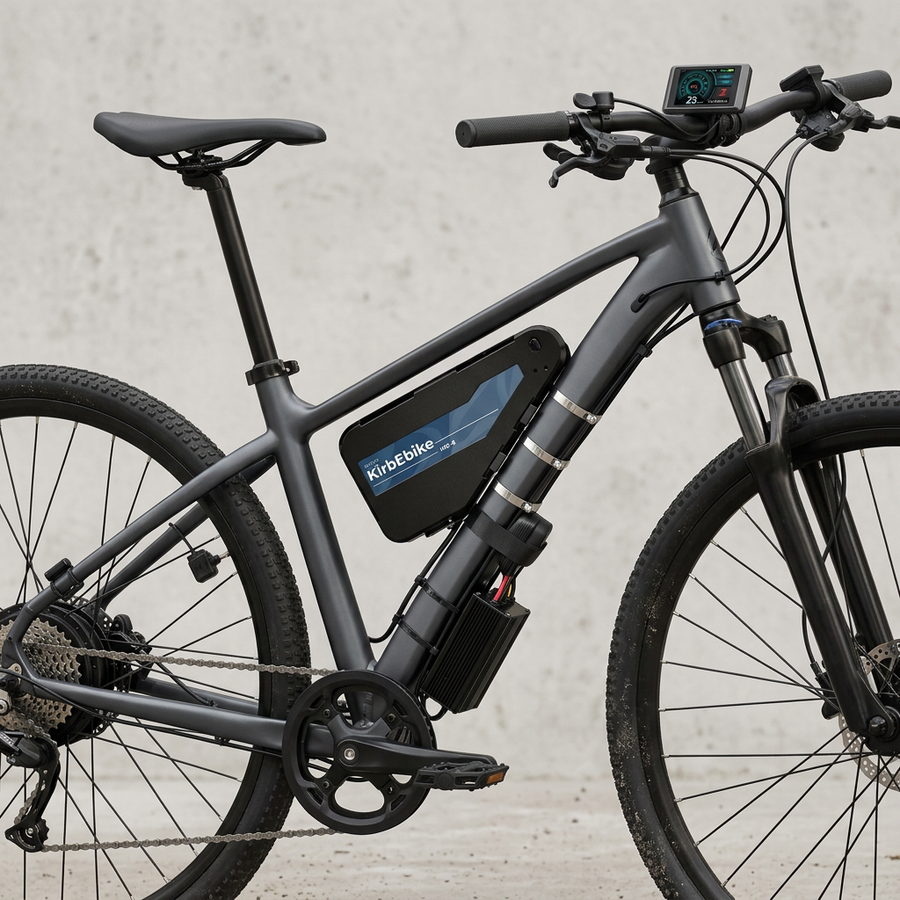
Measure the battery and its rail, and leave room to slide the pack off its base. Small, step-through and full-suspension frames often lack triangle space. Rear racks work but shift weight backwards — and paired with a rear hub motor can feel tail-heavy. Never drill a frame to force a mount.
📋
Pre-order compatibility checklist.
Wheel size confirmed against the kit (700C / 29 / 27.5 / 26″)
Dropout width: front ~100mm; rear 135mm QR or 142mm thru-axle — measured, not guessed
Axle type identified: quick-release, solid axle or thru-axle
Brakes: rotor standard and clearance checked, or a compatible rim braking surface
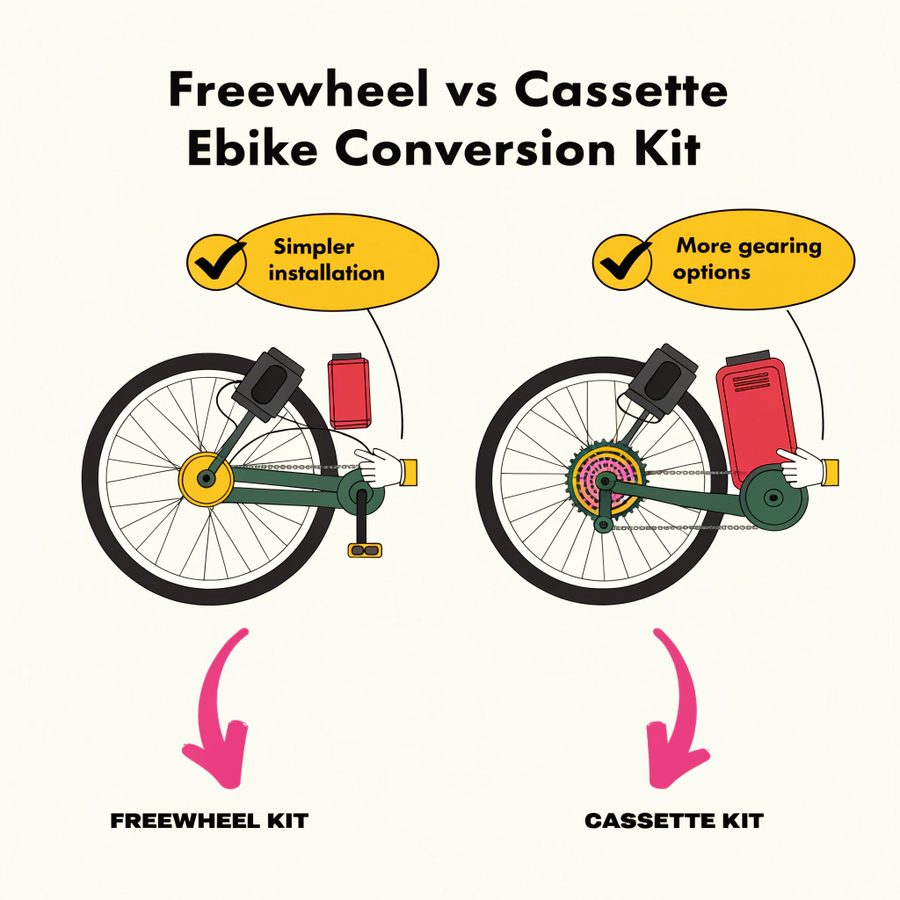
Gears: freewheel vs cassette confirmed for a rear kit
Bottom bracket: shell width and type measured (mid-drive only)
Battery space: pack fits the frame triangle with room to remove it
Frame condition: no cracks, deep corrosion or damaged threads
How KirbEbike Kits Change the Fit-and-Cost Maths
One ecosystem, shared parts. Core-kit batteries, controllers and displays are shared across the 500W–4000W range — so upgrades are a genuine path rather than a rebuild.
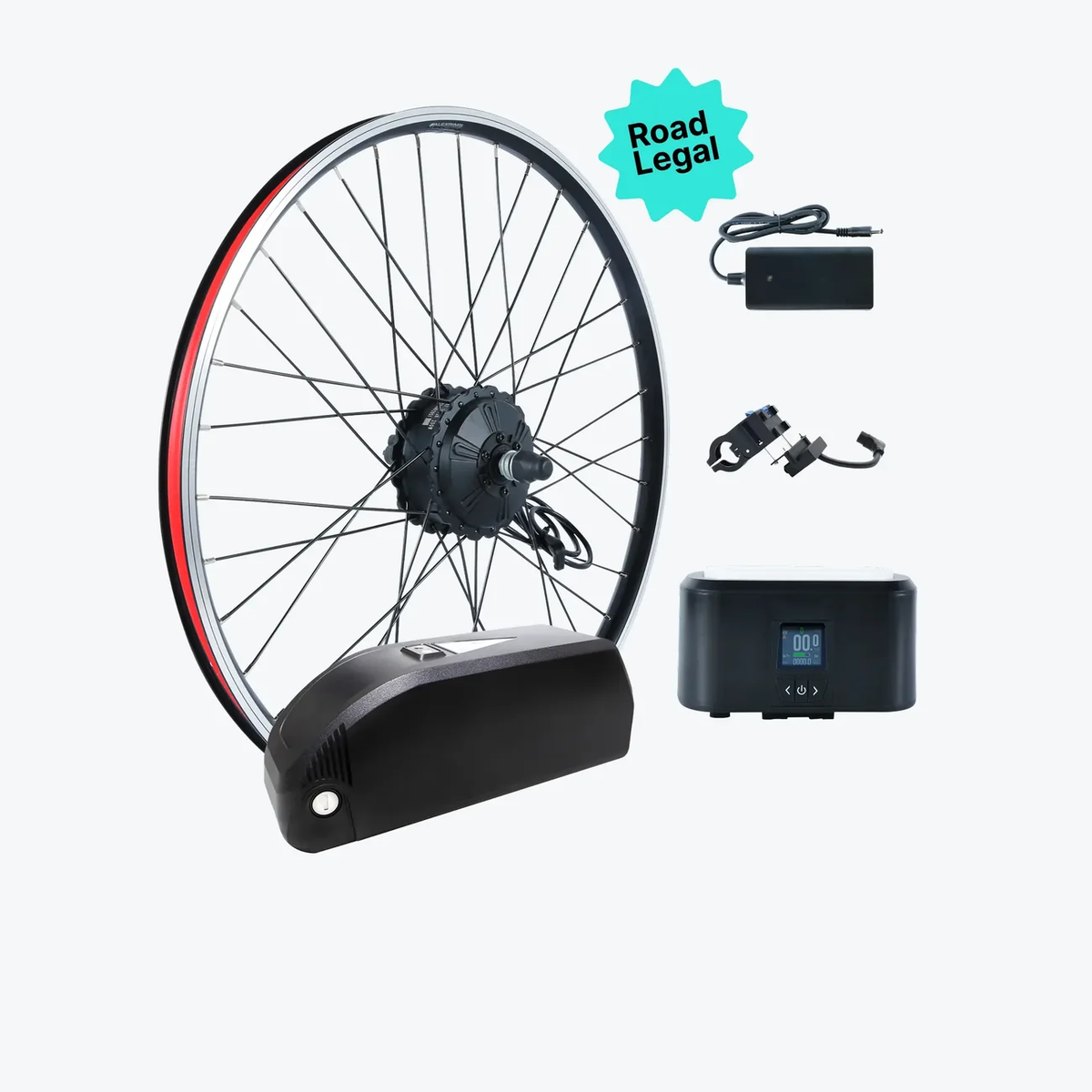
Two features help reduce the hidden costs above. Core-kit wheel variants come as a 7-speed threaded freewheel or an 8–11-speed cassette on supported sizes — so you match the hub to the drivetrain you already have. And the controllers are fully resin-potted for weather protection and heat management. Battery-inclusive configurations are available; confirm your selected variant includes both battery and charger.
The easiest fit in the range is the EZ Rider Kit — a 250W front-wheel system designed around EAPC limits. KirbEbike estimates about 20 minutes on a compatible bike and supplies the installation tools (actual time depends on tyre transfer, brake alignment and experience). It’s a complete, standalone system with a dual 36V battery and up to 60 miles of range.
*Complete-kit configurations. For the core 500W–4000W kits, the Taishan and HS-II packs (60A continuous BMS, 5A fast charging, 4–6h to full) and the Smart Controller & displays are shared across the range. The EZ Rider and Z16 are separate systems — don’t mix their parts with core-kit components.
Extra Costs That Inflate the Final Bill
The advertised kit price is one line of the budget. Inspect the bike before ordering — replacing worn parts at the same time is cheaper than pulling newly fitted components later.
Extra
Typical add
When you’ll need it
Torque arm & mounting hardware
£20–£100
Higher-torque hub motors; forks not built around a motor axle
Battery / charger upgrade
£100–£350+
Longer commutes, hilly routes, or a kit sold without a battery
Brake pads / rotors / brakes
£40–£150
Worn or weak brakes on a heavier, faster bike
Chain, cassette, chainring
£40–£150
Common with mid-drives; a stretched chain slips under power
Wheel building / spoke work
£60–£150
Motor hub supplied without a laced wheel, or a size mismatch
Small parts are easy to overlook — the accessories range covers the mounting hardware most conversions need. On chargers: use only the one supplied or approved for the pack. A plug that fits is not the same as a matched charger.
Example UK Conversion Budgets
Whole-project examples compare better than headline kit prices. Each includes motor, battery, charger, fitting supplies, labour and likely bike upgrades.
~£435
Budget DIY hub conversion
~£750
Standard shop-fitted commuter
~£1,430
Premium mid-drive build
Budget DIY hub — about £435
Front hub kit and wheel (£180), battery and charger (£180), torque arm and small parts (£35), basic tools or hire (£40). Works when the bike is already safe and the kit matches its standards. Leaves little room for new brakes or drivetrain parts.
Standard shop-fitted commuter — about £750
Better-quality hub kit with a branded battery (£550), professional fitting (£120), brake pads and service parts (£50), extra mounting hardware (£30). Cleaner and lower-risk than a bargain DIY build, with a clearer path to aftercare.
Premium mid-drive — about £1,430
250W-rated mid-drive configured to EAPC limits (£750), higher-capacity battery and charger (£350), professional fitting (£180), chain/cassette/chainring work (£150). Rises further on a non-standard bottom bracket — approaching the price of a mid-range complete e-bike.
Is Converting Cheaper Than Buying an E-Bike?
A conversion wins when you already own a suitable bike in good condition — you pay mainly for the electrical system instead of another frame and full component set. It’s especially strong on lightweight commuters, folders, tandems and cargo bikes, and it keeps a fit, saddle or gearing you like.
A complete e-bike often becomes better value once the conversion total passes roughly £1,000–£1,500, because factory models at that price bundle an integrated battery, matched brakes, reinforced wheels and one dealer warranty. Price the whole project first, then compare like with like.
UK Legal and Safety Checks Before You Fit
A conversion used on UK public roads must meet EAPC rules: a motor with a maximum continuous rating of 250W, working pedals, and assistance that stops at 15.5 mph (25 km/h). You can pedal faster; the motor just stops helping. If you only ride on the road, the road-legal kits are the simplest starting point.
Kits rated 500W, 1,000W, 3,000W or higher do not qualify as ordinary EAPCs — buying one online doesn’t make it road-legal. A non-compliant powered cycle can need registration, insurance, a licence and motorcycle-standard equipment.
KirbEbike’s Limit Mode switches between preset throttle, pedal-assist and speed settings on compatible app-programmable kits. These presets help control how the system behaves — but they do not change the motor’s rated power or guarantee road legality:
Mode
Throttle
Pedal assist
Use case
Limit 1
250W / 25 km/h
250W / 25 km/h
Reduced-output preset; does not reclassify a >250W motor
Limit 2
Disabled
250W / 25 km/h
Pedal-assist preset; classification depends on the completed bike
On batteries: a BMS monitors voltage, current and temperature, but can’t make poor cells or the wrong charger safe. Buy from a traceable supplier, charge on a hard surface away from your exit, and never use a swollen, crushed or water-damaged pack.
✅
Pre-ride validation (after fitting, before you ride).
Wheel nuts, thru-axle, cranks and pedals torqued to spec
Torque arm fitted and tight on any hub-motor build
Battery locks in, sits flush and can’t rattle loose over bumps
Brakes bite cleanly; no rotor rub through a full wheel spin
Gears shift across the full range with no chain-to-spoke contact
Cables clear of the chain, tyre and steering through full lock
Correct wheel size set so the speed reading and cut-off are accurate
Road build confirmed to stop assisting at 15.5 mph
Matched by wheel size & power
Find the Kit That Fits Your Bike
Battery-inclusive and kit-only configurations — check the selected variant for battery, charger, controller and display contents before comparing total cost.
Start with the main collection to match a kit to your wheel size and riding, or go straight to the EZ Rider Kit for the simplest road-legal fit.
FAQ
How much does it cost to put a conversion kit on a bike?
In the UK, budget about £350–£1,200 for a typical project including the kit, battery and fitting. Professional labour alone is usually £50–£200+, while premium or specialist conversions can pass £2,000. The final figure depends on motor type and how much brake, drivetrain or wheel work the fit needs.
Can I fit a conversion kit myself?
A front hub kit is a realistic DIY job if you can handle basic bike tools — the motor arrives inside a wheel and the rear gears stay untouched. Rear hub and mid-drive fits are harder and need more tools, so first-timers often save money overall by paying a shop for those.
Will a hub motor fit my bike?
It fits if the wheel diameter, dropout width and axle type match. Fronts are commonly 100mm; rears are usually 135mm quick-release or 142mm thru-axle. Check the brake standard and, for a rear kit, whether your bike runs a freewheel or a cassette — then match the selected hub variant to the drivetrain already on your bike.
Do Halfords do e-bike conversions?
Halfords does not advertise a general service to fit any third-party kit. Its policy covers legal EAPCs bought from Halfords or a short list of supported systems, and stores vary by staff training. Contact your chosen store with the exact bike and kit details first, or use a specialist that names the system it installs.
Are e-bike conversion kits any good?
Yes, when the donor bike is safe and compatible and the kit comes from a supplier with matched chargers, replacement parts and support. Conversions leave more visible cabling than a factory e-bike, and ride quality depends heavily on the fit. Match the motor to your route: hubs for most commutes, mid-drives for steep hills.
What are the disadvantages of conversion?
Compatibility work, visible wiring, added weight and more involved maintenance. Hub motors make wheel removal fiddlier; mid-drives wear chains and cassettes faster. A conversion can also stop being cheaper once tools, brakes and repairs are added — price the whole job before ordering.
What is the cheapest e-bike conversion kit?
Basic front hub kits are cheapest, with some motor-only prices near £200–£300. A complete budget build usually reaches £350–£550 once a battery, charger, torque arm and display are included. The cheapest unknown kit is false economy if matched parts and instructions aren’t available.
Is converting cheaper than buying an e-bike?
It’s cheaper when you already own a suitable bike and the fit needs few extra parts. Once the total passes roughly £1,000–£1,500, a complete e-bike with an integrated battery and single warranty can be better value. Compare the full project cost against a factory model before deciding.
How fast can a 3000W conversion kit go?
A 3000W kit can exceed 40 mph, but actual speed depends on voltage, controller current, wheel size, weight and gearing. It is not a road-legal EAPC in the UK, where the limit is 250W continuous with assistance stopping at 15.5 mph. Keep high-power builds to lawful private land.
About this guide. Author: KirbEbike Editorial. Last reviewed: July 2026. Methodology: labour bands, project budgets and policy statements cross-checked against the government, retailer and sector sources cited inline; KirbEbike product pairings and prices checked on live product pages in July 2026. Quotes vary by shop, region and bike condition — always price the whole project, and confirm your selected variant’s contents before ordering.
Stay in the know
Conversion guides, fitting advice and the deals worth knowing about. No spam.
Door je aan te melden ga je akkoord met ons Privacybeleid.