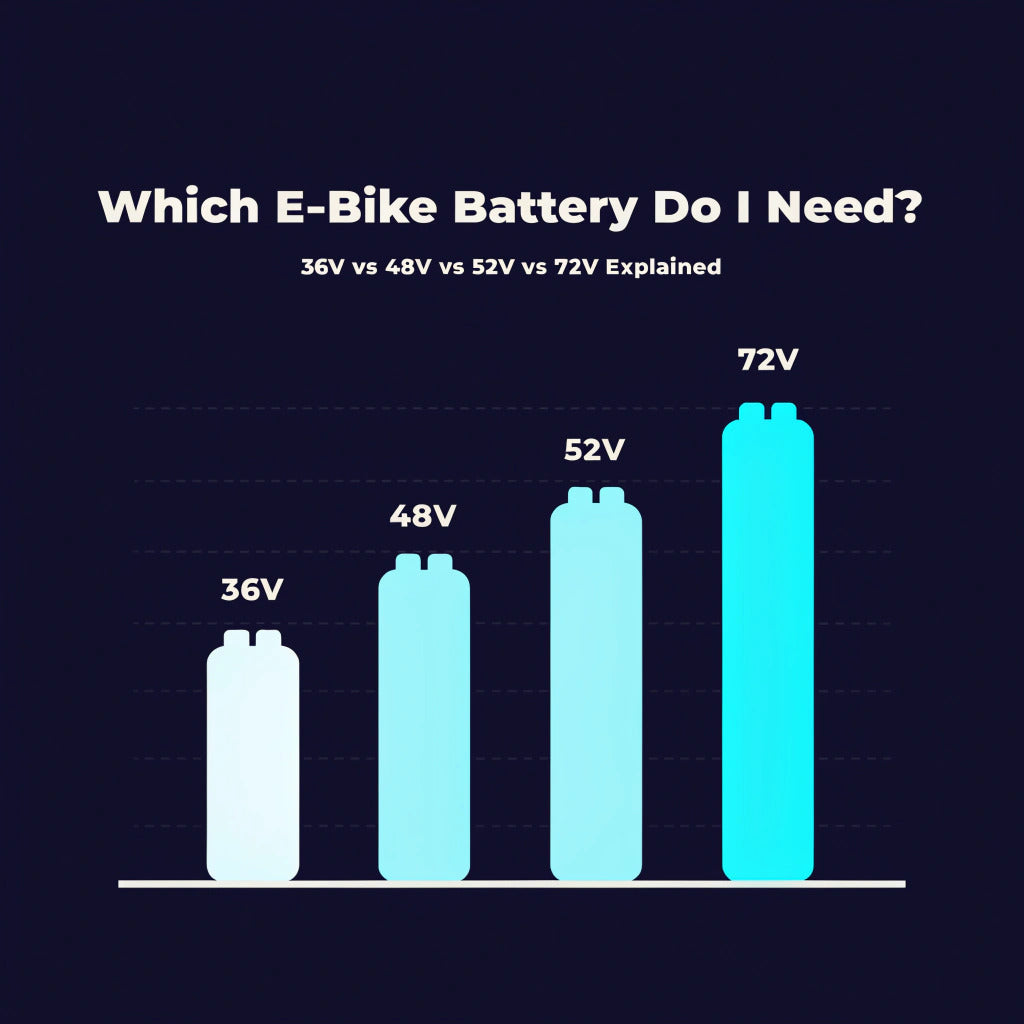
Which E-Bike Battery Do I Need? 36V vs 48V vs 52V vs 72V Explained
AK
Andy Kirby
Reviewed by the KirbEbike conversion-support team
Share
Unlock £10 off today
On this page
The highest voltage or the biggest amp-hour number is rarely the right answer. An e-bike battery has to match your controller, motor, charger, current demand, connectors and mounting space — get one of those wrong and even an expensive pack can underperform, cut out under load, or destroy your electronics. This guide explains what 36V, 48V, 52V and 72V actually mean, how to compare packs properly in watt-hours, and the compatibility checks that matter far more than the number on the label.
The short answer
36V suits a purpose-built lower-power or road-legal commuter system. 48V is the general-purpose choice with the widest range of compatible parts. 52V is a higher-headroom performance option that reaches about 58.8V fully charged — every component must be rated for that. 72V is a different class: a high-voltage system built entirely around 72V parts. Voltage alone never sets range, speed or legality — UK EAPC status depends on the motor’s continuous rating, pedal assist and the 15.5 mph cut-off, not the battery label (GOV.UK).
📚
In this series: Batteries and controllers
Start with this guide, then go deeper on the part that applies to your bike.
The battery is a system decision. The right pack matches the controller, motor, charger and frame — not just a voltage number.
The Quick Answer, by Voltage
8 key points
Voltage
Common system type
Main advantage
Main limitation
Typical buyer
36V
Lower-power commuter
Lower weight and cost
Less performance headroom
Short-distance commuter
48V
General conversion
Broadest component choice
Must still match current demand
Mixed-use rider
52V
Performance conversion
More voltage headroom
Not universally 48V-compatible
Hill / performance rider
72V
Complete high-power build
High power at lower current
Larger, heavier, demanding
Experienced private-land builder
Work the decision in this order — it prevents almost every expensive mistake:
Match the controller’s voltage range
Match the charger to the battery
Check the battery’s continuous discharge current
Compare energy in watt-hours, not amp-hours
Confirm connectors and polarity
Measure the battery mounting area
Check the motor, display, lights and accessories
Confirm the intended use is legal where you ride
KirbEbike lists battery and kit options across 36V–72V and several capacities, so it helps to shop by complete-system compatibility rather than voltage alone — the kit-and-battery collection is the practical starting point.
Voltage, Amp-Hours and Watt-Hours, in Plain English
Three numbers, one pack. Voltage is the push, amp-hours are the bucket, watt-hours are the actual fuel — and only watt-hours compare fairly across packs.
What does battery voltage mean?
Voltage is the battery’s electrical push. In a compatible system, higher voltage can support higher motor speed and power — but on its own it does not guarantee a specific top speed, hill-climbing result, range, wattage or legal classification. Those also depend on the motor winding, controller current, wheel size, load and programmed limits.
What do amp-hours measure?
Amp-hours (Ah) measure charge capacity — but Ah can never be compared across different voltages. A 36V 20Ah pack, a 48V 15Ah pack and a 72V 10Ah pack all store the same energy: 720Wh. Convert every pack to watt-hours before comparing.
What are watt-hours?
Watt-hours are the fuel tank, and the only fair basis for comparing range potential.
The Battery Management System (BMS) must supply enough current for the controller, continuously. Approximate electrical input = battery voltage × the controller’s current limit: at a 30A limit that’s about 1,080W at 36V, 1,440W at 48V and 2,160W at 72V — electrical input, not wheel output. One trap catches many buyers: a BMS quotes a continuous rating and a higher short-burst peak rating. It’s the continuous figure that must meet or exceed the controller’s continuous draw — never match a controller’s continuous demand to the BMS’s peak number.
Nominal Voltage vs Fully Charged Voltage
The number on the pack is the nominal voltage, not the maximum. A lithium-ion pack charges well above its label — and that peak is what your electronics actually have to tolerate.
Nominal label
Common series count
Approx. full-charge voltage
36V
10-series
42.0V
48V
13-series
54.6V
52V
14-series
58.8V
72V
20-series (commonly)
84.0V
Confirm the specific cell chemistry and manufacturer specification before relying on these figures — not every chemistry uses the same maximum cell voltage.
Why this matters to the controller: a controller advertised as “48V” must be checked against its actual maximum input-voltage rating. A 52V battery reaches roughly 58.8V full — beyond the limit of some controllers, displays, DC converters, lights and USB modules. And why the charger must match: a charger must match the battery’s chemistry, series count, maximum charge voltage, connector, polarity and approved current. Never pick a charger by connector shape — a plug that fits can still deliver the wrong voltage.
36V vs 48V vs 52V vs 72V, Side by Side
Decision factor
36V
48V
52V
72V
Component availability
Good
Very broad
Good (DIY)
More specialist
Pack size for equal Ah
Smaller
Moderate
Slightly larger
Usually large
Performance potential
Lower
Moderate–high
High
Very high
Conversion complexity
Lower
Moderate
Moderate–high
High
Mechanical demands
Lower
Power-dependent
Higher
Substantial
Typical use
Commuting
Mixed riding
Hills / performance
Private-land builds
Direct swap for another voltage?
No — never without confirming every component’s voltage rating
Size scales with energy. A down-tube pack like this suits 36V–52V commuter builds; bigger triangle packs carry the high-capacity, high-current cells.
Does higher voltage always mean more range?
No. Range depends mainly on usable watt-hours and how fast you spend them. At the same speed and load, a higher-voltage system may be slightly more efficient — but the moment you use the extra acceleration and speed it makes available, consumption per mile rises and range normally falls.
Does higher voltage always mean more torque?
No. Torque comes from controller phase current, battery current, motor design, gearing and thermal limits. More voltage can enable more power, but it does not translate directly into wheel torque.
Is a higher-voltage battery more efficient?
Higher voltage moves the same power at lower current, which reduces resistive losses in properly rated wiring and components. That benefit only applies when the whole system is designed for the voltage — it never makes an incompatible upgrade safe.
When a 36V Battery Makes Sense
36V is a valid design choice, not an obsolete one. It suits legal commuter conversions built around a compliant 250W motor, shorter or moderate rides, flatter routes, riders prioritising low weight, and compact or folding-bike conversions with lower-current electrics.
Benefits: usually lighter for a comparable pack, lower component cost, adequate for moderate pedal assistance, smaller charger and mounting options. Limits: less voltage headroom — high power requires more current, and you may notice more voltage sag under heavy load. It is not the platform for extreme-performance systems. How fast will a 36V e-bike go? There is no single figure: speed depends on the motor winding, controller, wheel size, load and the legal cut-off. A 36V battery can power a UK-compliant 15.5 mph EAPC or a quicker off-road setup — voltage alone does not decide it.
When a 48V Battery Makes Sense
48V is the widely supported general-purpose platform: mixed urban and recreational riding, moderate hills, cargo setups with the right capacity, and 500W–1,500W conversions where legally permitted, with the broadest controller and battery availability of any voltage.
Benefits: wide component availability, many capacity and case choices, easy sourcing of replacement controllers and chargers, and a good balance of cost, size and performance. Limits: it is not automatically road-legal, a poorly specified pack can still cut out under load, and in powerful builds the current rating matters more than the capacity. High-power 48V use still demands upgraded brakes, a frame assessment and secure axle retention.
48V vs 52V: Compatibility Before Performance
The only safe rule: move to 52V when every affected component is explicitly rated for its roughly 58.8V maximum charge voltage — the controller’s maximum input and low-voltage cut-off, the display, lights and DC converter, the charger, the connectors, and the warranty terms. KirbEbike’s own kits are engineered to accept both 48V and 52V packs, but that capability should never be generalised to every controller on the market. When in doubt, ask the controller manufacturer in writing.
52V vs 72V: Two Different System Classes
This is not a bigger-number contest. A 72V system suits very high power; a 48V or 52V system is typically easier to package, operate and support on a bicycle-style build. The power level and design of the complete vehicle decide which class you’re in.
✋
Can a 72V battery go on a 48V system? No. A 72V lithium-ion pack reaches roughly 84V fully charged — far beyond the limits of ordinary 48V electronics. Connecting one can destroy the controller, display and accessories instantly, and creates a serious hazard. A 72V build needs a complete 72V-rated system: frame, motor axle and torque plates, wheels, tyres, high-performance brakes, secure battery enclosure and protected high-current wiring. Most 72V builds no longer operate like ordinary pedal cycles and are for private land or properly classified use only.
Match the Battery to the Motor and Controller
Start with the electronics, not the battery. The controller label and manual decide which packs are even candidates.
This is the compatibility section that matters most — work through it in order:
Start with the controller label and manual. Record the nominal voltage, maximum input voltage, low-voltage cut-off, maximum battery current, phase current, connector type, display compatibility and any regen voltage limits.
Check the motor’s rated voltage and winding. Some motors run on more than one voltage, but changing voltage changes no-load RPM, loaded speed, heat and tuning. A wattage sticker alone doesn’t prove battery compatibility.
Match continuous current. Even at the right voltage, a 52V pack with a 20A continuous BMS is the wrong partner for a controller that draws 40A continuously. In powerful builds, current rating is usually the deciding spec.
Check connectors, polarity and everything downstream. XT60, XT90, Anderson-type, cradle contacts and proprietary plugs all exist — and two matching connectors can still be wired with reversed polarity. Displays, lights and USB modules can be single-voltage even when the controller isn’t; check the entire system.
How Many Watt-Hours Do You Need?
Shift the range question from voltage to stored energy. First calculate the pack’s energy: 36V × 15Ah = 540Wh; 48V × 15Ah = 720Wh; 52V × 20Ah = 1,040Wh; 72V × 20Ah = 1,440Wh. Then divide by how fast your riding spends it:
Riding condition
Planning consumption
Low assistance with active pedalling
8–12 Wh/mile
Normal mixed riding
12–20 Wh/mile
Hills, cargo or high assistance
20–35 Wh/mile
Fast off-road riding
35 Wh/mile or more
KirbEbike planning estimates, not test-certified figures — they assume roughly 90–110 kg rider-plus-bike, moderate terrain, 15–20 mph, light wind, standard tyres and some pedalling. Heavier loads, hills, cold, headwinds, knobbly tyres or throttle-only riding push consumption up.
Worked example: a 1,440Wh pack with about 85% usable (≈1,225Wh), ridden at 18 Wh/mile in normal mixed conditions, plans to roughly 1,225 ÷ 18 ≈ 68 miles. Use your own usable Wh and expected consumption, not the nominal figure.
And why runtime isn’t measured in hours alone: a battery has no fixed operating time. Estimated runtime ≈ usable energy (Wh) ÷ average draw (W). The same 1,440Wh pack gives about 1.2 hours at an average 1,000W — and far less at 3,000W. Watts are a rate, not an amount.
Battery Quality Beats the Voltage Label
A safe, well-built pack at the correct voltage will outperform a higher-voltage pack of poor quality every time. Check the cell manufacturer and model, pack configuration, interconnect and welding quality, insulation and temperature monitoring — naming Samsung, LG or Panasonic cells alone does not prove the whole pack is safe. The BMS needs the right series count, sufficient continuous current, and overcharge, over-discharge, short-circuit, temperature and cell-balancing protection.
For the UK, start with the Government’s OPSS statutory guidance on lithium-ion battery safety for e-bikes, which points to the relevant standards: BS EN 50604-1 for light electric-vehicle lithium batteries and BS EN 15194 for electrically assisted pedal cycles. UN 38.3 is transport testing for shipping cells — not a product-safety certification — and UL 2271/2849 are North American standards you may see cited alongside. The guidance also stresses keeping battery and charger compatible and avoiding modifications.
⚠️
Warning signs to walk away from.
No cell or BMS information published
No continuous current rating — only a peak figure
Certification logos that can’t be verified
A charger sold without specifications
Exposed or undersized wiring; a loose battery case
No warranty contact; capacity claims inconsistent with the pack’s size and weight
Any seller who says you can use any voltage with any controller
Battery Shape and Mounting
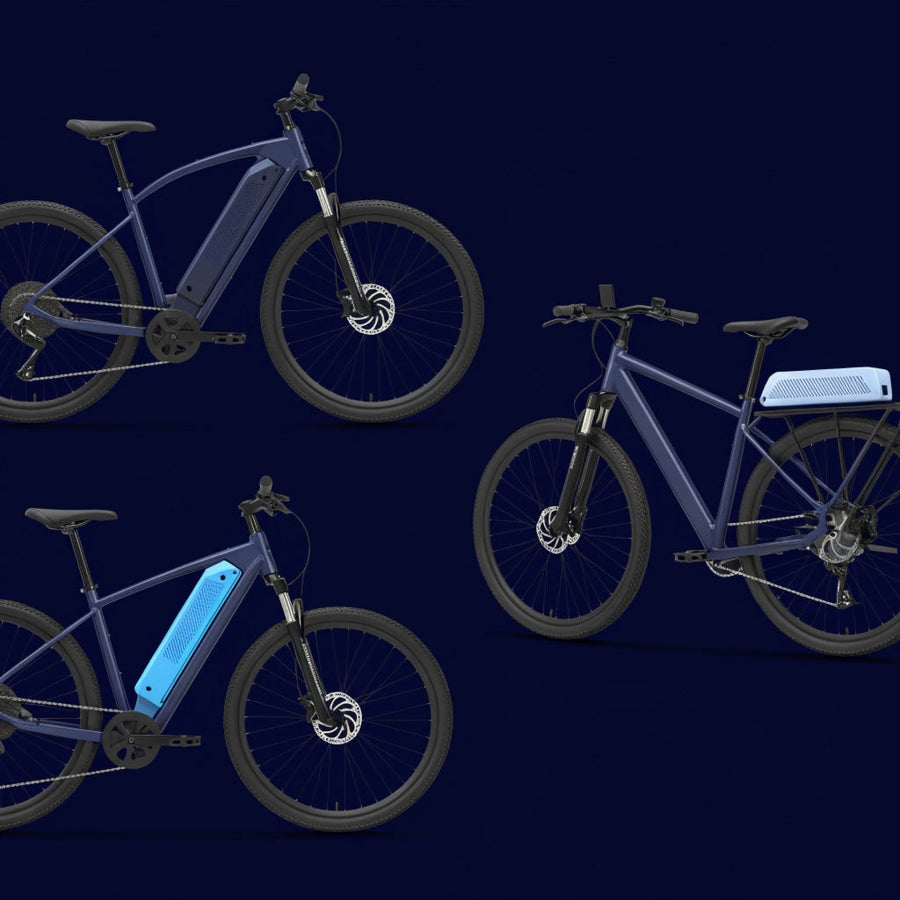
An electrically compatible battery can still be unsafe if it doesn’t fit. Down-tube packs give central weight and easy removal, but need frame-triangle clearance — measure case length, height and width, rail length, key-removal clearance, cable exit and bottle-boss position. Triangle packs suit high-capacity, high-current builds on larger hardtail frames; check crank, shock, bottle and cable clearance. Rear-rack packs free the triangle on step-through commuters, but a heavy rear battery raises the centre of gravity and can affect handling.
⚠️
Dual batteries need engineering, not optimism. Never connect two packs directly in parallel unless the batteries and combining hardware were designed for it — voltage equality, state of charge, chemistry, discharge paths, isolation and controller compatibility all have to be checked first.
KirbEbike Battery Options, by Use Case
KirbEbike is one option among several in this guide, and the right route depends on your complete system rather than the highest available power:
36V route — compatible commuter kits and lower-power conversions where manageable weight matters most
48V route — hub and mid-drive systems for mixed use, with a choice of capacities
52V route — performance kits with higher-voltage controllers, for riders needing more energy or current
72V route — purpose-built private-land systems with motors, frames and brakes reviewed for the output; not a normal upgrade from 48V
Engineered as a set. KirbEbike’s packs, controllers and displays are matched at the factory — the compatibility checks in this guide are already done inside the range.
Taishan vs HS-II: which KirbEbike pack?
Spec
Taishan
HS-II
Voltage options
48V / 52V / 60V / 72V
52V / 60V / 72V
Capacities
48V 30Ah · 52V 25Ah · 60V 20Ah · 72V 20Ah
52V 30Ah · 60V 20Ah · 72V 20Ah
Energy
1,260–1,440Wh
1,260–1,560Wh (52V 30Ah is the range’s largest)
Cells
LG 21700 (Samsung 50S on 72V models)
BMS
60A continuous / 70A peak
Charger
5A included
5A fast included
Weight
6.2–6.8 kg
6.4–7.55 kg
Dimensions
386.2 × 97 × 157.4 mm
Slimmer triangle profile — confirm per model
Sealing
IP65
Extras
The value workhorse
USB-C output; widest frame fit
Ideal motor range
500W–3000W (4000W on 72V)
500W–4000W
Warranty
1 year; UK / US / FR / NL service points
The value workhorse
Taishan Lithium Batteries + 5A Charger
From £579.99 · 48V–72V · up to 1,440Wh
LG 21700 cells (Samsung 50S on 72V) · 60A continuous BMS
IP65-sealed triangle pack with mount holder included
Confirm the exact capacity, BMS current, cell type, case dimensions and charger output for your chosen voltage on the product page before ordering.
Open Conversion Batteries vs Proprietary OEM Batteries
One compatibility warning matters more than any brand list: e-bike batteries split into open conversion packs and closed OEM packs, and the two are not interchangeable. A conversion build uses an open pack chosen to match your controller, current, connectors and mounting — that’s what the Taishan and HS-II are. Factory e-bikes from the big drive-unit brands use proprietary packs locked to that brand’s motor, mount and firmware — they cannot serve as general conversion batteries, and if your bike is a factory e-bike you should replace its pack like-for-like from that brand.
System type
Example
Best fit
Key limitation
Open / conversion
KirbEbike Taishan & HS-II
DIY and kit builds, 36V–72V
You must verify controller, current and connector fit
Closed OEM
Bosch-equipped factory e-bikes
That brand’s own drive units
Not a universal conversion battery; generation-specific
Closed OEM
Shimano-equipped factory e-bikes
That brand’s own drive units
Battery, mount, drive unit and firmware must all match
Common Battery-Selection Mistakes
🚫
The nine that cost the most.
Buying by voltage alone — current, capacity, compatibility and physical fit matter just as much
Comparing amp-hours across different voltages — convert to watt-hours
Assuming 52V is always safe on a 48V controller — check the full-charge voltage
Connecting a 72V battery to a 48V system — instant damage and a real hazard
A BMS whose continuous current is too small — sag or cut-offs under load
The wrong charger — a matching connector shape is not enough
Ignoring mounting strength — heavy packs need rigid, vibration-rated mounts
Assuming bigger is better — weigh the weight, handling, charge time and cost
Treating voltage as legality — UK EAPC status comes from the motor and assist configuration
Charging and Storage Safety
Use the charger supplied or explicitly approved for the exact battery model, and let the pack reach a safe temperature before charging — consumer lithium-ion should not be charged below 0°C without a system designed for it (Battery University). Charge in a clear, dry area away from exits and flammable materials, on a stable surface where you can monitor the pack.
Stop using a damaged battery immediately if you see swelling, cracks, water ingress, corrosion, an unusual smell, excess heat, hissing or intermittent power after an impact. For extended storage, follow the manufacturer’s instructions — storage stress depends on both temperature and state of charge, so a moderate charge in a cool place is generally best (Battery University BU-808).
Final Compatibility Checklist
📋
Tick every line before you order.
Nominal voltage matches the system, and full-charge voltage is within the controller’s limit
Motor, display, lights and DC converter all support the voltage
BMS continuous current meets controller demand; peak current is adequate
Watt-hours cover your required range with margin
Cell and BMS information is published; connector type and polarity match
Charger is approved for the exact battery
Case fits the frame, the mount carries its weight, and it clears suspension and steering
Safety claims are verifiable, the warranty covers your pairing, and the intended use is legal
Work through the checklist against your own bike, then choose a compatible pack from the KirbEbike battery collection, confirming voltage, continuous current, charger and mounting fit on the product page.
Conclusion: Buy a Complete Battery System, Not a Voltage
The right battery is the one electrically, physically and legally suited to your bike. Voltage influences performance but never determines range by itself; watt-hours measure the energy; and the BMS’s continuous current decides whether the pack can actually feed your controller. A 52V pack is not a guaranteed upgrade for a 48V system, and a 72V pack demands a complete 72V-rated build.
Start with the controller and motor specifications, calculate the watt-hours you need, then choose a battery whose voltage, current output, charger and mounting are all confirmed in writing. Charger, connector and mounting compatibility — and verifiable safety and after-sales support — matter as much as any headline spec.
Not Sure Which Battery Fits Your Build?
Note your controller’s voltage and continuous-current limits and the watt-hours you need, then compare the Taishan and HS-II packs by voltage, energy, BMS current and mounting fit.
A 52V system may support a higher motor speed than a comparable 48V system, but only when the controller and motor are compatible and speed limits allow it. Voltage alone does not guarantee a specific top speed.
What is the best voltage for an e-bike?
There is no universal best. Choose the voltage specified for your motor, controller, display, charger and intended use: 36V and 48V suit most commuter and mixed-use builds; 52V and 72V suit performance and high-power builds. Voltage does not set road-legality.
What is the difference between a 52V and 72V battery?
A 72V pack operates at a much higher maximum voltage (about 84V full) and needs different controllers, chargers and accessories. It belongs to a different, higher-power class of build than a 52V system.
How long does a 52V battery last?
Per-charge runtime depends on watt-hours and consumption, not voltage. Service life depends on cell quality, temperature, charging habits and storage — typically several hundred to over a thousand cycles with good care.
Is 72V better than 48V?
A 72V system can be better for very high power. A 48V system is usually lighter, simpler and more practical for general conversion use. Neither is automatically better — it depends on the build.
How fast will a 36V e-bike go?
Speed depends on the motor winding, controller, wheel size, load and software limits. A 36V battery has no fixed speed — it can power a UK-legal 15.5 mph EAPC or a quicker off-road setup.
Can I put a 52V battery on a 48V e-bike?
Only when the controller, display, lights and other electronics are all rated for the battery’s roughly 58.8V fully charged voltage. Check every component and the warranty terms before upgrading.
Can I put a 72V battery on a 48V e-bike?
No, not on an ordinary 48V system. A fully charged 72V pack can reach about 84V and can damage 48V components instantly. It needs a complete 72V-rated system.
How many hours does a 72V battery last?
Divide usable watt-hours by average power. A nominal 1,440Wh pack at an average 1,000W gives roughly 1.2–1.4 hours before reserves and losses; at higher power, much less. The label alone cannot tell you runtime.
Does a 72V battery make an e-bike faster?
It can support greater motor speed and power in a purpose-built system — but the motor winding, controller, wheel size, load and programmed limits still decide the result. Dropping a 72V pack into an incompatible bike just risks damage.
⚖️
A note on safety & legality. This guide explains battery selection in general terms and is not a substitute for your motor and controller manufacturer’s specifications. Never connect a battery whose voltage exceeds any component’s rating, and never improvise a charger. In the UK, a converted bike is only a road-legal EAPC when the motor is 250W continuous, assist cuts out at 15.5 mph and it requires pedalling; anything beyond that is for private land only (GOV.UK).
GOV.UK / OPSS — Statutory guidance: lithium-ion battery safety for e-bikes and e-scooters. gov.uk
Battery University — BU-808: How to prolong lithium-based batteries. batteryuniversity.com
Battery University — BU-410: Charging at high and low temperatures. batteryuniversity.com
About this guide. Author: KirbEbike Editorial. Technical review: KirbEbike conversion-support team. Last reviewed: July 2026. Methodology: voltage, watt-hour and compatibility explanations cross-checked against manufacturer documentation, KirbEbike’s published product range and the authoritative references cited inline; full-charge voltage figures are nominal-chemistry estimates that should be confirmed per battery. Specifications can change — verify on the live product pages before ordering.
Stay in the know
Conversion guides, fitting advice and the deals worth knowing about. No spam.