Geared Hub vs Direct-Drive: Which E-Bike Conversion Motor Should You Buy?
KE
KirbEbike Editorial
Reviewed by the KirbEbike conversion-support team
Share
Unlock £10 off today
On this page
One mechanical difference explains almost every trade-off between these two motors: a geared hub has an internal clutch, and a direct drive does not. The clutch is why a geared hub freewheels, and why it can never recover energy under braking.
The Quick Answer
Geared hub for commuting, stop-start riding, hills at moderate speed and easy unpowered pedalling. Direct drive for sustained higher-speed running, high continuous power and regenerative braking. Be careful with the usual generalisations, though: “direct drive is much heavier” is not universally true — our own geared 500W/750W and direct-drive 48V 1000W rear motors are both published at 4kg. Judge the specific motor, not the category.
The hub motor is the whole decision. Everything downstream — hills, coasting, noise, regen, weight — follows from whether there are reduction gears and a clutch inside it.
Direct Answer: Which Motor Type Suits Your Riding?
Your priority
Choose
Why
Verify before ordering
Daily commuting
Geared
Compact, freewheels, strong at low speed
Wheel size and axle interface
Hills at moderate speed
Geared
Reduction gearing multiplies torque
Continuous rating, not peak
Sustained higher speed
Direct drive
Efficient at its designed RPM
Controller current and battery
Riding often unpowered
Geared
The clutch removes motor drag
Gearing interface
Regenerative braking
Direct drive
No clutch, so the motor can be driven
Confirm the exact kit supports it
Lowest weight
Check the spec
Category does not decide it
Published motor weight per SKU
Read down to your priority. The last column is the part people skip.
Neither type is better. A geared hub suits low-speed torque and unpowered riding; a direct drive suits sustained speed, high continuous power and regen.
How Each Motor Works
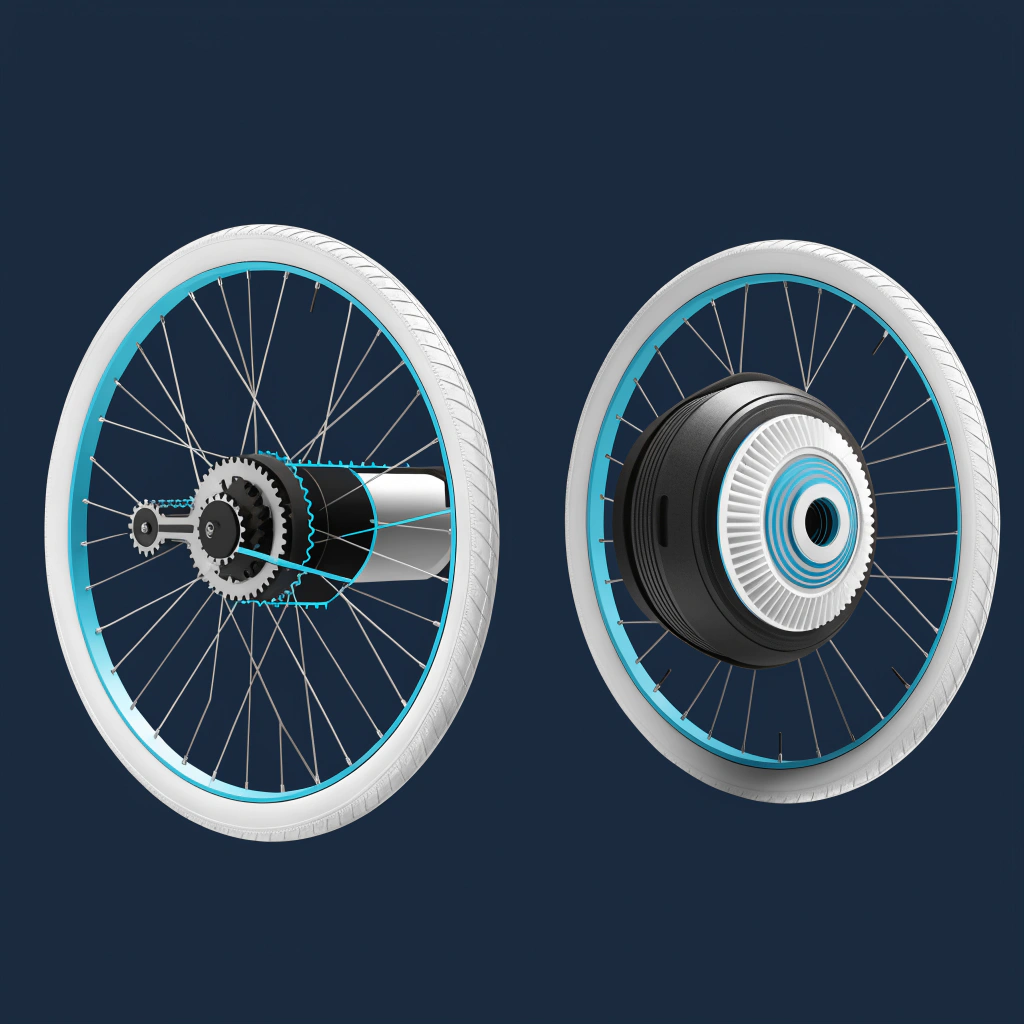
Geared hub — gears + clutch
Small fast motor behind a planetary reduction gearset
Gears trade speed for torque, so it stays compact
Clutch lets the wheel overrun the motor — it coasts normally
Faint gear whirr under power, quiet coasting
Gears and clutch are wear items
Direct drive — no gears, no clutch
The motor shell is the hub; the axle carries the stator
Any wheel rotation turns the motor — which is what enables regen
Always connected, so there is constant drag and faint cogging
Near silent in use
Fewer mechanical wear parts, but bearings and electronics still age
Fewer mechanical wear components is not the same as nothing wearing out. On a direct drive, bearings, Hall sensors, windings, insulation, magnets, seals, connectors and wiring all still depend on sound design and can degrade or fail.
Before you choose a type: six checks
Work in this order. The first check rules out more bikes than any of the others.
Axle interface first — identify the axle system, then width, then fork or frame material
Continuous rating — compare continuous rated output, not peak, across both candidates
Published motor weight — take the figure per SKU rather than assuming by category
Gearing interface — for a rear hub, confirm freewheel or cassette and the sprocket count
Controller and battery — controller current and battery continuous output must match the motor
Legal configuration — confirm the completed bike is legal where you intend to ride
That order matters. Identify the axle system before any width figure, because an open-dropout wheel and a thru-axle frame are different interfaces, not two widths of one thing (Park Tool on axle and retention systems), and if the hub does not match the frame’s specified interface the default answer is incompatible. Never file dropouts, never spread an aluminium or carbon frame, and cold-set steel only with the frame manufacturer’s approval and a competent professional. Our wheel and dropout size reference covers the identification.
Core Differences Side by Side
Factor
Geared hub
Direct drive
Internal gears
Planetary reduction gearset
None
Freewheels when unpowered
Yes, via an internal clutch
No, the motor is always driven
Low-speed torque
Strong for its size
Depends on winding and current
Sustained high speed
Less efficient
Its design strength
Regenerative braking
Not possible with the clutch
Possible with a suitable controller
Noise
Faint gear whirr under power
Near silent
Weight
Often lighter, but check the SKU
Often heavier, but check the SKU
Design consequences of one thing: whether a clutch and gears are present.
Hills, Speed and Motor Winding
Hill performance comes from torque at the wheel, and a geared hub gets it from reduction gearing rather than raw size. That is why a 250W geared hub climbs better than its wattage suggests, and why it suits a commuter facing short steep sections.
A direct drive climbing slowly is operating below its efficient RPM range: it cannot change its effective ratio, so it draws heavy current and sheds the surplus as heat with little airflow. Direct-drive hubs can therefore build heat during prolonged low-speed climbing.
⛰️
Choosing for a hilly route? Send us four numbers. We have not published a controlled hill test for these SKUs, so this guide gives you no gradient, duration or temperature threshold — anyone quoting one without test data is guessing. Send the gradient, climb length, wheel size and total load, and we will tell you which motor and controller pairing suits it, or that neither does. While riding: ease off, drop an assist level or stop to let the motor cool if you notice unusual heat at the hub, any smell, new noise, or the system reducing power on its own.
Speed depends on winding and wheel size rather than motor type. A hub motor has a designed RPM band, so the same motor in a 20-inch and a 29-inch wheel gives very different road speeds and torque at the tyre. Match the winding to the wheel size you run, and treat any speed claim without stated voltage, wheel size, load and gradient as meaningless.
⚖️
Power above 250W. A 500W, 750W or 1000W kit means the completed cycle is outside GB EAPC classification. It may be used on private land only with the landowner’s permission and subject to site rules, or on public roads only if the relevant motor-vehicle approval, registration, tax, insurance, licence and equipment requirements are met (GOV.UK). Restricting the display output does not change the motor’s documented continuous rating.
Weight, Coasting and Ride Feel
The generalisation is that geared hubs are lighter, and across the market it broadly holds. It does not appear to hold between our own two rear motors — but only when the figures are compared on the same basis, so here is that basis stated explicitly.
Motor
Published weight
What the figure covers
What it excludes
Source and date
SHENGYI geared rear hub 500W/750W MTX rim kit
About 4kg
Motor only
Rim, spokes, tyre, tube, freewheel or cassette, torque arm, controller, display, harness
Product page, 7 Aug 2026
SHENGYI direct-drive rear hub 48V 1000W kit, standard variant
About 4kg
Motor only
As above
Product page, 7 Aug 2026
48V 1000W all-black wheel variant
About 6.2kg
Motor wheel, not motor only — a different boundary
Tyre, tube, sprockets, torque arm, electronics
Published elsewhere in KirbEbike content; confirm before relying on it
Both 4kg figures are catalogue weights for the motor only, quoted to one significant figure — treat them as approximate rather than weighed measurements, and note the third row uses a different boundary entirely. A weighed comparison of both motors on the same scales has not been published.
Where weight does differ it sits at the wheel, which affects how the bike feels to lift and steer more than total mass suggests.
Coasting is the clearer difference, and it is mechanical rather than marginal. A geared hub’s clutch disconnects the motor when you stop driving, so the wheel spins freely and the bike pedals close to normally unpowered. A direct drive is always connected, giving a small constant drag plus a faint cogging feel at low speed. On any bike where a flat battery means pedalling home, that matters more than most specifications.
On noise, a geared hub emits a soft whirr under power and goes quiet coasting; a direct drive is close to silent. Neither should rattle, click or grind — those are fault symptoms, not characteristics.
Regenerative Braking: What It Actually Returns
This is where a direct drive has a capability a geared hub cannot have, and where the benefit is most overstated. The mechanism explains both. A geared hub’s clutch lets the wheel overrun the motor, so during deceleration the motor is mechanically disconnected and no energy can flow back. A direct drive has no clutch, the wheel always turns the motor, and with a controller built for it that motor can act as a generator.
What regenerative braking can return, at best
Theoretical maximum recoverable energy from potential energy (mgh) for a 100kg rider and bike, before any losses. Percentages are of a 500Wh pack. Teal = typical UK commute descent; blue = sustained hill or mountain descent. Real systems recover a fraction of these figures.
50 m descent
14 Wh · 3%
100 m descent
27 Wh · 5%
200 m descent
54 Wh · 11%
400 m descent
109 Wh · 22%
That arithmetic is the honest ceiling. Descending 100m recovers at most about 27Wh, roughly 5% of a 500Wh pack even with perfect capture, and no system is close to perfect. A peer-reviewed study of regenerative braking on a hub-type brushless DC motor, published in DergiPark, measured about 6.4% energy recovery at 320rpm falling to around 1.3% at 142rpm — which matches the mechanism: regen returns most at speed and very little at the low speeds where town riding happens. A direct drive also carries constant motor drag whether regen is enabled or not, which offsets part of the gain.
So value regen for what it does well: controlling speed on long descents and reducing brake wear. Treat any claim that it meaningfully extends everyday range with suspicion. And note we do not claim regen support for specific KirbEbike kits here — availability depends on the motor and controller paired with it, so ask us to confirm your exact configuration rather than assuming a direct-drive motor implies it.
Range, Efficiency and Heat
Neither type wins on range outright, because efficiency depends on where the motor is operating rather than on its architecture alone. A suitably wound geared hub often performs efficiently in stop-start, lower-speed use, and adds no drag when pedalling unassisted. A correctly matched direct drive can be efficient near its designed RPM, which suits sustained faster running.
The variables that can reverse either statement are motor winding, wheel diameter, controller current limit, road speed, gradient and total load. A direct drive in a small wheel on a fast flat route and a geared hub in a large wheel crawling up a long climb are both working away from their best point, and the category label predicts neither outcome. No like-for-like efficiency test or manufacturer efficiency map has been published for these SKUs, so treat the comparison as an architecture tendency rather than a measured result.
Heat is the practical limit on both, and decides more than peak power figures do. A direct drive grinding uphill has poor airflow and a large thermal mass slow to shed heat; a geared hub has a smaller case and heat-sensitive gears.
Low assist, flat
10–15 Wh/mile
Gentle assist on level ground in still air
Mixed riding
15–25 Wh/mile
Everyday commuting, moderate assist and loads
Fast, hilly or loaded
25+ Wh/mile
Sustained speed, climbing or heavy cargo
Plan on watt-hours divided by consumption rather than a headline range, and match the battery to the controller by voltage and continuous current.
Reliability and Maintenance
A direct drive is the mechanically simpler motor: no reduction gears and no clutch, so fewer mechanical wear components, which is a genuine advantage over a long service life. Bearings are the main mechanical wear item, but sensors, windings, insulation, seals, connectors and wiring can still degrade or fail. A geared hub adds a gearset and clutch that do wear, though replacement gear kits are commonly available and failure is usually gradual rather than sudden.
That said, motor type is a weak predictor of reliability next to sealing, installation quality, controller settings, heat management and parts supply. Both rear motors above are SHENGYI units, so the useful questions are whether the kit is properly sealed, whether the axle is retained with the specified torque restraint — which matters more on a direct drive, delivering full torque straight to the dropout — and whether parts will still be available in three years.
Front or Rear Placement
Rear placement puts drive where the rider’s weight already is. That is worth most in the wet and on steep starts, where a front hub is most likely to slip.
A front geared hub is the simplest conversion: it leaves the rear wheel, gears and brake untouched, which helps with awkward cassettes or internal gear hubs. It needs a fork with the correct open dropout spacing, an approved fork material and the specified torque restraint, and has less weight over the driven wheel, so traction suffers on wet or steep starts. A rear hub puts drive where the rider’s weight already is. For a rear hub, identify the gearing interface first. Higher-power direct-drive builds are rear-only in practice.
Kits to Compare
KirbEbike geared options
The EZ Rider kit is a 250W brushless geared front hub with a bundled battery, in universal and Brompton variants. The 250W front kit and the 36V/48V 250W kit are the road-legal front-hub route on Alexrims wheels. Stepping up, the 500W/750W MTX kit is a SHENGYI brushless geared rear motor at about 4kg, offered with 7-speed freewheel or 8–11-speed cassette variants — above 250W and therefore outside EAPC classification.
KirbEbike direct-drive option
KirbEbike · Direct drive · Private land only
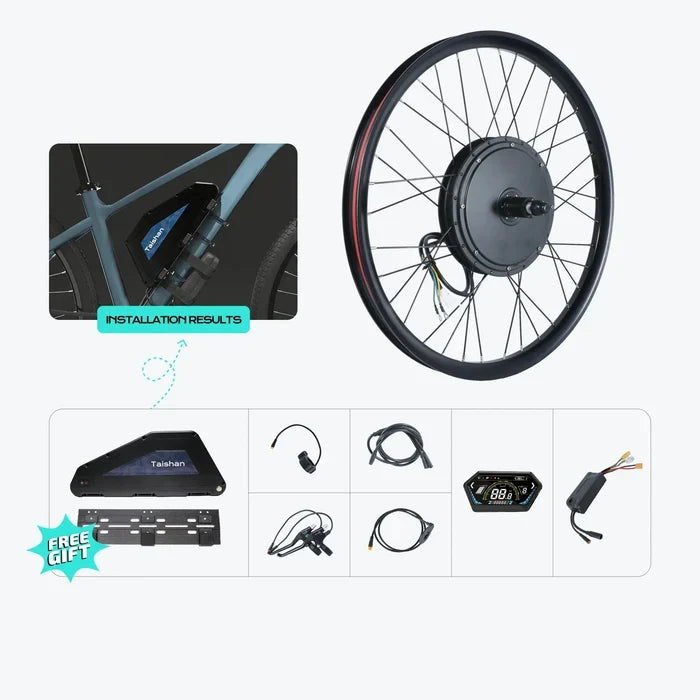
48V 1000W E-Bike Kit
From £365.25 without battery · published specification, checked 7 Aug 2026
SHENGYI brushless direct-drive rear motor, published at about 4kg
Disc-brake-only MTX wheel, 135–142mm dropouts
7-speed freewheel or 8/9/10/11-speed cassette motor options
Outside EAPC classification — torque arm essential
Confirm the variant when you order. The standard and all-black wheel variants differ, and the all-black version is published at a heavier 6.2kg for the motor wheel — a different measurement boundary, as the weight table above sets out. Ask us to confirm the exact motor type, model and weight in writing for the variant you are buying. Higher-power direct-drive systems sit in the off-road kit range.
Other systems
Bafang’s G-series is the best-known compact geared hub family, widely stocked in the UK in front and rear variants, though many listings are motor-only so wheel build, controller and battery may be separate. Yose Power sells budget geared kits at 250W and 350W with and without batteries, with the caveat that supplied sensors do not suit every crankset. Swytch, Boost and Cytronex are 250W-class geared systems with bundled batteries. UK direct-drive kits come mainly from generic marketplace sellers, which is why documentation, sealing and parts supply are worth paying for.
Option
Motor type
Power tier
Regen potential
Main caution
Bafang G-series
Geared
250W upward
No
Often motor-only; wheel and controller separate
KirbEbike 250W / EZ Rider
Geared
250W
No
Front-fork fit and material
KirbEbike 48V 1000W
Direct drive
1000W
Controller dependent
Outside EAPC; torque arm essential
KirbEbike 500W/750W MTX
Geared
500–750W
No
Outside EAPC; gearing interface
Swytch / Boost / Cytronex
Geared
250W class
No
Fork or axle limits by system
Yose Power
Geared
250–350W
No
Sensor and crank compatibility
Listed alphabetically. Regen depends on the controller, wiring and battery as well as the motor, and should be treated as unavailable unless confirmed in writing for the exact combination.
Which Motor by Riding Scenario
Scenario
Better choice
Reason
Watch out for
Flat city commute
Geared
Efficient at low speed, freewheels
Fork fit on a front hub
Short steep hills
Geared
Reduction gearing multiplies torque
Continuous rating and heat
Fast open-road running
Direct drive
Efficient near its designed RPM
Legal classification above 250W
Long descents
Direct drive
Regen aids speed control
Confirm regen on the exact kit
Frequent unpowered riding
Geared
No motor drag when coasting
Gear and clutch wear
Scenario first, then type, then the specific SKU.
What to Avoid When Choosing a Hub Motor
Mistake
Why it costs you
Assuming direct drive is always heavier
Our geared 750W and direct-drive 1000W are both published at 4kg
Buying a geared hub expecting regen
The clutch makes energy recovery impossible by design
Expecting regen to extend everyday range
A 100m descent yields about 27Wh at best, before losses
Running a direct drive on slow steep climbs
Least efficient point, poor airflow, heat build-up
Skipping the torque arm on a direct drive
Full torque goes straight to the dropout
Checking width before axle interface
Interface decides fit; width is the second question
Final Geared Hub vs Direct-Drive Checklist
Riding scenario defined: speed, gradient, load and how often you ride unpowered
Motor type matched to that scenario, not to a headline wattage
Continuous rated output compared, not peak, across both candidates
Published motor weight taken per SKU rather than assumed by category
Axle interface identified first, then spacing, then fork or frame material
Gearing interface confirmed for a rear hub, freewheel or cassette
Controller current and battery continuous output matched to the motor, with an authorised charger
Torque restraint specified and fitted, and the build legal where you ride
Product touchpoint
Choosing between our geared and direct-drive kits
For commuting and hills at moderate speed, the geared route is the EZ Rider or the 250W front kit for public roads, and the 500W/750W MTX for private land. For sustained higher-speed use, compare the 48V 1000W direct-drive specification. Regen should be treated as unavailable unless we confirm it in writing: direct-drive construction makes it mechanically possible, but it does not prove the supplied controller, display, wiring and battery BMS support it.
Conclusion: Match the Motor to the Speed You Ride At
The clutch explains almost everything. It lets a geared hub freewheel, gives it strong low-speed torque for its size, and makes regenerative braking impossible. Its absence makes a direct drive silent, mechanically simpler and capable of regen, while leaving it least efficient at exactly the low speeds where town riding happens.
So choose by the speed and gradient you actually ride, then verify the specific motor rather than trusting the category: continuous rating, published weight, winding for your wheel size, axle interface, gearing interface and controller current. Keep a road-going build at 250W with assistance stopping at 15.5mph, treat anything above that as outside EAPC classification, and use only a charger authorised for your pack.
Geared for town, direct drive for speed
Then check the specific SKU, because the category averages do not always apply.
Neither is better overall. Geared hubs suit low-speed torque, stop-start commuting and unpowered pedalling; direct drives suit sustained speed, high continuous power and regen.
Can a geared hub motor do regenerative braking?
No. The internal clutch that lets the wheel freewheel also disconnects the motor during deceleration, so there is no mechanical path for energy to flow back into the battery.
How much range does regenerative braking actually add?
Very little in everyday riding. A 100kg rider and bike descending 100m holds only about 27Wh of potential energy, roughly 5% of a 500Wh pack even at perfect capture, and real recovery is a fraction of that.
Which hub motor is better for hills?
A geared hub is usually better for short steep hills, because reduction gearing multiplies torque at low wheel speeds. A direct drive climbing slowly runs at its least efficient point and heats up.
Are direct-drive motors heavier than geared hubs?
Often, but not always. Check the published weight per motor: the KirbEbike geared 500W/750W and direct-drive 48V 1000W rear motors are both listed at 4kg.
Do direct-drive hub motors create drag when pedalling?
Yes, a small constant drag plus a faint cogging feel, because the motor is always connected to the wheel. A geared hub freewheels through its clutch and pedals close to normally.
Which hub motor is more reliable?
A direct drive is mechanically simpler, with fewer mechanical wear components and bearings as the main mechanical wear item — though sensors, windings, seals and electrical connections can still fail. Sealing, installation quality, heat management and parts availability predict reliability better than motor type.
Are geared hub motors noisy?
They produce a soft whirr from the gear mesh under power and go quiet when coasting. Direct drives are near silent. Rattling, clicking or grinding indicates a fault in either type.
Does wheel size change hub motor performance?
Yes. A hub motor has a designed RPM band, so the same motor in a smaller wheel gives more force at the tyre and a lower road speed. Match the winding to your wheel size.
Can a 1000W hub-motor conversion qualify as an EAPC in Great Britain?
No. A 1000W system exceeds the 250W maximum continuous rated output required for EAPC treatment, so the completed cycle is not an ordinary EAPC. That is a classification statement rather than a blanket prohibition: public-road use would require the applicable motor-vehicle approval, registration, vehicle tax, insurance, licensing and equipment; otherwise use is limited to private land with the landowner’s permission and subject to site rules. Rules differ outside Great Britain, so check the requirements where you ride.
Sources
Peer-reviewed study, DergiPark — Regenerative braking of a hub-type brushless DC motor on an electric bicycle: measured energy recovery by speed.
A note on safety & legality. General information, not a substitute for the manufacturer’s instructions. Fit the specified torque restraint, which matters especially on a direct drive delivering full torque to the dropout, never file dropouts or spread an aluminium or carbon frame, and match the battery to the controller by voltage and continuous current using only an authorised charger. In Great Britain a converted cycle is an EAPC only when it has working pedals, a motor rated no higher than 250W continuous and assistance that stops at 15.5mph; above that it is outside EAPC classification and may be used on private land with the landowner’s permission and subject to site rules, or on roads only with the relevant motor-vehicle approval, registration, tax, insurance, licence and equipment.
About this guide. Author: KirbEbike Editorial. Technical review: KirbEbike conversion support. Last reviewed: 7 August 2026. Methodology: motor architecture and its consequences are described from mechanism; regenerative-braking recovery is cited to a peer-reviewed measurement of a hub-type brushless DC motor, and the recoverable-energy chart is our own arithmetic from potential energy for the stated mass and descents, not a measured test. Axle, wheel and gearing standards were cross-checked against Park Tool, legality and battery safety against GOV.UK and London Fire Brigade guidance, all cited inline. KirbEbike and competitor motor types, weights and specifications were read from each supplier’s live product page on 7 August 2026 and are published claims; where our own pages describe the same product inconsistently, the main product-page specification is used and the discrepancy is flagged for correction. Regenerative-braking availability is not claimed for any specific kit; confirm it per motor and controller before ordering.
Stay in the know
Conversion guides, fitting advice and the deals worth knowing about. No spam.