Een ombouwkit voor het achterwiel kan de juiste wielmaat, motorvermogen en accuspanning hebben en toch onbruikbaar zijn als het tandwielmontagesysteem niet overeenkomt met je fiets. Freewheel- en cassettenaven gebruiken verschillende, niet-uitwisselbare interfaces — dus voordat je prijs of vermogen vergelijkt, moet je je aandrijving identificeren en de juiste achternaaf kiezen. Deze gids laat je precies zien hoe.

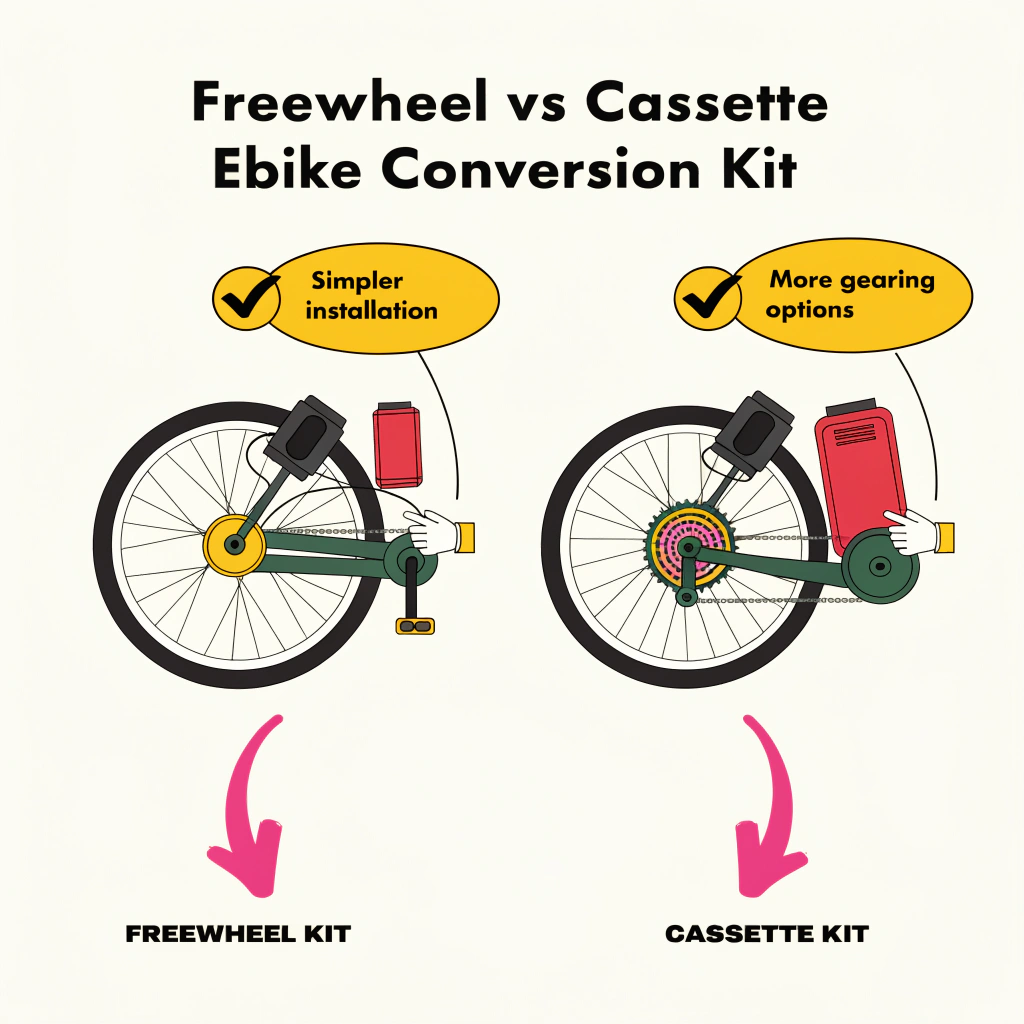
Een freewheel schroeft als één complete tandwiel- en ratelunit op een draadstift van de motornaaf. Een cassette schuift over een vertande freehub-body en wordt vastgezet met een borgring. De twee zijn niet uitwisselbaar op dezelfde motornaaf. Kies een freewheel-compatibele motor wanneer je donorfiets een opschroefbare freewheel gebruikt en je een eenvoudigere, goedkopere aandrijving wilt. Kies een cassette-compatibele motor wanneer je fiets een vertande cassette gebruikt en het behoud van een 8-, 9-, 10- of 11-speed aandrijving belangrijk is — en alleen als de freehub-standaard van de motor de cassette die je wilt monteren expliciet ondersteunt. Bestel niet alleen op basis van het aantal tandwielen: controleer eerst de montage-interface, de geïnstalleerde naafbreedte van de motor ten opzichte van je frame, de asvorm, de remcompatibiliteit en het ondersteunde aantal tandwielen.
Freewheel versus cassette in één oogopslag
Voordelen en nadelen zijn in deze tabel samengevat in plaats van hieronder herhaald. Als je slechts één ding op deze pagina leest, lees dan dit.
| Factor | Freewheel motornaaf | Cassette motornaaf |
|---|---|---|
| Bevestiging versnelling | Schroeft op schroefdraad in de naaf | Schuift op spiebanen, vastgezet met een borgring |
| Ratelpositie | Binnenin het tandwielpakket | Binnenin de freehub-body |
| Typisch gebruik | Eenvoudigere en oudere aandrijvingen | Moderne multi-speed aandrijvingen |
| Gangbare aantal tandwielen | Single-speed tot 7-speed | Veelal 8-speed en hoger |
| Versnellingsbereik | Minder moderne opties; beperkte uitersten | Groter bereik; kleinere hoge & grotere klimversnellingen |
| Vervanging | Hele unit wordt vervangen; meestal goedkoper | Tandwielen afzonderlijk vervangen; meestal duurder |
| Verwijdering | Schroeft als één blok los; kan vastzitten door gebruik | Eerst borgring eraf, dan schuiven de tandwielen eraf |
| Invloed op framebreedte | Kan meer ruimte laten voor de motorbehuizing | Freehub-body kan de benodigde naafbreedte vergroten |
| Belangrijkste risico bij aankoop | Beperkt je tot een laag aantal tandwielen | Freehub-standaard komt mogelijk niet overeen met je cassette |
| Uitwisselbaar op dezelfde naaf | Nee | Nee |
Behandel de bereiken van het aantal tandwielen als nuttige aanwijzingen, niet als universele regels. Er bestaan zeven-speed cassettes en acht-speed freewheels. Geen van beide systemen is in abstractie sterker, smaller of betrouwbaarder — die uitkomsten zijn afhankelijk van het individuele motorontwerp.
Hoe te bepalen of uw fiets een freewheel of cassette heeft
Dit is de controle die verkeerde bestellingen voorkomt. Werk de methoden in volgorde af en stop zodra je een duidelijk antwoord hebt.

Methode 1 — Controleer op een cassette-borgring
Een cassette heeft normaal gesproken een zichtbare borgring rond de as in het midden van het kleinste tandwiel, vaak met markeringen (hoewel vuil of de as deze kunnen verbergen). Een freewheel heeft geen aparte borgring — de hele cluster is één geschroefde eenheid.
Methode 2 — Draai de tandwielen achteruit
Met het achterwiel verwijderd, draait u de tandwielen achteruit en let u op de centrale gereedschapaansluiting. Bij een freewheel draait het buitenste tandwielcluster rond een stilstaande centrale verwijderingsfitting. Bij een cassette draaien de borgring en de tandwielen samen. Dit is Park Tool's eigen onderscheidende kenmerk, hoewel het de moeite waard is om het te bevestigen met methode 1 of 4 in plaats van alleen hierop te vertrouwen.
Methode 3 — Controleer de fiets- of naafspecificatie
Zoek het fietsmodel en bouwjaar, het model van de achternaaf en het huidige model van het tandwielpakket op in de technische documentatie van de fabrikant of in je oorspronkelijke aankoop specificatie. Shimano publiceert zijn compatibiliteits- en servicedocumentatie openlijk. Dit bevestigt vaak het systeem zonder gereedschap aan te raken.
Methode 4 — Verwijder de tandwielcassette
De definitieve methode, maar hiervoor is het juiste gereedschap nodig. Een freewheel schroeft los als een compleet tandwielblok met ratel; de borgring van een cassette komt er eerst af, daarna schuiven de tandwielen van de freehub-body. De gids van Park Tool voor het bepalen van het type cassette of freewheel toont de gereedschapaansluitingen. Als je twijfelt, stuur dan duidelijke foto's naar de kit leverancier of vraag een fietsmonteur voordat je bestelt.
Vertelt het aantal achterste versnellingen je welk systeem je hebt?
Niet overtuigend. "Zeven versnellingen betekent altijd freewheel" en "acht versnellingen betekent altijd cassette" zijn slechts grove richtlijnen. Vijf-, zes- en zeven-speed systemen zijn meestal freewheels, en acht-speed en hoger zijn meestal cassettes — maar er bestaan zeven-speed cassettes en acht-speed freewheels. Een versnellingsaantal is een eerste aanwijzing, geen bewijs van de interface.
Pasvorm is meer dan een versnellingsvraag
Een compatibele versnellingsinterface garandeert niet dat het motorwiel in je frame past. Vijf andere controles beslissen dat.

Breedte achtervork en Over-Locknut Dimension (OLN)
Meet de interne afstand tussen de achtervorken met het wiel verwijderd, en vergelijk dit met de Over-Locknut Dimension (OLN) van het motorwiel in plaats van een generieke aanduiding zoals "standaard achternaaf". Gangbare frame standaarden zijn onder andere 130 mm, 135 mm, 141 mm QR, 142 mm steekas, 148 mm Boost en bredere fatbike standaarden. Deze zijn niet automatisch uitwisselbaar.
Vaste as vs. snelspanner vs. steekas
Veel naafmotoren gebruiken massieve vaste assen met platte zijden, zelfs als de originele fiets een snelspanner gebruikt. Moderne steekasframes vereisen over het algemeen een ombouw motor die specifiek voor die standaard is ontworpen. Vijl, buig of forceer nooit een standaard motoras in een steekasframe.
Materiaal frame en staat uitvalpadden
Controleer het framemateriaal — staal, aluminium, carbon, magnesium of specialistisch — en inspecteer de uitvalpadden op scheuren, corrosie of schade. Het spreiden of koud zetten van het frame moet niet worden behandeld als een universele doe-het-zelf oplossing, vooral niet bij aluminium of carbon frames, waar het verborgen schade kan veroorzaken.
Uitlijning van de remschijf
Controleer de montagestandaard en diameter van de rotor, de speling van de remklauw, eventueel benodigde spacers, of de motorbehuizing de remklauw raakt en of het wiel na afstandhouders gecentreerd blijft.
- de resterende schroefdraadaangrijping voldoet aan het minimum van de fabrikant
- de positie van de rotor ten opzichte van de remklauw, met de remblokken gecentreerd op het remoppervlak
- het wiel nog steeds gecentreerd is in het frame na afstandhouders
- er geen interferentie is tussen de motorbehuizing, rotor, remklauw en frame
Derailleur- en kettinglijn speling
Controleer de speling van het kleinste tandwiel tot het frame, de speling van het grootste tandwiel tot de motor, de beweging van de derailleurkooi, de kettinghoek in de hoogste en laagste versnellingen, en de kabelgeleiding nabij de motoras. Een slechte kettinglijn veroorzaakt geluid, slecht schakelen en versnelde slijtage.
Kun je tijdens de ombouw overstappen van een freewheel naar een cassette?
Ja — maar niet door een cassette op een freewheelmotor met schroefdraad te installeren. Het wijzigen van systemen vereist een cassette-compatibel motorwiel. Omdat een ombouw van een achternaaf het hele wiel sowieso vervangt, is de praktische beslissing eenvoudigweg welke interface het nieuwe motorwiel heeft. Dit zijn de vier combinaties waarmee rijders daadwerkelijk te maken krijgen.
| Uw huidige fiets | Motor die u bestelt | Wat er gebeurt | Wat te controleren |
|---|---|---|---|
| Freewheel | Freewheel motor | De eenvoudigste weg — de nieuwe motor wordt geleverd met een eigen geschroefd freewheel. | Aantal tandwielen komt overeen met je shifter-indexering; staat van de ketting |
| Cassette | Cassette motor | Je bestaande cassette kan worden overgezet als de freehub-standaard overeenkomt. | Spline type & freehub body lengte; grootste tandwiel versus derailleurcapaciteit |
| Cassette | Freewheel motor | Je cassette kan niet worden hergebruikt — hij schroeft er niet op. Je koopt een freewheel. | Shifter-indexering versus freewheel-afstand; freewheel-breedte & speling; ketting; derailleur-limieten |
| Freewheel | Cassette motor | Je koopt een cassette — je freewheel kan niet op de spiebanen schuiven. | Cassette afgestemd op de spline-standaard van de motor; aantal versnellingen van de shifter; kettingbreedte; derailleurcapaciteit |
Hoe kan ik een freewheel e-bike kit gebruiken op een fiets met cassette?
Je monteert het freewheel dat bij (of past bij) de motor wordt geleverd, en accepteert dat je oude cassette met het oude wiel met pensioen gaat. De motor brengt zijn eigen interface mee; niets van de oude naaf wordt overgezet. Let op: de indexering van je shifter moet overeenkomen met de tandwielafstand van het nieuwe freewheel, de breedte van het freewheel moet passen bij je frame en kettinglijn, en de ketting moet overeenkomen. Als je nu 8-speed of hoger rijdt, betekent overschakelen naar een 7-speed freewheel meestal ook het vervangen van de shifter.
Wanneer je bestaande shifter en derailleur nog steeds kunnen werken
Je originele bedieningselementen kunnen nog steeds werken wanneer het nieuwe tandwielpakket hetzelfde aantal versnellingen heeft, de tandwielafstand overeenkomt met de indexering van de shifter, de derailleur het grootste tandwiel ondersteunt, de ketting geschikt is voor het aantal tandwielen en de kettinglijn acceptabel blijft. Het combineren van een oude, versleten ketting met een nieuw tandwielpakket veroorzaakt vaak overslaan onder belasting – vervang de ketting wanneer je het tandwielpakket verandert.
Welke KirbEbike variant moet ik bestellen?
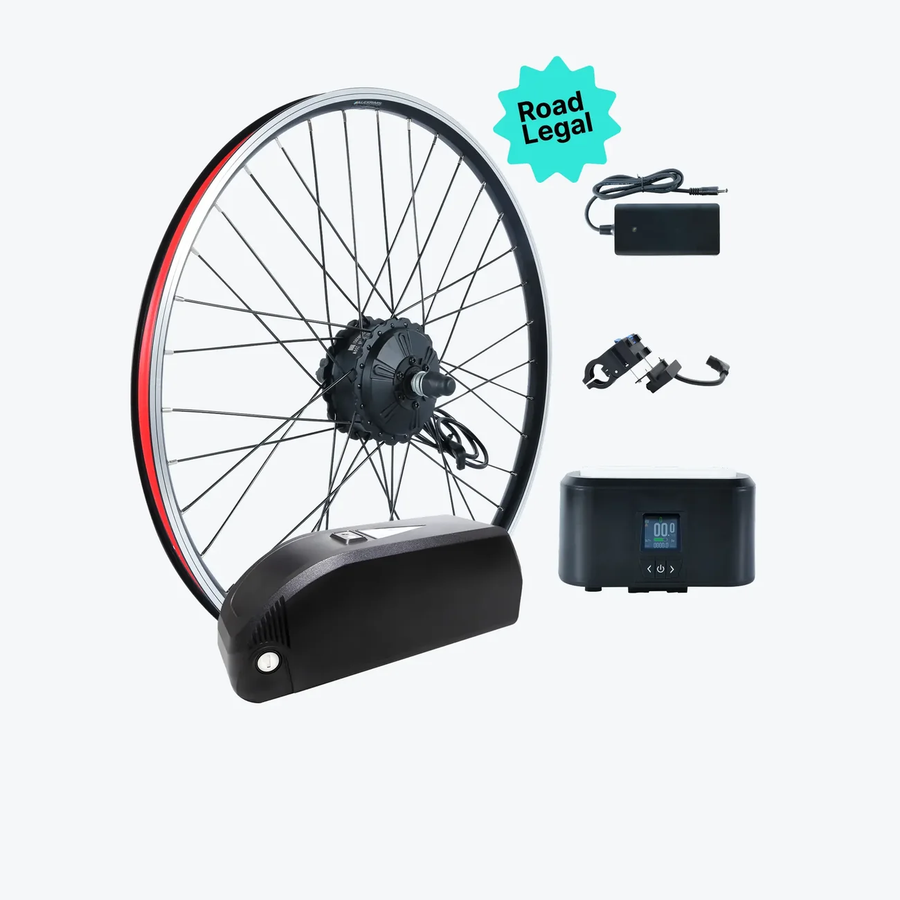
KirbEbike heeft achterwielkits in verschillende vermogensniveaus met een freewheel- of cassetteoptie, selecteerbaar per wielmaat. Gebruik deze tabel om de keuze te verfijnen en bevestig de exacte variant op de productpagina voordat je bestelt.

| Selectiepunt | Freewheel variant | Cassette variant |
|---|---|---|
| Aantal tandwielen | 7-speed | 8, 9, 10 of 11-speed |
| Type uitvaleinde | Open sleuf uitvaleinden | Open sleuf uitvaleinden |
| Steekasframes | Niet 12×142 steekas | Niet 12×142 steekas |
| Type rem | Schijfrem | Schijfrem |
| Batterij | Optioneel bij de meeste kits | Optioneel bij de meeste kits |
| Wielmaten | Selecteerbaar per kit | Selecteerbaar per kit |
Vermogensniveaus zijn onder andere de 500W/750W MTX, 48V 1000W en 52V 2000W MTX kits. Interface, aantal tandwielen en afmetingen variëren per variant en kunnen veranderen — controleer dit op de actuele productpagina voordat je bestelt.
KirbEbike Achternaaf Ombouwkits
Kies de interface en wielmaat die bij je fiets passen — 500W tot 2000W MTX, op bestelling gebouwd met een kleurendisplay, afgedichte controller en optionele accu.
Als u andere merken vergelijkt
Merkenrangschikkingen verouderen snel — voorraad, versies en pasvorm kunnen zonder kennisgeving wijzigen. Wat niet verandert, is de reeks zaken die u moet bevestigen. Beoordeel elke achternaafkit, van welke verkoper dan ook, op deze punten.
| Controleer | Wat goed is |
|---|---|
| Bevestigde interface | Geeft vrijloop of cassette expliciet aan, niet alleen het aantal versnellingen |
| Freehub standaard | Splinetype en bodylengte gepubliceerd, niet alleen "cassette" |
| Ondersteund aantal tandwielen | Een specifiek nummer voor de specifieke variant die u koopt |
| Geïnstalleerde naafbreedte | Een gepubliceerde OLN-waarde, niet een frame-standaardbereik |
| As en uitvaleinde | Astype vermeld; open uitvaleinde vs steekas ondubbelzinnig |
| Beschikbaarheid wielmaat | Uw maat daadwerkelijk in de variantenlijst, niet alleen het bereik |
| Remcompatibiliteit | Rotorstandaard en remklauwspeling behandeld |
| Inclusief batterij | Duidelijk of de batterij bij de prijs is inbegrepen |
| Tandwielen inbegrepen | Expliciet vermeld — ga ervan uit dat het niet is inbegrepen, tenzij anders vermeld |
| Voorziening van koppelarm | Geleverde hardware geïdentificeerd, met hoeveelheid |
| Ondersteuning en documentatie | Een echt installatiedocument voor die variant |
Voer deze zelfde controles uit, welk merk u ook kiest. Koop geen onbenoemde marketplace-kit omdat de titel het woord "cassette" bevat - en vertrouw geen merk-breed breedtebereik dat meerdere vermogensniveaus omvat, want verschillende varianten binnen één merk verschillen routinematig.
Hoe zit het met middenmotor ombouwpakketten?
Een middenmotor vervangt de achternaaf niet, dus u behoudt normaal gesproken uw bestaande vrijloop of cassette – deze beslissing is niet van toepassing. Omdat de motor kracht via de ketting en achtertandwielen stuurt, zijn de sterkte van de aandrijflijn en de beschikbaarheid van vervangende onderdelen belangrijker.
Benodigde gereedschappen en onderdelen voor installatie
Gereedschap voor een vrijloop-opstelling
Het juiste gereedschap voor het verwijderen van de vrijloop (patronen verschillen per merk), een grote verstelbare sleutel of bankschroef om deze te draaien, een asmoersleutel, een momentsleutel en vet. Het verwijderingsgereedschap steekt in de centrale fitting en de vrijloop schroeft als één blok los - er komt geen kettingzweep aan te pas.
Gereedschap voor een cassette-opstelling
Een compatibel cassette-borgringgereedschap, een kettingzweep om de tandwielen vast te houden terwijl de borgring wordt losgemaakt, een momentsleutel, een cassette-spacer waar gespecificeerd, en gereedschap voor het afstellen van de derailleur.
Conversie-specifieke onderdelen
Ongeacht de interface, budget voor een koppelarm of koppelplaten, correcte asringen, remrotorspacers alleen waar goedgekeurd voor uw motor, kabelbescherming, frame-veilige batterijmontagehardware en een vervangende ketting als de oude versleten is. KirbEbike vermeldt installatieaccessoires naast zijn collectie conversiekits.
Definitieve controlelijst voor aankoop
Elke regel hier is ook een fout die mensen maken. Bevestig ze allemaal voordat u betaalt.
- Vrijloop- of cassette-interface – fysiek geïdentificeerd, niet afgeleid van het aantal versnellingen. Zeven versnellingen betekent niet doorslaggevend vrijloop.
- Aantal achterste tandwielen en schakelindexering – en, voor een cassettenmotor, de splinestandaard achter het aantal snelheden.
- Gemeten breedte van de achtervork, vergeleken met de gepubliceerde OLN van de motor. Draai asmoeren nooit vast om een incompatibel frame rond een te grote naaf te trekken.
- Asstandaard: bolt-on, quick-release of steekas. Een motor met open uitvaleinden past niet op een 12x142 steekasframe.
- Wielmaat en velgcompatibiliteit.
- Remtype, rotorgrootte en remklauwspeling — met elke spacer die is goedgekeurd voor uw specifieke motor.
- Cassette- of vrijloopspeling tot frame en motor, en kettinglijn.
- Of tandwielen zijn inbegrepen. Ga ervan uit van niet, tenzij de pagina anders vermeldt.
- Batterij-, controller- en koppelarmvoorziening. Krachtige naafmotoren hebben een koppelarm nodig, ongeacht de interface.
- Een nieuwe ketting als de oude versleten is – een versleten ketting op nieuwe tandwielen slipt door onder pedaalbelasting.
Conclusie: De juiste naaf verslaat het “betere” systeem
Geen van beide systemen is automatisch het beste. Een vrijloop kan de praktische, economische keuze zijn voor een eenvoudige aandrijflijn; een cassette biedt meestal meer versnellingsopties op een moderne fiets. De juiste keuze is de interface die overeenkomt met uw donorbike en de exacte achternaafmotor die u koopt.
Als u van het ene systeem naar het andere overstapt, houd dan rekening met de indexering van de shifters, de kettingbreedte, de derailleurcapaciteit, de asstandaard en de framematen – en laat de exacte productafmetingen en ondersteunde tandwielaantallen de generieke adviezen overschaduwen. Identificeer eerst uw bestaande aandrijflijn, meet de achterkant van het frame en kies vervolgens een motorwiel waarvan de gepubliceerde interface en afmetingen overeenkomen met wat u hebt gevonden.
Veelgestelde vragen
Hoe weet ik of mijn fiets een vrijloop of een cassette heeft?
Kan ik een vrijloop e-bike kit gebruiken op een fiets met cassette?
Werkt mijn bestaande shifter nog steeds?
Gebruikt een 7-speed fiets altijd een vrijloop?
Welke KirbEbike-variant past op een 8, 9, 10 of 11-speed aandrijflijn?
Past een 142mm frame?
Bronnen
- Park Tool — Bepaling van cassette- en vrijlooptype. parktool.com
- Park Tool — Cassette verwijderen en installeren. parktool.com
- Park Tool — Vrijloop verwijderen en installeren. parktool.com
- Sheldon Brown — Cassette Navo's en Freehubs. sheldonbrown.com/free-k7.html
- Shimano — Technische documenten en compatibiliteit (SI). si.shimano.com