700C Ebike Conversion Kit UK: Road & Gravel Fit Guide
KE
KirbEbike Editorial
Reviewed by the KirbEbike conversion-support team
Share
Unlock £10 off today
On this page
A 700C conversion is mostly about measuring your bike before you buy. The wheel itself is the easy part — a 700C rim is the ETRTO 622 mm standard, the same diameter as a 29″ wheel, so a huge range of kits fits it. What actually decides the fit is your fork spacing, rear dropout width, brake type and tyre clearance. This guide works through each check with real numbers, then compares the 700C kits UK riders can actually buy — so you order once and order right.
Quick answer
A 700C conversion kit fits most road, gravel, hybrid and touring bikes, because a 622 mm ETRTO rim is the same diameter as a 29″ wheel. The details that decide the fit are your fork spacing (usually 100 mm front), rear dropout width (130/135 mm quick-release or 142 mm thru-axle), your brake type and your tyre clearance. Measure those before ordering. In the UK, road-legal means a 250 W kit that assists to 15.5 mph and needs pedalling; anything more powerful is for private land.
700C isn’t a diameter, it’s a wheel standard: an ETRTO 622 rim, about 622 mm across the bead seat where the tyre sits. It’s the dominant wheel size on drop-bar and flat-bar bikes, which is exactly why so many kits are built for it. You’ll find 700C wheels on road, gravel, hybrid, city, touring and cyclocross bikes — if your bike is one of those, a kit listing “700C” (or “29″/700C”) compatibility is almost certainly the right rim diameter.
For a fit to actually work, the motor wheel has to match four things: rim diameter, tyre width, axle spacing and brake system. Get the diameter right and you’re in the running; the other three are what the rest of this guide checks. Prefer to measure step by step? See KirbEbike’s guide to measuring a 700C bike wheel.
700C vs 28-Inch vs 29-Inch Wheels: Are They the Same?
This is where most first-time buyers get confused, and the answer is reassuring: 700C, 28-inch and 29-inch wheels are nearly always the same 622 mm rim. The difference is marketing convention and tyre type — 29″ is the MTB label for wide knobbly tyres, 700C the road/gravel label for narrower tyres, and “28-inch” an older European term for the same 622 mm rim.
The practical takeaway: a 29-inch motor wheel and a 700C motor wheel are mechanically the same rim. What differs is width — a narrower rim for slick road tyres, a wider MTX-style rim for fat gravel or trail tyres. Always check the ETRTO number on your tyre sidewall rather than trusting the inch label alone.
Wheel label
Rim diameter (ETRTO)
Typical tyres
Same as 700C?
700C
622 mm
Road, gravel, hybrid
—
29-inch (29er)
622 mm
Wide MTB / trail
Yes
28-inch
622 mm
City / touring (EU term)
Yes
27.5″ / 650B
584 mm
Gravel / MTB
No — different kit
How to Check If a 700C Kit Fits Your Bike
A 700C wheel is only the starting point. Work through the checklist below before ordering — nearly every fit problem traces back to one skipped measurement. Where a kit’s fitment notes are unclear, ask the seller in writing before buying.
✅
Pre-purchase fit checklist.
Wheel size — confirm a true 700C / 622 mm rim (check the tyre sidewall)
Tyre width — the motor wheel’s rim should suit your tyre width and surface
Fork spacing — front-hub kits usually need 100 mm; measure between fork dropouts
Rear dropout width — 130/135 mm quick-release, or 142 mm thru-axle
Brake type — rim (V/caliper) or disc; rotor size & mount
Tyre & frame clearance — room for the motor wheel, cables and mudguards
Battery mounting space — bottle bosses or triangle room for the pack
Step 1 — Confirm Your Wheel Size Using ETRTO Markings
The easiest, most reliable method needs no maths — just read the tyre sidewall. Alongside the inch marking you’ll see an ETRTO code such as 700 × 35C or 622 × 35. The number that matters is 622: it confirms a true 700C rim diameter. The second number (35) is the tyre width, which tells you whether a narrow road rim or a wider gravel rim suits you.
Sidewall marking
Rim diameter
Typical use
700C kit compatible?
700 × 23C / 25C
622 mm
Road / racing
Usually yes
700 × 35C
622 mm
Hybrid / light gravel
Usually yes
700 × 40–45C
622 mm
Gravel / adventure
Yes — check clearance
650B / 27.5 × 1.5–2.1
584 mm
Gravel / MTB
No — different kit
Match the 622 figure and the diameter is right. Because KirbEbike builds each motor wheel to order in all 13 standard sizes (20″–29″ and 700C), you read your sidewall and choose the matching option at checkout — the wheel arrives ready to bolt in. If your sidewall reads 584 or 650B, you have a 27.5″ wheel and need a different-diameter kit.
Step 2 — Measure Fork or Rear Dropout Spacing
The motor wheel replaces your existing wheel, so the axle spacing has to match your frame or fork. This is the measurement most often skipped — and the most common reason a conversion stalls. Take the wheel out, measure between the inside faces of the dropouts, and note whether your bike uses a quick-release skewer or a bolted thru-axle.
Front hub conversion (most road-legal 700C kits)
Most road, hybrid and touring bikes use a 100 mm front fork spacing with a 9 mm quick-release — the standard front-hub kits are built around, including KirbEbike’s 250W front-wheel kit. On any front-motor build, and especially on aluminium or carbon forks, fit a torque arm to stop the axle spinning in the dropout.
Front-hub, 100 mm fork. The simplest 700C conversion — the rear drivetrain is untouched; always add a torque arm on alloy or carbon forks.
Rear spacing varies more, so measure carefully. A wheel can be the correct 622 mm diameter and still not fit if the axle spacing is wrong.
Rear spacing
Axle type
Typically found on
Fit note
130 mm
Quick-release
Road & older gravel
Common road standard
135 mm
Quick-release
Hybrids, touring, older MTB
Widest kit choice
142 mm
Thru-axle
Modern gravel & trail
Needs a thru-axle-ready kit/adapter
Many affordable rear-hub kits are built around 135 mm quick-release, some spanning 130–142 mm. If your gravel bike uses a 142 mm thru-axle, confirm the kit explicitly supports it (or supplies an adapter) before ordering — not every kit does. KirbEbike’s rear-hub kits target 135–142 mm dropouts; check your spacing, especially on thru-axle frames, and match it at checkout.
Step 3 — Check Brake Compatibility
The motor wheel has to work with the brakes already on your bike, so confirm your brake type before you buy. There are two families:
Rim brakes (V-brakes, calipers) grip the rim’s braking surface. Many disc-only motor rims do not have a machined braking surface, so on a rim-brake bike you must confirm the motor wheel offers one.
Disc brakes (mechanical or hydraulic) grip a rotor. Check rotor size (commonly 140, 160 or 180 mm) and mount type (6-bolt or Center Lock) so your caliper still lines up.
⚠️
Safety — brakes scale with power. A converted 700C bike is heavier and faster, so the brakes work harder — and road bikes were designed around a lighter, slower machine. Keep rotors and pads in good order, keep to sensible power for the frame, and consider larger rotors on higher-power builds. Underpowered braking is a bigger risk than most first-time converters expect.
Road-legal · 700C
EZ Rider 250W Kit
The road-legal, dual-battery front-wheel kit that fits 700C on 100 mm forks — up to 60 miles of range and a natural feel for everyday commuting.
Front Hub vs Rear Hub vs Mid-Drive for a 700C Bike
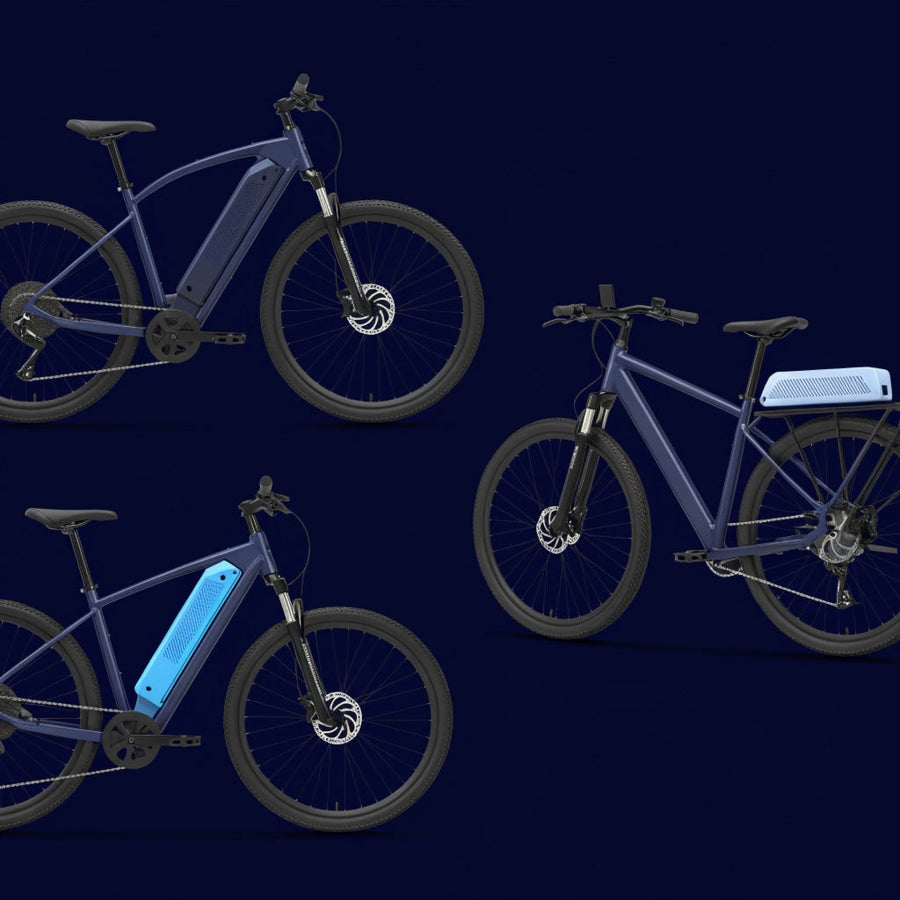
Once the wheel and spacing questions are settled, the next decision is where the motor goes. Each layout suits a different bike and riding style — the right answer depends on your surface, your gears and how much power you want.
Front Hub Motor Conversion for 700C Road Bikes
A front hub motor drives the front wheel and is usually the simplest install: your rear drivetrain is untouched, so there’s no cassette or freewheel to match. It’s how most road-legal 250W kits are built, and it suits straightforward commuting on tarmac.
Easiest installation — rear drivetrain left alone
No cassette/freewheel matching needed
Keeps your original gears; good for flat commuting
The trade-offs: front traction can slip on loose or wet ground, and the fork must suit the motor torque — always fit a torque arm.
Rear Hub Motor Conversion for 700C Gravel & Hybrid Bikes
Power where your weight sits. A rear hub gives better traction and a natural ride feel — the usual choice for gravel, touring and higher-power 700C builds.
A rear hub motor drives the back wheel, putting power where your weight already sits. It gives better traction and a more natural ride feel, and handles hills better — the usual choice for gravel, touring and higher-power builds.
Better traction on climbs and loose gravel
More natural, balanced ride feel under power
Suits gravel, touring and longer-distance commuting
Uses your existing cassette/freewheel gears
Most of KirbEbike’s higher-power 700C-compatible kits are rear-wheel — the 48V 1000W kit and the 52V 2000W MTX among them — built to order in your wheel size with 6-to-12-speed freewheel support.
Mid-Drive Conversion for Performance Gravel Riding
A mid-drive mounts at the bottom bracket and powers the chain, so it uses your bike’s gears. That gives strong climbing efficiency and balanced weight — ideal for steep, technical or loaded gravel riding — at the cost of more drivetrain wear and a more involved install.
Uses the bike’s gears for efficient climbing
Balanced central weight distribution
Best for steep terrain, adventure and higher torque
The trade-off: more drivetrain wear and a more complex install. Weighing mid-drive against hub for off-tarmac use? KirbEbike’s gravel and adventure bike setup guide works through motor choice, battery placement and drivetrain wear.
Feature
Front hub
Rear hub
Mid-drive
Installation
Easiest
Moderate
Hardest
Traction
Lower
Higher
High
Climbing
Depends on power
Good
Best (uses gears)
Drivetrain wear
None
Low
Higher
Best for
Flat commuting
Gravel / hills
Steep / loaded
Best 700C Kit Power Levels for UK Riders
Choose power by how and where you ride, not by the biggest number. On a 700C road or gravel frame, more wattage also demands stronger wheels, brakes and frame condition — so match the kit to the bike as well as the terrain. Crucially, only 250W kits are road-legal in the UK; higher power is for private land.
250W 700C Kits for Legal UK Road Riding
A 250W kit capped at 15.5 mph is the road-legal choice for daily commuting, fitness riding and flatter routes. It keeps assistance natural, adds the least weight and needs no configuration. KirbEbike’s 250W front-wheel kit fits 700C on 100 mm forks, and the road-legal, dual-battery EZ Rider kit (up to 60 miles of range) is a strong first landing for cold-weather commuters. Swytch, Cytronex and Boost also sit firmly in this 250W camp — all compared below.
500W–1000W Kits for Private Land & Off-Road Use
500W to 1000W kits suit steeper terrain, gravel trails, heavier riders and more demanding routes. At full power these exceed UK public-road limits and should be used where permitted — though smart kits can be limited back to 250W for the road. Rear-hub layouts are the norm here for traction and hill-climbing.
High-Power 2000W+ Kits
2000W and above is extreme-build territory: private land, performance projects and e-moto-style setups. These need stronger wheels, brakes rated for the speed and careful setup. On KirbEbike’s smart high-power kits, a one-button Limit Mode caps the bike at a road-legal 250W / 15.5 mph, then unlocks full power off-road — a useful way to run one bike for both worlds. Always confirm what your frame and brakes can safely handle.
Battery Selection for a 700C Conversion
The motor is only half the system. With a complete kit the battery is included, but the capacity should match your real rides — and the pack has to physically clear your 700C frame, which matters more on slim road triangles than roomy gravel frames.
What counts: voltage (must match the motor/controller — 36–52V for commuting-class kits, 60–72V for high power), amp-hours (Ah) and watt-hours (Wh = V × Ah, the true measure of range), cell quality, and mounting style. Express range as a band, never a single guaranteed figure.
36–52V
Commuting class
60–72V
High-power builds
Wh = V×Ah
What sets range
Match capacity to distance. A compact pack keeps a road build light; longer gravel days justify a larger pack with more reserve — and it must clear your frame triangle.
KirbEbike’s core kits share one battery ecosystem, so packs cross-fit across the 500W–4000W range and you can add a second later. The Taishan and HS-II batteries use named LG 21700 and Samsung 50S cells, an IP65 sealed case and a 5A charger. Whatever brand you buy, judge a pack on cell type, BMS rating, capacity and fit — in that order — and confirm it clears your frame. Compare the full ebike battery collection.
Common 700C Conversion Mistakes to Avoid
Most buying regrets come from a few avoidable errors. Run through these before you commit.
Assuming Every 700C Wheel Will Fit
Wheel size alone doesn’t confirm compatibility. A kit can be correctly labelled 700C and still not fit if your fork or rear dropout spacing, brake standard or clearance differ. Match the whole checklist, not just the diameter.
Ignoring Tyre and Frame Clearance
A motor wheel can change spacing slightly, and a wide MTX rim may not suit a narrow road frame or mudguards. Check fork width, frame clearance and mudguard fit against your chosen tyre width before ordering.
Choosing Too Much Power for a Lightweight Road Frame
Road bikes are built differently from mountain bikes. High power needs strong wheels, brakes in good order and a sound frame — fitting big wattage to a slim, tired road frame moves the weak point, it doesn’t remove it. On lightweight frames, a modest 250–750W kit is usually wiser.
Forgetting UK E-Bike Rules
Keep road-legal and off-road builds separate in your head. In the UK a kit is only a road-legal EAPC if it is 250W continuous, cuts assist at 15.5 mph and needs pedalling. Higher-power kits are for private land. Check the GOV.UK e-bike rules and ride within them.
Road Bike vs Gravel Bike Conversion: Which Is Easier?
Both use 622 mm wheels, but they convert differently. Gravel bikes usually give you more room to work with; road bikes ask for more care.
Feature
Road bike
Gravel bike
Tyre clearance
Lower
Higher
Brake setup
Rim or disc
Mostly disc
Battery mounting
Limited (slim triangle)
More options
Off-road ability
Limited
Better
Dropout spacing
Often 130 mm QR
130–142 mm (some thru-axle)
Conversion flexibility
Moderate
High
The bottom line: gravel bikes usually offer more conversion flexibility thanks to stronger frames, wider tyres, disc brakes and more mounting points. Road bikes convert well too, but favour a lighter, lower-power kit and careful attention to brakes and clearance.
Top 700C Conversion Kit Options (UK)
Below are 700C-compatible kits, checked in July 2026 and given the same scrutiny — fit, drivetrain, battery and support. The five span the two ends of the market: lightweight road-legal 250W systems (Swytch, Boost, Cytronex) and higher-power complete kits with a bigger battery (ElectroCity Bikes, and KirbEbike’s rear-hub range). Prices and stock change — confirm on each seller’s page, and remember higher-power kits are off-road/private-land only.
Seller (domain)
Example 700C kit
Battery incl.
Power / legality
Price (from)
swytchbike.com
Swytch GO (front hub)
Up to 378 Wh
250W · road-legal
£499
boostbike.uk
Boost rear-hub kit
36V 6Ah bottle
250W · road-legal
£522
cytronex.com
Cytronex C1 (700C)
Bottle battery
250W · road-legal
£982.99
electrocitybikes.co.uk
2000W 45A MTX (700C)
48–60V triangle
2000W · off-road
£529.99
kirbebike.com
250W front / 1000W MTX rear
LG/Samsung + charger
250W legal · up to 4000W
£237.70
All figures verified on each seller’s live page, July 2026, and subject to change — confirm before ordering.
Swytch is the lightest, quickest-fitting road-legal option (250W front hub, small removable battery) but is front-wheel only and shorter-range in its cheaper packs. Boost is a neat 250W rear-hub system (36V bottle, ~40 miles, app control) sold mainly through bike shops. Cytronex is the premium pick — just 3.6 kg added and strong UK support — but the most expensive here and 250W only.
ElectroCity Bikes is a value route to real 700C power (a 2000W 45A MTX rear kit from £529.99) but strictly off-road at full power and rear-cassette only. KirbEbike spans both camps, with a road-legal 250W front kit and EZ Rider alongside made-to-order high-power rear-hub kits — motor wheels built to your exact size, 6-to-12-speed freewheels, an LG/Samsung-cell battery and 1-year UK/US/Netherlands service — though it adds more weight than the lightweight road kits. The honest summary: for outright lightness on a road bike, Swytch or Cytronex lead; for high-power 700C on a budget, ElectroCity or KirbEbike make more sense; Boost sits in the middle for shop-fitted simplicity.
This is a representative sample, not the whole market — Bafang-based kits, plus builders such as Skarper and Pendix, also serve 700C bikes. Whoever you buy from, judge each kit on the same checklist: 700C/622 mm fit, fork and rear dropout spacing, brake and drivetrain match, battery cells and BMS, and after-sales support.
Why Choose KirbEbike for a 700C Conversion?
Built to your wheel size. Every KirbEbike motor wheel is made to order, shipping complete with controller, display, sensors, harness and an LG/Samsung-cell battery.
KirbEbike’s pitch for 700C riders is compatibility and support rather than the hard sell. Because every motor wheel is built to order in your exact size, the 700C fit is made to match your bike — you check the sidewall, pick the size, and it bolts in. Kits ship complete with a fully potted controller, colour display, sensors and a waterproof quick-release harness, plus a battery on named LG or Samsung cells with its 5A charger.
FitVerified sizing — all 13 standard sizes (20″–29″, 700C), disc and rim brake support, 6-to-12-speed freewheels
Ride Power App tuning — PAS levels, current/speed limits, acceleration strength, and a one-button road-legal Limit Mode on smart kits
Human support & warranty — 1-year cover with UK/US/Netherlands service, and free UK shipping from stock
None of that makes it automatically the right kit for you — the right kit is always the one that matches your frame, drivetrain and goals. But if you want made-to-order 700C fit with a bundled battery and real after-sales support, it’s a strong candidate to compare against the alternatives above.
Made to order · 700C/29″
52V 2000W MTX Rim Kit
KirbEbike’s rear-hub MTX kit built to your 700C wheel size — 6-to-12-speed freewheel, potted controller and an LG/Samsung-cell battery with charger. Off-road at full power, with a one-button road-legal 250W Limit Mode.
A successful 700C conversion depends on far more than wheel size. The 622 mm rim gets you into the running — but the fit is decided by your fork and rear dropout spacing and axle type, your brake system, your tyre and frame clearance, and choosing a motor and battery suited to how you ride. Measure those first and the install is quick; skip one and you’re repackaging a return.
Match the kit to your bike and riding: a front-hub 250W kit (or the road-legal EZ Rider) for simple, legal commuting, a rear-hub kit for gravel traction and hills, or a mid-drive for steep, loaded climbing. Compare KirbEbike on merit against Swytch, Boost, Cytronex and ElectroCity Bikes, confirm the fit on the seller’s page, ride within UK law — and enjoy the bike you already own, now electrified.
💡
The best 700C kit is not the most powerful one — it’s the one that matches your 622 mm wheel, fork and dropout spacing, brake and drivetrain standards, and riding goals, with a battery whose cells you can name.
Ready to convert your 700C bike?
Match a complete 700C kit to your fork, dropout and brakes — battery, charger and support included.
It depends on motor power, battery voltage, rider weight and the law. A UK road-legal 700C setup is limited to 15.5 mph (25 km/h) of assistance, which is plenty for commuting. Off-road/private-land builds on higher-voltage kits can go considerably faster, but top speed comes from the whole system — voltage, controller current, motor and wheel size — not wattage alone.
Will a 700C ebike conversion kit fit any 700C bike?
Not automatically. 700C confirms the 622 mm rim diameter, but the kit also has to match your fork or rear dropout spacing, axle type (quick-release or thru-axle), brake system and tyre clearance. Check all of those against the kit’s fitment notes before ordering.
How much does an ebike conversion kit cost?
Prices vary widely with motor power, battery size and included parts. Lightweight road-legal 700C kits typically run from around £237–£600, premium systems like Cytronex are higher, and high-power complete kits with a big battery sit in the mid-hundreds and up. Compare complete kit to complete kit, since a cheap kit-only price rises once you add a battery.
Is a 1000W e-bike legal in the UK?
No, not for public roads at full power. UK EAPC rules limit road-legal e-bikes to 250W continuous rated power with assistance cutting out at 15.5 mph, and the bike must be pedalled. A 1000W kit is for private land or closed tracks — though some smart kits can be limited back to 250W for road use.
Is it better to buy an ebike or convert my existing bike?
It depends on what you own. If you already have a good 700C bike and want lower cost, a familiar ride and the freedom to choose power and battery, conversion usually wins. If you’d rather have a fully integrated, factory-warrantied bike with no DIY, a complete e-bike makes more sense.
What are the disadvantages of ebike conversion?
The main trade-offs are added weight, the installation effort, ongoing battery care and the compatibility checks in this guide — and a conversion can void your original bike warranty. For most riders with a suitable 700C bike, the cost saving and keeping a familiar bike outweigh these, but they’re worth knowing first.
How fast is a 5000W ebike conversion kit?
Very fast, and firmly off-road/private-land only. Actual speed varies enormously with gearing, voltage, controller, wheel size and conditions, so there’s no single figure. Kits at this power are performance builds that demand strong wheels, brakes rated for the speed and careful setup — they are not road-legal in the UK.
What is the most powerful ebike conversion kit?
Very high-power kits (4000W and beyond) exist, but “most powerful” isn’t the same as “best for you”. The right choice depends on intended use, frame strength, brakes and legal limits. On a 700C road or gravel frame, chasing maximum wattage usually moves the weak point to the wheels, brakes or frame rather than helping.
How do I measure my bike for a 700C conversion kit?
Check four things: the tyre sidewall for the ETRTO number (622 confirms 700C), the fork or rear dropout spacing (measure inside face to inside face), whether the axle is quick-release or thru-axle, and your brake type and rotor mount. KirbEbike’s 700C measuring guide walks through it step by step.
Do police care about e-bikes in the UK?
Riders should follow UK e-bike regulations and make sure their setup is a legal EAPC (250W, 15.5 mph assist, pedal-required) for public roads. Higher-power or throttle-only builds are classed as motorcycles/mopeds and need registration and insurance, or must be kept to private land. Ride within the rules and keep road and off-road builds clearly separate.
⚠️
A note on safety & legality. Higher-power kits are off-road/private-land only in the UK — a road-legal EAPC is 250W and 15.5 mph. Fit torque arms (especially on front-hub and carbon/aluminium forks), use correctly rated connectors, keep brakes in good order, and charge lithium packs on a non-flammable surface, never unattended. See the sources below for official guidance.