MTX Rim vs Standard Ebike Wheel: Strength, Tyre Fit and Who Actually Needs It
An MTX wheel is a wider, heavier-duty build aimed at high-power rear-hub conversions. It changes tyre options and load capacity — and changes nothing at all about motor power, battery voltage or how well the bike stops.
KE
KirbEbike Editorial
Reviewed by the KirbEbike conversion-support team
Share
Unlock £10 off today
On this page
INTERNAL WIDTH DECIDES FITBUILD, NOT THE RIM NAMEUK MARKET
The Quick Answer
An MTX-style wheel gives you a wider rim and a heavier-duty build — typically double-wall aluminium with 12G spokes — which suits high-power rear-hub motors, heavier riders and rougher surfaces. A standard wheel is lighter, cheaper and entirely adequate for 250W commuting on sensible tyres.
What decides whether it is worth it is the internal rim width and your frame clearance, not the name on the rim. Tyre and rim widths must be matched according to ETRTO (Schwalbe), so measure before you order. And strength comes from the whole build — rim section, spoke gauge, count, lacing and tension together — rather than from any single specification.
Direct Answer: What Changes, and What Does Not
Aspect
MTX-style wheel
Standard ebike wheel
Decides your choice?
Rim width
Wider
Narrower
Yes, via tyre fit
Rim construction
Double-wall aluminium
Varies, often lighter
Yes, on high-power builds
Spoke gauge
Typically 12G / 2.6mm
Typically thinner
Contributes
Tyre range
Wider tyres supported
Narrower tyres suit better
Yes
Wheel weight
Heavier
Lighter
Yes, for handling
Motor power
No change
No change
No
Battery voltage
No change
No change
No
Braking performance
No change
No change
No
A wheel changes what the bike can carry and what tyres it can run. It does not change the electrical system.
Choose MTX for high-power rear-hub builds, wider approved tyres or heavier loads. Choose standard for 250W commuting, narrow tyres and lower rotating mass.
What Does "MTX" Actually Mean on a Conversion Kit?
MTX is a product designation used for a heavier-duty rim style rather than a technical standard, so it does not carry a defined width the way an ETRTO figure does. In practice, kits described as MTX are built around a wider double-wall aluminium rim, laced to a rear hub motor with thick 12G spokes — 2.6mm in diameter — and usually specified for disc brakes with a choice of freewheel or cassette drivetrain fitment. Our 52V 2000W and 52V 2600W kits both use this style of wheel.
An MTX-style motor wheel. Wide double-wall rim, 12G spokes and a direct-drive hub.
💡
A NUMBER IN A RIM NAME IS NOT A MEASUREMENT YOU CAN PLAN AROUND
Rim designations such as “MTX 39” are product names. Our product pages describe the rim as 39mm wide double-wall aluminium — the overall width. What determines which tyres fit is the internal, bead-seat width, which is narrower, so ask us for the internal width of the exact wheel size you intend to order and check it against the ETRTO table before buying a tyre.
Strength Comes From the Build, Not the Rim Name
A wheel is a system in tension, and no single specification makes it strong. Rim section and double-wall construction resist deformation. Spoke gauge contributes stiffness, but spoke count and lacing pattern distribute load, and hub flange geometry determines how that load reaches the rim. Above all, tension consistency is what keeps a wheel true: a wheel with thick spokes at uneven tension is weaker in practice than a well-built wheel with thinner ones.
The loads a conversion wheel actually sees are rider plus bike plus battery weight, motor torque applied repeatedly at the hub, and impact from potholes and rough ground. A rear hub motor is unusual in applying drive torque directly at the flange rather than through a cassette, which is why hub-motor wheels are built differently from ordinary rear wheels and why the torque arm matters alongside the wheel itself. Our guide to hub motor internals covers where that torque goes.
MTX vs Standard: Side by Side
Factor
MTX-style wheel
Standard ebike wheel
Typical use
High-power rear hub, rough surfaces
250W–750W commuting
Rim
Wider, double-wall
Narrower, varies
Spokes
12G / 2.6mm typical
Often 13G or 14G
Tyre range
Wider tyres
Narrower tyres
Rotating mass
Higher
Lower
Acceleration feel
Slightly duller
Slightly livelier
Impact tolerance
Better, when well built
Adequate for moderate use
Cost
Higher
Lower
Both need correct tension and regular checking. Neither is universally better.
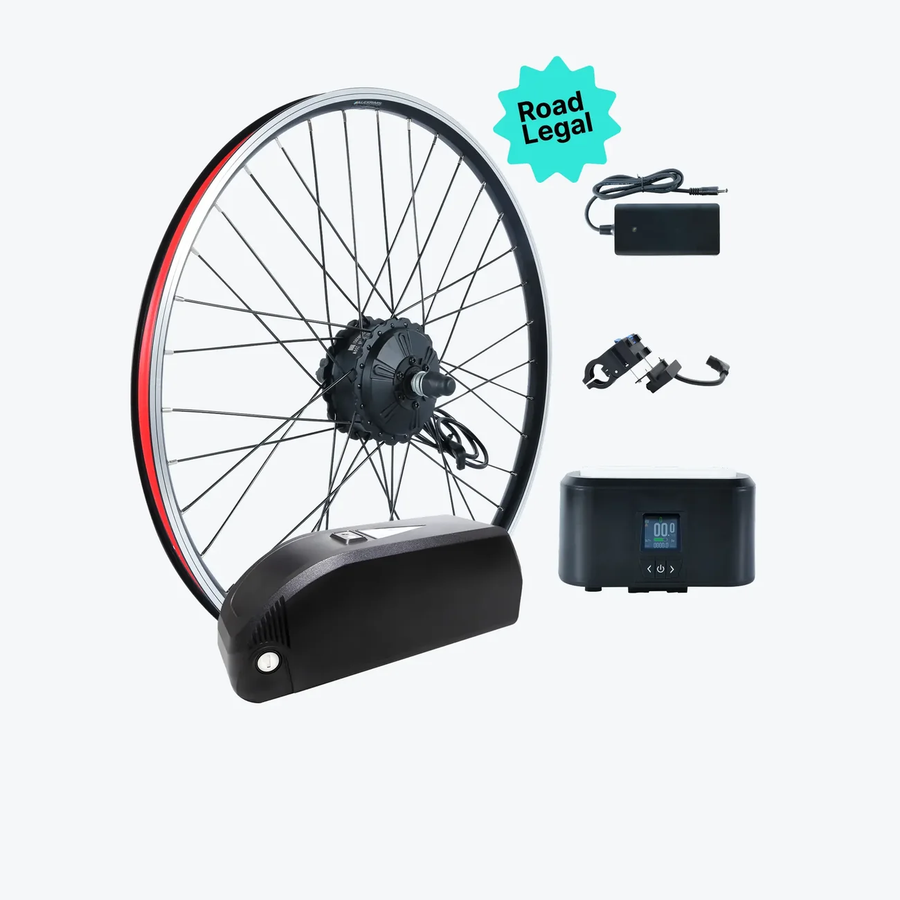
Standard wheel. Our 250W front kit uses Alexrims wheels — light and right for commuting.MTX rim. Our 500W–3000W kits use the wider double-wall MTX rim.
Rim Width vs Tyre Width: The Fit Question That Matters Most
Indicative bands to show the principle. For any specific combination, check the ETRTO table published by a tyre manufacturer rather than relying on a general chart.
Two rules govern this. First, the tyre’s inner diameter must match the rim bead-seat diameter — a 37-622 tyre fits a 622 × 19C rim (Schwalbe). Second, tyre width and internal rim width must be matched, with permissible combinations published by ETRTO and supplemented by tyre-maker recommendations. Fit a tyre too narrow for the rim and the rim is exposed to impact damage; fit one too wide and the tyre can unseat under load.
There is a measurable consequence people miss: the same tyre measures wider on a wider rim. Continental quantifies it for clincher tyres as roughly 0.4mm of width change for every 1mm the rim’s internal width differs from the measuring rim (Continental). So a 2.4-inch tyre on a wide MTX rim sits wider and squarer than the same tyre on a narrow rim, which is why frame and chainstay clearance must be checked with the actual rim you intend to use, not from the tyre label. Rotor and caliper clearance and mudguard fit need the same treatment. One further caution: hookless or straight-sided rims may only be used with tubeless-ready tyres.
On stability, a wider rim supports the tyre sidewall better and gives a squarer profile, which reduces squirm at lower pressures and can improve cornering confidence on wide tyres. That is a genuine benefit — but it is not automatic. Fit a narrow tyre to a wide rim and you get a stretched, less predictable profile along with the impact-damage risk, and the extra rotating mass makes steering feel slower. A wider rim helps when the tyre is wide enough to suit it.
MTX at 2000W and Above
At 2000W the case for a heavier-duty wheel is reasonable rather than absolute. A direct-drive rear hub is a heavy component applying torque directly at the flange, and it is carried alongside a large battery, so the wheel is working harder than on a 250W build. Riders who benefit are those running high current, carrying cargo, riding rough surfaces or at the heavier end of the weight range. Riders who gain little are those on smooth roads at moderate power with sensible tyres, where a well-built standard wheel is entirely adequate. Our 500W/750W kit uses an MTX rim too, which gives margin at that power rather than being essential.
The case strengthens as power rises. At 2600W the controller draws more current on the same 52V platform, so torque events are sharper. At 60V 2500–3000W the motor and system loads increase again, and at 72V 4000W you are firmly in extreme private-land territory where wheel, dropouts, brakes and frame all need to match. But two things stay true at every level: a stronger wheel does not make a weak frame safe, and torque restraint and correct dropout fit matter as much as the rim. Fitting a robust wheel to a damaged or unsuitable frame simply moves the failure point.
Wheel Size and Fat-Tyre Wheels
Diameter
What it offers
What to check
26-inch
Compact, common on high-power builds
Tyre availability, frame clearance
27.5-inch
Balance of rollover and agility
Clearance with wide tyres
29-inch
Better rollover, longer spokes
Frame clearance and standover
700C
Road and hybrid frames
Tyre width against tight clearance
Different trade-offs rather than a strength ranking. Spoke length, leverage and rollover all change with diameter.
Read the ETRTO bead-seat diameter from the tyre sidewall rather than trusting an inch label, because the inch designation is a rough code rather than a measurement (Park Tool). And do not confuse a wide MTB rim with a true fat-bike rim: 3.0-inch and 4.0-inch tyres need substantially wider rims than any MTX-style build, along with fat-specific dropout widths and a motor axle to suit. An MTX wheel is a wide MTB wheel, not a fat wheel. Our sizing page lists the dimensions we support.
Fat tyres need fat rims. Our fat-wheel kit uses a far wider rim than any MTX build.
Spoke Gauge vs Spoke Tension
12G means a 2.6mm spoke, which is thicker than the 13G or 14G spokes used on most bicycle wheels and adds stiffness and load capacity. What it does not do is guarantee a strong wheel on its own. Spoke count determines how the load is shared, and tension consistency around the wheel determines whether that sharing actually happens.
Loose spokes are the main cause of trouble on heavy hub-motor wheels. A spoke at low tension cycles between loaded and unloaded on every revolution, which fatigues it and lets the rim move, and on a wheel carrying a heavy motor that progresses faster than on a light wheel. New wheels also bed in, so tension should be rechecked after the first rides and periodically after that — our installation mistakes guide covers what to look for. If several spokes sound noticeably different when plucked, have the wheel checked rather than riding on.
What to Measure Before Ordering
💡
Six measurements to take first
Bead-seat diameter — read the ETRTO figure from the tyre sidewall, not the inch label
Rear dropout width — measured, and identify open dropout versus thru-axle
Drivetrain interface — freewheel or cassette, and the sprocket count
Rotor and caliper clearance — rotor size supported and caliper position with the new wheel
Frame and fork tyre clearance — measured with the tyre you intend to run on that rim width
Torque-arm space — somewhere to mount the specified restraint properly
Add two more before you commit: the internal rim width of the wheel you are buying, requested from the supplier, and the finished weight of the bike with motor and battery fitted, which affects handling and braking more than most people expect. Our axle interface guide, gearing guide and compatibility checklist cover the measurements in detail.
Who Actually Needs the Upgrade?
Choose an MTX-style wheel if you are running a high-power rear-hub motor, need a wider tyre that the standard rim does not properly support, carry cargo or ride at the heavier end of the range, or ride rough surfaces regularly — provided the weight ratings of the whole build support it.
A standard wheel may be the better choice for 250W commuting, for narrower tyres where a wide rim would give a poor profile, and where lower rotating mass makes the bike feel livelier. Our 250W front kit is a standard-wheel product for exactly that reason. And do not upgrade at all until rim width and frame clearance are confirmed — a wider wheel that fouls the chainstays is not an upgrade.
MTX and Standard-Wheel Options Compared
Three routes, listed alphabetically and judged on the same criteria: wheel build, published specification depth, power class and the main limitation. Confirm current specifications on each supplier’s page before buying.
1. eBikeling Direct-Drive Kits (1200–1500W)
Direct-drive hub wheel kits listed at 1200W and 1500W, some sold with a battery, so they sit below the MTX kits discussed here. They are a sensible reference if you are deciding whether a 2000W-class wheel is needed at all. Ask for the internal rim width rather than the rim description, confirm spoke gauge and dropout width, and check UK availability, shipping and warranty before comparing on price.
2. Generic 2000W MTX Rear-Wheel Kits
Unbranded 2000W rear-wheel kits on MTX-style rims are widely sold on marketplaces such as eBay UK, often in 26 to 29-inch sizes and with 48V or 52V battery options. They are the closest like-for-like comparison on price. The checks are the ones this article is about: the internal rim width, spoke gauge and count, dropout width, and whether a torque arm and battery are included. Documentation depth varies between listings.
3. KirbEbike MTX Rim Kits
Our MTX-style wheels are supplied as complete kits rather than bare wheels: the 52V 2000W with a 35A FOC controller, the 52V 2600W at 50A and the 60V 2500–3000W above them, on 39mm double-wall rims with a choice of freewheel or cassette motor; the 2000W and 2600W list 12G (2.6mm) spokes. Honest limits: these need open slotted dropouts within the listed range, the product pages give the overall rim width rather than the internal width, so ask us for it, and everything at this power level sits outside EAPC classification.
Option
Wheel build
Spec depth
Power class
Main limitation
eBikeling
Direct-drive hub wheels
Varies by listing
1200–1500W
Lower power; UK support
Generic 2000W MTX kits
MTX-style rear wheel
Varies by listing
2000W
Ask for internal rim width
KirbEbike
39mm MTX rims, 12G spokes
Current and cells published
500W–3000W
Internal width on request
Listed alphabetically. Ask every supplier for the internal rim width and spoke count.
UK Legal Note: The Wheel Changes Nothing
A wheel upgrade has no bearing on classification. In Great Britain an Electrically Assisted Pedal Cycle must have pedals capable of propelling it, a motor whose continuous rated power does not exceed 250W, and assistance that cuts off at 15.5mph (GOV.UK). An MTX wheel fitted to a 250W build does not affect that, and an MTX wheel on a 2000W build does not make it compliant — the completed cycle is outside EAPC classification and is treated as a motor vehicle (GOV.UK EAPC standards). Higher-power builds belong on private land with the landowner’s permission and subject to site rules, or must meet the full motor-vehicle requirements.
Product touchpoint
Ask for the internal rim width before you buy a tyre
The single most useful thing you can do is get the internal, bead-seat width of the wheel you intend to order, then check your tyre against the ETRTO table. Measure your dropouts and read the ETRTO figure off your tyre sidewall using our sizing page, then compare the conversion kits. If you are running 250W on smooth roads with a narrow tyre, a standard wheel is very likely the better buy — we would rather tell you that than sell you a wheel you do not need.
An MTX-style wheel is a wider, heavier-duty build that suits high-power rear-hub conversions, wider tyres, heavier loads and rougher ground. It brings more rotating mass and more cost, and it changes nothing about motor power, battery voltage or braking. For a 250W commuter on sensible tyres, a standard wheel remains the sensible choice.
Judge it on the build rather than the name: rim section, spoke gauge, count, lacing and tension together, and above all the internal rim width against the tyre you intend to run (Schwalbe). Measure your dropouts, bead-seat diameter, drivetrain interface and clearances before ordering, fit the specified torque restraint, and recheck spoke tension after the first rides. A well-built standard wheel beats a poorly tensioned wide one every time.
Internal width decides the tyre, the build decides the strength
Measure both before you order, and ask for the figures the rim name does not give you.
It is a product designation for a heavier-duty rim style, typically a wider double-wall aluminium rim laced with 12G spokes to a rear hub motor. It is not a technical standard with a defined width.
Is an MTX rim stronger than a standard rim?
A wider double-wall rim with thicker spokes has more load capacity, but strength comes from the whole build. Spoke count, lacing and tension consistency matter as much as rim section and spoke gauge.
What tyre width fits an MTX rim?
That depends on the internal, bead-seat width, not the rim name. Ask the supplier for the internal figure and check it against the ETRTO tyre and rim table published by tyre manufacturers.
Does a wider rim make a tyre wider?
Yes. Continental quantifies it for clincher tyres as roughly 0.4mm of width change for every 1mm the rim internal width differs from the measuring rim, so check frame clearance with your actual rim.
Do I need an MTX wheel for a 2000W motor?
Not necessarily. It helps with high current, cargo, rough surfaces or a heavier rider. On smooth roads at moderate power with sensible tyres, a well-built standard wheel is adequate.
What are 12G spokes?
Spokes 2.6mm in diameter, thicker than the 13G or 14G used on most bicycle wheels. They add stiffness and load capacity but do not guarantee a strong wheel without correct tension.
Is an MTX rim the same as a fat-bike rim?
No. An MTX wheel is a wide MTB wheel. True fat tyres of 3.0 or 4.0 inches need substantially wider rims, fat-specific dropout widths and a matching motor axle.
Which wheel size is strongest for an ebike conversion?
None is inherently strongest. Smaller diameters give shorter spokes and less leverage, larger ones roll over obstacles better. Build quality and tension matter far more than diameter.
How often should I check spoke tension on a hub-motor wheel?
After the first few rides while the wheel beds in, then periodically. Loose spokes fatigue quickly on a heavy motor wheel, so have it checked if several sound noticeably different when plucked.
Does an MTX wheel affect UK e-bike legality?
No. Classification depends on the motor’s continuous rated power, working pedals and a 15.5mph assistance cut-off. A wheel upgrade changes none of those.
A note on safety & legality. General information, not a substitute for the manufacturer’s instructions or a qualified wheelbuilder. Match tyre width to internal rim width according to ETRTO and the tyre maker’s guidance, and never fit a tyre outside the permitted range — too narrow risks rim damage on impact, too wide risks the tyre unseating. Hookless or straight-sided rims may only be used with tubeless-ready tyres. Fit the torque restraint specified for your motor, check frame, rotor and mudguard clearance with the actual rim and tyre, and recheck spoke tension after the first rides. A stronger wheel does not make an unsuitable or damaged frame safe. In Great Britain a converted cycle is an EAPC only when it has working pedals, a motor rated no higher than 250W continuous and assistance that stops at 15.5mph; a wheel upgrade does not change that classification (GOV.UK).
About this guide
Author: KirbEbike Editorial. Technical review: KirbEbike conversion-support team. Last reviewed: October 2026. Methodology: tyre and rim fit is cited to ETRTO via Schwalbe and Continental, wheel and tyre sizing standards to Park Tool, and legality to GOV.UK and Department for Transport guidance, all cited inline. The rim-and-tyre chart shows indicative bands to illustrate the principle and is not a substitute for the ETRTO table for a specific combination. Our product pages give the MTX rim’s 39mm overall width but not its internal width or spoke-tension specifications, so readers are directed to request the internal width for the exact wheel size they intend to order. No claim is made that any wheel diameter is inherently stronger than another. Competitor details are the suppliers’ own published claims.
Stay in the know
Conversion guides, fitting advice and the deals worth knowing about. No spam.