The environmental case for converting an existing bicycle rather than buying a purpose-built e-bike is more compelling than most riders realise. Manufacturing a new e-bike—complete frame, fork, wheels, drivetrain, plus electrical system—carries a substantial carbon footprint before it ever turns a wheel.
An ebike conversion kit adds electric assist to a bicycle that already exists, avoiding most of that embedded manufacturing impact while delivering functionally identical performance.
This isn't about small marginal gains. The difference in manufacturing emissions, material waste, and end-of-life disposal between these two approaches is significant enough to matter—and understanding why helps inform genuinely sustainable transport choices.
Manufacturing Footprint: Where the Biggest Difference Lies
![]()

Complete e-bike manufacturing emissions: Producing a purpose-built e-bike generates approximately 200-400kg of CO₂ equivalent depending on frame material, component specification, and where manufacturing occurs. This includes:
- Frame fabrication (aluminium extrusion, welding, surface treatment)
- Component manufacturing (wheels, drivetrain, brakes, suspension)
- Electrical system (motor, battery, controller, display)
- Assembly and distribution logistics
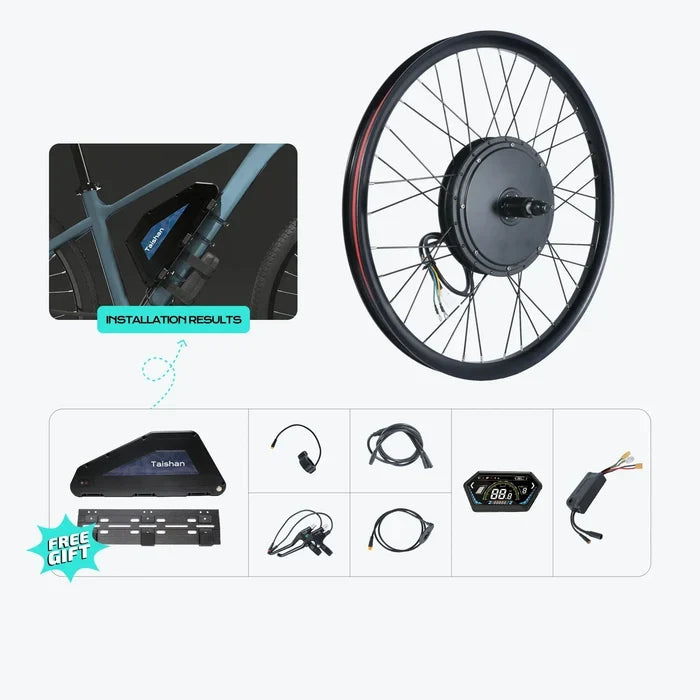
Conversion kit manufacturing emissions: A conversion kit's environmental cost is limited to the electrical components added to the existing bicycle—motor wheel, battery, controller, wiring harness, display. These typically represent approximately 50-80kg of CO₂ equivalent in manufacturing emissions.
The donor bicycle's manufacturing footprint is already "spent"—it exists regardless of whether it's converted. By adding a kit rather than purchasing a complete new e-bike, you're avoiding the redundant manufacturing of another complete bicycle frame, wheels, drivetrain, and mechanical components that duplicate what you already own.
|
Environmental Factor
|
New E-Bike
|
Conversion Kit
|
|
Manufacturing CO₂e
|
200-400kg
|
50-80kg
|
|
Frame fabrication
|
Full impact
|
Avoided (existing bike)
|
|
Component manufacture
|
Full set
|
Avoided (existing components)
|
|
Shipping weight
|
Complete bike
|
Kit components only
|
|
Packaging waste
|
Large bike box + materials
|
Compact kit packaging
|
Material Lifecycle: Circular Economy vs Linear Consumption
Converting an existing bike is fundamentally a circular economy action—extending the useful life of an existing manufactured good rather than retiring it prematurely in favour of a newer one.
What conversion prevents:
- A perfectly functional bicycle frame relegated to storage or landfill
- Unnecessary production of duplicate wheels, handlebars, saddle, pedals
- Additional shipping and packaging waste from a complete bike purchase
- End-of-life disposal of the displaced bicycle years before necessary
One Kirbebike customer has nearly 14,000 miles on a 1500W system over several years on the original battery and motor. Another has covered almost 20,000km in two years. These aren't new bicycles—they're existing frames given extended useful lives at performance levels no standard bicycle can match.
Battery Manufacturing: The Single Largest Environmental Cost
![]()

Battery production is the most carbon-intensive component of any electric vehicle—e-bikes included. A quality lithium-ion battery pack carries substantial manufacturing emissions related to raw material extraction (lithium, cobalt, nickel), cell production, and BMS electronics.
Here's the crucial point: Whether you buy a complete e-bike or fit a conversion kit, you're getting one battery. The battery's environmental cost is roughly equivalent in both scenarios when comparing like-for-like capacity and cell quality.
Where conversion offers an advantage is in battery replaceability and upgrade potential. Kirbebike's batteries are independent components available separately across the voltage range from 36V through 72V. When battery capacity eventually degrades after 1,000+ charge cycles, replacing just the battery extends the system's life for another several years without replacing the entire bike or electrical system.
Purpose-built e-bikes frequently use proprietary batteries integrated into the frame. When these degrade or the model is discontinued, replacement can be difficult or impossible—forcing premature retirement of an otherwise functional bike.
Transport Emissions: Getting From Manufacture to Rider
Kirbebike operates UK and US warehouses, with the 52V 2000W and 72V 4000W kits shipping from these locations for 2-7 business day delivery. This regionalised distribution reduces transport emissions compared to direct-from-factory shipping of complete bikes from overseas manufacturing facilities.
Packaging waste comparison:
|
Item
|
Complete E-Bike
|
Conversion Kit
|
|
Box size
|
Large bicycle carton
|
Compact component box
|
|
Protective foam
|
Extensive
|
Minimal
|
|
Plastic wrapping
|
Complete bike coverage
|
Component-level only
|
|
Cardboard weight
|
Substantial (full bike protection)
|
Modest (parts protection)
|
Real-World Carbon Savings: UK Commuting Context
The most significant environmental benefit of any e-bike—whether purchased complete or converted—is the displacement of car journeys. Oxford University research indicates that switching from car to e-bike for everyday journeys reduces transport carbon emissions by approximately 0.5 to 0.7 tonnes of CO₂ per person annually.
UK-specific context:
A Devon commuter who converted a 3.5-mile hilly route from car to e-bike (using an EZ Rider kit) transformed a 25-minute car journey into an 11-minute ride. Assuming a typical UK car at 150g CO₂/km, that's approximately 225kg of CO₂ saved annually just from this single commute route.
A train station commuter completing 6km daily on an EZ Rider conversion removes approximately 200-250kg of CO₂ annually compared to driving—and extends their existing bicycle's useful life rather than manufacturing an entirely new e-bike to achieve the same result.
Component Longevity and Independent Replaceability
Conversion kits offer a distinct environmental advantage through modular component independence. Each major component—motor, battery, controller, display—can be replaced individually when necessary without retiring the entire system.
One Kirbebike 1500W customer has replaced the controller (second unit) and display (third unit) over nearly 14,000 miles while keeping the original motor and battery. This targeted component replacement is environmentally superior to complete system retirement when a single element fails.
Why this matters: Purpose-built e-bikes frequently integrate components in ways that make independent replacement difficult or impossible. A failed controller or display on an integrated system can mean replacing the entire electrical system or retiring the bike entirely when parts are unavailable.
Kirbebike's component independence means:
- Individual parts replaceable as needed
- Performance upgrades possible without full system replacement
- Longer total system lifespan
- Reduced waste from premature retirement
The Upgrade Path: Environmental Efficiency Over Time
Conversion's modular nature supports environmentally efficient progression through power levels as rider needs evolve.
A commuter starting with a 250W EZ Rider kit for road-legal use can later upgrade to a 1000W rear wheel system for private land use—reusing the existing donor bicycle while selling the 250W kit to another rider entering the e-bike world. This cascade of use across multiple riders extracts maximum utility from each manufactured component.
End-of-Life Considerations
When a conversion kit eventually reaches end of life after many years of use, the donor bicycle frame—if still sound—can continue service with a new kit, be returned to standard bicycle use, or be retired with its full useful life extracted.
Purpose-built e-bikes reaching end of life present more complex disposal challenges. The integrated electrical systems complicate recycling; proprietary components limit parts harvesting; and battery packs with non-standard connectors can't be easily repurposed.
What happens to components at end of life:
- Motor wheels can be rebuilt or recycled for copper and steel content
- Batteries should be recycled through proper e-waste channels (LG cells in Kirbebike batteries are recyclable)
- Controllers and displays contain recyclable electronics
- The donor bicycle frame continues independent useful life
Noise and Local Air Quality: Secondary Environmental Benefits
Both converted bikes and purpose-built e-bikes share these advantages over cars and motorcycles:
Zero direct emissions — No exhaust, no particulate matter from combustion Minimal noise pollution — Hub motors and mid-drives operate near-silently compared to internal combustion engines Reduced brake dust — Regenerative braking potential on some systems, less aggressive braking overall
For UK urban environments where air quality and noise are documented public health concerns, every car journey displaced by e-bike use—whether conversion or complete bike—contributes to local environmental quality improvement.
Summary: The Environmental Advantage of Conversion
Converting an existing bicycle to electric rather than purchasing a purpose-built e-bike delivers measurable environmental benefits:
|
Benefit
|
Mechanism
|
Impact
|
|
Avoided manufacturing
|
No redundant frame/components
|
150-320kg CO₂e saved
|
|
Extended product life
|
Existing bicycle continues useful service
|
Circular economy principle
|
|
Reduced shipping
|
Compact kit vs complete bike
|
Lower transport emissions
|
|
Independent component replacement
|
Targeted replacement vs full retirement
|
Longer system lifespan
|
|
Upgrade path efficiency
|
Modular progression across power levels
|
Maximum component utilisation
|
For buyers concerned about environmental impact, converting an existing quality bicycle with a Kirbebike conversion kit with battery offers superior environmental performance compared to purchasing a new complete e-bike—while delivering functionally equivalent transport capability at genuine cost savings.
Frequently Asked Questions
How much CO₂ does converting a bike to electric save compared to buying new?
Converting avoids approximately 150-320kg of CO₂ equivalent in manufacturing emissions compared to purchasing a complete e-bike. This represents the carbon cost of manufacturing a redundant bicycle frame, wheels, drivetrain, and mechanical components you already own.
Is a conversion kit more environmentally friendly than a new e-bike?
Yes, measurably so. The conversion approach extends the useful life of an existing manufactured bicycle rather than producing a redundant new one. This embodies circular economy principles—extracting maximum utility from already-manufactured goods rather than premature replacement.
What happens to the environmental benefit if I wasn't going to use my old bike anyway?
The bicycle's manufacturing footprint is already "spent" whether you use it or not. By converting rather than retiring it, you're extracting value from that embedded environmental cost..
Do conversion kit batteries have the same environmental impact as e-bike batteries?
Battery manufacturing emissions are similar for equivalent capacity and cell quality. Kirbebike uses LG cells across the battery range—the same quality cells used in premium purpose-built e-bikes.
How long does a conversion kit need to last to be more environmentally friendly than buying new?
The environmental advantage exists from day one through avoided manufacturing of redundant bicycle components. The longer the kit remains in service, the more significant the advantage becomes.
: invalid url input)
usmile
Liquid error (snippets/blog-best-product line 36): product form must be given a product
Liquid error (snippets/blog-best-product line 59): product form must be given a product