De specificaties van ebike-ombouwsets vergelijken klinkt eenvoudig, totdat u ermee begint. Het motorvermogen spreekt elkaar tegen in verschillende advertenties. De geclaimde actieradius schommelt enorm tussen identiek ogende accu's. De ene set adverteert met "1000W" terwijl de andere zijn motor "500W" noemt en ze presteren identiek.
Reclameteksten zijn opgesteld om cijfers indrukwekkend te laten lijken in plaats van echte beslissingen te informeren. Deze gids doorprikt de verwarring rond specificatiebladen – door uit te leggen wat elk cijfer werkelijk betekent, wat u kunt negeren, wat u moet verifiëren en hoe u sets op een echt vergelijkbare basis kunt vergelijken.
Waarom specificatievergelijkingen verkeerd gaan

Voordat we ingaan op individuele specificaties, is het de moeite waard om de drie mechanismen te begrijpen die vergelijking moeilijk maken.
Piekvermogen versus nominaal vermogen is het meest voorkomende probleem. Een motor kan kortstondig een piekvermogen van 1000W leveren onder maximale belasting, terwijl zijn continue (nominale) vermogen 500W is. Beide cijfers zijn technisch correct. Marketing gebruikt piekvermogen. Techniek gebruikt nominaal vermogen. Vraag bij het vergelijken van sets altijd: welk wattage wordt vermeld?
Batterij Wh versus Ah creëert een andere valkuil bij het vergelijken. Twee sets kunnen de batterijcapaciteit vermelden als "13Ah" - maar een 36V 13Ah batterij bevat 468Wh, terwijl een 48V 13Ah batterij 624Wh bevat. Het Ah-nummer is identiek; de werkelijk opgeslagen energie is in het tweede geval 33% meer. Wattuur (Voltage × Ampère-uur) is de enige eerlijke vergelijking van batterijcapaciteit.
Wat er daadwerkelijk is inbegrepen in de kitprijs varieert enorm. De vermelde kosten van de ene kit omvatten batterij, sensoren, display, gereedschap en oplader. De andere omvat alleen het motorwiel. Het vergelijken van de vermelde prijzen zonder de inclusies te verifiëren, is het vergelijken van onvergelijkbare zaken.
Specificatie #1: Motorvermogen – Wat het werkelijk betekent

Wattage is het belangrijkste nummer op elke ombouwset. Het is ook het meest misleidende.
Nominale (continue) rating – wat de motor onbeperkt kan volhouden zonder oververhitting. Dit is het cijfer dat de prestaties in de praktijk bepaalt.
Piekvermogen – wat de motor kortstondig kan leveren onder maximale belasting. Vaak 150-200% van het nominale vermogen. Dit cijfer wordt vaak geadverteerd.
Wettelijke opmerking in het VK: Voor weggebruik met een EAPC is de maximale nominale output 250W. De 250W voorwielsets van Kirbebike zijn CE/ROHS gecertificeerd met deze rating, specifiek voor naleving van de Britse wegvoorschriften. Voor offroad en particulier terrein zijn hogere nominale ratings van 500W tot 4000W verkrijgbaar in het hele assortiment.
Waar op te letten bij het vergelijken van wattage:
- Vraag specifiek naar het nominale (continue) vermogen
- Controleer of de motorspecificaties een merknaam vermelden (bijv. SHENGYI voor de 500W-750W motoren met tandwieloverbrenging van Kirbebike)
- Controleer de CE/ROHS-certificering voor weglegale kits
- Vergelijk geen claims over piekvermogen van kits zonder nominale cijfers
Specificatie #2: Accu — De belangrijkste en meest misleidende specificatie

Accuspecificaties verdienen de meeste aandacht wanneer u specificaties van ebike-ombouwkits vergelijkt, omdat ze de actieradius in de praktijk, de levensduur en de veiligheid bepalen - en het is het gebied met de meeste marketinginflatie.
Capaciteit: Denk aan Wh, niet alleen aan Ah
|
Voltage
|
Capaciteit (Ah)
|
Werkelijke energie (Wh)
|
|
36V
|
13Ah
|
468Wh
|
|
48V
|
11.6Ah
|
557Wh
|
|
48V
|
16Ah
|
768Wh
|
|
52V
|
20Ah
|
1.040Wh
|
|
52V
|
30Ah
|
1.560Wh
|
|
72V
|
20Ah
|
1.440Wh
|
Twee kits die beide "13Ah" vermelden, leveren zeer verschillende energie als de ene 36V en de andere 48V gebruikt. Bereken altijd Wh voordat u de actieradius vergelijkt.
Celmerk: de doorslaggevende kwaliteitsindicator
De belangrijkste batterijspecificatie is de celaanbieder — en deze ontbreekt vaak in de vermeldingen van budgetkits.
Bekende celmerken om naar te zoeken: LG, Samsung, Panasonic. Deze fabrikanten leveren cellen aan de premium consumentenelektronica-industrie met een consistente chemie, geverifieerde degradatiesnelheden en veiligheidsprofielen.
Anonieme of merkloze cellen: Geen onafhankelijke kwaliteitsborging. Degradatiesnelheden onbekend. BMS-kwaliteit onbekend. Veiligheid onder abnormale omstandigheden onverifieerd.
Kirbebike specificeert LG-cellen voor alle batterijopties – van de 36V 7Ah EZ Rider-kitbatterij tot de LG 21700-cellen in het 52V 30Ah / 60V 20Ah pack met hoge capaciteit. De 48V 16Ah mid-drive kitbatterij wordt expliciet door LG geleverd met een levensduur van meer dan 1.000 cycli. Dit niveau van specificatietransparantie is direct vergelijkbaar; anonieme cellen zijn dat niet.
Specificatie #3: Koppel — Het klimcijfer waar niemand genoeg over praat
Wattage vertelt u hoeveel vermogen een motor verbruikt. Koppel vertelt u hoe hard hij kan duwen. Voor het Britse terrein – met name heuvelachtige woon-werkverkeer, gemengde ondergronden, beladen fietsen – is koppel vaak relevanter dan wattage.
Naafmotor koppel is over het algemeen lager, variërend van 35-80Nm, afhankelijk van de motorgrootte. De EZ Rider 250W kit levert 50Nm – voldoende voor vlak en middelzwaar terrein.
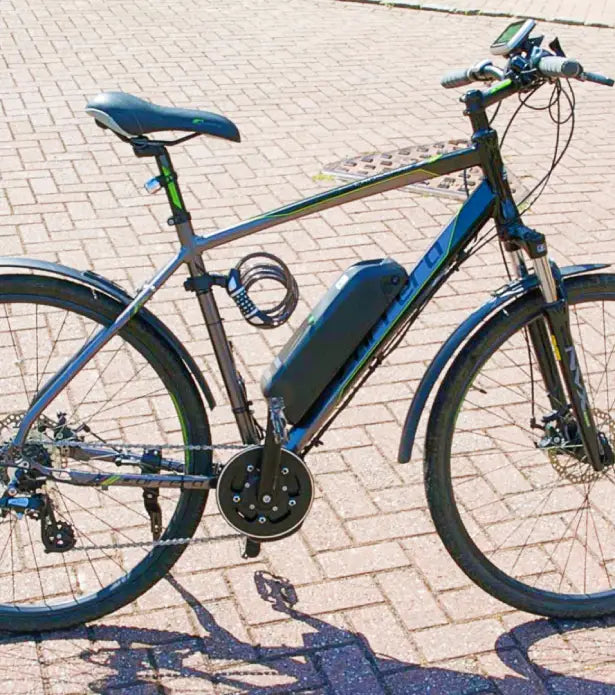
Middenmotor koppel is aanzienlijk hoger omdat de motor via de versnellingen van de fiets aandrijft, wat het mechanische voordeel bij beklimmingen vermenigvuldigt. De Tongsheng TSDZ8 levert 140Nm via zijn dubbele koppelsensorsysteem – meer dan het dubbele van de output van een vergelijkbare naafmotor op steil terrein.
Waarom dit belangrijk is voor specificatievergelijking: Een 500W middenmotor met 140Nm koppel presteert beter dan een 1000W naafmotor op langdurige beklimmingen. Alleen wattagevergelijking zou het tegenovergestelde suggereren.
Koppelmeting versus cadansmeting is een gerelateerde specificatie die de rijervaring dramatisch beïnvloedt. Cadanssensoren detecteren of de pedalen draaien (binair). Koppelsensoren meten hoe hard u trapt en moduleren de ondersteuning proportioneel. De dubbele koppelsensoren van de TSDZ8 leveren ondersteuning die natuurlijk aanvoelt – een Kirbebike-klant merkt op dat hij een dagelijkse heuvelachtige rit van 23 km voltooit op ondersteuningsniveau één, en eindigt met 80% batterij, specifiek omdat het koppelmeetsysteem het vermogen efficiënt beheert.
Specificatie #4: Motortype — Naaf versus Middenmotor, Tandwieloverbrenging versus Directe aandrijving
Het motortype beïnvloedt gewicht, efficiëntie, geluid, onderhoud en geschiktheid voor terrein. Het is een specificatie die marketing vaak verdoezelt door in plaats daarvan de nadruk te leggen op wattage.
|
Motortype
|
Gewicht
|
Efficiëntie
|
Geluid
|
Geschikt voor
|
Voorbeeld Kirbebike
|
|
Borstelloze naafmotor met tandwieloverbrenging
|
2,7-4,5 kg
|
Goed bij lagere snelheden
|
Licht tandwielgeluid
|
Woon-werkverkeer, vlak tot middelzwaar terrein
|
250W-750W voor/achter kits
|
|
Borstelloze naafmotor met directe aandrijving
|
4-6,8 kg
|
Goed bij hogere snelheden
|
Bijna stil
|
Prestaties, hogere snelheid
|
1000W-4000W bereik
|
|
Middenmotor (koppelmeting)
|
4,8 kg
|
Uitstekend bij alle snelheden
|
Stil
|
Heuvelachtig terrein, natuurlijk gevoel
|
TSDZ8 500W/750W
|
Waar op te letten bij het vergelijken van motortypen:
- Tandwielaandrijving of directe aandrijving? (Motoren met tandwieloverbrenging freewheelen; direct aangedreven motoren bieden potentieel voor regeneratief remmen)
- Montage aan de voor- of achterkant? (Achterkant biedt betere tractie; voorkant gemakkelijker te monteren op de meeste fietsen)
- Wordt een specifiek motormerk vermeld? (Kirbebike specificeert SHENGYI voor zijn 500W-750W motoren met tandwieloverbrenging)
- Wat is het opgegeven motorgewicht? (Relevant voor handling en spaakbelasting)
Specificatie #5: Controller — De verborgen prestatie-differentiatie
De controller is vaak het meest ondergespecificeerde onderdeel in de kitmarketing, maar heeft een aanzienlijke invloed op de rijervaring.
FOC (Field Oriented Control) controllers moduleren de vermogensafgifte soepel en efficiënt, reagerend progressief op de input van de rijder. Ze zijn stiller en produceren een betere efficiëntie onder variërende belastingomstandigheden.
Blokgolfcontrollers leveren vermogen in stappen, wat resulteert in een meer aan/uit-vermogensgevoel, hogere elektrische ruis en lagere efficiëntie bij gedeeltelijke belasting.
Stroomsterkte classificatie bepaalt de stroomcapaciteit. De EZ Rider kit gebruikt een 36V 14A FOC controller – de stroomsterkte afgestemd op de specificaties van de motor voor optimale efficiëntie. Mismatchende controllers (te groot of te klein ten opzichte van de motor) veroorzaken thermische stress of onderprestaties.
Waterdichtheidspecificatie is relevant voor Britse omstandigheden. Het TSDZ8 mid-drive display heeft een IP66-classificatie – een specifieke, verifieerbare weersbestendigheidsstandaard. Advertenties die displays alleen als "waterdicht" beschrijven zonder een IP-classificatie, bieden geen zinvolle specificatie.
De inclusielijst: Vergelijken op gelijke basis
Voordat u twee sets vergelijkt op prestatiespecificaties, moet u controleren of beide dezelfde componenten bevatten. Het verschil tussen een "kitprijs" en een "complete systeemprijs" kan aanzienlijk zijn.
Wat een echt complete set omvat:
|
Component
|
Inbegrepen in Kirbebike-kits
|
Vaak ontbrekend in budgetkits
|
|
Batterij (genoemde celmerk)
|
LG-cellen
|
Vaak uitgesloten of ongespecificeerd
|
|
Controller + display
|
FOC, TFT kleur
|
Soms alleen basis LCD
|
|
Remsensoren
|
Gratis (~£20 waarde)
|
Vaak een aparte aankoop
|
|
PAS/cadanssensor
|
D12L gratis (~£10 waarde)
|
Vaak apart
|
|
Installatiegereedschapset
|
Gratis (~£25 waarde)
|
Zelden inbegrepen
|
|
Oplader
|
Meerdere stekkers (VK/VS/EU/AU)
|
Soms uitgesloten
|
|
Koppelingsarm
|
Naafmotor kits
|
Vaak apart
|
|
Garantie
|
1 jaar fabrieksgarantie
|
Variabel
|
Snelheid en Bereik: De claims eerlijk interpreteren
Snelheidsclaims zijn eenvoudig te verifiëren aan de hand van de spanning en motorspecificaties, maar worden in marketing vaak overdreven.
Als algemene richtlijn voor naafmotoren:
- 36V systemen: typisch 25-35 km/u
- 48V systemen: typisch 35-50 km/u
- 52V systemen: typisch 50-60 km/u
- 60V+ systemen: 60 km/u+ mogelijk
Bereikclaims zijn waar de meeste inflatie optreedt. Het bereik wordt beïnvloed door het gewicht van de berijder, het terrein, het ondersteuningsniveau, de bandenspanning, de wind en de temperatuur. Een batterij die "60 km bereik" claimt onder ideale vlakke omstandigheden met minimale ondersteuning, levert aanzienlijk minder op heuvelachtig Nederlands terrein met zwaardere rijders op hogere ondersteuningsniveaus.
De verificatiechecklist: 8 vragen voordat u koopt
Gebruik deze vragen om marketingclaims van elke e-bike ombouwset met accu te doorprikken:
- Is het opgegeven wattage nominaal of piekvermogen?
-
Welk celmerk zit er in de accu? (LG/Samsung/Panasonic = geverifieerd; merkloos = onbekend)
-
Wat is de batterijcapaciteit in Wh? (Voltage × Ah)
- Voor welke levensduur is de accu beoordeeld?
- Is de controller FOC of vierkantgolf?
- Welke IP-classificatie heeft het display?
- Zijn sensoren, gereedschap en oplader inbegrepen in de opgegeven prijs?
- Heeft de leverancier CE/ROHS-certificering voor weglegale kits?
Conclusie
De mogelijkheid om de specificaties van e-bike ombouwsets nauwkeurig te vergelijken, onderscheidt aankopen die blijvende waarde leveren van die welke binnen een seizoen teleurstellen. De sleutel is om verder te kijken dan de headline wattages en bereikcijfers naar de specificaties die daadwerkelijk de prestaties en levensduur bepalen: nominale motorvermogen.
batterij Wh capaciteit en celmerk, controllertype, display IP-classificatie en volledige verificatie van de inhoud. Ontdek het volledige Kirbebike ombouwset assortiment waar elke specificatie transparant wordt vermeld – van benoemde LG-celbatterijen en FOC-controllers tot IP66-geclassificeerde displays en CE/ROHS-certificering – waardoor u precies de informatie krijgt die nodig is om op een werkelijk eerlijke basis te vergelijken.
Veelgestelde vragen
Wat is het verschil tussen nominaal en piekvermogen op een e-bike kit?
Nominaal (continu) wattage is wat de motor onbeperkt kan leveren onder belasting – het reële prestatiecijfer. Piekvermogen is de korte maximale output onder maximale belasting, typisch 150-200% van het nominale vermogen.
Hoe bereken ik de werkelijke batterijcapaciteit voor bereikvergelijking?
Vermenigvuldig voltage met ampère-uur om watt-uur (Wh) te krijgen – de enige nauwkeurige energievergelijking. Een 36V 13Ah batterij = 468Wh. Een 48V 13Ah batterij = 624Wh. Ondanks identieke Ah-cijfers slaat de 48V batterij 33% meer energie op.
Waarom is het merk van de batterijcel belangrijk bij het vergelijken van conversiekits?
Genaamde celmerken (LG, Samsung, Panasonic) bieden geverifieerde chemie, consistente degradatiesnelheden en geteste BMS-prestaties. Anonieme cellen bieden geen van deze garanties.
Is een middenmotor altijd beter dan een naafmotor voor het Nederlandse terrein?
Niet altijd – het hangt af van het terrein. Voor heuvelachtige routes leveren de TSDZ8 middenmotor met zijn 140Nm koppel en dubbele koppelmeting superieure klimprestaties en een natuurlijker rijgevoel in vergelijking met gelijkwaardige naafmotoren.
Wat betekent IP66-classificatie op een e-bike display?
IP66 geeft aan dat het display beschermd is tegen krachtige waterstralen uit elke richting – een zinvolle specificatie voor Nederlandse omstandigheden met regen, spatwater en condensatie. Displays die alleen als "waterdicht" worden beschreven zonder een IP-nummer, bieden geen verifieerbare beschermingsstandaard.