Quick-Release vs Thru-Axle: Will an E-Bike Hub-Motor Kit Fit Your Bike?
AK
Andy Kirby
Reviewed by the KirbEbike conversion-support team
Share
Unlock £10 off today
On this page
Identify the axle interface before anything else — before wattage, before battery size, before wheel diameter. It is the one check that can rule a conversion out entirely, and no amount of measuring width will substitute for it. Two bikes can take the same 700C wheel and still need completely different motor axles: wheel diameter tells you almost nothing about hub-motor compatibility, but the shape of your dropout tells you nearly everything. This guide works through the fit decision in order — interface first, then width, then frame material, then the approved motor route.
The quick answer
Most conventional hub-motor kits are built around open dropouts and a solid, flat-sided axle held by nuts. A quick-release frame usually has those open slots, so it is the more common candidate — though the original skewer is replaced by the motor’s own axle and nuts. A thru-axle frame has closed dropout holes and generally needs a purpose-built thru-axle motor or a manufacturer-approved adapter system. Never force a quick-release motor wheel into a thru-axle frame: Park Tool treats quick release, thru axle and solid axle as three different wheel-retention systems, not interchangeable versions of the same part. Settle the axle system first; only then is wattage worth discussing.
Fit before power. The dropout decides which motors are even candidates — wattage and battery choices come after.
The Six-Point Fit Gate
Every one of these must pass. A failure on any single point means the motor does not fit, whatever the other five say — fitting between the stays is not compatibility. A motor wheel that merely sits between the fork legs or rear stays has not been proven to fit: the axle must seat, clamp and resist torque exactly as its manufacturer intended.
#
Check
Pass
Fail
1
Axle interface
Frame and motor use the same retention system — open slot with nuts or skewer, or a closed bore with a thru-axle of the exact standard
Open-dropout motor against a closed thru-axle frame, or the reverse
2
OLD / spacing
Motor over-locknut dimension matches the frame’s stated spacing
Any mismatch — spreading or shimming to close a gap is not a pass
3
Dropout slot & material
Slot width and depth accept the axle flats; material and thickness suit the motor’s torque
Carbon dropouts, thin or damaged aluminium, or a slot needing material removed
4
Brake alignment
Rotor sits correctly in the caliper with the motor wheel fitted, within the caliper’s adjustment range
Rotor out of range, or alignment achieved only by shimming the caliper beyond its spec
5
Drivetrain & chainline
Freewheel or cassette type matches, speed count matches, chainline acceptable
Cassette against a freewheel motor, or a speed count the motor shell cannot take
6
Torque-reaction solution
Manufacturer-specified torque arm(s) fitted and fully engaged, with correct washers
No torque arm where one is specified, or an arm that cannot be properly anchored
Six checks, all pass/fail. This guide settles check 1 — the interface — because it is the one that rules bikes out entirely.
6
pass/fail checks before any hub motor fits
100mm
the common open front-fork spacing
130–157mm
the span of rear axle standards in use
0
KirbEbike hub motors offered in a thru-axle format
An Interface Question, Not an Arithmetic One
A 135mm quick-release frame and a 12×142 thru-axle frame are sometimes described as 7mm apart. That framing is misleading. They use different axle systems and different reference dimensions: 142 is not a 135 frame made wider. One holds the wheel in open slots with external nuts or a skewer; the other passes a 12mm axle through closed bores and threads it into the frame. Sheldon Brown puts the consequence plainly for thru-axle frames — there is no way to adjust dropout spacing by adding spacers.
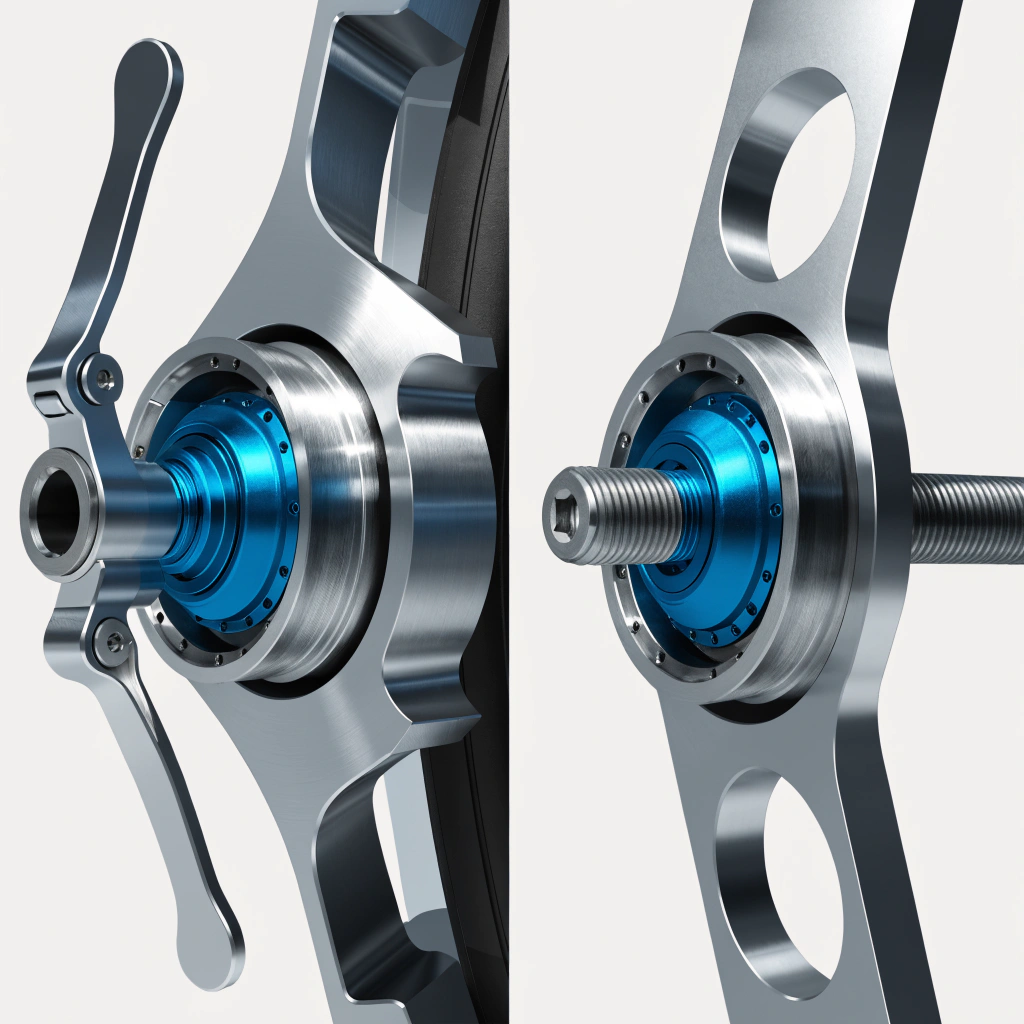
Two retention systems compared. The difference is how the wheel is held, not how far apart the dropouts sit — the open slot accepts a bolt-on motor axle, the closed bore does not.
What Is a Quick-Release Axle?
How a quick-release wheel is held in place
A traditional quick-release wheel uses five things working together:
A hollow hub axle
A thin skewer passing through it
A cam lever on one side
An adjusting nut on the other
Open U-shaped frame or fork dropouts
The mechanism matters more than it looks. When a quick release is tightened properly, the axle does not bear against the top of the dropout slot to resist load. The hub locknuts press hard against the inner faces of the dropouts, and those clamped faces transmit the forces into the fork or frame. That is friction doing the work — which becomes the central issue once a motor is involved.
One clarification buyers miss: “quick-release compatible” does not mean the hub motor has a quick-release skewer. Most conventional motor wheels use a flat-sided, solid or hollow motor axle that sits in the open dropout slots and is fastened by axle nuts. The skewer comes out and does not go back in.
Common quick-release spacing
These patterns are common rather than universal, so measure rather than assume:
Front: approximately 100mm
Older rim-brake road rear: approximately 130mm
Mountain, hybrid and many disc-brake rears: approximately 135mm
QR Boost rear: approximately 141mm
Benefits of quick release for conversion
👍
Why QR frames are the common conversion candidate.
Tool-free wheel removal on the original wheel
Broad compatibility with older road, hybrid and mountain-bike frames
Lower component weight and a simple open-dropout design that is easy to inspect
Much wider availability of conventional conversion-motor formats
One honest caveat: the converted wheel is no longer tool-free. Motor axle nuts need a wrench, and they need checking after the first rides.
What Is a Thru-Axle?
The modern disc-bike default. Thru-axles dominate current road, gravel and mountain bikes — and they change the conversion question completely.
How a thru-axle wheel is held in place
A thru-axle works on a different principle. It passes through a closed frame or fork dropout, passes through the hub, and threads into the opposite dropout or a replaceable threaded insert. Its diameter, length and thread dimensions are frame-specific, and it locates the wheel repeatedly in exactly the same position.
Manufacturers treat these as separate fixing methods, not variants of one thing. Shimano lists quick release and 12mm or 15mm E-THRU as distinct axle-fixing systems, and its dealer documentation states that certain hubs can only be used with the matching frame and through-axle — warning that using another type of frame can allow the wheel to come off while riding. Width alone does not define compatibility.
Common thru-axle standards
The first number is normally axle diameter; the second relates to hub and frame spacing.
Bike position / type
Common standard
Road / gravel front
12×100mm
Road / gravel rear
12×142mm
MTB front
15×100mm
Boost MTB front
15×110mm
MTB rear
12×142mm
Boost MTB rear
12×148mm
Super Boost rear
12×157mm
Why thru-axles are common on modern disc bikes
Secure retention in a closed interface; repeatable rotor alignment, which matters when pad clearance is under a millimetre; interfaces suited to suspension forks; and better control of exactly where the wheel sits. Treat axle type as a question of retention and alignment rather than stiffness — wheel and frame stiffness come from the hub, bearings, frame, fork and clamping design together, not from the axle rod alone.
How to Tell Which One Your Bike Has
A one-minute check. Looking at the dropout in the shed prevents the most expensive conversion mistake there is.
Look at the dropout shape
✓ Quick release or bolt-on
An open slot — the wheel drops downward out of the frame once loosened
A cam lever or external axle nuts usually visible
The skewer stays in the hub when the wheel is out
The candidate interface for conventional bolt-on hub motors
✕ Thru-axle
A closed circular hole in the frame or fork
The axle must be withdrawn completely before the wheel comes out
One frame side normally carries the axle thread
Not a candidate for a standard bolt-on motor wheel
Do not identify it from a lever alone
This is where people go wrong. Some thru-axles have removable or built-in levers, so a lever proves nothing on its own. Park Tool describes thru-axles that work much like a quick release, others that need a special fitting engaged before they will loosen, and others that are simply levers you turn. The decisive check is whether the wheel sits in an open slot or whether an axle passes through closed dropout holes.
Read the axle markings
Pull the axle out and look at it. Thru-axles often show diameter, total length, thread pitch, thread length and a tightening torque — and those numbers are not decoration. A Shimano 12×142 rear axle, for instance, may be 171mm overall with a 15mm thread length at 1.5mm pitch, and a different model with the same 12×142 label can differ on every one of those figures.
Photograph the bike before ordering
Take clear images of both sides of the dropout, the axle or skewer removed, the brake rotor and caliper, the rear cassette or freewheel, and the whole fork or rear triangle — and send them with your measurements. KirbEbike’s wheel and dropout sizing page lists motor assembly widths as ranges rather than single numbers: a 100mm front format, roughly 135–140mm for rear motors on 5–7-speed gearing and about 137–145mm for 8–9-speed, each 2–3mm wider again if spacers are fitted, plus 135mm fat-bike front and 175mm fat-bike rear. Treat those as product ranges, and send photos to support rather than assuming one width covers your frame.
Why a Standard QR Hub Motor Will Not Fit Most Thru-Axle Frames
Open dropouts vs closed dropouts
A conventional motor axle has to drop into open slots from below. A thru-axle frame has closed holes, so the motor axle cannot be installed through the frame in the same way at all. This is a geometry problem, not a tolerance problem, and no amount of force or packing solves it.
The axle must resist motor torque
An ordinary bicycle hub only has to stay put. A hub motor applies reaction torque to its axle every time you accelerate, which is why the interface has to provide all of the following:
Correctly seated axle flats
Anti-rotation washers where the manufacturer specifies them
Axle-nut contact on suitable, flat surfaces
One or two torque arms where required
No rotational play at the frame interface
Remember that a properly tightened quick release carries load through friction at the clamped locknut faces. A motor cannot rely on that alone, because its torque tries to spin the axle in the dropout — and a sleeve that merely fills a closed axle hole provides none of the functions above.
Motor cables may exit through the axle
Many hub-motor cables exit through one end of the motor axle. A conventional thru-axle passing through that same route conflicts with the design — a detail that is easy to miss in a product photo and impossible to ignore during installation.
Rotor, cassette and wheel centre must stay correct
An improvised adapter rarely changes only one thing. It can shift rotor position, cassette position, chainline, wheel dish, tyre clearance and derailleur clearance — and the effects compound.
Can You Convert Between the Two Standards?
The frame sets the standard. Hubs sometimes convert with approved end caps; frames and forks do not convert at all.
Converting a conventional bicycle hub
Sometimes, yes. Some standard hubs have replaceable end caps or axle assemblies that switch between quick-release and thru-axle — but only where the manufacturer publishes an approved conversion for that hub. It is hub-specific, never interchangeable between brands.
Converting the frame or fork
⛔
No. And the modifications people ask about are all unsafe. Never file, grind or otherwise remove material from a dropout, axle slot or fork end to make a motor fit. Never spread or cold-set an aluminium or carbon frame — aluminium work-hardens and cracks, and carbon has no safe cold-setting process at all. Do not cold-set a steel frame without the frame manufacturer’s explicit approval and a competent bicycle professional carrying out and inspecting the work. Do not drill a quick-release frame to create closed thru-axle mounts, and do not cut open a set of thru-axle dropouts. There is no universal “a few millimetres is fine” allowance — disregard any rule of thumb to that effect. If the exact hub does not match the specified frame interface, the default answer is incompatible, and it takes positive evidence from both the frame manufacturer and the motor manufacturer to move off it.
Converting a hub motor
A hub motor raises problems an ordinary hub does not: torque reaction, flat-sided axle geometry, axle-nut threads, cable routing, torque-arm mounting, and motor-specific bearing and axle construction. A standard bicycle-hub end-cap conversion should never be assumed to transfer to a hub motor. Shimano’s own guidance shows how tight these tolerances are even on non-motor hubs: a replacement E-THRU axle must be the same model as the one on the frame, because a different model may not mount properly given differences in axle length, screw size and housing diameter. If that is true of a plain axle, it is more true of a motor axle carrying torque.
When an adapter may be acceptable
Only when the motor manufacturer publishes that specific adapter for that specific motor and that specific axle standard, and supplies the installation documentation for the combination. A generic marketplace adapter carries no approval from anyone — the fact that it is sold alongside hub motors is not evidence that it works with yours. KirbEbike does not currently publish an approved thru-axle adapter for any of its hub motors. Where an approved combination does exist from another manufacturer, all six of these must still hold:
Designed for the exact motor
Approved for the exact axle standard
Compatible with the frame’s recesses and inserts
Able to restrain motor torque
Able to preserve rotor, cassette and wheel alignment
Supported by published installation instructions
🔧
Two requirements after installation, whichever route you take. First, verify brake alignment and axle retention on the built bike before riding: rotor centred in the caliper within its adjustment range, axle nuts or thru-axle torqued to the manufacturer’s figure, torque arms fully engaged, and no rotational play at the frame interface when you load the cranks against the brake. Second, re-inspect after the first ride and again after the first few rides — axle-nut torque, torque-arm position, dropout faces for marking or movement, and rotor alignment. Motor torque finds a loose interface quickly, and the first few rides are when it shows.
Quick-Release vs Thru-Axle Size Comparison
Rear standards only, so the comparison is like-for-like. The bars show how little separates the standards in millimetres — and how completely the retention method changes across the colour boundary.
Rear axle standards: millimetres apart, mechanically different
Blue = open dropout (quick release / bolt-on) · Teal = closed thru-axle. Hub / dropout spacing in mm.
10×130 QR · older road
130mm
10×135 QR · hybrid / MTB
135mm
QR Boost · approx 141
141mm
12×142 thru · road / gravel
142mm
12×148 Boost thru · MTB
148mm
12×157 Super Boost thru
157mm
Two clarifications matter more than the chart. Not all quick-release hubs use the same rear spacing. And two thru-axles both labelled 12mm may still differ in total length, thread pitch, threaded length and head shape — the label is a starting point, not a specification.
Standard
Dropout
Typical use
Conventional hub-motor fit
9×100 QR front
Open
Road, hybrid, older MTB
Common after fork and torque checks
10×130 QR rear
Open
Older road bikes
Motor-specific — limited spacing
10×135 QR rear
Open
Hybrid and older MTB
The common rear format
9×135 QR front
Open
Fat-bike front / specialist
Matching motor format only
12×100 thru front
Closed
Road and gravel
Purpose-built motor required
15×100 thru front
Closed
Older MTB
Purpose-built motor required
15×110 Boost front
Closed
Modern MTB
Purpose-built Boost motor required
12×142 rear
Closed
Road, gravel, non-Boost MTB
Approved motor or adapter only
12×148 Boost rear
Closed
Modern MTB
Purpose-built Boost motor required
12×157 Super Boost rear
Closed
Aggressive MTB
Specialist motor only
135mm Quick Release vs 12×142 Thru-Axle
Conventional 135mm quick release and non-Boost 12×142 can place the rotor and cassette in broadly similar positions — which is exactly why people assume they are interchangeable. The extra 7mm in the 142 interface belongs to the locating portions of the end caps and the frame recesses, not to moving the cassette 7mm further out. Related positions; different retention:
✓ 135mm QR / open system
Open dropout slots
QR or bolt-on retention
Motor axle flats can sit in the slots
External axle nuts common
Conventional hub motors widely available
✕ 12×142 thru-axle system
Closed dropout holes
12mm axle passes through the frame
Needs a purpose-designed anti-rotation interface
Frame-threaded axle common
Limited specialist motor options
Front vs Rear Hub-Motor Fit
The rear adds drivetrain checks. Cassette or freewheel, speed count and derailleur clearance all join the axle question on a rear conversion.
Front quick-release hub motor
Usually the simplest hub-conversion route, provided the fork uses 100mm open dropouts, the dropout slot matches the motor axle, the fork material is approved, brake compatibility is confirmed and a suitable torque arm can be installed. Do not assume every fork qualifies: suspension lowers and carbon forks are frequently unsuitable for a front motor regardless of width, and a front motor puts its reaction torque into the part of the bike that steers. The EZ Rider 250W front kit is an example of this route — a 100mm front format with the wheel built to your size, which sidesteps rear cassette and derailleur questions entirely.
Rear quick-release hub motor
More checks, more reward in traction and feel. Confirm rear spacing, cassette versus freewheel, gear count, derailleur clearance, brake rotor mount, axle length, torque-arm placement and frame material before ordering. Gearing drives the width, which is why quoted ranges span several millimetres — a range is not a fit specification. Use the per-variant matrix below and confirm your own frame against it.
Steel or aluminium, torque arm required at this power. Not for carbon.
250W front kits
Open dropout only
100mm front fork
n/a — front hub
Per the listing
Steel or aluminium fork with torque arm. Not for carbon forks.
Any KirbEbike hub motor
No thru-axle variant offered
—
—
—
A closed thru-axle frame cannot take these motors — see the routes below.
Fit matrix checked 25 July 2026. Axle diameter and flat dimensions are not published per variant — confirm both with KirbEbike support against your measured dropout slot before ordering. The freewheel and cassette versions are different motors and cannot be swapped after purchase.
The single most important line is the last one. Every KirbEbike hub motor is an open-dropout format. If your frame uses a thru-axle, no KirbEbike hub kit fits it — and the honest routes are a motor purpose-built for your exact standard from a manufacturer that publishes the fit, a mid-drive, or leaving that bike unconverted.
Front thru-axle hub motor
Requires a motor purpose-built for the exact front axle standard, such as 12×100 or 15×110. A standard 100mm bolt-on motor cannot normally be placed in closed thru-axle fork ends, and no washer stack changes that.
Rear thru-axle hub motor
Requires a system that explicitly supports your exact standard — 12×142, 12×148 or something less common — and that also handles cassette and rotor position, motor torque restraint, frame inserts and recess dimensions, and the frame’s axle thread arrangement. Ask the seller to confirm all five in writing.
Hub-Motor Routes to Compare by Axle Compatibility
These are fit routes rather than a ranked list of best kits. Every option below is judged on the same criteria: axle standard, dropout type, front or rear position, wheel sizes, brake compatibility, gear compatibility, torque-restraint design, battery inclusion, and documentation. Confirm current specifications on each manufacturer’s own page before buying.
KirbEbike open-dropout hub-motor kits
The open-dropout route. Made-to-order wheel sizes and several power levels — on open dropouts only.
Best considered for conventional open-dropout bikes, riders who need a made-to-order wheel size, rear systems across several power levels, and buyers who want kit and battery options from one supplier — the kits-with-battery collection covers the power range. Fit is set per variant rather than by a range: see the matrix above for each motor’s over-locknut dimension, drivetrain type and supported speeds. The honest limitation is the important part: these are open-dropout formats. Where a product page lists a 142mm option, confirm with support whether that refers to a closed thru-axle interface or only to motor assembly width, because those are not the same claim. If your frame is 12×142 closed, treat KirbEbike as unsuitable until support confirms otherwise in writing.
Boost 142mm thru-axle system
A motor-specific thru-axle route. Boost’s configurator asks for axle type up front — unusual among conversion kits. Name and image shown for comparison; not affiliated.
Useful for readers who want a low-power rear-hub conversion with selected 12×142 compatibility and a motor-specific approach. Boost’s kit configurator asks for axle type up front and offers 120mm single-speed open dropout, 130/135mm open dropout and a 142mm thru-axle option. It is a 250W rear geared hub with a 252Wh pack — a road-legal commuter proposition rather than a performance one. Verify the exact frame recess, dropout insert and cassette requirements on the current product page, and note that the wheel is built to order.
Swytch front-hub system
The front-wheel sidestep. A front kit leaves the rear axle question untouched — which may or may not be the answer you need. Name and image shown for comparison; not affiliated.
Useful for lower-power commuter conversions on supported open-dropout front forks, and for riders who want the lightest system — a 250W front hub in the 3kg class with the battery included. State the limitation clearly, though: a conventional front-hub option does not solve rear thru-axle incompatibility. If the reason you are reading this is a 12×148 Boost rear end, a front kit changes the subject rather than answering it — which may still be the right outcome.
System
QR / open dropout
12×142
Boost 12×148
Motor type
Best suited to
KirbEbike hub kits
Common supported route
Verify with support
Not a published route
Geared / direct drive by model
Broad wheel and power choices
Boost
Yes on supported frames
Selected frames
Check current support
Rear geared hub
Lightweight road-legal conversion
Swytch
Supported front forks
Not a rear solution
No general solution
Front geared hub
Light commuter builds
Fit routes on identical criteria. Adapters belong to their own motor system and are never transferable between brands.
Conclusion: Match the Motor to the Dropout and Axle System
A quick-release bike normally has open dropout slots, which makes it the more common candidate for a conventional bolt-on hub motor. The motor wheel will usually replace the original skewer with a flat-sided axle, washers and axle nuts, and it will need a torque arm to keep that axle from rotating. A thru-axle bike has closed dropout holes and requires a motor or adapter engineered for its exact axle diameter, spacing and torque loads — and it should never be converted with improvised sleeves, loose spacers or frame modifications, because no combination of those becomes safe through careful assembly.
So work in this order: identify the dropout shape first, measure the axle standard second, and select motor power only once mechanical compatibility is confirmed. Legality is the other bookend — in Great Britain a road-legal EAPC needs a 250W continuous motor with assistance cutting off at 15.5 mph (GOV.UK), so the fit answer and the legal answer both need to land before the wattage question is interesting.
Measure First, Then Choose Power
Dropout shape, spacing and brake type decide what will physically go on your bike. Wattage is the last question, not the first — send photos of your dropouts and we’ll confirm fit before you order.
How can I tell whether my bike has quick release or a thru-axle?
A traditional quick-release wheel sits in open U-shaped dropouts and uses a thin skewer that stays in the hub. A thru-axle passes through closed dropout holes and must be withdrawn completely before the wheel can come out. Judge the dropout, not the lever.
Can I install a hub-motor kit on a quick-release bike?
Often, yes. Most conventional hub motors replace the original quick-release wheel with a motor axle secured by nuts. Wheel size, dropout spacing, slot width, brakes, gears and torque-arm fit all still need checking first.
Can I install a standard hub motor on a thru-axle bike?
Usually not directly. A thru-axle frame needs a motor or manufacturer-approved adapter designed for that exact closed-dropout axle standard. Purpose-built systems exist precisely because a standard motor will not do it.
Can I change my bike from quick release to thru-axle?
Not with a skewer swap. The frame or fork must already have the correct closed and threaded dropout structure. Some individual wheel hubs convert with manufacturer-approved end caps, but the frame standard itself does not change.
Is a thru-axle better than quick release?
For a modern disc bike, a thru-axle gives more secure retention and repeatable rotor alignment. Quick release remains lighter, more convenient and far more compatible with conventional conversion motors.
Are all quick-release hubs the same size?
No. Common rear quick-release spacing includes roughly 130mm, 135mm and around 141mm for QR Boost. Front is often 100mm, though fat-bike and specialist standards such as 135mm front also exist.
What does 12×142 thru-axle mean?
The axle is approximately 12mm in diameter and 142mm identifies the rear hub and frame interface. It is a non-Boost rear standard with closed dropouts. Two axles sharing that label can still differ in length, thread pitch and head shape.
Is 12×148 the same as 12×142?
No. A 12×148 rear hub uses Boost geometry, which changes more than overall width — brake rotor, cassette and hub-flange positions all shift. A Boost frame needs a Boost-specific motor, not a spacer.
Is a geared or direct-drive hub motor better for conversion?
Geared motors are usually lighter and suit moderate commuter assistance. Direct-drive motors are generally larger, quieter and better suited to higher sustained power. Neither type fits at all unless its axle matches your bike, so settle fit before motor type.
Do I need a torque arm on a quick-release hub-motor conversion?
Very often, yes — especially with higher power, front motors, aluminium dropouts or regenerative braking. Follow the exact motor and torque-arm manufacturer instructions rather than treating wattage as the rule.
⚖️
A note on safety & legality. This guide is general information, not a substitute for each manufacturer’s fitting instructions or a professional assessment of your bike. Never modify a frame, fork or dropout to accept a motor axle, and always fit the torque restraint the motor manufacturer specifies. In Great Britain a converted bike is only a road-legal EAPC when the motor is 250W continuous, assistance cuts off at 15.5 mph and it requires pedalling; higher-power kits are for private land with permission, or properly registered and insured use (GOV.UK).
Sources
Park Tool — Wheel removal and installation: quick-release, thru-axle and solid-axle systems. parktool.com
About this guide. Author: KirbEbike Editorial. Technical review: KirbEbike conversion support, with hands-on build and customer-support experience across open-dropout hub conversions. Reviewed: 25 July 2026; next review due January 2027. Where each figure comes from: motor format, over-locknut range, freewheel and cassette options, supported speeds and wheel sizes are taken from live KirbEbike product pages and the published wheel and dropout reference, checked 25 July 2026; the interface failures described are those that most often generate KirbEbike fit enquiries and returns; axle standards and removal procedure are cited inline to Park Tool, Shimano dealer manuals and Sheldon Brown. Data gap: KirbEbike does not currently publish axle diameter or flat dimensions per motor variant — confirm those with support before ordering. No instrumented fit, stiffness or retention testing was carried out; this is a compatibility reference, not a substitute for the frame manufacturer’s guidance or a professional assessment. Specifications change — confirm the exact variant before ordering.
Stay in the know
Conversion guides, fitting advice and the deals worth knowing about. No spam.