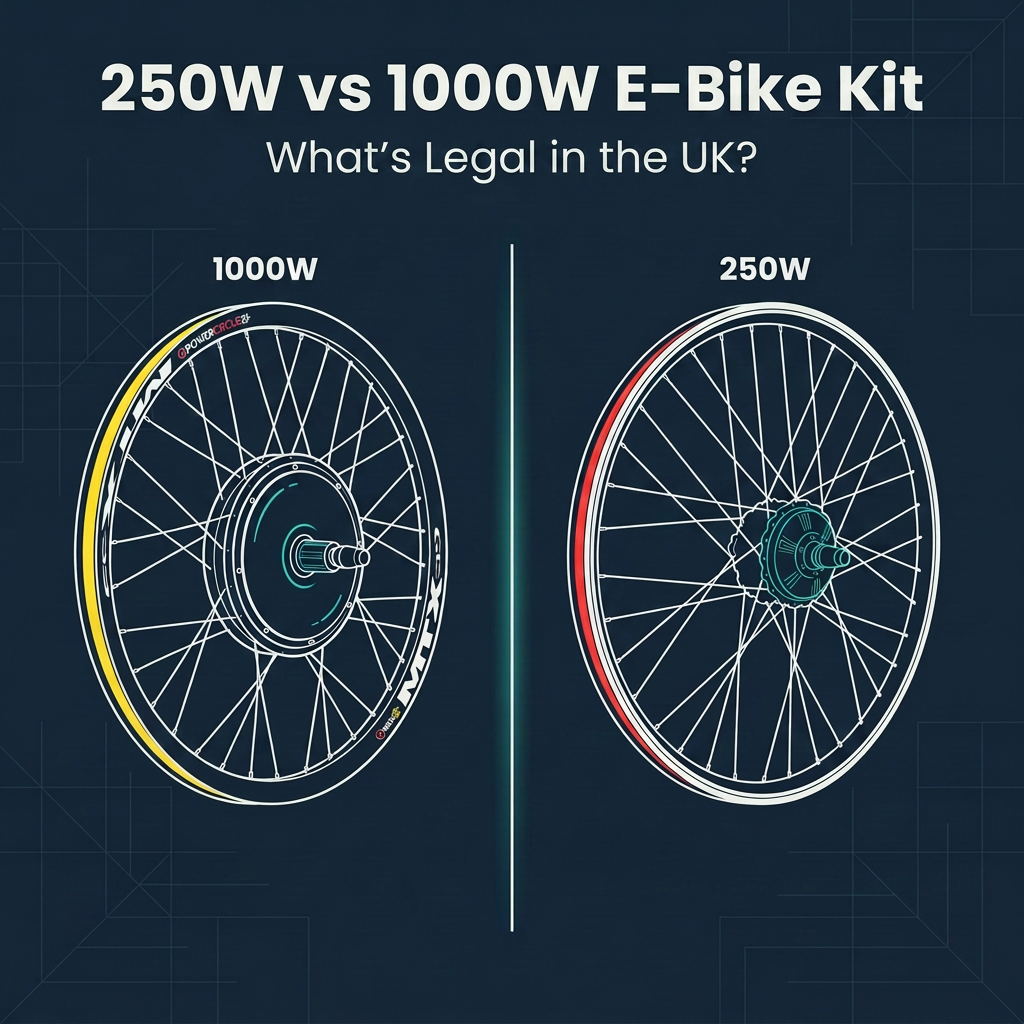
250W vs 1000W E-Bike Kit: What's Legal in the UK? (2026)
KE
KirbEbike Editorial
Reviewed by the KirbEbike conversion-support team
Share
Unlock £10 off today
On this page
Two conversion kits can look identical in a product photo — same hub motor shape, same wiring, same wheel. But in the UK, one can be ridden to work through town like any ordinary bicycle, while the other legally counts as a motor vehicle the moment it touches a public road. The difference comes down to a single number printed on the motor. This plain-English guide explains the 250W road-legal rules, why a 1000W+ kit is off-road only, where each one is allowed to ride, and how to choose the right side of the line before you spend a penny.
Quick answer
In Great Britain, a 250W conversion can qualify as an Electrically Assisted Pedal Cycle (EAPC) — but only when the completed bicycle meets every condition: usable pedals, a maximum continuous motor rating no higher than 250W, and assistance that stops at 15.5 mph. Ride it like a normal bike, with no tax, insurance or licence. A 1000W+ kit is not a standard EAPC — selecting a low assist level or riding slowly does not change its documented rating. Northern Ireland has separate guidance.
The Legal Split, at a Glance
UK law looks past the product photo to the motor’s continuous rating — and that single number decides which world your bike lives in: bicycle or motor vehicle.
One number, two worlds. At 250W continuous or under (with a 15.5 mph cut-off and working pedals) the bike is an EAPC. Above 250W, the law treats it as a motor vehicle — with plates, insurance and helmet requirements.
250W road-legal kit — EAPC
Ridden like a normal bicycle
No registration, tax or insurance
Roads, cycle lanes & bridleways
Rider must be 14 or older
1000W+ off-road kit — motor vehicle
Not a normal bicycle on the road
Needs approval, registration & insurance for road use
No cycle lanes or public paths
Private land only, with permission
The one number that matters
250W or under = bicycle · Above 250W = motor vehicle on the road
Everything flows from maximum continuous rated power (plus the 15.5 mph cut-off and working pedals). A relabelled sticker or a software “road mode” does not rewrite the motor’s rating.
250W vs 1000W+ Kits: Quick Legal Comparison
A road-legal 250W kit is built for commuting, cycle routes, errands and leisure rides on public roads. A 1000W+ kit is aimed at higher-output riding on suitable private land where the owner has given permission.
Feature
250W road-legal kit
1000W+ off-road kit
UK classification
Can qualify as an EAPC
Usually a motor vehicle
Continuous rating
No more than 250W
1000W or higher
Assisted-speed limit
Assistance stops at 15.5 mph
Often assists beyond 15.5 mph
Public-road use
Yes when EAPC rules are met
No — not as a normal bike
Cycle-lane use
Yes (as a bicycle)
No (unregistered vehicle)
Private-land use
Yes, with permission
Yes, with permission
Registration
Not required
Usually required for road use
Motor insurance
Not required
Usually required for road use
Driving licence
Not required
Entitlement may be required
Main use case
Commuting & public routes
Private-land performance
What Makes a 250W Conversion Kit Road-Legal?
A sticker that says “250W” is not enough on its own. The complete converted bicycle has to meet every EAPC condition. Miss one and the bike falls outside the category, however modest the motor.
✅
EAPC checklist — all must be true.
Continuous rating of 250W or less — the sustained output, not a short peak reading
Assistance cuts out at 15.5 mph (25 km/h) — you may pedal or coast faster, but the motor must stop driving you
Working pedals that propel the bike — decorative or footrest pedals don’t count
Pedal-assist, not twist-and-go — a full-speed throttle may need type approval
Rider is at least 14 years old
Required markings shown — power output or motor manufacturer, plus battery voltage or max assisted speed
Continuous power is the legal figure — not peak
The number the law cares about is maximum continuous rated power: the output a motor is designed to sustain in normal use. Peak power is a short burst — a compliant 250W motor may briefly draw 500W to pull away from a standstill without becoming a “500W motor”. It works the other way too: a kit sold and labelled 500W, 750W or 1000W is not brought inside the EAPC category just because you select a lower assist level.
⚠️
Watch the controller, too. A rough electrical-input sum is volts × amps: a 48V pack drawing 20A is about 960W of electrical input. That isn’t the same as a 960W continuous mechanical rating, but a very high-current controller behind a “250W” motor is a red flag. Judge the motor, controller, display and programmed limits as one package.
Why a 48V 250W kit can still be legal
Voltage alone does not decide EAPC status. A 48V battery can run a motor rated at 250W continuous; the higher voltage simply lets the system deliver that power at lower current, often more smoothly. The complete bike must still cut assistance at 15.5 mph and meet the other conditions — but a “48V” label does not make a bicycle illegal by itself.
A road-legal shortcut
Start With a Kit Built for the Limits
If you plan to ride on UK public roads, choose a kit designed around the 250W continuous limit and 15.5 mph cutoff — rather than trying to restrict a higher-powered system later. The EZ Rider Kit is a 250W pedal-assist system with assistance set to cut out at 15.5 mph; the 250W Front Wheel Kit and 36V/48V 250W Kit are lower-cost options designed for the same limits. Confirm throttle configuration, markings, speed settings and the final install before treating any conversion as an EAPC.
A 1000W+ kit sits outside the EAPC category because of its rated power and real-world capability. Fitting pedals or riding gently does not erase the motor’s design rating.
What the law sees
1000W is 4× the 250W EAPC ceiling
Most pair with controllers that assist past 15.5 mph
Many include a full twist or thumb throttle
Capability, not usage, sets the classification
Why “riding carefully” doesn’t help
Low assist mode leaves the rating unchanged
“I’ll never touch the throttle” isn’t a legal fix
A removable limiter is a compliance concern
10 mph on a 1000W motor is still a motor vehicle
An electric cycle that fails the EAPC tests is generally treated as a motor vehicle rather than a bicycle — bringing rules on registration, insurance, licensing, approved construction and protective equipment. Calling the product an “e-bike kit” does not decide its category; the law looks at how the finished vehicle is built and what it can do.
The 1000W+ off-road pick
48V 1000W Ebike Conversion Kit
From £365.25 · waterproof design · rear hub
Four times the EAPC power ceiling — strong reserve on steep private climbs
Waterproof connectors and wiring rated for the current
Pairs with the Smart Controller’s Limit Mode presets
Private land / off-road use with the landowner’s permission
Compatible KirbEbike systems paired with the Smart Controller and Ride Power App may include a hardware Limit Mode. Holding the display’s UP button for two to three seconds switches between preset power, throttle and assistance settings. This can reduce the bike’s output for controlled riding — but it does not change the motor’s continuous rated power or make a high-power system road-legal.
Limit Mode in the Ride Power App. Presets adjust power, throttle and assistance on compatible controllers — useful for controlled riding, but they do not reclassify the motor’s documented rating.
Mode
Throttle
Pedal assist
Use case
Limit 1
250W / 25 km/h
250W / 25 km/h
Reduced-output preset; does not reclassify a >250W motor
Limit 2
Disabled
250W / 25 km/h
Pedal-assist preset; not legal proof for a >250W motor
Read this before you switch. Limit Mode adjusts available power, throttle and assistance settings. It does not change the motor’s documented continuous rating or reclassify a high-power system as an EAPC. Treat a >250W or readily unrestricted build as a private-land or separately approved motor-vehicle system.
Where Can You Ride Each Kit?
A compliant 250W EAPC goes broadly where any bicycle may go. An unregistered 1000W+ conversion is limited to suitable private land — and “off-road” is not the same as “legal to ride here”.
Location
250W EAPC
1000W+ (unregistered)
Public roads
Yes
No
Cycle lanes
Yes
No
Public bridleways / shared paths
Usually
No
Parks, forest trails, open access
Where bikes are allowed
Not automatically
Bike parks / organised venues
Often, per site rules
Only if the venue permits
Private land (with permission)
Yes
Yes
⚠️
“Off-road” is not a legal permission. A forest trail, park path or open-access area is not automatically a lawful place for an unregistered 1000W bike — land managers can prohibit motor vehicles even where bicycles are welcome, and a visitor needs permission covering the specific activity and area. Ready for that kind of riding? Explore the Off-Road Kits range, then confirm your site accepts a converted bike of that power.
What Actually Changes on the Bike?
More watts buy stronger acceleration and more sustained output — but also more battery demand, heat, weight and stress on bicycle parts. A well-matched 250W system still climbs usefully when torque, gearing, wheel size and your own input work together.
4×
The legal power ceiling
15.5 mph
Legal assist cut-off
Nm
Torque decides hills, not W
Wh
Watt-hours decide range
On the bike
250W road-legal
1000W+ off-road
Hill climbing
Useful with the right torque + gearing
Strong reserve on steep private climbs
Acceleration
Gradual; eases off at 15.5 mph
Harder, especially from a stop
Battery drain
Less energy per mile
Can empty a pack quickly at full output
Heat & wiring
Modest in normal road use
Needs connectors and cables rated for the current
Added weight
Compact hub is commuter-friendly
Heavy hub + big battery shifts handling
Frame stress
Close to original bike loads
Dropouts, spokes and brakes all work harder
Read all three dials, not just watts. Torque (Nm) decides how a bike climbs; watt-hours (Wh) decide how far it goes. Wattage alone tells you neither.
💡
Torque, not watts, climbs hills. Compare motors in newton-metres — two 250W motors can feel completely different if one makes more low-speed torque. And range comes from watt-hours: a 48V 20Ah pack holds about 960Wh; a 36V 10Ah pack about 360Wh. Buying more watts is not the only way to climb better.
🔨
Powerful builds need a stronger bike. A frame built for pedal power may not be ready for repeated high-output acceleration. On powerful hub installs a torque arm is essential to stop the axle spinning in the dropout, and hydraulic discs with larger rotors help keep control. Component compatibility and a proper inspection matter more than fitting the biggest motor you can find.
Can a 1000W Kit Be Limited to 250W for the Road?
Reducing a display setting does not automatically turn a 1000W motor into a 250W EAPC. A “road mode” that trims current or top speed can make a bike easier to ride — but if the restriction can be undone through a menu, app, wire or switch, the system’s unrestricted capability still keeps it outside the category. The Department for Transport has warned that a cycle capable of exceeding the limits in another mode is not a compliant EAPC.
🛡️
The safer road-use route. For regular public-road riding, fit a motor whose documented continuous rating is 250W or less, and configure the whole system to cut assistance at 15.5 mph. Replacing a controller or display can reduce current and hide high-power menus, but it doesn’t rewrite the rating stamped on the motor — and detuning several major parts often costs more than starting with a purpose-built road-legal kit.
Can You Register a 1000W+ Conversion for the Road?
Sometimes — but only via the motor-vehicle route, and approval is not guaranteed. A custom conversion can be hard to certify, because a kit sold for many different frames can’t promise that every frame, fork, brake, light and tyre will satisfy vehicle approval.
Step
What it involves
Type approval
Motorcycle Single Vehicle Approval (MSVA) checks braking, lighting, controls, tyres, markings and more — not just wattage
DVLA registration
After approval, register the vehicle and obtain a number plate; missing receipts or unclear identity can stall it
Insurance & tax
Valid motor insurance and the correct vehicle-tax process — bicycle theft cover is not motor insurance
Driving licence
The right entitlement for the vehicle’s class; pedals do not remove this once it’s a motor vehicle
Helmet & construction
An approved motorcycle helmet and compliant lighting, brakes and tyres for the registered category
For most riders a compliant 250W EAPC is simply the easier choice. Treat registration as a vehicle-building project, not a quick paperwork step.
The Risks of Riding a 1000W+ Kit on the Road
An unregistered 1000W+ conversion can expose the rider to several motor-vehicle offences. Enforcement isn’t limited to big cities — police and councils have run local operations targeting illegally modified e-bikes.
What can trigger a stop
Unusually fast riding or throttle-only use
An obviously oversized motor
Riding dangerously or antisocially
Roadside inspection of label & controls
What it can cost
Fixed penalty or prosecution for no insurance
Licence points — now or in future
Seizure, plus recovery & storage charges
Personal liability after a collision
🚫
No licence? Extra risk. If the vehicle is treated as a moped or motorcycle and the rider lacks the correct licence, that can be a separate offence — pedals do not prevent motor-vehicle classification. Age and licence requirements vary by category, so check the applicable route before any high-power build is used beyond permitted private land.
Not sure which side of the line you need?
Match the Kit to Where You Actually Ride
Road-legal 250W systems for public roads and cycle routes; high-power kits for permitted private land. Battery-inclusive bundles with UK support.
Choose the kit based on where you plan to ride, then compare power, fitting requirements and legal conditions. A 250W-rated system can qualify as an EAPC when the completed bicycle meets every applicable requirement; high-power kits and systems with an unrestricted mode should be treated as private-land or off-road options unless the completed vehicle follows the registration and approval route.
* High-power and readily unrestricted systems should be treated as private-land or separately approved motor-vehicle builds. Limit Mode changes riding settings but does not alter the motor’s documented continuous rating or legal classification.
How to Choose — a Quick Decision Checklist
Start with where the bike will be ridden, then work down. The legal category comes before the power level — never buy a 1000W kit planning to “solve the law later”.
📋
Before you buy, confirm:
Where you’ll ride 90% of the time — public roads point to 250W; confirmed private land opens up higher power
The motor’s continuous rating in writing — not the number in the product title
A real 15.5 mph assist cut-off and working pedal-assist, if it’s for the road
No hidden unrestricted road mode that would void EAPC status
Battery matches motor + controller — the BMS must supply the controller’s current without cutting out
Frame, fork, dropout & brakes suit the power — add torque arms where needed and have the build checked
For high power: your riding site permits it — get the landowner’s permission for the specific activity
Frequently Asked Questions
Are 1000W e-bikes legal in the UK?
Not as a standard EAPC on public roads — a 1000W continuous rating is four times the 250W limit, so the bike is treated as a motor vehicle. It’s legal on the road only after type approval, DVLA registration, tax, insurance, the right licence and an approved helmet. Unregistered, it’s for private land with permission. Selecting a low assist level or staying under 15.5 mph doesn’t change the classification.
Is a 250W e-bike legal in the UK?
Yes, when the whole bike meets every EAPC rule: assistance stops at 15.5 mph, the pedals can propel it, the rider is 14+, and the markings and pedal-assist conditions are met. A compliant EAPC needs no registration, tax, insurance or licence. Before buying, confirm “250W” means maximum continuous rated power and that no unrestricted road mode is built in.
Can I ride a 500W e-bike in the UK?
Not as an ordinary EAPC — 500W exceeds the 250W ceiling, so on public roads it may be treated as a motor vehicle even with pedals. The 2024 government consultation discussed a possible 500W limit, but a proposal is not the current law. Use a 500W kit only where it’s permitted, such as suitable private land.
Is a 48V 250W e-bike legal?
It can be — voltage isn’t the main test. The motor must have a maximum continuous rating of 250W or less, and the system must still cut assistance at 15.5 mph and meet the pedal, age, marking and throttle rules. Problems arise when “250W” is only a restricted mode on a motor actually rated much higher.
How fast can a 250W e-bike go without a limiter?
Without the required cut-off it may keep assisting past 15.5 mph — which means it no longer meets EAPC rules. Actual top speed depends on gearing, voltage, controller current, wheel size, rider weight and terrain; the 250W rating doesn’t set a fixed maximum. For road use, keep the factory 15.5 mph cut-off active — you may still pedal or coast faster under your own power.
Is a 750W electric bike legal in the UK?
Not as a normal EAPC — 750W is three times the ceiling, so it may be treated as a moped or motorcycle with all the registration, insurance and licensing that implies. A software setting that lowers the displayed power doesn’t change the motor’s rated capability. Private-land use may be possible with permission; public trails and parks are not automatically legal.
Do police care about illegal e-bikes in the UK?
Yes — forces do act on illegally modified and high-power e-bikes, especially when ridden dangerously or without insurance. They can inspect the motor, throttle and speed capability, report riders for offences, and seize a bike used without proper cover or a suitable licence. Recent local operations have reported fines, seizures and the destruction of illegally upgraded e-bikes.
How fast is a 1000W e-bike in mph?
Often around 25–35 mph, but there’s no single figure — voltage, controller current, wheel size, motor winding, rider weight, aerodynamics and terrain all matter, and product speed claims are usually measured in ideal conditions. On UK roads the key point is that a 1000W motor exceeds the 250W limit and usually assists beyond 15.5 mph, so treat it as a private-land setup unless it has completed the full motor-vehicle route.
The Bottom Line
6 key points
Start with where you’ll ride. A properly configured 250W conversion can be a road-legal EAPC — working pedals, a 250W continuous rating and assistance that stops at 15.5 mph let riders aged 14+ use roads and cycle paths with no registration, tax, insurance or licence. Focus on torque, battery capacity, gearing, brakes and a clean install rather than the biggest wattage number.
A 1000W+ kit delivers stronger acceleration and more power for steep terrain, but it isn’t a standard road-legal bicycle. Without motorcycle approval, registration, insurance, the correct licence and required safety kit, ride it only on suitable private land with permission. A low-power mode or a gentle right hand doesn’t change the motor’s rating or its legal class — Limit Mode can provide lower-output presets on compatible systems, but a high-power build remains a private-land or separately approved motor-vehicle system.
Pick Your Side of the Line
Road-legal 250W kits for everyday riding — or high-power systems for permitted private land. Both with batteries, app support and UK service.
Compliance note. This guide is general information on Great Britain’s EAPC rules, not legal advice, and rules can change. Any kit above 250W or 15.5 mph is off-road / private-land only unless it has completed full motor-vehicle approval and registration. Always confirm the current law and your riding location’s rules before you ride — see the official GOV.UK guidance linked in Sources.
DfT — Proposed changes to EAPC legislation: consultation outcome. gov.uk
About this guide. Author: KirbEbike Editorial. Last reviewed: July 2026. Methodology: legal statements cross-checked against the GOV.UK, Department for Transport and legislation.gov.uk sources cited above; product specifications and prices checked on live KirbEbike product pages in July 2026. This is general information for Great Britain, not legal advice — EAPC rules can change and Northern Ireland has separate guidance. Always confirm the current law and your completed bike’s configuration before riding.
Stay in the know
Conversion guides, fitting advice and the deals worth knowing about. No spam.