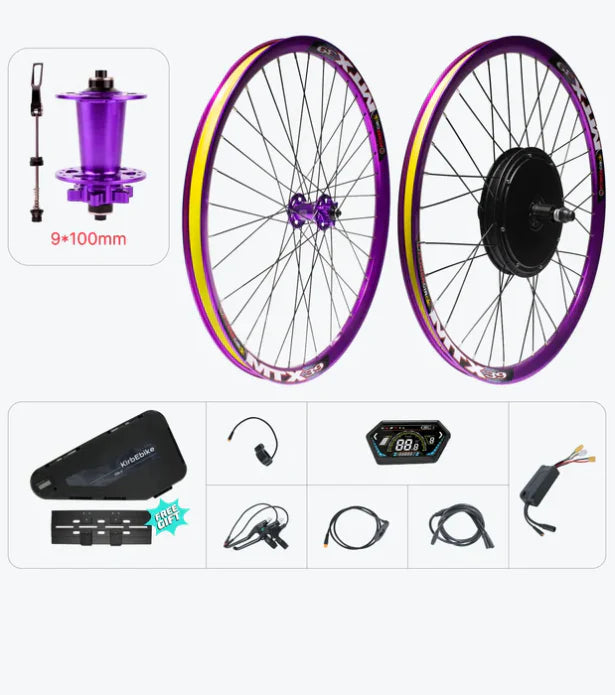
E-bike motor wattage directly determines speed capability and acceleration responsiveness—250W delivers 25-35 km/h adequate gentle assistance flat terrain legal compliance, 500-750W achieves 35-45 km/h confident all-around performance mixed conditions.
1000W reaches 45-50 km/h serious capability hills and heavy riders, while 2000-4000W attains 50-85+ km/h extreme performance private property applications—but actual speed depends on complex interaction between motor power, rider weight, terrain gradient, wind resistance, tire rolling resistance, voltage system (36V, 48V, 52V, 60V, 72V affecting RPM ceiling), and controller programming making wattage primary but not sole speed determinant.
Understanding what choosing the best ebike kit motor power delivers requires examining physics fundamentals, real-world Kirbebike performance data across power levels, voltage-wattage interaction, diminishing returns higher power, and honest expectations matched to terrain, rider characteristics, and legal compliance rather than simplified "more watts = proportionally faster" assumptions disconnected from physics reality and practical cycling experience.
Understanding Motor Wattage Fundamentals

What Wattage Actually Measures
Power Output Definition:
Watts measure motor electrical power conversion to mechanical force:
Basic Physics:
-
1 Watt = 1 Joule/second (energy transfer rate)
-
Higher wattage = more power (force × velocity)
-
Speed relationship: Power enables overcoming resistance
-
Acceleration: Power determines rate of speed increase
-
Hill climbing: Power fights gravity (weight × gradient)
Common Misconception:
"Doubling watts doubles speed" — FALSE
Reality: Speed increases follow diminishing returns:
- 250W → 500W: Significant speed gain (30-50% faster)
- 500W → 1000W: Moderate speed gain (20-30% faster)
- 1000W → 2000W: Modest speed gain (15-25% faster)
- 2000W → 4000W: Small speed gain (10-15% faster)
Why Diminishing Returns:
Wind resistance increases exponentially with speed:
-
Low speeds (20 km/h): Resistance minimal (most power accelerates)
-
Medium speeds (30-40 km/h): Resistance moderate (half power fights wind)
-
High speeds (50+ km/h): Resistance dominant (most power fights wind)
-
Very high (70+ km/h): Resistance extreme (marginal speed gains)
250W Motors: Legal Gentle Assistance

36V 250W Front Hub Motor:
Designed UK/EU legal compliance and gentle urban assistance:
Specifications:
- Power: 250W rated continuous
- Voltage: 36V system
- Speed capability: 25-30 km/h
- Motor weight: 2.7kg
- Application: Legal compliance, flat urban
Real-World Speed Performance:
Flat Terrain (0% Grade):
-
70kg rider: 28-30 km/h comfortable cruising
-
85kg rider: 25-28 km/h sustained
-
100kg rider: 23-26 km/h (marginal power)
Gentle Hills (3-5% Grade):
-
70kg rider: 20-23 km/h (adequate)
-
85kg rider: 18-22 km/h (slowing noticeable)
-
100kg rider: 15-18 km/h (struggling)
Moderate Hills (8-10% Grade):
-
70kg rider: 12-15 km/h (hard pedaling required)
-
85kg rider: 10-13 km/h (significant effort)
-
100kg rider: 8-11 km/h (inadequate power)
Who 250W Serves:
✓ Legal compliance priority (UK/EU road legal) ✓ Flat urban commuting (under 5% typical grades) ✓ Lightweight riders (under 80kg) ✓ Gentle assistance expectation (not primary propulsion) ✓ Short distances (5-15km daily)
500-750W Motors: All-Around Sweet Spot
500-750W SHENGYI Geared Rear Hub:
Most popular power range delivering versatile capability:
Specifications:
- Power: 500W or 750W selectable
- Voltage: 36V or 48V options
- Speed capability: 35-45 km/h
- Motor weight: 4.5kg
- Brand: SHENGYI (proven reliability)
- Application: All-around versatility
Real-World Speed Performance:
500W 48V System:
Flat Terrain (0% Grade):
-
70kg rider: 35-38 km/h comfortable sustained
-
85kg rider: 33-36 km/h good performance
-
100kg rider: 30-34 km/h adequate
Moderate Hills (8-10% Grade):
-
70kg rider: 22-26 km/h confident climbing
-
85kg rider: 20-24 km/h good capability
-
100kg rider: 18-22 km/h adequate (not struggling)
Steep Hills (12-15% Grade):
-
70kg rider: 15-18 km/h manageable
-
85kg rider: 13-16 km/h slower but adequate
-
100kg rider: 11-14 km/h marginal
750W 48V System:
Flat Terrain (0% Grade):
-
70kg rider: 38-42 km/h strong performance
-
85kg rider: 36-40 km/h confident
-
100kg rider: 34-38 km/h good capability
Moderate Hills (8-10% Grade):
-
70kg rider: 26-30 km/h excellent climbing
-
85kg rider: 24-28 km/h confident capability
-
100kg rider: 22-26 km/h adequate power
Steep Hills (12-15% Grade):
-
70kg rider: 18-22 km/h good capability
-
85kg rider: 16-20 km/h confident climbing
-
100kg rider: 14-18 km/h adequate (not struggling)
Who 500-750W Serves:
✓ Mixed terrain (flat plus 8-15% hills regular) ✓ All-around cycling (commuting, recreation, errands) ✓ Average riders (70-95kg) ✓ Moderate distances (10-30km daily) ✓ Best value-performance balance
1000W Motors: Performance Focus

48V 1000W Direct-Drive Rear Hub:
Serious capability for demanding applications:
Specifications:
- Power: 1000W rated continuous
- Voltage: 48V system
- Speed capability: 45-50 km/h
- Motor weight: 4-6.2kg
- Type: Direct-drive (robust)
- Application: Performance, heavy riders
Real-World Speed Performance:
Flat Terrain (0% Grade):
-
70kg rider: 45-48 km/h strong capability
-
85kg rider: 43-46 km/h confident performance
-
100kg rider: 40-44 km/h good power
-
115kg rider: 38-42 km/h adequate
Moderate Hills (8-10% Grade):
-
70kg rider: 30-34 km/h excellent climbing
-
85kg rider: 28-32 km/h confident capability
-
100kg rider: 26-30 km/h good performance
-
115kg rider: 24-28 km/h adequate power
Steep Hills (15-18% Grade):
-
70kg rider: 20-24 km/h very good capability
-
85kg rider: 18-22 km/h confident climbing
-
100kg rider: 16-20 km/h adequate performance
-
115kg rider: 14-18 km/h manageable
Who 1000W Serves:
✓ Regular steep hills (12-20% sustained grades) ✓ Heavy riders (90-115kg) ✓ Cargo applications (significant loads) ✓ Performance priority (speed capability) ✓ Power reserves (comfortable margin)
|
Motor Power
|
Voltage
|
Flat Speed (85kg Rider)
|
10% Hill Speed (85kg)
|
15% Hill Speed (85kg)
|
Best Application
|
|
250W
|
36V
|
25-28 km/h
|
18-22 km/h
|
10-13 km/h
|
Legal compliance, flat urban
|
|
500W
|
48V
|
33-36 km/h
|
20-24 km/h
|
13-16 km/h
|
All-around mixed terrain
|
|
750W
|
48V
|
36-40 km/h
|
24-28 km/h
|
16-20 km/h
|
Hills, versatility, performance
|
|
1000W
|
48V
|
43-46 km/h
|
28-32 km/h
|
18-22 km/h
|
Serious hills, heavy riders
|
|
2000W
|
52V
|
52-57 km/h
|
35-40 km/h
|
26-30 km/h
|
Steep terrain, performance
|
|
3000W
|
60V
|
75-80 km/h
|
45-50 km/h
|
35-40 km/h
|
Extreme capability
|
|
4000W
|
72V
|
75-85+ km/h
|
50-55 km/h
|
40-45 km/h
|
Maximum power
|
Factors Beyond Wattage Affecting Speed
Rider Weight Impact
Physics Reality:
Heavier riders require more power achieving same speed:
Weight Comparison (500W Motor, Flat):
-
60kg rider: 38-40 km/h
-
70kg rider: 35-38 km/h
-
85kg rider: 33-36 km/h
-
100kg rider: 30-34 km/h
-
115kg rider: 28-32 km/h
Each 15kg Weight Addition: Approximately 2-4 km/h speed reduction (same motor power)
Terrain Gradient Dominance
Hill Climbing Power Demands:
Gravity dramatically increases power requirements:
Power Needed (85kg Rider + 15kg Bike = 100kg Total):
Flat (0%): ~200W maintaining 30 km/h 5% Grade: ~450W maintaining 30 km/h 10% Grade: ~850W maintaining 30 km/h 15% Grade: ~1300W maintaining 30 km/h
Reality:
500W motor maintains 30 km/h flat, but only 20-24 km/h on 10% grade (power insufficient fighting gravity)
Wind Resistance Exponential Increase
Speed-Resistance Relationship:
Wind resistance increases square of speed:
Resistance Power Requirements (85kg Rider):
-
20 km/h: ~50W fighting wind
-
30 km/h: ~150W fighting wind
-
40 km/h: ~350W fighting wind
-
50 km/h: ~650W fighting wind
-
60 km/h: ~1100W fighting wind
Why High-Power Motors Don't Double Speed:
Most power fights wind resistance, not accelerating bicycle
Tire and Rolling Resistance
Rolling Resistance Factors:
- Tire pressure (lower = higher resistance, slower)
- Tire width (wider = higher resistance generally)
- Tire compound (softer = grippy but slower)
- Surface (smooth pavement vs rough road vs gravel)
Impact: 2-5 km/h speed difference (optimized vs poor tire choice)
Legal Speed Limits vs Motor Capability
Compliance Programming
Legal Limits Recap:
-
UK/EU: 25 km/h motor assistance maximum (250W)
-
US Federal: 32 km/h (20 mph) Class 1/2, or 45 km/h (28 mph) Class 3 (750W ceiling)
Motor Capability vs Legal Configuration:
500W Motor:
- Capable: 35-40 km/h unrestricted
- Legal (UK): 25 km/h programmed limit
- Legal (US): 32 km/h (20 mph) or 45 km/h (28 mph) depending on class
1000W Motor:
- Capable: 45-50 km/h unrestricted
- Legal (UK): Illegal public roads (250W ceiling exceeded)
- Legal (US): Illegal (750W ceiling exceeded), private property only
User Responsibility:
Rider configures legal compliance through controller programming—capability doesn't determine legality, configuration and use do.
Making Power-Speed Decisions
Matching Power to Needs
Decision Framework:
Choose 250W When: ✓ Legal compliance mandatory (UK/EU road legal) ✓ Flat terrain only (under 5% typical grades) ✓ Lightweight riders (under 80kg) ✓ Gentle assistance adequate (not primary propulsion) ✓ Short urban commutes (5-15km)
Choose 500-750W When: ✓ Mixed terrain (flat plus 8-15% hills) ✓ All-around cycling (versatility priority) ✓ Average riders (70-95kg) ✓ Moderate distances (10-30km daily) ✓ Best value-performance balance
Choose 1000W When: ✓ Regular steep hills (12-20% sustained) ✓ Heavy riders (90-115kg) ✓ Cargo applications (significant loads) ✓ Performance focus (speed capability) ✓ Accept legal ambiguity (private property technically)
Choose 2000W+ When: ✓ Very heavy riders (110kg+) ✓ Extreme hills (20%+ sustained) ✓ Maximum capability priority ✓ Private property use only (legal compliance)
Realistic Expectations
What Higher Power Delivers:
✓ Better acceleration: Dramatic improvement low speeds ✓ Hill climbing: Maintains higher speeds grades ✓ Heavy rider performance: Adequate power proportional weight ✓ Headwind capability: Overcomes resistance better ✓ Cargo capacity: Handles loads without struggle
What Higher Power Doesn't Deliver:
✗ Proportional top speed: Diminishing returns (wind resistance) ✗ Unlimited range: Higher consumption (physics unavoidable) ✗ Legal compliance: Higher power often exceeds limits ✗ Lighter weight: More powerful motors heavier ✗ Lower cost: Capability premium (battery, motor, controller)
Conclusion
Motor wattage fundamentally determines e-bike speed capability and acceleration responsiveness—250W delivers 25-35 km/h adequate gentle assistance flat urban applications legal compliance, 500-750W achieves 35-45 km/h versatile all-around performance serving 80% of riders excellently mixed terrain, 1000W reaches 45-50 km/h serious capability heavy riders and steep hills.
Ready to select optimal motor power for your cycling needs? Explore the complete electric bike kit battery range including 250W legal-compliant systems (UK/EU road legal, gentle urban assistance), 500-750W all-around capability (mixed terrain excellence, best value), 1000W performance options (serious capability, heavy riders).
2000W+ extreme power (specialized applications, private property), and expert guidance ensuring your conversion delivers appropriate speed, acceleration, and hill climbing capability through motor wattage matched to terrain realities, rider weight, legal compliance requirements, and performance expectations grounded in physics rather than marketing hyperbole.
Frequently Asked Questions
How much faster is 1000W compared to 500W e-bike motor?
Real-world approximately 25-35% faster flat terrain: 500W achieves 33-36 km/h while 1000W reaches 43-46 km/h (85kg rider)—not double speed despite double power due to exponential wind resistance increase consuming additional watts.
Does doubling motor wattage double e-bike speed?
No—speed increases follow diminishing returns due to exponential wind resistance: 250W → 500W increases speed ~30% (not 100%), 500W → 1000W increases ~25%, 1000W → 2000W increases ~20%, 2000W → 4000W increases ~15%.
What motor wattage do I need for hills?
Depends on gradient and rider weight: gentle hills (5-8%) and average riders (70-90kg) adequate 500W, moderate hills (8-12%) and/or heavy riders (90-105kg) need 750-1000W.
How does rider weight affect e-bike motor speed?
Significantly—each additional 15kg reduces top speed approximately 2-4 km/h (same motor power) because heavier mass requires more force accelerating and climbing.
What's the fastest legal e-bike motor wattage?
UK/EU: 250W maximum maintaining bicycle classification (25 km/h assisted speed limit). US Federal: 750W maximum for Class 1/2 (20 mph) or Class 3 (28 mph).