Spend £300, Save £40

Winkelwagen

Je winkelwagen is leeg

Best 72V 20Ah vs 30Ah Battery: Range, Weight & Performance Comparison
72v Battery14 jul. 202617 min read

Best 72V 20Ah vs 30Ah Battery: Range, Weight & Performance Comparison

Ontvang vandaag nog €10 korting

kirbEbike10

Copy successful
{{SEO_TITLE}} | KirbEbike
The short answer

For most riders a 72V 20Ah pack is the lighter, easier-fitting choice — about 1,440Wh of energy and a nimbler bike. A 72V 30Ah pack stores roughly 2,160Wh — around 50% more energy — so it suits longer rides, heavier bikes and demanding builds, at the cost of extra weight, size and price. Higher Ah does not make the bike faster; it mainly buys range and lets the system hold power for longer.

⚠️
UK legal note. Both are high-power, off-road / private-land setups — neither is a road-legal EAPC in the UK, where the limit is 250W and 15.5 mph. A one-button limit mode can cap power for the road, but software limiting alone does not reclassify a high-power build as road-legal — EAPC status also depends on continuous rated motor power, the 15.5 mph assist cut-off, pedals and required markings.
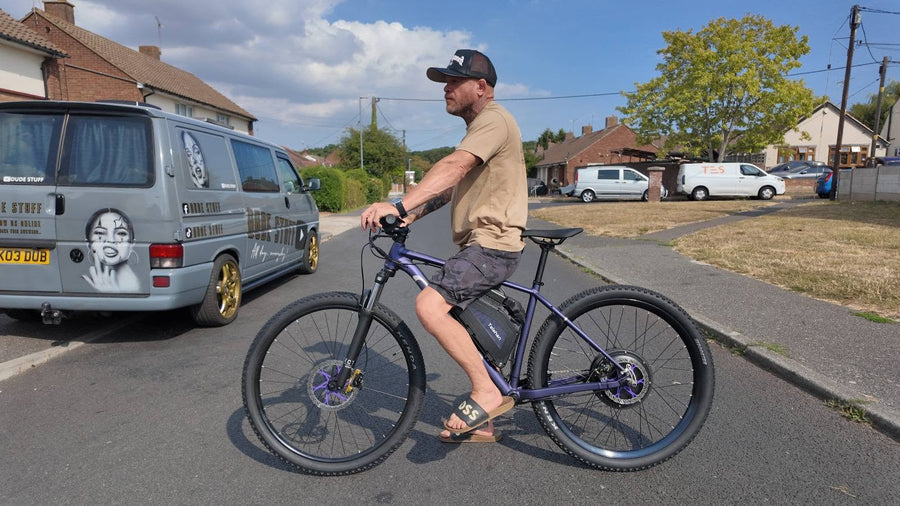
A 72V hub-motor conversion on a hardtail MTB with an HS-II triangle battery in the frame
A real 72V conversion. A rear hub motor paired with an HS-II triangle pack mounted low in the main frame — the high-power, off-road setup this guide is about.

72V 20Ah vs 30Ah Quick Comparison Calculator

Before the detail, here is the whole decision in one view. Read it as “same 72V, two different amp-hour tanks.” The number that actually matters for range is watt-hours (Wh) — and Wh comes straight from volts multiplied by amp-hours.

Specification 72V 20Ah Battery 72V 30Ah Battery
Voltage 72V 72V
Capacity 20Ah 30Ah
Energy storage ≈1,440Wh ≈2,160Wh
Range potential Lower ~50% more energy on board
Weight Lighter Heavier
Charging time Shorter (same charger) Longer (same charger)
Frame space needed Easier fit Needs more room
Best for Balanced, lighter builds Long-distance / high-power builds

Figures are nominal, before real-world losses. Actual range depends on the motor, controller current, rider weight, terrain and how hard you ride.

🧮
The maths, shown: watt-hours = volts × amp-hours. 72V × 20Ah = 1,440Wh (the 20Ah tank); 72V × 30Ah = 2,160Wh (the 30Ah tank). The 30Ah pack stores 720Wh more energy at the same voltage — that is the entire difference. Range, weight and charge time all follow from those two numbers.

What Does 30Ah Mean on a 72V Ebike Battery?

Amp-hours (Ah) refer to the capacity of a battery — in other words, the size of the fuel tank. A 30Ah pack holds more charge than a 20Ah pack at the same voltage, so it can be ridden longer before it needs recharging. By itself, however, the Ah figure only describes half the picture, since it does not account for voltage.

Amp Hours vs Watt Hours: What Actually Determines Range?

Range is determined by energy, not amp-hours. Watt-hours fold voltage into the number and let you compare packs of different voltages. That distinction matters more than most spec sheets admit:

  • Amp-hours (Ah) indicate charge capacity — helpful, but only at a specific voltage.
  • Watt-hours (Wh) measure the energy used (volts × Ah) — the real energy you spend as you ride.
  • A 72V 30Ah pack (≈2,160Wh) holds about 50% more energy than a 72V 20Ah pack (≈1,440Wh), at the same nominal voltage.

More stored energy means longer rides between charges, fewer charging stops on a big day and shallower discharge cycles (gentler on the cells over time). What it does not do is raise top speed, which is set by voltage, controller current, motor and wheel size — not amp-hours. There is no universal mileage figure, so treat any “X miles” claim as a ballpark to verify against your own build.

72V 20Ah vs 30Ah Battery Range Comparison

There are only two things that set range: energy on board (Wh) and how quickly you use it (Wh per km). A fast, fat-tyre or hilly build might use 20–35+ Wh/km, and much less on an efficient road-style build. The charts below turn each pack size into practical distance bands using representative consumption figures.

1,440Wh
72V 20Ah energy on board
2,160Wh
72V 30Ah energy on board
+50%
Extra energy at 30Ah

Estimated Range From a 72V 20Ah Battery

With roughly 1,440Wh available, a 20Ah pack suits shorter high-power rides, weekend trail sessions and riders who want to keep weight down. Using common off-road consumption bands, a realistic spread looks like this:

Estimated range — 72V 20Ah (≈1,440Wh)
Nominal distance = watt-hours ÷ consumption. Real range shifts with power, weight and terrain.
Eco / mixed
~70 km
Spirited / hilly
~48 km
Eco / mixed (20 Wh/km)Spirited / hilly (30 Wh/km)

The usual factors move these numbers: throttle use, sustained speed, gradients, tyre size and pressure, and rider or cargo weight. Ride lightly on pedal-assist and you will beat the eco figure; throttle up every hill and you will miss it.

⚠️
Read every range with its assumptions. The figures above are calculator estimates (watt-hours ÷ consumption), not full-power promises. Real range on a 72V build swings with controller current, motor power, rider and cargo weight, terrain, wheel and tyre size, and throttle vs pedal-assist. Ridden hard at full power, a 20Ah pack returns far less than the eco band.
💡
High-load scenario — 72V 20Ah on a 4000W kit. KirbEbike quotes a 30–40 km range for its 72V 20Ah pack on the 4000W kit — the same ≈1,440Wh tank, but a much higher-draw motor. That is the honest full-power end of the spread: a hard-ridden 4000W build empties the pack far faster than a 20 Wh/km eco estimate. (Assumptions: 4000W motor, 60A controller, off-road, mixed throttle and PAS. Source: live 72V 4000W kit page, verified July 2026.)

Estimated Range From a 72V 30Ah Battery

At about 2,160Wh, a 30Ah pack is built for longer days, higher-power motors, heavier bikes and riders who want a bigger buffer before charging. The same consumption bands stretch further:

Estimated range — 72V 30Ah (≈2,160Wh)
Same consumption bands, more energy on board (shown on the same scale as the 20Ah chart).
Eco / mixed
~108 km
Spirited / hilly
~72 km
Eco / mixed (20 Wh/km)Spirited / hilly (30 Wh/km)
💡
Worth stressing: a 30Ah pack does not make the bike quicker. Riders often spend the extra energy on higher speed and harder acceleration, which burns watt-hours faster — so a 30Ah build ridden hard can deliver similar real-world range to a 20Ah build ridden gently. The extra capacity buys the ability to sustain power for longer, not a higher ceiling.

72V 20Ah vs 30Ah Battery Weight Difference

Capacity is not free. More energy means more cells, and more cells mean more mass and bulk. That trade-off shapes how the finished bike handles, how easy it is to lift, and whether the pack even fits your frame.

Why a Larger Battery Weighs More

A 30Ah pack needs more cells in parallel than a 20Ah pack of the same voltage, and each cell adds weight, volume and cost. For reference, KirbEbike’s verified 72V 20Ah triangle pack weighs around 6.8–7.2 kg depending on series; a 30Ah pack of the same voltage sits meaningfully heavier again. Triangle-format packs help by carrying that mass low and centred in the frame, which keeps handling stable — but you will still feel the difference lifting the bike into a car or up a flight of stairs.

When a Lighter 72V 20Ah Battery Makes More Sense

  • You transport the bike often — into a car boot, onto a rack, up to a flat.
  • You run a smaller frame with limited triangle space.
  • Your rides are shorter and 1,440Wh comfortably covers them.
  • You value agility and a nimble feel over maximum range.

When the Extra Weight of a 72V 30Ah Battery Is Worth It

  • You ride long distances and want to charge less often.
  • You run a high-power conversion that draws hard and benefits from a bigger reserve.
  • Your bike is heavy — fat-tyre, cargo or e-moto style builds.
  • Range buffer matters more to you than saving a couple of kilos.

BMS Rating: Why It Matters More Than Battery Size Alone

Capacity decides how far you can go; the Battery Management System (BMS) decides how hard the pack can be pushed while you get there. On a high-power 72V build, the BMS is often the real performance limit — a huge 30Ah pack with an underrated BMS can still cut out under load, while a well-matched 20Ah pack keeps delivering.

How the BMS Controls Power Delivery

The BMS is the pack’s built-in safety and management board. It handles the jobs that keep a high-voltage battery safe and consistent:

  • Over-current protection — caps how much current the pack will deliver.
  • Over-charge and over-discharge protection — keeps cells inside safe voltage limits.
  • Cell balancing — keeps individual cells in step for longer pack life.
  • Temperature protection — steps in if the pack runs too hot.

Matching BMS Current With Your Motor and Controller

The rule is simple and non-negotiable: the BMS continuous discharge rating must meet or exceed the controller’s current draw. If a controller can pull 60A but the BMS is rated below that, the pack will sag, trip its protection or cut out — problems that get wrongly blamed on the motor. Match the BMS rating to your controller’s actual current draw, not to a headline wattage, and pick a BMS with margin to spare.

Controller draw Minimum BMS (continuous) Notes
~40–45A ≥ 45A Typical 1500–2000W builds
~50–60A ≥ 60A 3000W-class builds — a 60A BMS fits here
~80A+ ≥ 80A Demanding custom builds — pack must be built for it

Frame Fit and Installation: Will a 72V 30Ah Battery Fit?

Fit anxiety — “will it actually go in my frame?” — drives more battery returns than any other single issue. A 30Ah pack is physically larger than a 20Ah pack, so the answer comes down to measuring your frame triangle before you order, not after.

Measuring Your Frame Triangle Before Buying

Take a tape measure to the inside of your main triangle and note the following before checkout. Compare each figure against the pack’s published dimensions — and remember bottle-cage bolts and cable runs eat into usable space:

  • Top tube length (inner)
  • Seat tube clearance / height
  • Down tube space and any bottle bosses
  • Cable and hose routing that crosses the triangle
  • Available mounting points for the bracket
📏
Frame-measuring checklist — measure before you order.
  • Available frame space — usable length, height and depth inside the triangle
  • Mounting-hole position — do the bracket bolts line up with your bottle bosses?
  • Insertion & removal clearance — room to slide the pack in and lift it out
  • Shock / suspension clearance — full-suspension frames lose triangle space as the shock moves
  • Crank & pedal clearance — the pack must not foul the cranks or your heels
  • Cable & hose routing — gear, brake and dropper lines that cross the triangle

Triangle Battery vs Other Mounting Options

Triangle packs sit inside the main frame, which is why they are the default for high-power builds. Compared with rack or seatpost packs, a triangle pack gives you:

  • A lower centre of gravity for more stable handling
  • Better weight distribution, front to back
  • A cleaner, more integrated-looking conversion
A fat-tyre e-moto style bike with a KirbEbike triangle battery strapped in the frame
Triangle pack, installed. A frame-fit triangle battery keeps the mass low and centred — here on a fat-tyre e-moto build.

Whichever pack you choose, always check the actual battery dimensions and weight against your measurements before ordering — a dimensioned drawing plus real installed photos is the fastest way to remove the doubt.

Taishan 72V pack dimensions 386.2 x 97 x 157.4 mm
Taishan 72V 20Ah. 386.2 × 97 × 157.4 mm — the compact, slim-case option, with charger and mount included.
HS-II 72V pack dimensions with callouts
HS-II 72V 20Ah. 360.6 / 281.3 / 195.4 / 131.6 mm — a deeper triangle that needs more frame room.
⚠️
Check each outline separately — the two packs are not the same size. The two 72V series have different footprints, so measure against the one you are actually buying. The HS-II triangle pack needs more frame room than the compact Taishan:
Taishan 72V 20Ah — 386.2 × 97 × 157.4 mm (a long, slim 97 mm-wide case; the compact option for tighter triangles).
HS-II 72V 20Ah — 360.6 / 281.3 / 195.4 / 131.6 mm (a shorter but deeper triangle profile that needs more room — confirm it fits before ordering).

Charging Time Comparison: 72V 20Ah vs 30Ah

With the same charger, a bigger tank takes longer to fill — there is simply more energy to put back. A 20Ah pack finishes sooner; a 30Ah pack, holding 50% more energy, takes proportionally longer. Charge time is a function of three things: charger output (amps), the pack’s starting state of charge, and how full you top it to.

Factor 72V 20Ah 72V 30Ah
Energy to replace ~1,440Wh ~2,160Wh
Relative charge time (same charger) Shorter Longer
Benefit of a faster charger Useful More useful — offsets the bigger tank

Which 72V Battery Should You Choose?

If you already know your priorities, here is the decision in short. Neither pack is “better” in the abstract — the right one matches your motor, controller, frame space, riding style and expected range.

Choose a 72V 20Ah Battery If You Want:

  • Lower weight and easier handling
  • Simpler installation in tighter frames
  • A lower upfront cost
  • Enough range for shorter rides
  • A more compact build

Choose a 72V 30Ah Battery If You Want:

  • Maximum range potential from a single pack
  • Longer off-road or trail sessions
  • More energy reserve before charging
  • Less frequent charging on big days
  • Better support for demanding, high-draw builds

72V Battery Recommendation by Rider Type

Rider type Suggested pack Why
Practical builder 72V 20Ah Balanced performance and easier installation
Performance rider 72V 30Ah More reserve for sustained high-power riding
Long-distance rider 72V 30Ah / dual Maximum range, or two packs for all-day range

Recommended 72V Battery Options for High-Power Builds

Below is a comparison of UK-facing 72V triangle packs, checked live in July 2026. The aim is to help you choose on the things that matter — cell type, BMS current, warranty, fit and support — rather than to crown one brand “best”. KirbEbike is one option among several and is listed on merit; the alternatives are named, priced and linked so you can compare directly. Prices and stock change, so confirm on each seller’s own page before buying.

A note on reading the table: most of these are 72V 20Ah packs, with genuine 30Ah listings from E-Bike Power UK and coreebikes.co.uk. Discharge figures are the BMS continuous / peak ratings, which matter more than capacity for feeding a high-power motor.

Seller (domain) Pack Cells BMS cont./peak Price Warranty / notes
kirbebike.com 20Ah LG 21700 / Samsung 50S 60A BMS from £579.99 1-yr; 5A charger, app-tunable, 4-country service
ebikepoweruk.com 20Ah Samsung 50S 60A £469 States kits are not UK road-legal
ebikepoweruk.com 30Ah Samsung 50S 80A £749 Big-capacity triangle, XT90
coreebikes.co.uk 30Ah Samsung 50S (20s6p) 80A / 100A £798 1-yr; dimension diagram, IP54; 20Ah via bundles
all4ebikes.co.uk 20Ah LG 21700 (5000mAh) 60A £479.90 12-mo; Cardiff shop, in-store fitment, XT90
eccride.com 20Ah Samsung 50S 60A / 90A ~£280–385* 15-mo; London service, UKCA/CE; sold out (waitlist)
myperfectebike.com 20Ah Samsung 50S 60A / 120A £525 12-mo; UK stock 2–3 days, 9 kg, XT150

*ECC Ride price is the listed range across its 48V/52V/72V variants; the 72V 20Ah is currently sold out (waitlist). All figures verified on each seller’s live page, July 2026, and subject to change — confirm before ordering. Competitor links open in a new tab.

ECC Ride 72V triangle e-bike battery
ECC Ride 72V triangle pack (Samsung 50S cells, 60A/90A BMS).
Core Ebikes 72V triangle battery in a protective bag
Core Ebikes 72V 30Ah triangle pack (Samsung 50S, 80A/100A BMS).
💡
Why KirbEbike offers 72V 20Ah rather than 30Ah. The 72V line tops out at 20Ah by design, and the trade-offs are straightforward on verified specs:
  • Fit — the 20Ah pack drops into more frame triangles (Taishan 386.2 × 97 × 157.4 mm); a 30Ah pack is larger and harder to fit.
  • Weight — a compact ~1,440Wh pack keeps a high-power bike easier to lift and handle.
  • Cells — Samsung 50S 21700, named rather than generic.
  • BMS — a 60A BMS, matched to feed 3000W–4000W builds with the right controller.
  • Charging — a bundled 5A charger fills the pack in about 4–5 hours.
Want more range instead? KirbEbike’s longest-range option is a 52V 30Ah (not a 72V 30Ah) — or run two 72V 20Ah packs in parallel.
Matched & ready

KirbEbike 72V Taishan & HS-II Packs

Samsung 50S / LG 21700 cells, a 60A BMS matched to 3000–4000W builds and a bundled 5A charger — in a compact 20Ah triangle format that fits more frames.

View the Taishan 72V pack →
60A BMS
Continuous rating
LG / Samsung
21700 cells
IP65
Sealed pack
1yr
Warranty

How the UK Options Compare

Where does KirbEbike sit? Not the cheapest and not the dearest — mid-pack on price. What it adds for that is a bundled 5A fast charger, the app-tunable controller ecosystem, and a four-country (UK/US/France/Netherlands) service network, with LG or Samsung 50S cells and a 60A BMS in line with the field. If outright price is your only priority, the sub-£500 options above win; if you value the bundled charger, tuning and after-sales reach, KirbEbike earns its place.

  • Taishan 72V 20Ah (60A BMS, 5A charger) — the compact-footprint option.
  • HS-II 72V 20Ah (60A BMS, 5A fast charger) — needs more frame room; USB-C output.
  • 72V 4000W kit (ships with a 72V 20Ah pack) — the high-power kit these packs suit.

Beyond This Shortlist

This is a representative sample of UK-facing sellers, not the entire market — others such as TrailSurge, BOOANT and E-Bike Masters also list 72V Samsung- or LG-cell triangle packs, and specialist builders will make a custom pack for sustained 60A+ or an unusual frame. Whoever you buy from, judge each pack on the same five things, in this order: cell type, BMS continuous current (matched to your controller), warranty, physical fit and after-sales support — all confirmed on the seller’s own page. See our 72V triangle pack reviews for closer looks.

Common Mistakes When Choosing Between 20Ah and 30Ah

Most 72V buying regrets come from a handful of avoidable errors. Run through these before you commit.

Choosing Only Based on Amp-Hours

Bigger is not automatically better. A 30Ah pack is the wrong call if it will not fit your frame, if the extra weight hurts handling for your riding, or if your controller and motor can’t make use of it. Match capacity to real need, not to the largest number on the shelf.

Ignoring the BMS Current Rating

A large tank with a weak BMS still limits performance. If the BMS continuous rating sits below your controller’s draw, expect voltage sag and cut-outs regardless of capacity. The BMS must support the controller — check it explicitly.

Assuming a Bigger Battery Means More Speed

It doesn’t. Top speed is set by voltage, controller current, motor winding and wheel size. Going from 20Ah to 30Ah adds range and reserve, not miles per hour. If speed is the goal, that is a controller-and-motor conversation, not a capacity one.

Forgetting Battery Mounting Safety

High-power packs are heavy and carry serious energy, so they need a secure mount (not zip ties alone), correctly rated connectors, and sensible charging habits. A rattling pack stresses connections and wiring over time — fit the bracket properly and re-check it after the first few rides.

Final Verdict: 72V 20Ah vs 30Ah — Which Is Better?

For most riders, a 72V 20Ah pack is the easier bike to own: lighter, simpler to fit and cheaper up front, with around 1,440Wh that comfortably covers shorter and mixed rides. A 72V 30Ah pack, at roughly 2,160Wh, is the choice when range is the priority — long off-road days, heavy or high-power builds, and riders who want a bigger reserve before charging — accepting more weight, bulk and cost in return.

💡
The right battery is not the one with the biggest capacity. It is the one that matches your motor, controller, riding style, frame space and expected range — backed by a BMS rated for your controller’s draw and cells you can trace. Get that match right and both packs will serve you well; get it wrong and no amount of amp-hours will save the build.
⚠️
A note on 72V 30Ah — and where to go for more range. This guide compares 72V 20Ah vs 30Ah because it is a common search, but KirbEbike currently sells the 72V pack in 20Ah, not 30Ah — a deliberate choice, since at 72V a compact 20Ah pack fits more frames, keeps weight down and still delivers the 60A-BMS current a 3000W–4000W motor needs. If range is genuinely your first priority, you have two routes: run a second 72V 20Ah pack in parallel for near-double capacity, or accept a lower voltage for a bigger single tank — KirbEbike’s longest-range pack is the HS-II 52V 30Ah (~1,560Wh, up to 55–85 km on 500W–3000W builds). Match voltage to your motor and controller first.

Still choosing between 20Ah and 30Ah?

Match the pack to your motor, controller and frame first — then pick capacity for the range you actually ride.

FAQs

What is the difference between a 72V 20Ah and 30Ah battery?
The voltage is identical at 72V; only the capacity changes, from 20Ah to 30Ah. That gives the 30Ah pack more stored energy — roughly 2,160Wh versus about 1,440Wh — so more range potential, at the cost of extra weight, size and price. It does not raise top speed.
How long will a 72V 20Ah battery last in hours?
There is no fixed figure, because runtime depends on how much power you draw. Divide the pack’s energy (~1,440Wh) by your average consumption in watts: a gentle 500W of continuous draw suggests roughly two to three hours, while pinning a 3000W motor drains it far faster. Speed, terrain and riding style all move the number.
Is a 72V 30Ah battery good for an ebike?
For the right build, yes. It is a strong option for high-power conversions that need longer rides between charges, provided your frame has room for the larger pack and your controller and BMS are matched to the current involved. On a small frame or a short-range commute, a 20Ah pack is usually the smarter fit.
How many hours does a 30Ah battery last?
Amp-hours alone can’t tell you the hours — you need watt-hours and your average power draw. Take the energy (72V × 30Ah ≈ 2,160Wh) and divide by your typical wattage. At a steady 500W that is roughly four hours; under heavy high-power riding it will be a good deal less.
How far can a 72V 30Ah battery go?
There is no universal range number. Real distance depends on speed, motor power, terrain, rider weight and throttle use. Using common off-road consumption bands, a 30Ah pack might cover roughly 70–110 km — more on gentle mixed riding, less on fast, hilly or heavily loaded runs. Treat any single figure as a ballpark to verify.
What does 30Ah mean on a battery?
Amp-hours (Ah) describe the battery’s charge capacity — broadly, the size of the tank. A 30Ah rating means the pack can, in principle, deliver 30 amps for one hour (or a smaller current for proportionally longer). To compare packs of different voltages, convert to watt-hours: volts × amp-hours.
How much is a 72V 30Ah battery?
Prices vary widely with cell quality, BMS rating, pack shape, warranty and whether a charger is included. As a rough guide, quality 72V high-capacity packs from UK-facing sellers tend to run from the mid-hundreds of pounds upward. Always compare like-for-like — cells, BMS current and charger — rather than headline price alone.
What are the top 3 battery brands?
Quality depends on both the cells inside and how the pack is built, so it is more useful to name reputable cell makers than to crown a single winner. LG, Samsung and Panasonic are widely regarded 21700 cell manufacturers; a good pack pairs cells like these with a properly rated BMS and solid construction.
What is the best aftermarket ebike battery?
There isn’t a single best — it depends on your setup. The right choice matches your motor and controller voltage, carries a BMS rated for the controller’s draw, offers the capacity your rides need, and physically fits your frame. Judge candidates on cell type, BMS rating, capacity, fit and support, in that order.
How long would a 72V 30Ah battery last (years)?
Most quality packs are rated for several hundred charge cycles — commonly around 800 to 1,000 — which for regular use often works out to roughly three to five years before you notice reduced capacity. Lifespan depends on cell quality, how deeply you discharge, storage temperature and charging habits; shallow cycles and gentle charging extend it.
⚠️
A note on safety. 72V packs store a lot of energy. Never exceed the rated voltage or current of your controller and motor, use correctly rated connectors, charge on a non-flammable surface, don’t leave packs charging unattended, and stop using any battery that swells, smells odd or runs abnormally hot. See the sources below for official guidance.

Sources

  1. Cycling UK — Guide to e-cycle batteries. cyclinguk.org
  2. GOV.UK — Electric bikes: licensing, tax and insurance (the rules). gov.uk/electric-bike-rules
  3. GOV.UK — Electrically assisted pedal cycles (EAPCs) in Great Britain: information sheet. gov.uk
  4. Electrical Safety First — Lithium-ion batteries. electricalsafetyfirst.org.uk
  5. Battery University — Battery capacity and charging fundamentals. batteryuniversity.com

Looking for something else?

How Fast Can an E‑Bike Legally Go in Your Country? (US, UK, EU Overview)

Hoe snel mag je legaal met een e-bike rijden in jouw land? (Overzicht VS, VK, EU)

LEARN MORE
Throttle vs Pedal Assist: Legal Differences and What’s Allowed on Public Roads

Gashendel versus Trapbekrachtiging: Juridische Verschillen en Wat is Toegestaan op de Openbare Weg

LEARN MORE
Safety Checklist Before Riding a High‑Power E‑Bike Conversion Kit

Veiligheidschecklist voor het rijden met een krachtige e-bike ombouwkit

LEARN MORE
Do You Need Insurance for an E‑Bike or Conversion Kit? Basics by Region

Heb je een verzekering nodig voor een e-bike of ombouwkit? Basisprincipes per regio

LEARN MORE

Read more from Blogs

Looking for something else?

Upgrading Brakes and Wheels for High‑Power E‑Bike Kits: What’s Required

Remmen en Wielen Upgraden voor Krachtige E-Bike Kits: Wat is Nodig

LEARN MORE
How to Avoid Battery Fires: Safe Charging and Storage for E‑Bike Packs

Hoe accubranden te voorkomen: Veilig opladen en en opslag van E-Bike accu's

LEARN MORE
Are E‑Bike Conversion Kits Safe for Older Bikes? Frame Strength & Risk Assessment

Zijn e-bike ombouwsets veilig voor oudere fietsen? Sterkte van het frame en risicobeoordeling

LEARN MORE

Read more from Blogs

Further reading