A 750W label does not automatically mean a faster or better conversion kit. The practical difference depends on whether the wattage is nominal or peak, the battery voltage, controller current, motor construction, wheel size, rider weight and how the assistance is programmed. This guide has one job: the low-to-mid-power geared-hub decision — matching 500W or 750W to your load, how often you climb, your battery voltage and the ride feel you want, using KirbEbike’s matched 500W/750W MTX rim kit as the worked example.
Choose 500W for lighter riding, moderate hills, a more bicycle-like ride and active pedalling. Choose 750W if you climb regularly, carry more weight, or need more power on hills and from a standstill. Never decide from wattage alone — compare battery voltage, controller current, torque, motor type, wheel size and total system weight, because a well-matched 500W kit can feel stronger than a poorly configured 750W one. And note that neither meets UK EAPC public-road limits at full rated output.

Why More Watts Don’t Automatically Mean a Better Kit
For typical riding and moderate slopes, a 500W system may be the more appropriate option; the 750W kit earns its place where the route, rider and cargo repeatedly push the motor toward its limits. The trouble with comparing by wattage is that the number means different things on different listings: some manufacturers publish nominal wattage, others emphasise peak; the motor only ever receives what the battery and controller can deliver; mechanical output is lower than electrical input because of losses; and motor design decides how well power becomes wheel torque.
KirbEbike’s 500W and 750W MTX rim kits make a useful matched comparison, because the same product family offers a 36V 500W configuration and a 48V 750W configuration with the same 25A smart controller, display, sensors and harness — keeping the variables down to the ones that actually matter.

The Main Differences
The extra 250W mainly increases the reserve available for acceleration, climbing and carrying weight. It doesn’t guarantee a higher top speed, and it doesn’t halve the effort. In practice it shows up in five ways: power available under load, heat tolerance on longer climbs, controller and battery demand, motor and battery weight, and the force of the assistance.
| Factor | 500W kit | 750W kit |
|---|---|---|
| Best use | Commuting and moderate terrain | Hills, cargo and stronger assistance |
| Typical system voltage | Often 36V or 48V | Often 48V |
| Acceleration | Controlled and progressive | Usually stronger, if the controller permits |
| Moderate hills | Capable with pedalling | More reserve under load |
| Steep or long hills | More dependent on rider input | Usually less strained |
| Range at equal speed | Can be similar — the rider spends the difference, not the label | |
| Range using full power | Usually longer | Usually shorter |
| System weight | Often lower | Often slightly higher |
| Ride character | Lighter, smoother, bicycle-like | Stronger, more forceful assistance |
| UK public-road status | Not EAPC at full 500W | Not EAPC at full 750W |
Broad tendencies, not guaranteed specifications. A 500W mid-drive and a 750W hub can perform very differently, and two hub kits can differ because of controller, winding and wheel size.
Where the extra 250W shows most: starts from rest, sustained climbs, strong headwinds, cargo, soft ground, larger wheels, and low-cadence or throttle-heavy riding. Where it feels smallest: steady flat cruising, low assistance, active pedalling, matched speed limits, similar controllers, and a light rider with no load.
Nominal Watts, Peak Watts — and Why the Controller Decides
Nominal (continuous-rated) power is what a motor is designed to sustain under defined conditions — not the power used at every moment, not the highest possible input, and not a guaranteed speed. Peak power is a temporary burst during acceleration or climbing. Grin Technologies’ analysis of motor ratings makes the practical point: the same nominal motor on a higher-current controller produced substantially more peak output, because controller current — not the label — sets the low-speed force.
Electrical input is roughly voltage × controller current, which explains why two similarly labelled kits behave differently:
Why two “750W” kits can feel different: one may be 750W nominal with a high-current controller; another 500W nominal but marketed by peak; another limited by software, wound for speed, wound for torque, or fitted to a different wheel diameter. Controller programming — ramp rate, pedal-assist response, start current, speed limiting, sensor delay — changes the ride before the motor label does.
500W vs 750W for Hills

A blanket “750W for hills” answer doesn’t survive contact with real gradients. Hill performance depends on motor type and winding, battery and phase current, wheel diameter, total mass, how long the gradient lasts, your gearing, and the motor’s thermal limit. A 750W motor in a 29″ wheel on a long climb can be working harder than a 500W motor in a 26″ wheel on the same hill.
| Prefer 750W when… | Why it changes the answer |
|---|---|
| Gradients above ~8% last more than 2–3 minutes | Sustained load is a thermal problem, not a peak-power one — the larger motor sits further from its limit |
| Total system mass is above ~110kg | Required wheel torque scales with mass and gradient together; payload makes the reserve worth its weight |
| You’re fitting a 27.5″, 29″ or 700C wheel | A larger wheel reduces torque at the rim for the same motor torque |
| Low gearing is unavailable, or you ride throttle at low cadence | A geared hub is least efficient at low wheel speed under load — the motor absorbs the whole climb |
| Climbs repeat with little recovery between them | Heat accumulates across a route; recovery time matters as much as any single gradient |
| The controller can actually supply the current | The 25A controller is the real ceiling — a 750W motor behind a starved controller won’t out-climb a well-fed 500W one |
Two or more applying is a stronger signal than any one alone. If none apply, the 500W will climb your hills with active pedalling — and the money is better spent on battery capacity.
If three or more apply — particularly sustained steep gradients under a heavy load — the comparison you actually want is not 500W against 750W at all: a mid-drive is the more appropriate comparison, because gear multiplication addresses the low-speed torque problem that neither hub kit can solve by wattage.
500W mid-drive vs 750W hub: architecture beats the label
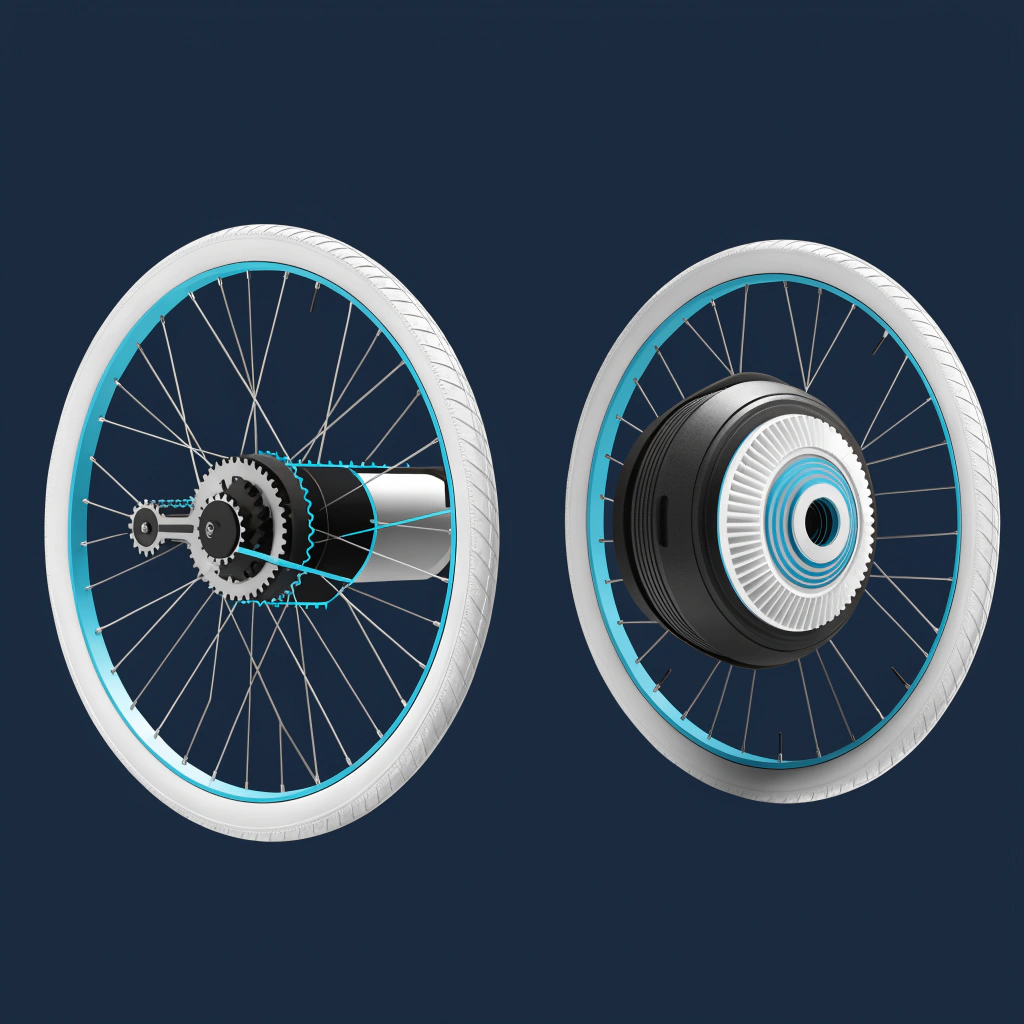
A 500W mid-drive routinely out-climbs a 750W geared hub, because it drives through the bicycle’s gears instead of at a fixed ratio at the wheel:
| Dimension | 500W mid-drive | 750W geared rear hub |
|---|---|---|
| Axle torque on a climb | Multiplied by the bike’s gears — wheel torque can far exceed the motor’s own output | Fixed ratio at the wheel; cannot be geared up |
| Gear use | Requires deliberate shifting to stay in the efficient band | No shifting needed |
| Shift load | Motor torque passes through the chain — ease off to change gear | Chain carries rider power only |
| Drivetrain wear | Faster chain, chainring and sprocket wear | Normal bicycle wear rates |
| Wheel service | Standard wheel; punctures unchanged | Motor wheel handled with its cable attached |
| Frame fit | Bottom-bracket shell width and standard | A dropout question — 135–142mm rear spacing |
| Heat on long climbs | Stays in its efficient rpm band via the gears | Turns slowly under load, where a geared hub heats fastest |
KirbEbike’s Tongsheng TSDZ8 mid-motor kit is offered in 36V 500W and 48V 750W versions with a torque sensor — the right comparison point when your terrain is genuinely steep.
500W vs 750W Speed
A 750W kit has no universal top speed, and it isn’t automatically faster than every 500W kit. Speed depends on voltage, winding, controller settings, wheel diameter, tyres, posture, total weight, gradient, wind and any limits. A typical unrestricted 500W hub may sit around the low-to-mid 20 mph range in favourable conditions; a 48V 750W system may reach the mid-to-upper 20s in some configurations. KirbEbike’s product page lists approximately 35–45 km/h for this motor-wheel family — a manufacturer estimate under specific conditions, not a guarantee.
Top speed vs climbing speed: winding matters more than most buyers expect. A speed-wound motor is quick on the flat but weaker at low climbing speeds; a torque-oriented winding accelerates and climbs better but tops out lower. Two kits with the same label can sit at opposite ends of that trade-off.
500W vs 750W Range
Motor wattage does not equal energy consumption. A 750W motor doesn’t draw 750W continuously — when both kits carry the same rider at the same speed into the same wind, consumption can be closer than buyers expect. The 750W system uses more battery mainly when the rider actually uses its extra ability: accelerating harder, climbing faster, holding higher speed, pedalling less, or carrying more. The rider spends the difference, not the label.
| Battery | Nominal energy | Usable (~80%) | Planning range at 15–25 Wh/mile |
|---|---|---|---|
| 36V 15Ah | 540Wh | ~430Wh | About 17–29 miles |
| 48V 20Ah | 960Wh | ~770Wh | About 31–51 miles |
| 48V 30Ah | 1,440Wh | ~1,150Wh | About 46–77 miles |
Planning examples, calculated not measured. Assumptions: 100–110kg total mass, 12–15 mph average, rolling terrain, 2.0–2.4″ tyres at pressure, 10–20°C. A heavy rider climbing in winter can sit above 25 Wh/mile; a light rider pedalling actively in summer below 15. Below ~5°C usable capacity falls further. Measure your own consumption over a few rides and re-plan from that.
Browse the battery range before assuming the motor decides your mileage.
Weight and Ride Feel
The motor itself may not account for most of the weight difference — KirbEbike lists its SHENGYI geared rear motor at about 4 kg for both configurations. The bigger variable is everything around it: a higher-voltage or higher-capacity battery, heavier wiring, torque arms, a stronger wheel. A larger battery adds range and reduces sag, but adds kilograms and shifts the balance — a pack mounted low and central handles better than a heavy rack-mounted one, and the bike must still be pedalled, carried and lifted when the battery is flat.
How each usually feels: the 500W is progressive, light and easy to modulate — closer to a normal bicycle, more dependent on rider input on hard climbs. The 750W is stronger from a stop, more forceful at high assist, less strained with cargo — and more likely to expose weak brakes or a flexible frame.
Cadence sensor
- Detects pedal rotation
- Delivers assistance in steps
- Simpler and lower cost
- May surge at high assistance
Torque sensor
- Detects pedal force
- Usually feels proportional
- More natural response
- Better low-speed modulation
Sensor type often affects ride feel more than the 250W difference does — a softly tuned 750W can feel calmer than an aggressively tuned 500W. Controller details and a test ride matter more than the number on the box.
Which Kit Suits Which Rider?
| Your main priority | Recommended starting point |
|---|---|
| Light, natural commute | 500W |
| Moderate hills with active pedalling | 500W |
| Frequent steep hills | 750W only when the hills-table conditions apply; otherwise compare a mid-drive |
| Heavier rider or regular cargo | 750W, once brakes, tyres and axle hardware match |
| Maximum range | A larger-Wh battery, not a larger motor |
| Lowest system weight | 500W |
| Strong acceleration from a standstill | 750W |
| GB public-road EAPC use | Neither at full output — use a compliant 250W system |
| Technical or sustained steep trails | A suitable mid-drive rather than either hub kit |
A heavier rider doesn’t automatically need 750W — assess rider weight, bike weight, cargo, gradient, wheel size and desired speed together, because the extra reserve only becomes valuable as gradient or payload rises. For cargo or trailer use, also check brake capacity, frame and rack rating, tyre load, axle hardware, torque arms and battery watt-hours.
Does 750W Always Drain the Battery Faster?

No — the rating shows capability, not continuous consumption. At the same speed on flat ground both systems do the same work, so consumption is similar. The 750W uses more only when the rider spends its extra ability. And a smaller motor working near its limit can be less efficient than a larger one working comfortably, so the bigger kit is not automatically the thirstier one.
Installation Differences and What to Check
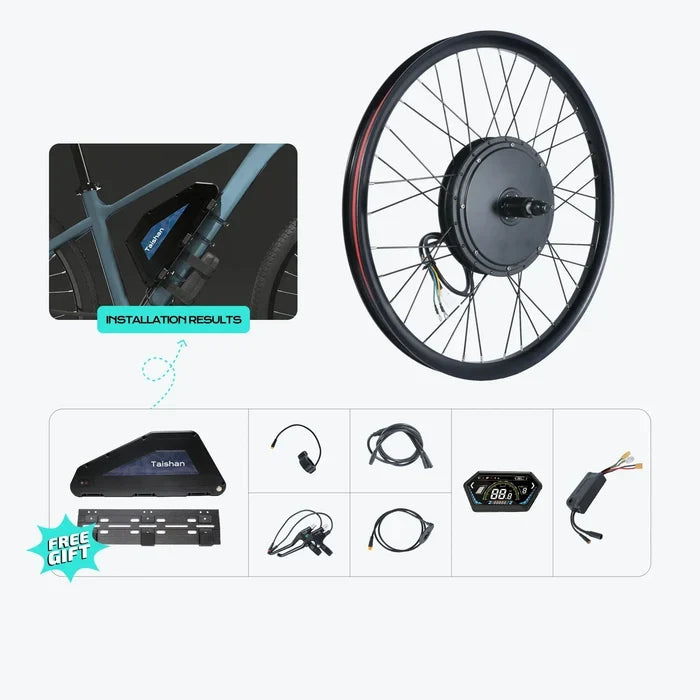
Both configurations share the family installation: a pre-built rear motor wheel, controller, colour display, PAS sensor, throttle, brake controls and waterproof harness. Before buying either, confirm the wheel diameter, dropout width, axle compatibility, brake type, cassette or threaded freewheel and gear count, battery space, controller mounting and cable routing.
Torque arms and brakes: a powered hub puts torque through the dropout, so a torque arm matters most at higher power, on aluminium frames, with narrow dropouts, at high start current, or on a front fork. A faster or heavier conversion may also justify larger rotors, better pads or upgraded tyres — assess the finished bike rather than assuming one specification fits all.
KirbEbike 500W vs 750W Configuration
| Item | 36V 500W configuration | 48V 750W configuration |
|---|---|---|
| System voltage | 36V | 48V |
| Motor | SHENGYI geared rear hub, about 4 kg | |
| Controller | 25A smart controller, Bluetooth app tuning | |
| Nominal electrical ceiling | ~900W (36V × 25A) | ~1,200W (48V × 25A) |
| Rear dropout fit | 135–142mm | |
| Drivetrain variants | 7-speed threaded freewheel, or cassette 8/9/10/11-speed — chosen at order; cassette sprockets not supplied | |
| Wheel sizes | 20″ and 24″ (freewheel only); 26″, 27.5″, 28″, 29″ and 700C (freewheel or cassette) | |
| Brakes | Disc | |
| Matched battery options | 36V 15Ah (540Wh) | 48V 20Ah (960Wh); 48V 30Ah (1,440Wh) |
| Battery supplied with kit | No — ordered and shipped separately | |
| Harness | Waterproof, quick-release connectors | |
| GB public-road status | Not an EAPC at full 500W | Not an EAPC at full 750W |
Verified against the live product page and the wheel and dropout reference in July 2026. Kit variants change without notice — re-check before ordering.
Two rows decide most orders. The drivetrain variant is not interchangeable after purchase — a 7-speed threaded freewheel motor will not take a cassette, so count the sprockets on your current rear wheel before selecting. And the dropout fit is the other blocker: measure the inside width of your rear dropouts and note the frame material, because an aluminium frame at the narrow end of 135–142mm needs a torque arm more urgently than a steel one at the wide end.
The 750W version is not an automatic upgrade. Choose 500W for less weight and more active pedalling, 750W if you’ll genuinely use the stronger output, and a larger battery if your real concern is range rather than acceleration.
Other Conversion-Kit Options to Compare

These systems don’t all target the same power class, so they’re compared on buyer fit rather than ranked:
| Product | Motor approach | Main strength | Best use | Main trade-off |
|---|---|---|---|---|
| KirbEbike 500W/750W | Rear hub | Power and battery choice | Mixed commuting and hills | Weight and legal restrictions |
| Cytronex | Lightweight front hub | Natural feel, low mass | Road commuting | Smaller battery, lower output |
| Swytch | Compact front hub | Portability | Short urban trips | Limited battery capacity |
| Bafang mid-drive | Crank drive | Uses bicycle gears | Steep hills | Install and drivetrain wear |
Cytronex builds a lightweight UK conversion around a small bottle battery — the better choice when low weight matters more than output. Swytch’s compact front-hub system suits short urban trips and easy fitting. Bafang mid-drives climb efficiently through the gears at the cost of a more involved fit and faster drivetrain wear. Each solves a different problem; none is universally best.
UK Law: Can You Ride 500W or 750W on Public Roads?
A bike is an EAPC in Great Britain only when it has working pedals, a maximum continuous-rated output no higher than 250W, and assistance that stops above 15.5 mph (GOV.UK). Neither a 500W nor a 750W kit meets that at full rated output — outside EAPC rules a bike is treated as a motor vehicle, with registration, tax, insurance, licensing, an approved helmet and vehicle approval potentially required. For public-road commuting, use a genuinely compliant system from the Road Legal Kits collection.
Safety and Frame Suitability
Before fitting either kit, inspect the donor bicycle: frame cracks, dropout condition, wheel bearings, headset, brakes, tyres, spokes, chain and sprockets. The 750W system’s extra acceleration exposes loose battery mounts, weak brakes and flexible frames that a gentler 500W setup can mask. On the electrical side, use only the supplied or authorised charger (GOV.UK battery guidance) — and avoid higher-voltage battery swaps without approval, controller shunts, BMS replacement or speed-limit defeat devices, which can overload the system and change its legal status.
How to Choose, in Five Steps
- Describe the route in numbers — steepest regular gradient, how long it lasts, how many times per ride
- Add the total load — rider, bicycle, kit, battery, bags, child seat, trailer. Above ~110kg, the case for 750W strengthens
- Decide how much you’ll pedal — active riders get more from the smaller motor; throttle-heavy low-cadence riders need the reserve
- Size the battery from watt-hours — trip distance × a realistic Wh/mile figure, divided by 0.8 for reserve and losses
- Check the donor bike and the rules — dropouts, drivetrain variant, wheel size, brakes, battery space and the legal position before ordering
Conclusion
A 500W kit is usually the better all-round conversion for lighter commuting, active pedalling and moderate terrain. A 750W kit earns its extra weight when you regularly meet sustained steep gradients, carry cargo or ride at a heavier total load — when the conditions in the hills table actually apply to your route.
Either way, don’t decide from the motor label. Controller current, battery voltage and usable watt-hours, motor architecture, wheel size and system mass decide how the bike rides; the number on the box does not.
Match the Kit to Your Route, Not the Wattage
Compare the 500W and 750W configurations, then match wheel size, gearing, battery capacity and controller settings to the route you actually ride each week.
Frequently Asked Questions
Is a 500W e-bike better than a 750W e-bike?
How fast does a 750W conversion kit go?
How fast can a 500W kit go?
How long will a 500W e-bike battery last?
How many watts are best for an e-bike?
How long does a 750W e-bike last on one charge?
Can I ride a 750W electric bike on public roads in the UK?
Is it better to buy an e-bike or a conversion kit?
Sources
- GOV.UK — Electrically assisted pedal cycles (EAPCs): standards and legal requirements. gov.uk
- GOV.UK — Riding an electric bike: the rules. gov.uk/electric-bike-rules
- GOV.UK — Battery safety for e-cycle users. gov.uk
- Cycling UK — EAPC regulations. cyclinguk.org
- Grin Technologies — Understanding e-bike motor power ratings (technical analysis, cited unlinked).