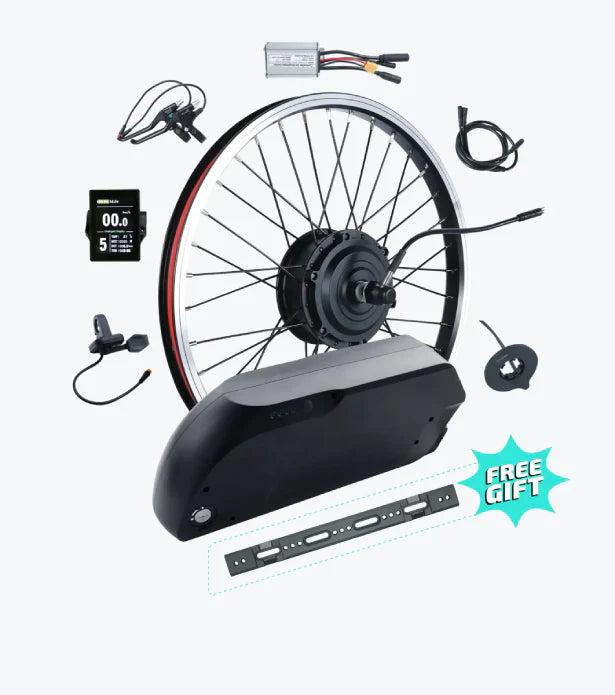
When converting your bicycle into an electric powerhouse, voltage selection stands as one of the most critical decisions you'll make. The voltage of your e-bike system fundamentally determines speed capabilities, hill-climbing ability, battery efficiency, and overall riding experience.
Understanding these differences helps you choose the right conversion kit for your specific needs.
Understanding E-Bike Voltage Systems
Voltage in e-bike systems represents the electrical pressure pushing current through your motor. Higher voltage doesn't just mean more power—it fundamentally changes how your motor operates, affecting torque delivery, thermal management, and energy efficiency. Each voltage tier serves distinct riding purposes, from casual urban commuting to extreme off-road performance.
The relationship between voltage and performance isn't linear. A 48V system delivers considerably more than just 33% more performance than a 36V setup—the improvements cascade through multiple performance metrics simultaneously.
36V E-Bike Systems: Entry-Level Efficiency

Performance Characteristics:
- Maximum speeds: 15-20 mph (25-32 km/h)
- Motor power range: 250W-500W
- Ideal for flat terrain and gentle slopes
- Excellent battery efficiency for short commutes
The 36V platform represents the foundation of electric bicycle technology. These systems excel in urban environments where legal speed restrictions apply and terrain remains relatively flat. KirbEbike's EZ Rider Kit exemplifies this category with its 36V 250W configuration, delivering 15.5 mph top speed with exceptional range efficiency.
Best Applications:
- Daily city commuting under 10 miles
- Casual recreational riding
- Compliance with strict regional e-bike regulations
- Riders prioritizing lightweight systems
The primary advantage of 36V systems lies in their energy efficiency at lower speeds. Battery cells experience less thermal stress, contributing to extended battery longevity—often exceeding 1000 charge cycles with proper maintenance.

Performance Characteristics:
- Maximum speeds: 28-35 mph (45-56 km/h)
- Motor power range: 750W-1500W
- Moderate hill-climbing capability
- Balanced power-to-efficiency ratio
The 48V configuration has emerged as the industry standard for serious e-bike enthusiasts. This voltage provides substantial power increases over 36V while maintaining reasonable component costs and battery weight. KirbEbike's 48V 1000W conversion kit demonstrates this sweet spot perfectly, offering genuine performance upgrades without crossing into extreme territory.
Why 48V Dominates the Market
Thermal Management: 48V motors run cooler than 36V equivalents at similar power outputs because they draw lower amperage for the same wattage. This reduced current flow minimizes resistive heating in motor windings and controller components.
Component Availability: The massive popularity of 48V systems means broader component selection, better aftermarket support, and competitive pricing across batteries, controllers, and motors.
Legal Flexibility: Many regions permit higher wattage motors at 48V while still classifying them as bicycles rather than motor vehicles, avoiding registration requirements.

Performance Characteristics:
- Maximum speeds: 30-38 mph (48-61 km/h)
- Motor power range: 1500W-2600W
- Strong hill-climbing performance
- Extended voltage headroom for battery longevity
The 52V platform emerged from the electric skateboard community and quickly gained traction among performance e-bike builders. This voltage represents a relatively modest increase over 48V numerically, but the practical benefits prove substantial.
The 52V Advantage
Most "48V" motors actually perform optimally around 52-54V (fully charged 48V lithium batteries reach 54.6V). Purpose-built 52V systems operate within this ideal range throughout most of their discharge cycle, maintaining peak performance longer than 48V equivalents.
KirbEbike's 52V 2000W MTX Rim kit exploits this advantage, delivering 50-60 km/h speeds with 40-60km range using high-capacity battery packs. The system maintains strong acceleration even as battery charge depletes—a common weakness in lower voltage configurations.
Battery Longevity Benefits: Operating motors at their optimal voltage reduces strain during discharge cycles. A 52V battery powering a motor designed for 48-52V operation experiences less voltage sag under load, preserving battery health over thousands of cycles.
Performance Characteristics:
- Maximum speeds: 45-55+ mph (72-88+ km/h)
- Motor power range: 3000W-5000W+
- Exceptional hill-climbing capability
- Motorcycle-level performance
The 72V category represents the pinnacle of e-bike power systems. These configurations blur the line between electric bicycles and electric motorcycles, demanding significant mechanical upgrades to frames, brakes, and wheels.
KirbEbike's 72V 4000W extreme performance kit delivers genuine motorcycle performance, reaching 55+ mph with devastating acceleration. However, this power demands respect—proper safety equipment becomes mandatory, and legal restrictions often reclassify these vehicles beyond bicycle status.
Critical Considerations for 72V Systems
Component Stress: Every mechanical component experiences forces multiplied by speed squared. Brakes, wheels, frames, and forks must handle stresses far exceeding their original design parameters.
Electrical Complexity: 72V systems require robust wiring, high-amperage controllers, and advanced battery management systems. Component failures at this voltage level can prove catastrophic rather than merely inconvenient.
Legal Status: Most jurisdictions classify 72V e-bikes as motor vehicles requiring registration, insurance, and licensing. Research local regulations thoroughly before committing to this performance level.
|
Voltage
|
Typical Power
|
Top Speed
|
Ideal Terrain
|
Battery Range
|
Best For
|
|
36V
|
250W-500W
|
15-20 mph
|
Flat urban
|
15-35 miles
|
Casual commuting
|
|
48V
|
750W-1500W
|
28-35 mph
|
Mixed terrain
|
25-45 miles
|
Daily performance riding
|
|
52V
|
1500W-2600W
|
30-38 mph
|
Hills & trails
|
25-60 miles
|
Enthusiast riding
|
|
72V
|
3000W-5000W
|
45-55+ mph
|
Any terrain
|
25-50 miles
|
Extreme performance
|
Battery Capacity and Range Considerations
Voltage tells only part of the performance story—battery capacity (measured in amp-hours) determines how long that performance sustains. A 36V 15Ah battery stores 540 watt-hours of energy, while a 52V 30Ah battery holds 1560 watt-hours—nearly triple the capacity.
Range calculations must account for riding style, terrain, rider weight, and assist levels. Conservative estimates suggest:
-
36V systems: 15-35 miles with moderate pedaling assistance
-
48V systems: 25-45 miles with balanced power usage
-
52V systems: 25-60 miles depending on battery capacity
-
72V systems: 25-50 miles under aggressive riding conditions
KirbEbike offers various battery configurations matched to each voltage platform, ensuring optimal range for different use cases.
Motor Compatibility and Efficiency
Not all motors handle voltage increases equally. Hub motors generally tolerate voltage ranges better than mid-drive systems, which require precise voltage matching to their internal gearing.
Hub Motor Advantages:
- Simpler voltage tolerance
- Direct power delivery
- Minimal mechanical integration requirements
- Better suited for speed-focused applications
Mid-Drive Advantages:
- Superior hill-climbing efficiency
- Natural riding feel through existing gears
- Better weight distribution
- Optimized for torque delivery
KirbEbike's mid-motor conversion kit demonstrates how voltage selection affects torque characteristics—the 48V 750W configuration delivers 140Nm maximum torque, transforming hill climbing performance compared to 36V alternatives.
Controller and Display Integration
Modern e-bike controllers serve as the intelligence layer managing voltage delivery. FOC (Field-Oriented Control) controllers maximize efficiency by precisely controlling current flow through motor phases, critical for higher voltage systems where wasted energy generates problematic heat.
Display integration becomes increasingly important at higher voltages. Real-time monitoring of battery voltage, current draw, and motor temperature helps prevent component damage and optimizes range. KirbEbike's TFT color displays provide this critical feedback across all voltage platforms.
Making Your Voltage Decision
Choose 36V if:
- Legal restrictions limit power and speed
- Your commute covers flat terrain under 10 miles
- System weight and simplicity matter most
- Budget constraints prioritize initial cost
Choose 48V if:
- You want balanced performance and efficiency
- Hills are moderate and occasional
- Legal regulations permit Class 3 e-bikes
- Long-term reliability matters more than extreme performance
Choose 52V if:
- Performance and range both rank as priorities
- Terrain includes challenging hills
- You understand component quality requirements
- Legal flexibility exists in your area
Choose 72V if:
- Maximum performance outweighs all other considerations
- You're prepared for motorcycle-level mechanical upgrades
- Legal compliance includes motor vehicle registration
- Budget accommodates premium components throughout
Conclusion
Voltage selection fundamentally defines your e-bike conversion experience. While 36V systems offer simplicity and efficiency for casual riding, 48V configurations deliver the performance sweet spot for most enthusiasts. The 52V platform extends capabilities for demanding riders, while 72V systems enter motorcycle territory with corresponding complexity.
KirbEbike provides comprehensive conversion kit options across all voltage platforms, ensuring you can match system specifications to your specific riding requirements. Understanding these voltage differences empowers informed decisions that maximize satisfaction with your electric bicycle conversion.
Frequently Asked Questions
Can I upgrade my 36V system to 48V later?
Voltage upgrades require replacing the motor, controller, display, and battery—essentially a complete system replacement. Planning your target voltage from the start proves more cost-effective than incremental upgrades.
Do higher voltage systems drain batteries faster?
Not necessarily. Higher voltage systems often prove more efficient because they draw lower amperage for equivalent power output, reducing resistive losses in wiring and components.
Will a 52V battery damage my 48V motor?
Many 48V motors tolerate 52V operation, but this technically voids warranties and may shorten motor lifespan. Check manufacturer specifications before attempting voltage mismatches.
How does cold weather affect different voltage systems?
All lithium batteries lose capacity in cold temperatures, but higher voltage systems with larger capacity packs (measured in amp-hours) maintain usable range better than smaller, lower voltage alternatives.
Are 72V systems legal for road use?
Legal status varies dramatically by jurisdiction. Most areas classify 72V e-bikes exceeding certain power or speed thresholds as motor vehicles requiring registration, insurance, and operator licensing.
Does voltage affect charging time?
Charging time depends primarily on battery capacity (amp-hours) and charger output (amps). A 36V 15Ah battery charges in similar time to a 48V 15Ah battery when using comparable chargers.
Can I use multiple voltage batteries on the same bike?
Some riders install dual battery systems, but they must match voltage exactly. Parallel connections require identical voltage; series connections add voltages together but demand specialized controllers and safety systems.