EBike Battery BMS Amps: How to Match to Your Motor and Controller
KE
KirbEbike Editorial
Reviewed by the KirbEbike conversion-support team
Share
Unlock £10 off today
On this page
Two batteries can share the same voltage and the same amp-hours — and still behave completely differently on the road. The difference is the BMS amp rating: how much current the battery’s protection board lets out. Get it right and the pack keeps up under load; get it wrong and the bike cuts out halfway up a hill. This guide explains BMS amps in plain English and shows you, step by step, how to match the number to your motor and controller.
The short answer
Match your BMS continuous-discharge rating to your controller’s maximum battery current — not the motor’s wattage label. Use the three-way rule: controller demand ≤ BMS continuous current ≤ pack’s safe output. A high-power build may need a 60A-class BMS; a commuter controller may only need 25–30A. Check the controller limit, the cell model and the BMS data sheet before buying. And in Great Britain, software settings don’t make a high-power system road-legal.
controller demand ≤ BMS continuous current ≤ pack’s safe output
Quick BMS Sizing Reference
Here is the whole decision in one view. Read it as: whatever current your controller can actually draw, that’s the number the BMS has to feed — as long as the cells can back it up. Everything else in this guide is a way of confirming those numbers.
Motor / build class
Typical controller draw
Suggested BMS continuous
Where it fits
250W road-legal
10–15A
20–25A
UK EAPC pedal-assist commute
500–750W hub
15–25A
25–30A
Value upgrade, mixed terrain (off-road)
1000W hub / mid-drive
25–30A
30–40A
Hills, commuter+ (off-road above 250W)
2000W performance
35–45A
45–50A
Speed-focused off-road / trail
3000W high-power
50–60A
60A continuous
Off-road / private-land build
4000W flagship
60A (FOC)
60A continuous (published spec)
Extreme off-road — KirbEbike 72V 4000W kit
Dual-motor
Add both controllers
Sum + margin
Combined draw sizes the BMS
Figures are indicative sizing bands, not fixed rules. Always verify the controller’s exact battery-current limit, the cell model, parallel count and the BMS data sheet before ordering.
🧮
The maths, shown: amps = watts ÷ volts. 1,500W ÷ 50V = 30A; 3,000W ÷ 72V ≈ 42A. But treat this as a starting estimate only — real controllers are usually programmed higher once losses and voltage sag are counted (KirbEbike’s 4000W kit runs a 60A FOC controller). The real number comes from the controller’s programmed current limit. Read that, not the motor label.
What Does “BMS Amps” Actually Mean?
The Battery Management System (BMS) is the protection board inside your pack, and its amp rating is simply how much current it lets out. Think of the battery as a water tank: amp-hours are the size of the tank, BMS amps are how far the tap opens. A bigger tank does not mean a stronger tap — and the tap can never safely flow more than the pipes (the cells) can supply.
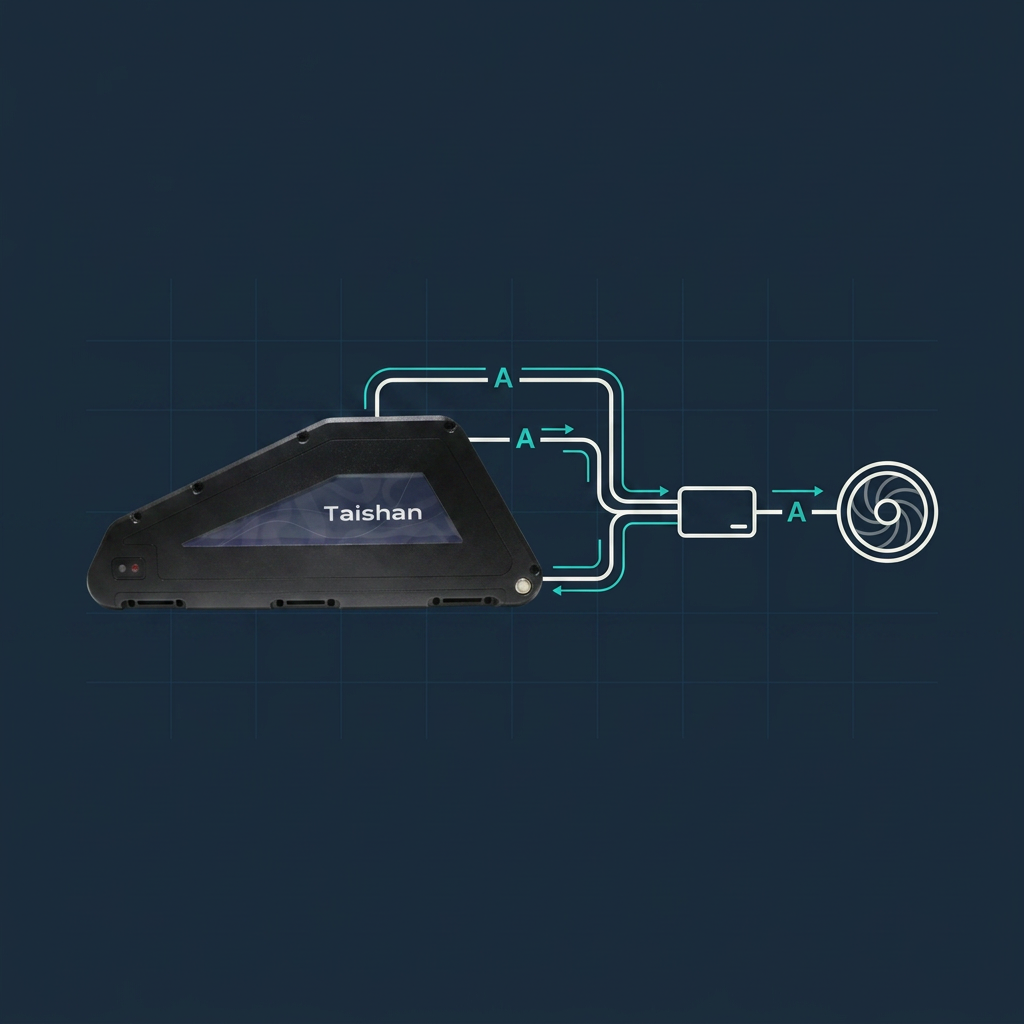
The BMS is the pack’s gatekeeper. Current flows through these MOSFETs — run them past their continuous rating and the board heats up until protection cuts the power.
Discharge amps vs amp-hours
Amp-hours (Ah) describe how much charge the pack stores. Discharge amps describe how fast it can release it. A 20Ah battery may support 20A, 40A or 60A depending on its cells and construction. Confirm both figures separately on the seller’s own product page.
Continuous vs peak — what actually matters
Continuous — the current the BMS can carry for a long time. Match this to your controller.
Peak — a short burst allowance for launches and hill spikes. Seconds, not minutes.
Overcurrent trip — the fault threshold where the BMS disconnects.
Cell discharge rating — the true source limit. The BMS can’t exceed what the cells can safely give.
⚠️
Read every rating with its context. Listings routinely mix continuous, peak and trip figures in one product title. A pack advertised as “100A BMS” may hold only a fraction of that continuously. Continuous is the number that sizes to your controller — not peak, not trip. If the seller can’t tell you the continuous rating with a straight face, that is the answer.
BMS Requirements by Controller Draw
Where does your build sit on the current ladder? The bars below show the typical controller battery-current range for each class of build. Bars are indicative bands — read your own controller label first.
Typical controller battery current by build class
Size the BMS continuous rating at or above the top of your band.
250W road-legal
10–15A
500–750W hub
15–25A
1000W hub / mid
25–30A
2000W performance
35–45A
3000W high-power
50–60A
4000W flagship
60A (FOC)
💡
High-load example — 60A BMS on a 4000W kit. KirbEbike’s 72V 4000W kit pairs a 60A FOC controller with Taishan and HS-II packs whose live pages publish a 60A BMS. That is a close current match — so cells, connectors, wiring, cooling and trip behaviour all matter under sustained load. Don’t assume extra peak headroom unless a data sheet states the peak current and duration. Off-road / private-land setup. (Source: live pages, July 2026.)
Why Motor Wattage Alone Can’t Size Your BMS
Motor wattage is a rough starting estimate at best. Two bikes with the same motor label can use very different controllers — and the controller is what actually decides current draw. A 750W motor may run a 15A controller in one build and a 30A controller in another. Same label, different battery needs.
How battery voltage changes under load
Nominal voltage isn’t constant. A 52V pack starts at 58.8V full and drops as energy leaves it. The same power needs more current as voltage falls — which is why sums built only on nominal voltage under-estimate demand at the bottom of the charge.
How to Find Your Controller’s Maximum Battery Current
This is the number that sizes your BMS. Look for it in this order: label → spec sheet → display/app settings.
Programmable controllers show you the number. On app-tunable systems, record both the active current setting and the hardware maximum before sizing the BMS.
1. Check the controller label
These terms all mean the same thing: maximum current, current limit, battery current, DC current, rated current, maximum input current. One trap: don’t assume the biggest number on the label is battery current — controllers also list phase current, which is separate and often much higher.
2. Review the spec sheet
The sheet should say whether the figure is continuous or maximum, battery-side or phase-side. If it doesn’t — or the seller can’t confirm — treat the number as unverified.
3. Check display or app settings
Programmable controllers set the active limit in a display menu or app. The label may show the hardware maximum while the setting is lower. KirbEbike’s Ride Power App smart controllers expose DC current, PAS levels and speed modes — record both the active setting and the hardware limit.
Battery current vs phase current
Battery current flows from the pack into the controller. Phase current flows from the controller to the motor windings — and at low speed it can be several times higher. A 10A battery draw can become 20A of phase current up a steep start. Size the BMS to battery current, always.
Dual-motor builds: add the limits
Two controllers on one battery draw together. Two 25A controllers = a possible 50A combined demand — and the cells, BMS, fuse, cable and connector must all be built for it.
How to Work Out Your Pack’s Safe Output
The cells set the real ceiling. Before trusting any BMS number, find out what the cells inside the pack can actually deliver.
1. Identify the exact cell model
“Premium lithium cells” tells you nothing. Find the manufacturer and model — two cells of the same size can have very different current limits. KirbEbike’s Taishan and HS-II packs publish the cell model on the page (LG 21700; Samsung 50S on the 72V packs) precisely so you can check it.
2. Find the parallel count (the P in 14S4P)
Pack layouts use S×P notation: S is series (voltage), P is parallel (capacity and current). A 14S4P pack has four cells sharing the load in each group.
3. Multiply — then derate for heat and age
Cell continuous rating × parallel count = a theoretical ceiling. A 4P pack of 10A cells has 40A of cell headroom — before nickel strips, welds, fuse, connector and case airflow shave it down. Older cells sag more; cold weather cuts available power. A pack ridden constantly at its limit ages fast.
4. Use the lowest rating in the chain
The usable limit is the lowest verified rating among cells, BMS, wires, connector and fuse. A 60A cell layout behind a 40A BMS is a 40A battery. A 60A BMS on 30A cells is not a 60A battery.
Matching BMS Amps: Getting the Three Numbers in Order
When controller demand ≤ BMS continuous ≤ pack’s safe output, the system just works. When any number is out of order, something else in the chain has to give. Two practical rules:
Match up to the controller. A 30A controller shouldn’t lean on a 20A BMS — hard acceleration will trip protection, especially warm or near-empty. Meeting the controller exactly works; a modest margin is kinder, if the cells support it.
Stay within the cells. A 4P pack of 8A cells has a 32A ceiling — a 30A BMS fits the design; a 60A BMS would let the controller pull far past safe before protection wakes up. This is the missing check in many DIY builds.
Size the BMS up if you…
Keep it matched if you…
Have quality cells that safely support 40A+
Have entry cells rated around the controller current
Ride sustained heavy loads or steep hills
Ride a typical commute / mixed use
Want thermal margin on long climbs
Want a lighter, more compact pack
Plan a controller upgrade within a year
Prioritise cell longevity over headroom
Run cargo or high-power off-road builds
Ride mostly flat terrain at moderate assist
Check trip behaviour, not just the headline
Read the BMS data sheet for continuous, peak, peak duration, trip threshold and trip delay. One “40A” BMS trips at 60A after several seconds; another behaves differently. The headline number alone doesn’t describe protection.
Sizing Examples by Motor Wattage
These show the process, not fixed rules. Verify controller label, cell model, parallel count and BMS data sheet before buying.
System
Controller max battery current
Suggested BMS continuous
Pack notes
500W motor
15A
20A (with margin)
Cells, wiring and connector must support 20A+
750W motor
25A
30A
Entry cells often fall short — check the exact model
1000W motor
30A
30–40A
48V 16Ah entry pack at 30A fits; 40A leaves headroom
2000W motor
40A
40–50A
Full pack path (cells + busbars + connector) must carry it
3000W motor
60A
60A+
A 60A controller demands a verified 60A battery
3000W motor
80A
80A+
Cells, main cable and connector all sized to 80A continuous
Dual-motor (2×25A)
50A combined
60A
The battery supplies the combined draw
What Happens When BMS Amps Are Too Low
An undersized BMS works fine on light rides and fails only under load — which makes the battery, controller or motor look faulty when the real issue is protection. The tell-tale symptoms:
Cut-outs during acceleration — display and motor shut off together, then reset once load is removed.
Shutdowns on hills — a climb holds high current far longer than a launch; a BMS that survives bursts can still trip halfway up.
Weak torque and voltage sag — the pack doesn’t disconnect, but voltage droops until the controller cuts power back; the gauge plunges under throttle and recovers at rest.
BMS overheating — running near the continuous limit heats the MOSFETs until thermal protection steps in, especially in a sealed case.
Repeated trips — a warning, not a normal mode. Never bypass discharge protection; lower the controller current or fit a battery built for the load.
Can BMS Amps Be Too High?
Yes — for the battery, not the motor. A big BMS doesn’t push current anywhere (the controller draws only what it’s programmed to). The danger is that an oversized BMS sets the protection threshold above what the cells and wires can handle. A pack with a safe 40A cell output plus a 100A BMS lets a big controller drag it far past 40A before anything trips: cells overheat, sag hard and age fast.
A higher-rated BMS makes sense only when cells, busbars, wiring, fuse, connector and controller are all built for the same current range. KirbEbike’s Taishan and HS-II pages publish a 60A BMS across the listed models, with XT90 discharge connectors on the 60V/72V packs — the whole current path built for the load, not just the board.
Common Mistakes When Choosing BMS Amps
Sizing from motor wattage alone — watts ÷ volts is a sanity check, not a spec. Read the controller.
Confusing amp-hours with discharge amps — capacity is the tank; discharge is the tap.
Treating peak as continuous — a “60A peak” BMS is not a 60A continuous BMS.
Ignoring cell limits — “high-power cells” is not a cell model. Get the exact cell and parallel count.
Forgetting the wiring — a right-sized BMS can’t protect a thin nickel strip or a loose connector from heat.
Upgrading the controller without re-checking the battery — going 25A → 40A is a 60% jump in potential draw.
Recommended BMS Ratings: UK 72V Packs Compared
UK-facing 72V-class packs, checked live in July 2026, with a specific eye on the BMS continuous rating — the number that actually feeds a high-power motor. KirbEbike is one option among several, listed on merit; alternatives are named for direct comparison.
Seller (domain)
Pack
Cells
BMS cont./peak
Price
Warranty / notes
kirbebike.com
72V 20Ah
LG 21700 / Samsung 50S
60A
from £579.99
1-yr; 5A charger; UK/US/NL battery service
ebikepoweruk.com
72V 20Ah
Samsung 50S
60A
£469
Not UK road-legal, XT90
ebikepoweruk.com
72V 30Ah
Samsung 50S
80A
£749
Big-capacity triangle, XT90
coreebikes.co.uk
72V 30Ah
Samsung 50S (20s6p)
80A / 100A
£798
1-yr; dimension diagram, IP54
all4ebikes.co.uk
72V 20Ah
LG 21700 (5000mAh)
60A
£479.90
12-mo; Cardiff shop, in-store fitment
eccride.com
72V 20Ah
Samsung 50S
60A / 90A
~£280–385*
15-mo; London service, waitlist
myperfectebike.com
72V 20Ah
Samsung 50S
60A / 120A
£525
12-mo; UK stock, 9 kg, XT150
*ECC Ride price is the listed range across its 48V/52V/72V variants; the 72V 20Ah is currently on a waitlist. All figures verified July 2026 — confirm before ordering.
💡
Why KirbEbike uses a 60A BMS on high-power packs. The 60A rating is designed as part of a complete current path, not a stand-alone claim:
Matched to the controller — aligns with the 60A FOC controller on the 72V 4000W kit
Named cells — LG 21700, with Samsung 50S on the 72V packs. Traceable, not generic
Full protection path — XT90 discharge connectors on 60V/72V packs, sized for the sustained load
IP65 sealed — the BMS lives inside a weather-sealed case
Service — 1-year warranty with UK/US/Netherlands battery service
60A BMS
Continuous, published
LG / Samsung
Named 21700 cells
IP65
Sealed pack
1yr
Warranty
Matched current path
Taishan & HS-II Battery Packs
60A continuous BMS on named LG/Samsung cells, XT90 discharge path and a 5A charger — matched to KirbEbike’s high-power controllers.
This is a representative sample, not the whole market — specialist builders (TrailSurge, BOOANT, E-Bike Masters and custom pack builders) will make sustained 60A+ or unusual-frame packs to order. Whoever you buy from, judge each pack on the same five things, in order: cell type, BMS continuous current (matched to your controller), warranty, physical fit, after-sales support.
Final Verdict: Sizing BMS Amps Correctly
Start with the controller’s maximum battery-current limit — not the motor’s watt label. Then confirm the BMS continuous rating meets it, and the cells back the BMS. For many KirbEbike-compatible high-power builds that lands on a 60A continuous BMS on named cells, because that is what the 60A FOC controller on the 72V 4000W kit is built to draw. Going higher is worthwhile only when the entire current path — cells, busbars, cable, connector and controller — is built for it. Browse matched options in the kit and battery collection.
⚠️
A note on 80A+ builds. If you’re running a genuine 80A+ controller, KirbEbike’s stock 72V packs are not the intended pairing — the 60A rating is deliberate, matched to the 4000W kit’s controller. Use a purpose-built higher-current pack from a specialist, or a manufacturer-approved dual-battery system. Never parallel two packs with a generic splitter — voltage, state of charge, BMS behaviour and connectors must all be engineered for parallel use. An 80A+ build is a private-land or separately approved motor-vehicle project in Great Britain.
FAQs
How many amp BMS do I need?
One whose continuous discharge rating meets or exceeds your controller’s maximum battery current, while staying within the safe output of your cells. Start with the controller label: a 25A controller pairs well with a 30A BMS (if the pack supports it); a 40A controller usually needs 40A or higher. Don’t choose from motor wattage or amp-hours alone.
How many amps can my ebike battery handle?
Only the lowest safe current in the chain — cells, parallel count, BMS, wires, connector, fuse and construction. Multiply the cell continuous rating by the parallel count for a theoretical ceiling, then use the manufacturer’s finished-pack rating where given, since it already accounts for wiring and heat.
What does a 30A BMS mean?
Usually that the BMS is designed to carry up to 30A of continuous discharge under its stated conditions. It doesn’t trip the instant current touches 30.1A — a higher peak may be allowed for seconds first. Check whether “30A” means continuous, peak or trip current, and confirm the cells support 30A as a finished pack.
Should BMS amps be higher than controller amps?
At least equal, and a modest margin is often kinder — a 25A controller with a 30A BMS, a 40A controller with 45–50A. But the extra rating must not exceed the pack’s safe output, or the bigger BMS actually weakens cell protection.
Can I use a higher-amp BMS on my ebike battery?
Only if the cells, parallel count, busbars, wiring, connectors and fuse can safely support the higher current. A bigger BMS doesn’t force more current, but it allows more before protection activates. Swapping a 30A pack’s BMS for a 60A unit does not make the pack safe at 60A.
Does a bigger BMS make my ebike faster?
No. Top speed is set by voltage, controller current, motor winding and wheel size. A bigger BMS can reduce cut-outs and help sustained power hold up, but it doesn’t raise the ceiling. If speed is the goal, that’s a controller-and-motor conversation.
⚠️
A note on safety. High-current packs store a lot of energy. Never exceed component ratings, use correctly rated connectors, charge on a non-flammable surface, don’t leave packs charging unattended, and stop using a swollen, damaged or abnormally hot battery. In Great Britain, systems above EAPC limits are for suitable private land or the separate motor-vehicle approval route.
Sources
Cycling UK — Guide to e-cycle batteries. cyclinguk.org
About this guide. Author: KirbEbike Editorial. Last reviewed: July 2026. Methodology: sizing bands, controller pairings and pack specifications cross-checked against live retailer pages (July 2026) and the technical references cited inline. BMS behaviour, cell models and controller limits vary by product and can change — always confirm the continuous ratings for your exact battery, controller and kit before buying. If any check is uncertain, ask the seller or a qualified technician.
Stay in the know
Conversion guides, fitting advice and the deals worth knowing about. No spam.