High-power e-bike conversion delivers exhilarating speed, unstoppable climbing capability, heavy load handling, and performance rivaling electric motorcycles—but selecting extreme systems requires understanding legal implications, safety requirements, frame limitations, component upgrades, and responsible usage distinguishing performance enthusiasts from reckless operators.
While the best ebike kit options span power levels from 250W to 4000W, understanding when high power (1500W+) serves legitimate needs versus creating dangerous liability determines whether your conversion delivers thrilling performance or catastrophic consequences through inadequate preparation.
This comprehensive guide examines high-power conversion kits, safety-critical requirements, legal considerations, component necessities, installation challenges, and responsible usage ensuring performance-focused riders achieve legitimate speed goals safely while understanding the substantial responsibilities accompanying extreme electric bicycle power.
Understanding High-Power E-Bike Systems
![]()

Defining what constitutes "high power" and understanding implications ensures realistic expectations and appropriate preparation.
Power Level Definitions
E-Bike Power Categories:
Standard Power (250-750W):
- Legal: Most jurisdictions
- Speed: 25-40 km/h typical
- Application: Normal cycling
- Requirements: Standard components
- Risk: Minimal
High Power (1000-2000W):
- Legal: Private property typically
- Speed: 45-60 km/h capability
- Application: Performance enthusiasts
- Requirements: Upgraded components
- Risk: Moderate with preparation
Extreme Power (2500-4000W):
- Legal: Private property only
- Speed: 75-85+ km/h potential
- Application: Extreme performance
- Requirements: Comprehensive upgrades
- Risk: Substantial—expert level only
Legal Considerations Critical
Legal Status Reality:
High-power systems face significant legal restrictions:
UK/EU Legal Limits:
- Maximum power: 250W road legal
- Speed limit: 25 km/h assisted
- Above limits: Not road legal
- Usage: Private property only
- Insurance: Not available as bicycle
Consequences Exceeding Limits:
- Vehicle classification: Motorcycle
- Registration required: None available
- Insurance required: Not obtainable
- Riding illegally: Serious penalties
- Confiscation possible
- Criminal record potential
Legal High-Power Usage:
- Private land only
- Race tracks permitted
- Closed courses acceptable
- Public roads: Absolutely prohibited
- Enforcement: Increasingly strict
Safety Requirements Non-Negotiable
Critical Safety Considerations:
High power demands comprehensive safety measures:
Mandatory Upgrades:
- Hydraulic disc brakes: 180-203mm rotors
- Quality tires: Rated for speeds
- Frame inspection: Crack-free essential
- Torque arms: Heavy-duty both sides
- Quality components: No compromises
- Protective gear: Full-face helmet minimum
Rider Skill Requirements:
- Experienced cyclist essential
- High-speed handling understood
- Emergency braking practiced
- Mechanical knowledge adequate
- Responsible judgment critical
- Risk awareness complete
Top High-Power Conversion Kit Recommendations
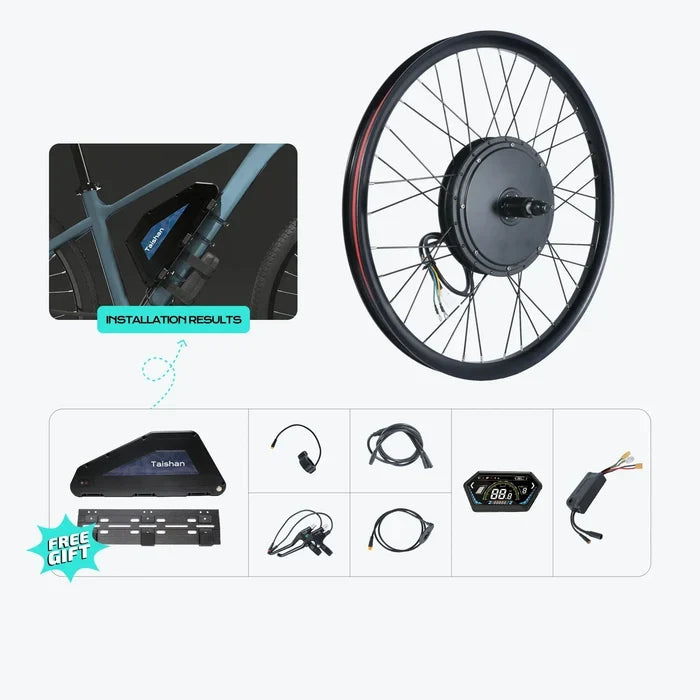
Best Extreme Power: 72V 4000W System
![]()

Ultimate Performance:
Maximum capability for experienced performance riders:
Complete System Specifications:
Motor Configuration:
- Power: 72V 4000W brushless direct-drive
- Type: Heavy-duty rear hub motor
- Weight: 6.8kg robust construction
- Speed: 75-85+ km/h capability
- Torque: Unstoppable acceleration
- Construction: Professional-grade components
Why Maximum Capability:
- 4000W delivers motorcycle-like power
- 72V voltage superior efficiency high speeds
- Heavy-duty construction handles stress
- Professional-grade reliability
- Extreme performance capability
- Ultimate speed potential
Battery Configuration:
- Voltage: 72V 20Ah with 5A fast charger
- Cells: Premium high-discharge rated
- Range: 40-80km aggressive riding
- Performance: Sustained extreme power
- Quality: Military-grade construction
- Weight: Substantial (manage expectations)
Performance Capabilities:
- Top Speed: 75-85+ km/h (conditions dependent)
- Acceleration: Explosive 0-50 km/h
- Climbing: Any grade conquered
- Load: Heavy rider plus cargo
- Power: Continuous high output
- Intimidation: Serious capability
Critical Requirements:
Mandatory Component Upgrades:
- Brakes: High-performance hydraulic disc (203mm rotors minimum)
- Tires: Speed-rated quality construction
- Frame: Thoroughly inspected, no damage
- Torque arms: Heavy-duty both sides mandatory
- Wheels: Reinforced construction
- Chain: Heavy-duty rated
Installation Complexity:
- Time: 30-40 minutes experienced installer
- Torque arms: Critical both sides
- Electrical: Heavy gauge wiring
- Brake upgrade: Essential before riding
- Frame assessment: Professional recommended
- Testing: Gradual power familiarization
Legal and Safety:
- PRIVATE PROPERTY USE ONLY
- Not road legal anywhere
- Track/closed course appropriate
- Full protective gear mandatory
- Experienced riders only
- Extreme risk if misused
Ideal User Profile:
- Private land access
- Track day enthusiast
- Experienced performance rider
- Comprehensive safety understanding
- Mechanical expertise adequate
- Responsible judgment demonstrated
Best High Power: 52V-60V 2000W-3000W Systems
![]()

Serious Performance Balance:
Substantial capability with somewhat more manageable characteristics:
System Options:
52V 2000W Configuration:
- Power: 2000W brushless direct-drive
- Speed: 50-60 km/h capability
- Weight: 5.1-5.3kg
- Application: Serious performance
- Battery: 52V 20-30Ah options
60V 2500W-3000W Configuration:
- Power: 2500-3000W brushless
- Speed: 75-85 km/h potential
- Weight: 6.8kg heavy-duty
- Application: Extreme performance
- Battery: 60V 20Ah
Performance Characteristics:
- Speed: 50-85 km/h depending on power
- Acceleration: Rapid power delivery
- Hills: Unstoppable climbing
- Range: 40-80km aggressive use
- Capability: Professional-grade
Safety Requirements:
- All extreme power requirements apply
- Mandatory component upgrades
- Private property use only
- Experienced riders essential
- Comprehensive preparation
Value Proposition:
- Substantial capability
- More manageable than 4000W
- Serious performance delivered
- Component stress moderate
- Expertise required
High-Power System Comparison
|
System
|
Power
|
Top Speed
|
Acceleration
|
Best For
|
Risk Level
|
Legal Use
|
|
52V 2000W
|
2000W
|
50-60 km/h
|
Very fast
|
Performance enthusiasts
|
High
|
Private only
|
|
60V 2500-3000W
|
2500-3000W
|
75-85 km/h
|
Explosive
|
Serious performance
|
Extreme
|
Private only
|
|
72V 4000W
|
4000W
|
75-85+ km/h
|
Motorcycle-like
|
Ultimate capability
|
Maximum
|
Private only
|
Critical Safety Requirements
Brake System Upgrades Mandatory
Stopping Power Essential:
High speeds demand exceptional braking:
Minimum Brake Requirements:
2000W Systems:
- Type: Hydraulic disc mandatory
- Rotor size: 180mm minimum (203mm recommended)
- Pads: Metallic high-performance
- Condition: Perfect—no compromise
- Upgrade: Before any riding
2500-4000W Systems:
- Type: High-performance hydraulic disc
- Rotor size: 203mm mandatory (220mm preferred if compatible)
- Pads: Racing-grade metallic
- Calipers: Multi-piston preferred
- Condition: Perfect—recently serviced
- Upgrade: Professional installation
Brake Testing:
- Test at low speeds initially
- Gradually increase speed testing
- Emergency stop practice
- Modulation understanding
- Maintenance regular
Frame and Structural Assessment
Frame Integrity Critical:
High power stresses frames beyond design limits:
Pre-Conversion Inspection:
Visual Inspection:
- Cracks: Any crack = disqualification
- Welds: Inspect all weld points
- Dents: Assess structural impact
- Corrosion: Check dropout areas
- Alignment: Verify frame straight
Frame Suitability:
- Steel/Chromoly: Best for high power
- Aluminum: Acceptable with torque arms (inspect carefully)
- Carbon fiber: NOT suitable for high-power conversion
- Age: Older frames suspect
- Quality: Budget frames inadequate
Torque Arm Requirements:
- 2000W: Heavy-duty both sides mandatory
- 3000W+: Extra-heavy-duty both sides
- Installation: Professional-grade
- Inspection: Monthly minimum
- Replacement: Any damage immediately
Tire and Wheel Requirements
Speed-Rated Components:
Standard bicycle tires inadequate for high speeds:
Tire Requirements:
Minimum Standards:
- Quality: Premium brand construction
- Rating: Appropriate for speeds achieved
- Condition: Excellent—recently replaced
- Pressure: Manufacturer maximum
- Inspection: Before every ride
- Replacement: At first wear sign
Wheel Strength:
- 2000W: Reinforced wheels recommended
- 3000W+: Heavy-duty wheels mandatory
- Spoke tension: Professional building
- Rim quality: No damage tolerated
- Regular inspection: Critical
Protective Gear Mandatory
Personal Protection:
High-speed crashes catastrophic without proper gear:
Minimum Protective Equipment:
Essential Gear:
- Helmet: Full-face motorcycle-grade (bicycle helmets inadequate)
- Gloves: Motorcycle gloves with armor
- Jacket: Abrasion-resistant with armor
- Pants: Reinforced or motorcycle jeans
- Boots: Ankle protection minimum
- Eye protection: If not full-face
Why No Compromise:
- 75+ km/h crashes = motorcycle severity
- Road rash devastating
- Head injuries catastrophic
- Legal liability substantial
- Insurance won't cover
- Medical costs enormous
Responsible High-Power Usage
Private Property Only
Legal Operation:
Public road use creates serious legal consequences:
Appropriate Venues:
- Private land with permission
- Closed racing circuits
- Dedicated electric bike tracks
- Off-road trails (where permitted)
- Private property exclusively
Absolutely Prohibited:
- Public roads (illegal)
- Bike paths (dangerous and illegal)
- Pedestrian areas (reckless)
- Shared spaces (liability)
- Any public property
Legal Consequences:
- Vehicle seizure
- Substantial fines
- Criminal record possible
- Injury liability unlimited
- Insurance void
- Prosecution certain if caught
Progressive Power Familiarization
Gradual Capability Exploration:
4000W instantly available = disaster for unfamiliar riders:
Safe Power Introduction:
Phase 1: Low Power (Days 1-3)
- Limit controller to 25% power
- Familiarize with handling
- Test braking thoroughly
- Understand weight distribution
- Practice emergency maneuvers
Phase 2: Medium Power (Days 4-7)
- Increase to 50% power
- Speed range 30-40 km/h
- Extended braking practice
- Cornering at speed
- Emergency scenarios
Phase 3: High Power (Week 2+)
- 75% power carefully
- Speed 50-60 km/h
- Advanced handling techniques
- Performance limits understood
- Confidence established
Phase 4: Full Power (Experienced Only)
- 100% power selectively
- Maximum speed exploration
- Complete control demonstrated
- Risk fully understood
- Judgment proven sound
Maintenance Critical
High-Power Maintenance Schedule:
Extreme systems demand rigorous maintenance:
Monthly Service:
- Professional brake service
- Torque arm replacement if any wear
- Wheel trueing and tension
- Tire replacement if needed
- Comprehensive safety inspection
- Component replacement proactive
Real-World High-Power Experience
Track Day Enthusiast
Rider Profile:
- Motorcycle racing background
- Private track access
- Performance passion
- Safety-conscious
- Expert mechanical skills
System Selected:
- 72V 4000W Extreme System
- Premium brake upgrade
- Reinforced wheels
- Full motorcycle gear
- Professional installation
Results After 12 Months:
- Exhilarating track performance
- 80+ km/h achieved safely
- Zero component failures
- Comprehensive maintenance followed
- Responsible usage only
- Thrilling safe experience
Key Lessons: Extreme power delivers incredible performance when used responsibly with comprehensive safety preparation, appropriate venue, proper equipment, and experienced rider judgment—track-only usage essential.
Key Lessons: High-power systems demand comprehensive safety preparation, appropriate venue, protective equipment, experienced rider skill, and responsible judgment—public road use guarantees eventual catastrophic consequences legally and physically.
High-Power Decision Framework
DO NOT Choose High Power If:
Disqualifying Factors: ✗ Public road use intended ✗ Inexperienced cyclist ✗ Inadequate safety budget ✗ Poor mechanical knowledge ✗ Questionable judgment ✗ No private venue access ✗ Speed thrill primary motivation
Consider High Power Only If:
Qualifying Factors: ✓ Private property access confirmed ✓ Experienced performance rider ✓ Comprehensive safety budget ✓ Expert mechanical skills ✓ Demonstrated responsible judgment ✓ Appropriate venue available ✓ Performance passion legitimate ✓ Legal understanding complete ✓ Risk acceptance mature
Conclusion
High-power e-bike conversion (1500W-4000W) delivers exhilarating performance, motorcycle-like capabilities, and thrilling speed for experienced riders with private venue access, comprehensive safety preparation, and mature responsible judgment—but demands understanding that public road use remains absolutely illegal, component upgrades non-negotiable, protective gear mandatory, and catastrophic consequences certain when safety requirements ignored or legal restrictions violated.
Ready to explore legitimate high-performance e-bike capabilities responsibly? Explore the complete electric bike kit battery range including extreme performance systems with detailed safety requirements, component upgrade necessities, legal restrictions, installation guidance, and expert support—but remember that high power demands high responsibility, and failure to operate safely and legally creates catastrophic consequences for riders, bystanders, and the entire e-bike community facing increasing restrictions from irresponsible high-power usage.
Frequently Asked Questions
Are high-power e-bike conversion kits (2000W+) legal for road use?
No—UK/EU law limits road-legal e-bikes to 250W and 25km/h. Systems exceeding these limits legally classify as motorcycles requiring registration, insurance, and licensing (unavailable for conversions).
What safety upgrades are mandatory for high-power conversion kits?
Absolutely required: High-performance hydraulic disc brakes (180-203mm+ rotors), speed-rated quality tires, heavy-duty torque arms both sides, reinforced wheels, comprehensive frame inspection (crack-free), full motorcycle-grade protective gear (full-face helmet.
Can standard bicycle frames handle 3000W-4000W motor power?
Most cannot safely—high power stresses frames beyond design limits. Steel/chromoly frames best suited with proper torque arms and no damage. Aluminum frames possible with heavy-duty torque arms and careful inspection.
How fast can 72V 4000W e-bike conversion kit actually go?
75-85+ km/h achievable depending on rider weight, aerodynamics, terrain, battery charge, and conditions—motorcycle speeds creating motorcycle-severity crashes without motorcycle protections.
Do I need special insurance for high-power e-bike conversion?
Standard bicycle insurance won't cover high-power systems. Motorcycle insurance unavailable (conversion not registered vehicle). Effectively uninsurable for road use—another reason high-power systems legal only on private property.
: invalid url input)
usmile
Liquid error (snippets/blog-best-product line 36): product form must be given a product
Liquid error (snippets/blog-best-product line 59): product form must be given a product