Deciding how much to spend on a high power ebike kit is one of the most consequential decisions any electric bike builder makes—and it's one that most guides handle poorly. They either fixate on headline motor wattage without addressing total system cost, or they give vague ranges without explaining what actually drives the price difference between a capable kit and a genuinely exceptional one.
This guide cuts through that by working through the real cost drivers at each power tier, what you genuinely need to budget beyond the kit itself, and where Kirbebike's direct-to-consumer model changes the value calculation entirely.
UK Legal Notice: Any e-bike kit above 250W continuous output is not compliant with EAPC regulations for public road use in the UK. High-power kits from 1000W upwards are for private land and off-road use only. Always ride legally and responsibly.
First: What Makes a High-Power Kit Cost What It Does?
![]()

The price gap between a basic kit and a high-power conversion kit isn't arbitrary. Four real engineering factors drive cost at the performance end of the market.
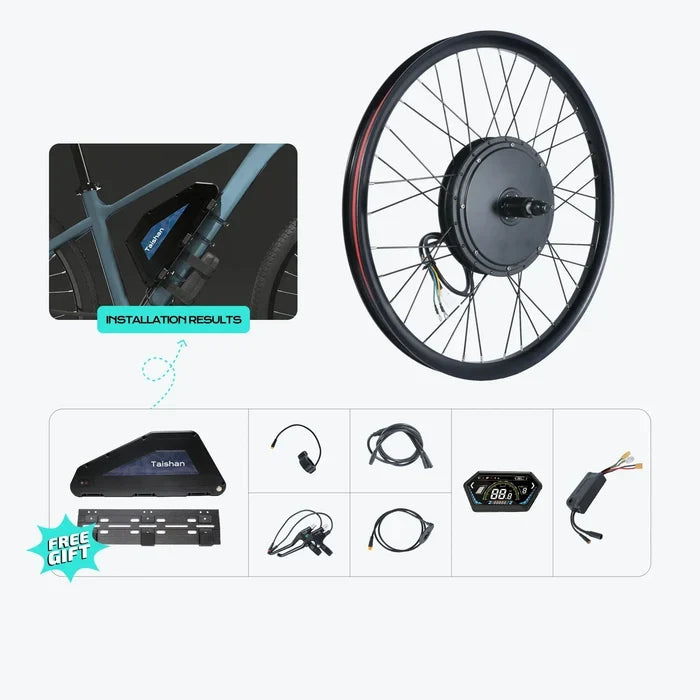
Motor construction complexity — High-power direct-drive hub motors use significantly more copper winding, larger magnets, and heavier-duty bearing assemblies than entry-level geared motors. A 4000W motor weighs 6.8kg for a reason; that mass represents raw materials and precision engineering that a 2.7kg 250W motor doesn't need.
Battery voltage and cell count — Higher power demands higher voltage. A 72V 20Ah battery contains far more cells than a 36V 7Ah unit—more lithium, more BMS complexity, a heavier casing rated for higher discharge currents. Cell brand matters enormously here: LG cells in Kirbebike's batteries deliver verified chemistry and consistent 1,000+ cycle lifespans that generic cells simply don't provide.
Controller capability — High-current controllers handling 60A+ require more robust components, better thermal management, and more sophisticated protection circuitry than a basic 14A FOC unit. The controller must match the motor's peak current demands reliably under sustained load.
Rim and spoke specification — High-power motors on MTX-spec double-walled rims are built to handle the additional torque stresses that would stress standard single-wall rims. This is an engineering requirement, not a premium add-on.
The Kirbebike High-Power Range: What Each Tier Delivers
![]()

Rather than abstract wattage ranges, here's what actual performance tiers look like across the Kirbebike high power ebike kit lineup.
Entry High-Power: 48V 1000W
The 48V 1000W hub motor kit is technically the start of the performance range—not road-legal for UK public use, but representing a significant step up from road-legal 250W systems.
|
Spec
|
Detail
|
|
Motor
|
Brushless Direct Drive Rear, 1000W
|
|
Motor Weight
|
4kg (standard) / 6.2kg (all-black)
|
|
Battery
|
36V 13Ah–48V 11.6Ah
|
|
Speed
|
45-50km/h
|
|
Range
|
35-45km
|
|
Disc Brake
|
Yes
|
Who this suits: Riders wanting a meaningful performance step above road-legal systems for private land use, without committing to extreme wattage. The 1000W system is the most widely reviewed in the Kirbebike range, praised consistently for installation ease and all-round capability. A 48V 1000W electric bike delivers enough torque for most mixed-terrain private land riding without the weight or battery demands of higher-powered systems.
Mid High-Power: 1500W–2000W (Fat Tire and MTX)
This tier splits into two distinct product lines depending on tyre specification.
For fat tire builds:
|
Spec
|
Detail
|
|
Motor
|
1500W–2000W Brushless Direct Drive
|
|
Motor Weight
|
5.1–5.3kg
|
|
Battery
|
52V 20Ah
|
|
Speed
|
50-60km/h
|
|
Range
|
40-60km
|
For standard MTX rim builds (52V 2000W):
|
Spec
|
Detail
|
|
Motor
|
2000W Brushless Direct Drive Rear
|
|
Motor Weight
|
5.1–5.3kg
|
|
Battery
|
52V 25Ah / 30Ah options
|
|
Speed
|
50-60km/h
|
|
Range
|
40-60km
|
The 52V 2000W MTX kit is Kirbebike's highest-reviewed product across the entire range with 122 verified reviews. Customer feedback describes it as "reliable," "came quickly, all working," and "setup was rather easy." One customer reports their 52V 2000W e-bike as being their "pride and joy" for night rides and beach runs—a system they describe as the most reliable kit they've owned.
Serious Performance: 60V 2500W–3000W
Stepping into 60V territory represents a meaningful system-wide upgrade. Higher voltage means lower current for equivalent power—reducing heat in wiring and connectors while enabling higher continuous output.
|
Spec
|
Detail
|
|
Motor
|
2500–3000W Brushless Direct Drive Rear
|
|
Motor Weight
|
6.8kg
|
|
Battery
|
60V 20Ah
|
|
Speed
|
75-85km/h
|
|
Range
|
40-80km
|
How fast is 3000W in mph? At this power level, speeds of 45MPH+ become achievable—well beyond any road-legal limit and firmly in the private land / off-road category. This system suits serious off-road riders, land owners with extensive private trails, and performance enthusiasts who've graduated from lower power levels.
Extreme Performance: 72V 4000W
The apex of the Kirbebike high power ebike conversion kit range.
|
Spec
|
Detail
|
|
Motor
|
4000W Brushless Direct Drive
|
|
Motor Weight
|
6.8kg
|
|
Battery
|
72V 20Ah
|
|
Speed
|
75-85km/h (55MPH+)
|
|
Range
|
40-80km
|
|
Designed For
|
MTB and Fat Tire
|
A 72V system changes the character of the build completely. The higher voltage enables peak power outputs that feel qualitatively different to 48V systems—faster throttle response, stronger sustained torque on demanding terrain, and the ability to maintain performance when the battery is under high load.
How fast does a 72V 4000W ebike go? In real-world conditions, 55MPH+ is achievable. This is unambiguously a high-performance machine for private land use.
Beyond the Kit: The True Total Spend
![]()

The kit cost is the starting point, not the end point. Any honest answer to how much to spend on a high-power ebike kit must include these additional categories.
Brakes — Non-Negotiable
|
Kit Power
|
Minimum Brake Standard
|
Notes
|
|
1000W
|
Mechanical disc
|
V-brakes inadequate
|
|
1500W-2000W
|
Hydraulic disc strongly recommended
|
Speed and weight demand better stopping
|
|
2500W-3000W
|
Hydraulic disc required
|
No exceptions for this power level
|
|
4000W
|
Premium hydraulic disc
|
4-piston recommended
|
High-power builds achieve speeds where braking distance is a genuine safety issue. This is not where to economise.
Donor Bike Requirements
High-power kits generate significant torque at the rear dropout. The donor frame must be:
-
Steel or aluminium — no carbon fibre frames
-
Structurally sound — no cracked welds, damaged dropouts, or compromised tubes
-
Appropriate geometry — mountain bike geometry handles additional weight and power better than road or hybrid frames at higher power levels
-
Torque arm compatible — axle dropout must accept a torque arm to distribute motor forces safely
For 2000W+ builds specifically, a quality hardtail MTB is the appropriate donor platform. The suspension fork helps manage the additional weight of the front battery or controller, and MTB brakes are more readily upgradeable to hydraulic standards.
Tyre Upgrade
At 50-85km/h on private land, standard bike tyres with minimal tread are not appropriate. Budget for:
- Heavy-duty knobby tyres for off-road use
- Puncture-resistant construction given the additional load and speed
- Fat tyre fitment for the 1500W-2000W fat tire variant
Chain and Drivetrain
Under motor load at high power, chains wear significantly faster than under pedal-only use. Budget for:
- New chain before installation
- Replacement chains every 1,500-2,500km under heavy motorised use
- Cassette replacement when chain wear reaches replacement threshold
The Direct-to-Consumer Value Advantage
Understanding why Kirbebike's kits deliver exceptional performance-per-pound requires understanding how the market works. Traditional e-bike component retail involves manufacturer → importer → distributor → retailer → consumer, with each step adding margin. Equivalent electrical performance through this chain commands significantly higher prices.
Kirbebike sells directly. There are no intermediaries. The kit cost reflects manufacturing and shipping costs plus a reasonable margin—not four layers of distribution markup. This is why a 52V 2000W complete kit with an LG-cell battery ships from UK and US warehouses with free delivery and a 1-year warranty at prices that represent genuine value rather than retail-inflated cost.
Power Level Decision Framework
Use this framework to determine the right power tier for your needs:
Choose 1000W if:
- First high-power build with private land access
- Mixed terrain, moderate speeds
- Want the most widely-tested Kirbebike system
- Budget-conscious entry into performance territory
Choose 1500W-2000W if:
- Regular off-road riding on varied terrain
- Want fat tire capability
- Need sustained performance on climbs
- Comfortable with hydraulic brake upgrade
Choose 2500W-3000W if:
- Serious performance is the primary goal
- Access to extensive private trails
- Comfortable with full hydraulic disc setup
- Know how fast is 3000W in mph and want that capability
Choose 4000W if:
- Maximum performance is the only objective
- MTB or fat tire platform ready
- Fully committed to appropriate safety equipment
- Experienced with high-power e-bike systems
Conclusion
The right spend on a high power ebike conversion kit is determined not by an arbitrary budget ceiling, but by matching power tier to actual riding requirements and then building a complete system budget that includes brakes, donor bike preparation, and consumables.
Underspending on the kit and pairing it with inadequate brakes or a poor battery is consistently worse value than spending appropriately upfront. Kirbebike's direct-to-consumer model means that appropriate spend delivers more actual performance than equivalent retail spend elsewhere,
Frequently Asked Questions
Is a 1000W ebike kit legal in the UK?
No. UK EAPC regulations limit road-legal e-bikes to 250W continuous motor output with assistance cutting off at 25km/h. Any kit above 250W—including all 1000W systems—is for private land and off-road use only. Kirbebike's 250W kits are the appropriate choice for UK road legal operation.
How fast does a 48V 1000W electric bike go?
A 48V 1000W system typically reaches 45-50km/h (approximately 28-31mph) under normal conditions. Actual speed depends on rider weight, terrain gradient, and throttle/assist level used. For private land use, this represents a meaningful performance step beyond road-legal systems.
What battery do I need for a 2000W ebike kit?
A 2000W system requires a high-capacity, high-discharge battery. Kirbebike's 52V 2000W MTX kit pairs with a 52V 25Ah or 30Ah LG cell battery—the high capacity maintains range under power demand, and the LG cells deliver the discharge current the motor requires without voltage sag.
Do I need hydraulic brakes for a high-power ebike kit?
For 1500W and above, hydraulic disc brakes are strongly recommended; for 2500W+, they are effectively essential. The combination of motor weight, system speed, and terrain demands on high-power builds exceeds what mechanical disc or V-brake systems reliably manage.
Can any mountain bike be converted with a high-power kit?
Steel or aluminium hardtail MTBs are well-suited to high-power hub motor conversions. Carbon fibre frames are not appropriate due to the forces involved at the dropout. The donor bike should be in sound mechanical condition with appropriate dropout spacing and the ability to accept a torque arm.
: invalid url input)
usmile
Liquid error (snippets/blog-best-product line 36): product form must be given a product
Liquid error (snippets/blog-best-product line 59): product form must be given a product