A 750W kit is usually the more practical choice for moderate hills, mixed riding and riders who value efficiency. A 1000W kit makes more sense when the bike regularly faces heavier loads, steeper climbs or demanding private-land use — and the extra 250W never guarantees a fixed increase in speed. On KirbEbike’s kits there’s a twist that changes the whole question: both systems share the same 48V 25A controller, so the difference you’re buying is motor architecture — geared hub vs direct drive — not available power. This guide decides that question properly.
Use 750W for mostly flat or moderately hilly terrain, frequent pedalling, sensible range and standard components. Go to 1000W when the route involves regular steep climbs, high load from rider and cargo weight, and the battery, controller, frame, dropouts and brakes can handle the added strain. Neither qualifies as an ordinary EAPC for unrestricted public-road use in the UK; in the US the position depends on the federal definition plus state and local law. Confirm where you can legally ride before ordering.

750W Geared vs 1000W Direct Drive: the Quick Comparison
| Factor | 750W geared hub | 1000W direct-drive hub |
|---|---|---|
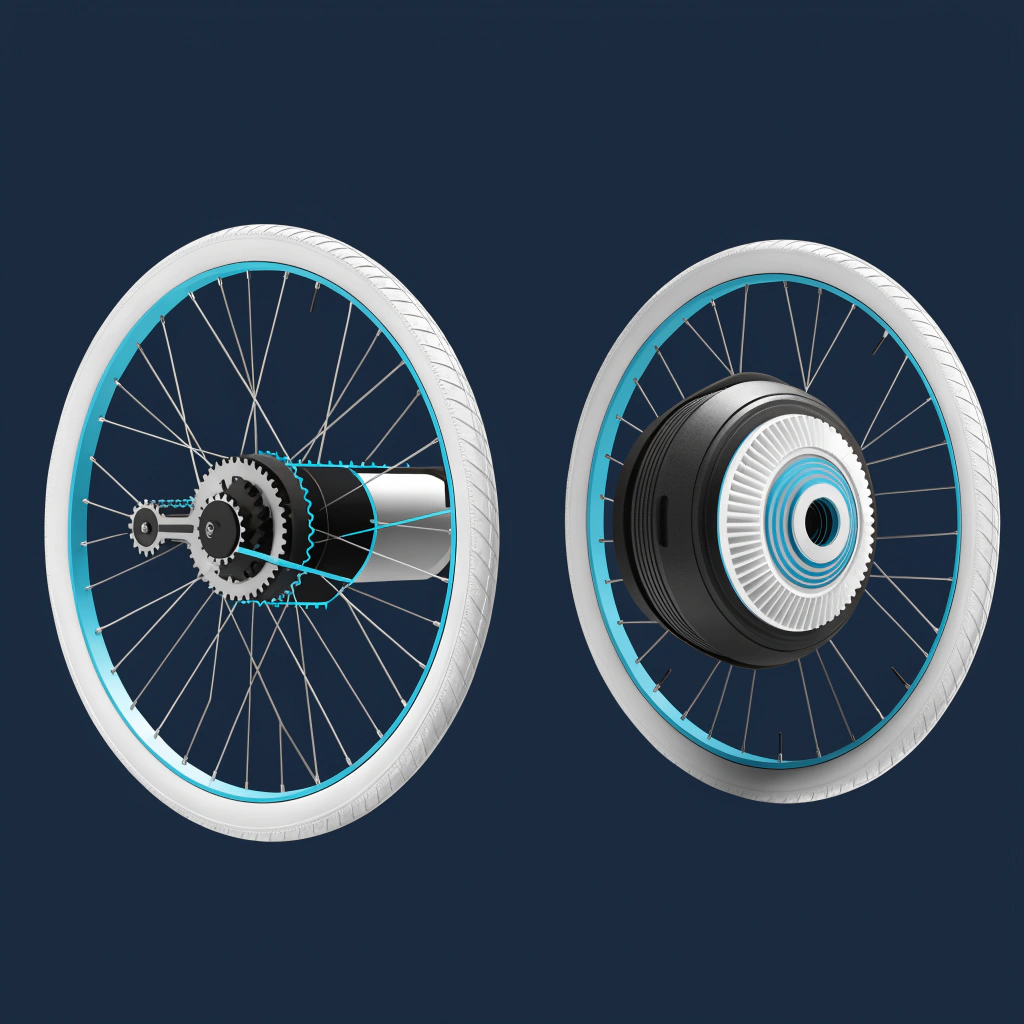
| Motor architecture | Internal planetary gearing between motor and wheel | Motor drives the wheel directly — no internal gears |
| Electrical ceiling (KirbEbike kits) | About 1,200W — the same 48V × 25A controller on both | |
| Low-speed pull | Stronger — gearing multiplies torque where wheel speed is lowest | Weaker from a standstill; it prefers to be moving |
| Sustained speed | Gears and motor work harder to hold a high steady speed | More comfortable holding a sustained speed |
| Heat under sustained load | Smaller thermal mass — heat builds faster on long full-power climbs | Larger thermal mass tolerates steady output well |
| Unpowered drag | Freewheels cleanly | Slight magnetic cogging when unpowered |
| Wear items | Internal gears and clutch are consumables | No internal gears to wear |
| Published mass | About 4 kg | About 4 kg standard; ~6.2 kg all-black variant |
| Best reason to choose | Stop-go riding, standing starts, short sharp climbs, lower weight | Steady long-distance running, sustained load, mechanical simplicity |
What Does 750W or 1000W Actually Mean?
The wattage on a motor is not a complete performance specification. Four different numbers get called “power”: continuous (rated) power is what the system sustains under stated conditions; peak power is the short-duration output the controller and battery allow; electrical input is voltage × current; and mechanical output is what reaches the wheel after losses. Never compare one product’s continuous rating against another’s peak claim.
The controller matters as much as the label. A 48V system at 20A draws about 960W and at 25A about 1,200W — which is why two kits with different labels can behave similarly, and two with the same label can behave differently. Grin Technologies’ analysis of motor ratings found the same nominal motor on a higher-current controller produced substantially more peak output, because controller current sets the low-speed force. Actual voltage also drops with state of charge and load, so these figures are limits, not constants.
Torque is not set by wattage either. Bafang’s own OEM catalogue illustrates this: its M615 mid-drive platform is listed in both 750W and 1000W with up to 160 Nm, while its H550W rear hub is listed in 750W and 1000W with 85 Nm and 100 Nm respectively. Identical wattages, very different torque — a generic torque figure should never be assumed from a label. (Those are OEM drive units for factory e-bikes, cited only to show how torque varies at a fixed wattage; the purchasable Bafang retrofit equivalents are the BBS02B and BBSHD mid-drives, compared later.)

Performance: Speed, Acceleration and Hills

How fast does a 750W kit go? There is no universal figure — battery voltage, wheel size, winding, controller programming, rider weight and position, tyres, gradient, wind, pedalling and any restriction all move the number. KirbEbike’s 500W/750W MTX rim kit lists a manufacturer-stated 35–45 km/h for that motor-wheel family.
How fast does a 1000W kit go? The extra rated power mainly improves acceleration and the ability to hold speed against hills, wind or load — it doesn’t buy a fixed top-speed increase, because aerodynamic drag rises sharply with speed. The 45–50 km/h KirbEbike gives for its 48V 1000W kit is a specification figure, not a guarantee.
Where the extra 250W shows most: carrying load, headwinds, pulling away from low speed, sustained climbs, large-diameter wheels, and holding assistance as battery voltage sags. At moderate pedal-assist on level ground, the two can feel very similar — neither is near its ceiling.
And motor type can matter more than the 250W: the 750W option is a geared hub, the 1000W a direct drive — two different characters, not just two numbers. A well-matched 750W mid-drive (like the torque-sensing TSDZ8 mid-motor kit) can climb more efficiently than a poorly matched 1000W hub, because it uses the bicycle’s gears.
Will a 1000W Kit Drain the Battery Faster?
Range follows energy used, not the label. Compare packs in watt-hours (voltage × amp-hours): 48V 15Ah = 720Wh, 48V 20Ah = 960Wh, 48V 30Ah = 1,440Wh. Then apply the formula once: estimated runtime ≈ usable energy (Wh) ÷ average draw (W), planning on roughly 85% of nominal reaching the road — a 960Wh pack is about 815Wh usable.
| Average draw during the ride | What that looks like | Planning band (960Wh pack, ~815Wh usable) |
|---|---|---|
| ~300–400W | Low PAS, active pedalling, flat ground | About 2–2.5 hours |
| ~500–600W | Moderate assist, mixed terrain | About 1.5–2 hours |
| ~750W | Sustained hard work — a long climb or heavy load | About 1 hour |
| ~1,000W | Near the ceiling; rarely sustained in practice | Under 1 hour |
| ~1,200W | The 25A controller limit — brief bursts only | Well under 1 hour |
Time bands, not range — calculated from usable energy, not measured. Turning hours into miles needs an assumed speed: 1.5 hours at 15 mph is ~22 miles; at 25 mph closer to 37 — but the higher speed raises the draw and shortens the band it came from. Measure your own consumption over a few rides and plan from that.
Why a 1000W kit can still return good range: it doesn’t draw 1000W continuously — at low PAS and moderate speed it uses far less. Given the same battery, route and effort, the two kits can consume similar energy; the 1000W loses its advantage mainly when the rider uses the extra output. Capacity and discharge current are separate specs too: a large battery is still unsuitable if its BMS can’t supply the controller’s current — browse kits and compatible batteries together rather than separately.
Is Upgrading From 750W to 1000W Just a Motor Swap?

Usually not. A conversion kit is one electrical and mechanical system, and raising the power raises the demand on every part of it:
- Battery — nominal and full-charge voltage, continuous and peak discharge current, BMS rating, connector and wire gauge, pack condition and charger compatibility. A 48V battery is not automatically suitable for every 48V controller.
- Controller and display — voltage range, continuous and maximum current, phase and Hall connections, display protocol, PAS and throttle compatibility, temperature protection. A controller change may also require a new display or harness.
- Motor and wheel — rated voltage and power, dropout width, axle dimensions, cassette or freewheel compatibility, rotor alignment, rim and spoke condition.
- Frame and torque restraint — frame material, dropout shape and thickness, axle flats, torque arm fit, fastener engagement and cable-exit clearance. The higher the current, the higher the torque, the greater the dropout stress — never force a motor axle into an unsuitable dropout.
What else must be upgraded for a safe 1000W build? The question isn’t whether the motor can make more power — it’s whether the whole bicycle can manage and stop it. Review the brakes (rotor diameter, pads, hydraulic vs mechanical, heat on descents, cut-off sensors) against total weight and speed; check tyre ratings, rim integrity, spoke gauge and axle torque; and treat ageing, damaged or lightweight frames — aluminium dropouts, carbon, suspension pivots — with suspicion. On delivery, favour smooth controller tuning over aggressive starts, and remember UK guidance warns that drive-system modifications can increase electrical load and overheating risk (GOV.UK battery guidance).
750W vs 1000W by Riding Environment
Power choice and legal environment can’t be separated, so this table is split by where the bike will actually be ridden:
| Where you’ll ride | Use case | Likely fit | Why |
|---|---|---|---|
| GB public road (EAPC) | Commuting, road riding, cycle paths | Neither at full rating | An EAPC is capped at 250W continuous with a 15.5 mph cut-off — use a compliant road-legal system instead |
| GB private land / registered vehicle | Steep or sustained climbs | Depends on architecture | Direct-drive 1000W holds power on long steady gradients; the geared 750W restarts more readily on short pitches; a mid-drive may beat both |
| GB private land / registered vehicle | Heavy rider, cargo or trailer | 1000W | More reserve for hill starts and mass — provided frame, dropouts, brakes and torque arms are engineered for it |
| GB private land / registered vehicle | Long steady off-road runs | 1000W | Direct drive is happiest holding sustained speed rather than restarting under load |
| US, subject to state and local law | Commuting and path use | 750W or below, then check locally | The federal product definition stops below 750W; state class rules and local path access decide the rest |
| Any market | Long-distance efficiency riding | 750W, or a limited 1000W | Watt-hours and pedal contribution matter more than rated power — both share the same 1,200W ceiling |
Recommendations are conditional on riding environment; nothing here overrides the legal position below. For cargo or trailer use, assess combined mass, hill starts, brake capacity, frame and rack ratings, voltage sag and sustained motor temperature.
Comparing Purchasable 750W and 1000W Kits
All of these are systems a rider can buy and fit to an existing bicycle, assessed on the same criteria and not ranked:
| Option | Motor type | Rated power | Sold as | Best suited to |
|---|---|---|---|---|
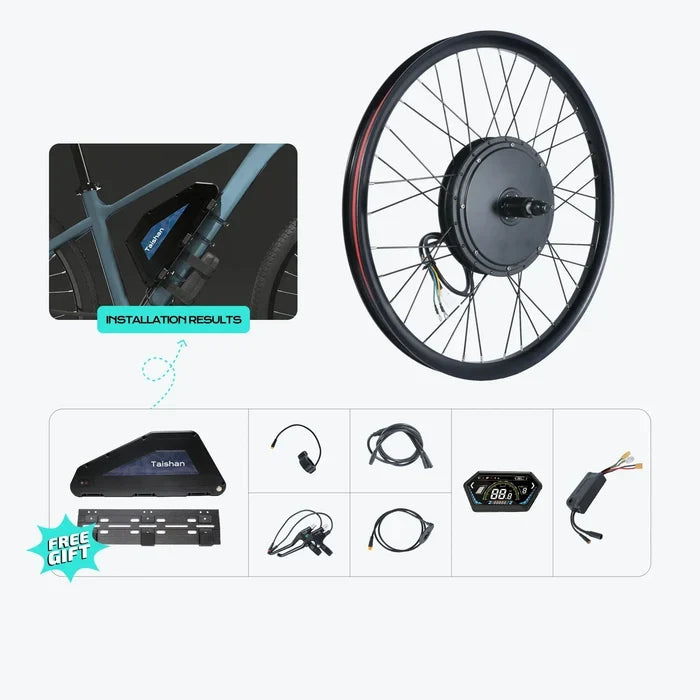
| KirbEbike 500W/750W MTX | Geared rear hub | 36V 500W / 48V 750W | Complete retrofit kit: 25A controller, display, PAS, throttle, e-brake levers, waterproof harness | Stop-go riding, standing starts, moderate hills |
| KirbEbike 48V 1000W | Direct-drive rear hub | 48V 1000W | Complete retrofit kit, same 25A controller and electronics | Sustained speed, longer steadier routes, private land |
| Bafang BBS02B | Mid-drive | 750W | Retrofit kit for 68/73mm BSA bottom brackets | Hill climbing through the bike’s gears |
| Bafang BBSHD | Mid-drive | 1000W | Retrofit kit — the heavy-duty option | Cargo and off-road builds where maximum torque matters |

The KirbEbike hub kits ship complete — pre-built motor wheel, 25A controller, colour display, PAS, throttle, e-brake levers and waterproof harness — with 135–142mm dropouts and cassette or 7-speed freewheel variants. Their stated limitation is that full-power configurations exceed UK EAPC road limits. The Bafang mid-drives drive through the gears, which helps on sustained climbs, at the cost of faster drivetrain wear, a more involved installation and a bottom-bracket compatibility check hub kits don’t require — and UK retailers note the BBSHD is likewise sold for off-road and private-land use only.
Are 750W and 1000W Kits Road-Legal?
UK: an ordinary EAPC must have working pedals, a motor rated no higher than 250W continuous, and assistance that cuts off by 15.5 mph. Neither kit meets that at full rating; outside EAPC rules a vehicle may be treated as a motorcycle or moped, requiring type approval, registration, tax, insurance, a licence and an approved helmet.
US: two separate layers, and conflating them is the most common mistake in US buying advice. The federal layer classifies a product: the CPSC’s low-speed electric bicycle definition covers a bike with operable pedals, a motor of less than 750W, and a motor-only top speed below 20 mph under stated test conditions (CPSC) — so a motor labelled exactly 750W or above sits outside it, and neither kit should be called “federally legal”. The state and local layers decide where you can actually ride: most states run a three-class system with their own caps, speed limits and path access (PeopleForBikes) — check your state, then the specific trails and parks you’ll use.
Private land and trails: the landowner’s permission is required, and trail managers can impose separate restrictions. Permission to be on the land is not permission to ride a high-power vehicle on it.
Common Mistakes When Choosing
- Choosing only by advertised top speed — claims depend on the test setup
- Comparing peak power with rated power — label both before concluding
- Reusing an underrated battery — expect BMS cut-outs, sag and hot connectors
- Assuming higher watts always climb better — motor type, wheel size, gearing and cooling decide
- Ignoring dropout and drivetrain fit — check wheel, axle, cassette/freewheel and brakes first
- Increasing power without reviewing the brakes
- Assuming a software limit makes any kit road-legal
- Running full throttle on every ride — it erases the range advantage and raises the heat load
Final Decision Checklist
- Where will the bicycle legally be ridden?
- What is the steepest regular climb, and how long is it?
- What is the combined rider, bicycle and cargo weight?
- Is the motor a geared hub, direct drive or mid-drive?
- What are the continuous and peak controller currents — and can the battery safely supply them?
- How many watt-hours are available?
- Will the motor axle fit the dropouts without modification, and are torque arms available?
- Are the brakes, tyres, wheel and frame appropriate?
- Is maximum power needed regularly — or would a 750W system with better gearing solve the same problem?
Conclusion: Which KirbEbike Variant Should You Order?
The honest headline: these two kits share more than the labels suggest. Both run the same 48V 25A smart controller, so both have an electrical ceiling of roughly 1,200W. The extra 250W of rated power doesn’t buy extra available power — it buys a different motor architecture. That is what you’re actually choosing between.
| Decision factor | 48V 750W (500W/750W MTX kit) | 48V 1000W kit |
|---|---|---|
| Motor architecture | SHENGYI geared rear hub | SHENGYI brushless direct-drive rear hub |
| Published motor mass | ~4 kg | ~4 kg standard; ~6.2 kg all-black wheel variant |
| Character under load | Gearing multiplies torque at low wheel speed — pulls away and climbs from a standstill readily; freewheels when off power | No internal gears — happier holding sustained speed; slight magnetic drag unpowered |
| Controller | 48V 25A smart controller, Bluetooth app tuning — ~1,200W ceiling on both | |
| Rear dropout fit | 135–142mm | 135–142mm (190mm on the 26″ fat variant) |
| Drivetrain variants | 7-speed threaded freewheel, or cassette 8/9/10/11-speed — fixed at purchase, not interchangeable | |
| Wheel sizes | 20″, 24″ (freewheel only); 26″–29″, 700C | 26″–29″, 700C; 26″ × 4.0 fat |
| Battery pairing | 36V 15Ah or 48V 20Ah — size on watt-hours and BMS current | From 48V 16Ah upward — the 25A controller sets the minimum BMS continuous rating |
| GB legal environment | Not an EAPC at full 750W | Not an EAPC at full 1000W |
| Order this one when… | Your route has frequent standing starts, stop-go traffic or short sharp climbs, and you want the lighter option that freewheels cleanly | Your route is longer and steadier, you hold speed for sustained stretches, or you want the mechanically simpler motor |
Built from the live product pages, checked July 2026 — confirm your exact configuration before ordering.
Two things decide most orders before architecture does. The drivetrain variant is fixed at purchase — a 7-speed threaded freewheel motor will not accept a cassette, so count the sprockets on your current rear wheel first. And the battery must supply what the 25A controller asks for: a pack whose BMS continuous rating sits below that will sag or cut out under exactly the loads you bought the kit to handle.
Check the Fit Before You Choose the Wattage
Measure your dropouts, wheel size, brakes and battery space, note your controller current, then match the kit to the route you actually ride — and confirm where it’s legal to use it.
Frequently Asked Questions
What is the difference between a 750W and 1000W conversion kit?
How fast does a 750W conversion kit go?
Is a 1000W e-bike much faster than a 750W?
Is 750W enough for steep hills?
Does a 1000W motor use more battery than a 750W?
Can I upgrade a 750W e-bike to 1000W?
Are 750W and 1000W conversion kits road-legal?
What are the disadvantages of a 1000W kit?
Sources
- GOV.UK — Riding an electric bike: the rules. gov.uk/electric-bike-rules
- GOV.UK — Battery safety for e-cycle users. gov.uk
- US Consumer Product Safety Commission — low-speed electric bicycle definition. cpsc.gov
- PeopleForBikes — state-by-state electric bike laws. peopleforbikes.org
- Grin Technologies — Understanding e-bike motor power ratings (technical analysis, cited unlinked).