Published 27 January 2026 · Updated 24 July 2026
· 9 min read
36V vs 48V E‑Bike Batteries: Which Voltage Is Right for You?
Unlock £10 Off Today
kirbEbike10
Copy successful
36V or 48V? Compare ride feel, hill performance, watt-hours, full-charge voltage and component compatibility before choosing your e-bike battery.
Choosing between a 36V and 48V e-bike battery is not simply a case of choosing the higher number. The right voltage must match the motor, controller and charger, then suit the way you ride.
36V vs 48V: the quick answer
Choose 36V for a lighter, usually more affordable system focused on everyday commuting, flatter routes and moderate assistance. Choose 48V when stronger acceleration, hill climbing or cargo capability matters more. For range, compare watt-hours (Wh)—not voltage alone.
Comparison
36V system
48V system
Best suited to
Commuting, leisure riding and flatter routes
Hills, heavier riders, cargo and stronger acceleration
Ride feel
Smooth, efficient and easier to keep lightweight
More responsive with greater performance headroom
Typical weight and cost
Usually lower for a comparable setup
Usually higher because the system and battery may be larger
Full-charge voltage
42V for a standard 36V lithium-ion pack
54.6V for a standard 48V lithium-ion pack
Range
Depends mainly on usable Wh, assistance level, speed, terrain, rider weight, tyre pressure and temperature
Compatibility
Battery, controller, display, motor rating and charger must support the same system voltage
Neither voltage is universally better: choose the matched system that fits your route, load and performance needs.
Compatibility comes before performance
Do not connect a 48V battery to a controller or display rated only for 36V. The extra voltage can trigger protection faults or damage components. Check the labels and manuals for the battery, controller, display and charger; if a component is marked “36/48V”, confirm that its settings and low-voltage cut-off support the battery you intend to use.
Important: use the charger supplied for the battery voltage and chemistry. A 36V lithium-ion battery normally charges to 42V, while a 48V lithium-ion battery normally charges to 54.6V. The chargers are not interchangeable.
Compare range with watt-hours, not voltage alone
Battery energy is calculated as volts × amp-hours = watt-hours. For example, a 36V 15Ah battery is 540Wh, while a 48V 15Ah battery is 720Wh. That does not guarantee 33% more real-world distance: a more powerful setup can also use energy faster. Compare Wh first, then account for assistance level, hills, speed, load, weather and tyre pressure.
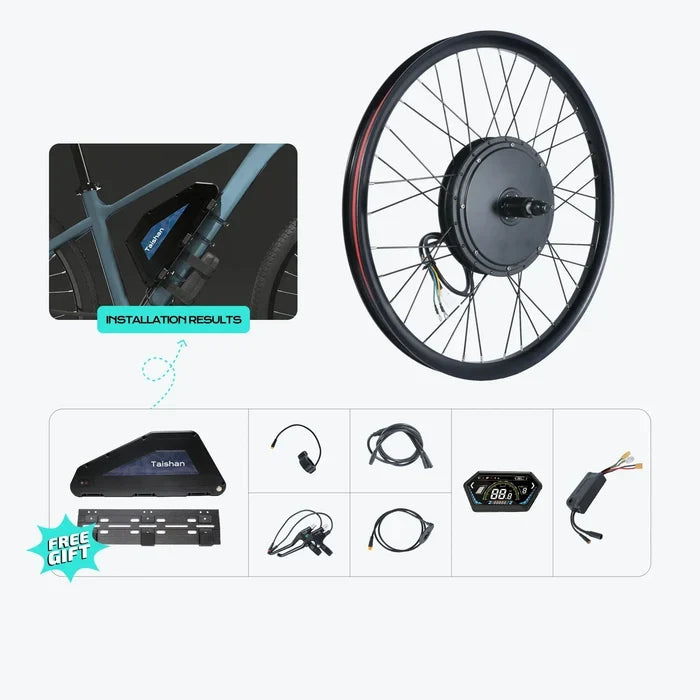
If you are building or upgrading a conversion, start with a complete matched system rather than choosing the battery in isolation. Explore KirbEbike’s electric bike conversion kits and compatible battery options, then confirm voltage, connector, mounting space and controller limits before ordering.
The Science Behind Battery Voltage
Battery voltage determines the electrical pressure pushing current through your motor. Higher voltage doesn't necessarily mean more power, but it does affect how efficiently that power gets delivered. Think of voltage as water pressure in a pipe—higher pressure moves water more effectively, just as higher voltage moves electrical energy more efficiently.
How Voltage Affects Motor Performance
Electric motors respond differently to varying voltages. A motor rated for both 36V and 48V operation will spin faster and deliver power more efficiently at 48V. This isn't about the motor working harder; it's about the system operating within a more optimal electrical range.
Key Performance Impacts:
Higher voltage reduces current draw for equivalent power output
Lower current means less heat generation in wiring and controllers
Reduced heat improves efficiency and extends component lifespan
Higher voltage systems maintain power better under load
36V Battery Systems: The Practical Choice
The36v ebike battery represents the traditional standard for e-bike conversions, particularly for commuters and casual riders. These systems offer reliable performance for everyday cycling without unnecessary complexity or expense.
Advantages of 36V Systems
Efficiency at Lower Speeds 36V batteries excel in the 15-25 km/h range typical of urban commuting. At these moderate speeds, the electrical efficiency differences between 36V and 48V become minimal, making the lower voltage perfectly adequate.
Legal Compliance Many regions regulate e-bikes by power output, often capping systems at 250W nominal power. A 36V 250W system naturally fits within these restrictions while delivering appropriate assistance for legally compliant riding.
Weight Considerations Lower voltage batteries with equivalent capacity typically weigh slightly less than their 48V counterparts. For riders prioritizing lightweight setups or those with weight-sensitive applications like folding bikes, this matters.
Cost Effectiveness 36V systems generally cost less across all components—batteries, controllers, and motors. For budget-conscious riders or those with basic needs, the savings add up without sacrificing essential functionality.
Ideal 36V Applications
Riding Style
Battery Capacity
Expected Range
Best Use Cases
Urban Commuting
10-13Ah
30-40km
Flat city streets, short trips
Leisure Riding
13-15Ah
40-60km
Recreational cycling, parks
Folding Bikes
7-10Ah
25-35km
Portability-focused applications
Legal Compliance
Any capacity
Varies
Road-legal requirements
The EZ Rider Kit with its 36V 7Ah battery exemplifies this approach—compact, legal, and perfectly suited to urban environments where portability and compliance matter more than raw performance.
48V Battery Systems: Enhanced Performance
The48v ebike battery has emerged as the performance-oriented standard, offering tangible advantages for riders who demand more from their electric assistance.
Why 48V Delivers Better Performance
Superior Hill Climbing Higher voltage translates to better sustained power delivery on inclines. A 48V 1000W system maintains consistent assistance up steep grades where a 36V equivalent would struggle or overheat.
Extended High-Speed Efficiency At speeds above 30 km/h, 48V systems operate more efficiently than 36V alternatives. The higher voltage reduces current requirements, minimizing resistive losses in wiring and components.
Greater Power Headroom 48V batteries support higher wattage motors without excessive current draw. This electrical headroom means cooler operation and better component longevity even during demanding rides.
Improved Range at Speed Counterintuitively, 48V systems often deliver better range than 36V batteries of similar amp-hour capacity when riding at higher speeds, thanks to improved electrical efficiency.
48V System Specifications
Common 48V Configurations:
48V 10Ah: Compact setup for moderate performance (35-45km range)
48V 16Ah: Popular balanced option (50-70km range)
48V 20Ah: Extended range for longer adventures (70-90km range)
The 48V 1000W conversion kits represent the sweet spot for many riders—substantial power for varied terrain, legal in many jurisdictions for off-road use, and compatible with standard bicycle frames.
Direct Performance Comparison
Understanding how these voltages compare in real-world scenarios helps clarify which suits your needs.
Speed and Acceleration
36V Performance Envelope
Top Speed: 25-35 km/h (depending on motor wattage)
Acceleration: Moderate, adequate for urban environments
Speed Consistency: Slight reduction on moderate hills
Best Operating Range: 15-30 km/h
48V Performance Envelope
Top Speed: 35-50 km/h (with appropriate motors)
Acceleration: Quick, responsive throttle response
Speed Consistency: Maintains speed even on steep grades
Best Operating Range: 20-45 km/h
Range Calculations
Range depends on multiple factors beyond voltage, but voltage affects efficiency at different speeds.
Scenario
36V 13Ah
48V 11.6Ah
Advantage
Flat urban (20 km/h)
50km
45km
36V (similar energy, better low-speed efficiency)
Mixed terrain (25 km/h)
40km
45km
Even (efficiency balances out)
Hilly routes (30 km/h avg)
30km
45km
48V (significantly better under load)
High-speed riding (35+ km/h)
25km
50km
48V (much more efficient)
These figures assume equivalent total energy storage (approximately 468Wh for 36V 13Ah vs 556Wh for 48V 11.6Ah), demonstrating how voltage impacts efficiency differently across riding conditions.
Motor Compatibility Considerations
Not all motors accept both voltages equally. Understanding motor-voltage relationships prevents mismatched components and disappointing performance.
Hub Motor Voltage Selection
Hub motors typically specify rated voltage, though many tolerate a range. A "48V motor" might actually operate acceptably from 36V to 52V, though performance varies significantly.
36V Hub Motors:
Optimized for 250W-500W applications
Lower maximum speeds
Adequate torque for flat terrain
Cooler operation at lower speeds
48V Hub Motors:
Support 750W-1500W power levels
Higher top speeds naturally
Better heat dissipation capabilities
More versatile across terrain types
Mid-Drive Motor Voltage
Mid-drive motors leverage bicycle gearing, making voltage selection less critical than with hub motors—but it still matters.
The Tongsheng TSDZ8 mid-drive system illustrates this perfectly:
36V 500W version: 140Nm torque, ideal for urban and moderate terrain
48V 750W version: Same 140Nm torque but with better high-speed efficiency and heat management
Both deliver equivalent climbing ability through gear leverage, but the 48V variant maintains assistance more consistently during sustained high-power demand.
Weight and Size Comparison
Physical dimensions matter for bike integration and handling characteristics.
Volume and Mass Differences
36V Battery Dimensions:
Typical 36V 13Ah: 350-380mm length, 1.8-2.2kg
Mounting: Fits standard downtube mounts
Center of Gravity: Favorable for handling
48V Battery Dimensions:
Typical 48V 16Ah: 380-420mm length, 2.4-2.8kg
Mounting: May require longer downtube space
Center of Gravity: Slightly lower due to larger pack
The weight difference remains modest—typically 400-600g for equivalent energy storage. This rarely affects handling noticeably but matters for portable applications.
Charging Time and Infrastructure
Both voltages charge at similar rates when using appropriately rated chargers, though absolute charging times differ due to capacity variations.
Charging Specifications
Battery Type
Typical Charger
Full Charge Time
Fast Charge Option
36V 7Ah
2A (72W)
4-5 hours
4A available
36V 13Ah
2A (72W)
7-8 hours
4A recommended
48V 11.6Ah
2A (96W)
6-7 hours
4A available
48V 16Ah
2A (96W)
8-10 hours
5A recommended
Universal Charging Compatibility: Both 36V and 48V systems use standard charging ports and protocols. Quality chargers include:
Over-charge protection
Temperature monitoring
Automatic shutoff at full capacity
Multi-region plug compatibility
Long-Term Cost Analysis
Initial purchase price tells only part of the financial story. Total ownership costs include replacement batteries, component wear, and efficiency losses.
Lifecycle Considerations
36V System Costs:
Lower initial investment across all components
Replacement batteries more affordable
Controller and wiring less expensive
Adequate performance for intended applications means no upgrade temptation
48V System Costs:
Higher initial investment but better performance value
Break-Even Analysis: For riders covering 100+ km weekly, 48V efficiency advantages can offset higher initial costs within 2-3 years through reduced charging frequency and longer component life. For occasional riders, 36V's lower entry cost makes more financial sense.
Making Your Decision
Selecting between 36V and 48V ultimately depends on matching system capabilities to your specific riding profile.
Choose 36V When:
Primary use involves flat urban commuting
Legal compliance requires lower power limits
Budget constraints prioritize affordability
Portability and weight matter significantly
Maximum speed expectations stay under 30 km/h
Annual mileage remains moderate (under 2,000km)
Choose 48V When:
Routes include significant elevation changes
Higher speeds improve commute efficiency
Off-road or trail riding factors into usage
Long-term performance satisfaction matters
Budget accommodates higher initial investment
Annual mileage exceeds 3,000km
Future upgrade potential appeals
Conclusion
The 36v vs 48v ebike battery decision fundamentally shapes your electric cycling experience. While 36V systems deliver admirable performance for urban commuting and casual riding at attractive prices, 48V batteries provide enhanced efficiency, superior hill-climbing, and better long-term versatility.
For those still uncertain, starting with a quality48V ebike battery system provides performance headroom that accommodates evolving needs, while 36V remains perfectly adequate for defined, moderate-use applications. Whichever voltage you choose, quality components and proper maintenance ensure years of satisfying electric-assisted cycling.
Frequently Asked Questions
Can I use a 48V battery with a 36V motor?
Not recommended. Over-voltage operation causes excessive heat, damages motor windings, and may destroy the controller. Always match battery voltage to motor specifications, or use a controller that supports multiple voltage ranges.
Which voltage gives better range per charge?
At equivalent energy storage (watt-hours), 48V typically delivers 10-15% better range at higher speeds due to improved efficiency. However, 36V may perform equally well at lower urban speeds where electrical losses remain minimal.
How does cold weather affect different voltages?
Both voltages experience similar percentage capacity loss in cold conditions (10-20% reduction below 10°C). However, 48V systems often handle the reduced capacity better since they started with higher performance margins.
Do 48V systems charge faster than 36V?
Charging time depends primarily on battery capacity (Ah) and charger output (A), not voltage. A 36V 13Ah and 48V 10Ah battery with 2A chargers take similar times despite voltage differences, as total energy storage is comparable.
Will higher voltage extend my motor's lifespan?
Generally yes. 48V systems draw lower current for equivalent power output, generating less heat in motor windings and electrical connections. Reduced heat stress typically extends component lifespan by 20-30%.
Can I upgrade from 36V to 48V later?
Technically possible but impractical. Voltage changes require replacing motor, controller, display, and battery—essentially a complete system rebuild. Choose appropriate voltage initially to avoid expensive conversions.
Which voltage is better for heavy riders or cargo bikes?
48V systems better suit heavier loads. The improved efficiency and power delivery maintain performance under high weight demands where 36V systems might struggle or overheat during sustained high-power operation.