That new grinding sound coming from your e-bike motor isn't something to ignore. E-bike motors are among the most reliable components in a conversion kit, often running thousands of kilometres without issues—but when noise or vibration develops, pinpointing the exact cause determines whether you need a five-minute tightening job or a bearing replacement.
This diagnostic guide covers every noise type you're likely to encounter on e-bike hub motors and conversion kits, from the frustratingly common to the genuinely serious.
First: Is the Noise Actually from the Motor?
![]()

Before diagnosing the motor itself, confirm the sound is coming from the right place. E-bikes have multiple noise sources that are routinely misidentified as motor problems.
Quick noise source identification:
Ride slowly and methodically test each theory:
-
Noise only when pedalling, disappears when coasting → Likely drivetrain (chain, bottom bracket, chainring) rather than motor
-
Noise when motor is engaged but not when freewheeling → Electrical issue or motor internals
-
Noise regardless of pedalling or motor engagement → Likely wheel bearings, loose spokes, or axle issues
-
Noise only at specific speeds → Resonance issue from loose component vibrating at a particular frequency
-
Noise only when braking → Brake pad alignment, not motor related
Spending two minutes on this test prevents unnecessary motor disassembly.
The Noise Diagnosis Chart
Use this reference before reading the detailed sections below.
|
Sound Type
|
Most Likely Cause
|
Urgency
|
DIY Fix Possible?
|
|
Metallic clicking (rhythmic)
|
Loose motor mounting bolts
|
Low
|
Yes
|
|
Grinding or rumbling
|
Worn hub bearings
|
High
|
Moderate
|
|
High-pitched whining
|
Geared hub internal gears
|
Medium
|
Partial
|
|
Buzzing/humming
|
Phase wire fault or controller
|
Medium
|
Yes (connections)
|
|
Creaking under load
|
Loose axle or dropout fit
|
Medium
|
Yes
|
|
Rattling
|
Loose motor cover screws
|
Low
|
Yes
|
|
Intermittent clunking
|
Torque arm not secured
|
High
|
Yes
|
|
Stuttering sound
|
Hall sensor fault
|
Medium
|
Yes (check wires)
|
Category 1: Mechanical Noises
Loose Motor Mounting Bolts — The Most Common Culprit
Vibration from normal riding gradually loosens mounting hardware on all motor types. On hub motors, this primarily means the axle nuts or quick-release skewers. On mid-drive motors like the Tongsheng TSDZ8 available from Kirbebike, the bottom bracket mounting bolts and crank arm fixing bolts are the priority.
Symptoms of loose mounting:
- Rhythmic metallic clicking that increases with speed
- Creaking particularly noticeable when applying power uphill
- Slight side-to-side movement visible in the motor when rocked by hand
Inspection and fix:
For hub motors:
- Check axle nuts (or quick-release tension) are fully tight
- Verify torque arm bolts are secure—torque arms prevent axle rotation in the dropout and are critical for high-power kits
- Apply thread lock (blue Loctite) to motor mounting bolts that have loosened more than once
For mid-drive motors:
- Check bottom bracket mounting bolts to specified torque (typically 40-50 Nm—use a torque wrench)
- Verify crank arm fixing bolts are correctly torqued
- Check chainring bolts and motor mount to frame interface
Important note for Kirbebike kits: The Tongsheng TSDZ8 mid-drive kit ships with thread lock already applied to the bolts—a detail that customers have specifically noted and appreciated. Replacing thread lock when re-tightening is good practice for long-term security.
Worn Hub Bearings — Requires Prompt Attention
Hub bearings are the most wear-prone internal component in any hub motor. They support the motor's weight and rotation while absorbing road vibration across thousands of kilometres. When they begin to fail, the noise progresses from a subtle roughness to an unmistakable grinding.
Sound characteristics:
- Deep rumbling or grinding that worsens under load
- Rough sensation when spinning the wheel by hand with the bike stationary
- Motor gets noticeably hotter than usual after moderate rides
Why e-bike hub bearings wear faster:
Hub motors on Kirbebike kits weigh between 4kg (1000W model) and 6.8kg (72V 4000W model)—significantly heavier than standard bicycle hubs. This constant load accelerates bearing wear, particularly on the non-drive side bearing that supports more of the motor weight.
Bearing replacement process:
This is a moderate DIY task requiring:
- Bearing puller or press
- Replacement bearings matching original specifications (check motor documentation)
- Bearing grease
- Basic workshop tools
Checking bearing condition without disassembly:
- Lift the wheel clear of the ground
- Grab the tyre on both sides and attempt to rock it side-to-side (perpendicular to the axle)
- Any play indicates bearing wear or loose axle nuts
- Spin the wheel with one hand—rough, gritty resistance indicates bearing damage
Internal Gear Noise on Geared Hub Motors
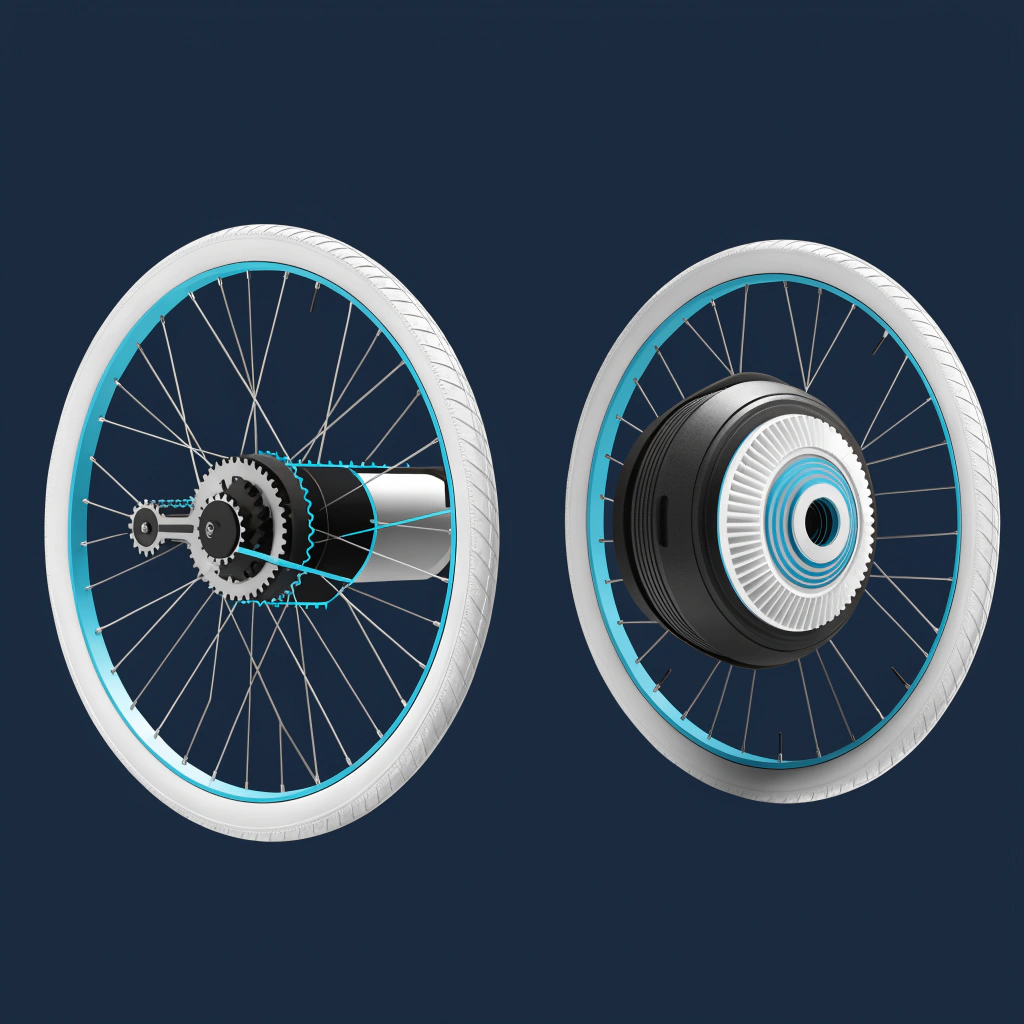
Geared hub motors (typically used in lower-wattage kits like 250W-500W systems) contain planetary gear reduction systems made from nylon or plastic gears. These offer advantages in efficiency and weight but are wear components with finite lifespans.
Geared vs. direct-drive noise characteristics:
Kirbebike's higher-power kits (1000W and above) use brushless direct-drive rear motors with no internal gears—significantly reducing this failure mode. The geared Shengyi motors in the 500W-750W MTX Rim kits do use internal gearing.
Signs of gear wear:
- Increasing whine that's proportional to motor speed (not wheel speed)
- Clicking that varies with throttle/assist level rather than road speed
- Gradual increase in noise over many months
Torque Arm Issues — A Safety-Critical Noise Source
The torque arm is a metal bracket that prevents the motor axle from rotating within the dropout under high torque loads. Missing, loose, or incorrectly installed torque arms cause a distinctive clunking under acceleration.
Why this matters beyond noise: A loose torque arm allows the axle to rotate, causing the motor cable to wind around the axle—a serious failure mode that damages wiring and can cause complete motor failure. On high-power kits (1000W+), unsecured torque arms also risk dropout damage to the bicycle frame.
Torque arm inspection:
- Locate the metal bracket bolted between the axle flat and the frame or fork
- Verify it's secured with an appropriate bolt (not zip ties alone)
- Check the axle flat engages properly in the dropout slot
- Ensure no movement between torque arm and frame mounting point
Mid-Drive vs. Hub Motor: Different Noise Profiles
Understanding which motor type you have helps focus diagnosis efficiently.
|
Noise Factor
|
Hub Motor
|
Mid-Drive (Tongsheng TSDZ8)
|
|
Main noise source
|
Bearings, loose mounting
|
Drivetrain, chainring, bottom bracket
|
|
Gear noise risk
|
Geared hubs only
|
N/A (no reduction gears)
|
|
Chain involvement
|
Minimal
|
Direct—chain wear affects motor performance
|
|
Typical fix complexity
|
Motor disassembly
|
Drivetrain service
|
|
Noise from drivetrain wear
|
Indirect
|
Significant and direct
|
Mid-drive systems are fundamentally more connected to drivetrain condition. A noisy mid-drive kit often needs drivetrain service—chain replacement, cassette inspection, and chainring check—rather than any work on the motor itself.
The Tongsheng TSDZ8 motor in Kirbebike's mid-motor kit includes a 38T aluminium chainring designed for optimum engagement, but chain compatibility and condition remain critical maintenance items.
Preventive Maintenance: The Quiet Bike Schedule
![]()

Prevention costs far less than repair. This maintenance schedule keeps noise from developing in the first place.
After every 200km or monthly:
- Check all motor mounting bolts for tightness
- Inspect torque arm security
- Listen for bearing condition change (informal comparison)
- Lubricate chain
Every 500km:
- Check spoke tension on motor wheel
- Inspect motor cable at exit point for wear
- Check motor cover screws
- Clean and inspect phase connectors
Every 1,000km or annually:
- Full bolt inspection with torque wrench
- Check bearing condition by wheel rocking test
- Inspect PAS sensor alignment and magnet condition
- Clean all electrical connectors and apply fresh dielectric grease
Conclusion
Most e-bike motor noise issues fall into predictable, fixable categories—and most are solved without motor disassembly. The systematic approach of identifying the noise type, testing whether it's load-dependent or speed-dependent, and working through the mechanical causes before electrical causes resolves the majority of cases efficiently.
Regular maintenance prevents most noise issues from developing at all; Kirbebike customers regularly report 14,000+ miles on their kits, demonstrating that well-maintained motors run quietly for years. For riders whose noise issues point toward needing a fresh start or an upgrade to a more powerful system, explore the full range of Kirbebike conversion kits and batteries to find the right fit for your riding needs.
Frequently Asked Questions
Why does my e-bike motor make a noise only when I'm pedalling hard uphill?
Load-dependent noise is typically caused by loose mounting bolts or an unsecured torque arm—both allow micro-movement between the motor axle and dropout that becomes audible under high torque. Check all motor mounting hardware and torque arm security before investigating internal components.
Is some motor noise normal on a new e-bike conversion kit?
A very faint hum from direct-drive hub motors is entirely normal—it's the electromagnetic coils operating. Geared hub motors produce a slightly more noticeable whirring sound from internal gearing. What isn't normal on a new kit is grinding, clunking, clicking, or irregular buzzing. If your new kit makes unexpected sounds from day one, check all installation connections before assuming a fault.
My motor runs silently alone but vibrates when the battery is low. Why?
Low battery voltage causes the controller to deliver inconsistent current to the motor phases, resulting in rough power pulses that create vibration. This is particularly noticeable on direct-drive motors. The vibration typically disappears when battery is adequately charged. If it persists with a full battery, check phase wire connections.
How do I know if my hub motor needs bearing replacement or complete motor replacement?
If the motor runs smoothly (no electrical faults) but has bearing noise, bearing replacement is the economical choice. If the motor has multiple issues—grinding bearings, electrical faults, and physical damage—replacement makes more sense. As a guide, bearing replacement costs a fraction of motor replacement and extends motor life by thousands of kilometres when done before bearings completely fail.
Can I reduce motor noise by changing controller settings?
Some noise reduction is possible through controller tuning on programmable systems. Reducing maximum current reduces electromagnetic "cogging" at low speeds. Adjusting PAS sensitivity reduces abrupt power delivery that amplifies noise. However, controller settings cannot fix mechanical issues—bearing grinding and loose bolts require physical repair regardless of software settings.
: invalid url input)
usmile
Liquid error (snippets/blog-best-product line 36): product form must be given a product
Liquid error (snippets/blog-best-product line 59): product form must be given a product