The best donor bike is not the most expensive one. It is a correctly sized, structurally sound used bike that needs few repairs and leaves a clear path for the motor, battery and brakes. This guide is the buying half of the conversion decision: how to cost a used bike honestly, how to reject unsuitable ones in ten minutes, what each frame material really means, and the red lines that end an assessment on the spot — whatever the asking price.
For most first conversions, start with a well-maintained used hardtail mountain bike or hybrid that fits the rider, has no structural damage and needs only routine service. A cheap bike that requires wheels, brakes and drivetrain parts is not a bargain. Inspect and price the bicycle before choosing a kit: confirm ownership, crash history, frame and fork condition, braking, wheel health and repair cost first. Only after the bike passes should you measure the motor interface, axle, battery space and legal configuration.

Before You Look at Bikes: The True-Cost Comparison
A cheap donor is only cheap if it does not need a second bike’s worth of work. Cost the finished, rideable bike — not the asking price — and compare it against the two alternatives before you commit. Do this arithmetic first and most unsuitable bargains rule themselves out.
| Cost line | Cheap donor (needs work) | Better donor (sound) | Complete e-bike |
|---|---|---|---|
| Purchase | Low | Higher | Highest |
| Immediate service and repairs | Bearings, cables, hubs, headset, bottom bracket — the usual reason it was cheap | Routine service only | None |
| Brakes | Often a full upgrade at conversion power | Pads, possibly rotors | Included and matched |
| Tyres | Frequently due, and load rating must suit the finished mass | Possibly due | Included and matched |
| Drivetrain | Chain, sprockets, sometimes shifter and derailleur | Chain and sprockets | Included |
| Battery mounting hardware | Extra if the frame has no suitable mounts | Usually straightforward | Integrated |
| Conversion kit and battery | Same either way | Same either way | n/a |
| Installation, if not self-fitted | Higher — more to put right first | Lower | n/a |
| Ride-ready total | Often the highest of the three | Usually the lowest | Predictable, with one warranty |
| What you carry afterwards | Unknown history, split warranty, ageing parts | Known condition, one kit warranty | Single warranty, no fitting risk |
Indicative comparison, not a quotation — fill in real local prices for the specific bike in front of you. The pattern holds more often than buyers expect: repairs on a poor donor routinely exceed the price gap to a sound one.
Two things to establish before money changes hands
Proof of ownership and a serial check. Photograph the frame number and check it against a stolen-bike register (BikeRegister is the common UK one) before paying. Ask for the original receipt or purchase record, and be wary of a seller who cannot say where the bike came from, will only meet away from an address, or has removed or defaced the frame number — a missing serial is a walk-away on its own.
Service history and crash history. Ask directly what has been replaced and when, whether the bike has been crashed, and whether any part of the frame or fork has been repaired or repainted. A bike with records is easier to assess and easier to price. No records is not automatically a rejection, but it means the inspection below carries all the weight — and it strengthens the case for a professional assessment before you fit a high-load system.
Best Used Bikes for an E-Bike Conversion
Choose the donor by fit, condition and standards, not by brand name or frame material. Suitability assumes good condition; a neglected example drops a grade, and the red gates below override every row.
| Donor type | Suitability | Best route | Main advantage | Main risk |
|---|---|---|---|---|
| Hardtail MTB | Excellent | Rear hub or mid-drive | Strong wheels, tyre clearance, simple frame | Suspension fork and axle standard |
| Hybrid / commuter | Excellent | Front or rear hub | Common standards, efficient on road | Narrow tyres, light-duty brakes |
| Steel touring bike | Very good | Hub or mid-drive | Rack mounts, stable, serviceable | Older wheel and drivetrain standards |
| Road bike | Conditional | Light front hub or specialist | Low weight, efficient | Tight clearances, lightweight parts |
| Folding bike | Conditional | Model-specific front hub | Compact transport | Narrow fork, fold and battery clearance |
| Full-suspension MTB | Difficult | Mid-drive or specific system | Comfort and control | Battery space, linkage, ground clearance |
| Carbon frame or fork | Only with written approval | An exact combination approved in writing by the frame manufacturer and the system manufacturer, after professional inspection | Low original weight | Carbon has no safe generic route: clamping and point loads can fail without visible warning, and impact damage is often invisible. Without documented approval, treat it as do-not-convert |
| Department-store bike | Judge by condition — often reject | Only if it clears every gate | Cheap to buy | Reducing power does not make a poor frame, fork, wheel or brake safe. Reject outright for cracks, damaged dropouts, weak brakes with no upgrade path, unstated load ratings or unavailable parts |
Torque-arm requirements scale with power — on aluminium dropouts a correctly fitted torque arm is part of the specification, not an optional extra.
The Preliminary Rejection Screen
This is a ten-minute screen designed to reject unsuitable bikes quickly at the roadside or in a seller’s garage. It cannot approve one. Ten minutes cannot rule out hidden carbon damage, frame misalignment, worn or pitted bearings, internal corrosion or structural fatigue — all of which need the bike stripped, cleaned and inspected properly.
Start with provenance and fit: confirm the frame number and check it against a register, then confirm standover clearance, reach and saddle height. A bike that does not fit you will not become comfortable once it is heavier and faster.
Hardtail MTB vs Hybrid: Which Is the Better Donor?
| Factor | Hardtail MTB | Hybrid / commuter |
|---|---|---|
| Tyre clearance | Usually generous | Moderate |
| Rough surfaces | Better | Roads and light gravel |
| Battery space | Usually good | Often good |
| Brakes | Commonly disc | Varies by model |
| Rolling efficiency | Lower on knobby tyres | Usually higher |
| Hub-motor fit | Straightforward on older QR models | Often straightforward |
| Thru-axle risk | Increasingly common | Common on higher-end models |
✓ Choose a hardtail when…
- Your riding includes rough gravel and tracks
- You want wider tyres and a rear hub or mid-drive
- You need a roomy front triangle for the battery
- Disc brakes matter for the finished weight
✕ Choose a hybrid when…
- The riding is mostly paved commuting
- Lower rolling resistance matters more than clearance
- A moderate front or rear hub covers the job
- Rack and mudguard mounts are on the list
Do not over-generalise: a neglected hardtail is a worse donor than a sound hybrid, so compare the two bikes in front of you rather than the categories.
Steel vs Aluminium vs Carbon Donor Frames
Steel is easy to inspect, common on older rigid MTBs and tourers, often has a generous triangle and can be repaired by a specialist. Watch for hidden internal rust, obsolete standards and dented tubing — being steel does not make a damaged tube safe. Aluminium makes a good donor when the frame is undamaged, the dropouts are sound and motor torque is managed with the correct torque arm. The claim that aluminium cannot take a hub motor is wrong; so is the claim that it can take one without torque restraint.
Carbon is conditional rather than banned: it needs written approval from both the frame maker and the system supplier, no crash history, no clamping on unapproved areas and no filing, because impact damage is often invisible. Titanium, magnesium, bonded and custom frames warrant a word with the original builder. Condition, dropout construction and the chosen motor matter more than the material name.
Frame Inspection: What to Check Before You Buy
Clean the frame first, because dirt hides hairline cracks, corrosion, dents and lifting paint. Then work through the high-stress areas:
- Head-tube junctions, bottom-bracket shell and seat-tube junction
- Chainstays, seatstays and both sets of dropouts
- Brake mounts, rack mounts, suspension pivots — and alignment: rear wheel centred, fork legs parallel, straight derailleur hanger
- Signs of undocumented repair: ground-down welds, paint mismatched at one joint, epoxy patches, unexplained carbon wrap, distorted dropout faces
Confirm Compatibility Only After the Bike Passes Inspection
This guide helps you decide whether a used bicycle is worth buying — it does not repeat the full conversion-fit process. Once the bike passes the condition and repair-cost checks, measure the motor interface, wheel and axle standard, battery position, braking and legal configuration against the wheel and dropout reference. A seller’s claim that a bike is “standard” is not enough: record the tyre marking, axle type, dropout spacing, brake type and usable frame space before choosing a kit.
Best Donor Bike by Riding Purpose
Purpose narrows the donor faster than category alone. Every row still depends on the bike passing the gates below.
| Purpose | Strong candidate | Useful route | Main checks |
|---|---|---|---|
| GB road-legal commuting | Hybrid, commuter or rigid MTB | A compliant 250W system such as the 250W front-wheel kit — see the note below | A 250W label alone proves nothing. Brakes, tyres and battery mount must also suit the finished bike |
| Hilly commuting | Geared hybrid or hardtail | A compliant 250W hub — the EZ Rider kit pairs one with a 792Wh dual pack — or a suitable mid-drive | Gearing, motor heat, brake condition |
| Light gravel | Hardtail or wide-tyre hybrid | Rear hub — the 500W/750W MTX kit is the mixed-terrain example — or mid-drive | Tyre clearance, wheel strength |
| Technical trails | Quality hardtail or full suspension | Mid-drive or matched rear hub | Suspension, brakes, clearance |
| Cargo and delivery | Touring, cargo or strong hybrid | Rear hub or mid-drive | Rack and frame load rating, brakes, capacity |
| Private-land performance | Strong MTB-style donor | A higher-power hub such as the 48V 1000W kit — not road-legal at full output | Frame, brakes, torque restraint, tyres |
Donor-Bike Gates: Red, Amber, Green
Donor bikes are not well served by a score out of 100: a total implies weighting and validation that no screening tool can honestly claim, and a bike with one fatal fault can still score well. Gates are harder to misapply. Work through red first — a single red ends the assessment, whatever else is good about the bike.
| Gate | What it means | Criteria |
|---|---|---|
| RED — reject | Automatic failure. No wattage reduction, torque arm or repair budget changes this. | Any crack, dent or deep structural corrosion in frame or fork · bent, twisted or previously repaired fork · damaged, opened-out, cracked or filed dropouts · frame misalignment · undocumented structural repair, ground-down welds or mismatched paint at one joint · no dependable braking and no viable upgrade path · no secure manufacturer-specified battery mounting location · an axle standard that cannot be matched · carbon frame or fork without written approval from both manufacturers · no serial number, or a serial that fails a register check · repair cost approaching a sound donor or a complete e-bike |
| AMBER — resolve first | Not a rejection, but not a green light. Each item needs a professional opinion, a quote, or written confirmation. | Unknown service and crash history · worn bearings, headset or bottom bracket · brakes adequate now but marginal at conversion power and mass · tyres whose load rating is unconfirmed · obsolete or hard-to-source wheel, drivetrain or brake standards · suspension fork of unknown condition · aluminium dropouts needing a torque arm you have not yet confirmed · battery space tight or mounting needing extra hardware · rack or frame load rating unstated for cargo use |
| GREEN — inspect fully | Worth paying a professional to assess, and worth measuring for a kit. | Sound, clean, crack-free frame and fork with documented history · dropouts undamaged and matched to an available motor interface · brakes in good order and rated for the intended mass and speed · tyres with a suitable load rating · current, serviceable wheel and drivetrain standards · a clear, manufacturer-specified battery mounting location with a removal path · the bike fits you |
KirbEbike screening heuristic, not a standard or a certification. Red items are absolute; amber items must each be resolved before purchase; green means the bike has earned a proper inspection — not that it is approved for conversion.
Donor Bikes and Buying Mistakes to Avoid
| Mistake | Why it costs you |
|---|---|
| Buying on brand reputation | Condition and standards decide suitability, not the badge |
| Assuming aluminium cannot be converted | It can, with the correct torque arm and sound dropouts |
| Buying a thru-axle bike for an open-dropout motor | Closed dropouts will not take a bolt-on axle |
| Ignoring battery dimensions | A pack that does not fit becomes a rack build or a return |
| Forgetting freewheel or cassette | The wrong interface strands a rear-hub build |
| Buying power before inspecting wheels and tyres | The weakest part decides the safe limit |
| Treating strap mounting as a minor issue | It is an automatic fail — no acceptable mounting location means no conversion on that frame |
| Buying a carbon bike expecting a generic kit to fit | Without written approval from both manufacturers, it is a do-not-convert |
| Choosing the cheapest bike | Lowest ride-ready total is the figure that matters, not the asking price |
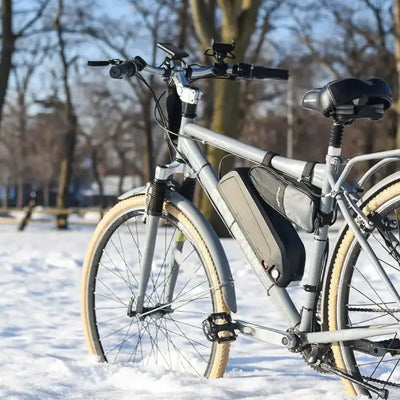
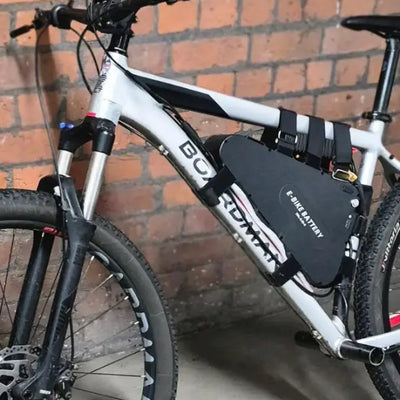
Battery Mounting Is an Automatic Fail, Not a Minor Warning
A pack slung on straps, cable ties or bungees is not a mounting solution, and it is not a detail to fix later. Battery mass sits high and moves with every bump; a mount that works in the driveway can shift, chafe, contact a moving part or drop the pack on the road. If the donor bike has no acceptable mounting option, that is a rejection.
Six requirements — all of them:
- A manufacturer-specified rail, bracket or approved mounting solution — not an improvised one
- Rated fasteners into designed frame mounts, correctly torqued, with load spread rather than concentrated
- Cable strain relief at the pack so no load reaches the connector
- Clearance from moving parts — cranks, tyre, suspension through full compression, and the chain
- Clearance from hot parts, including the motor and any controller
- A demonstrated removal path: the pack must come out for charging repeatedly, in the frame as built, without straining the cable or fouling the frame

Conclusion: Buy the Donor on Condition, Not the Badge
For most riders, the strongest used donor is a sound hardtail or hybrid with common parts, dependable brakes and a repair bill that still leaves the complete project good value. Brand prestige and purchase price do not compensate for damage, poor fit or obsolete standards.
Inspect the frame and fork before measuring the motor interface. Then check wheels, brakes, battery position, drivetrain and repair cost, because a bike needing new brakes, wheels and gears can erase the saving. Match the motor type to the bicycle rather than the reverse, and where axle, brake or structural compatibility stays uncertain, get written confirmation from the supplier before ordering. Keep the battery and charger matched throughout — government battery-safety guidance for e-cycle users is explicit on that point.
A Good Donor Makes the Rest Easy
Fit, frame condition and standards first. Power last. Once the bike earns a green gate, measure it properly and match the kit to what you actually own.
Frequently Asked Questions
What is the best bike for an e-bike conversion kit?
What is the best bike frame for an electric conversion?
What should I check before buying a used donor bike?
Is a hardtail mountain bike better than a hybrid for conversion?
When should I walk away from a donor bike?
How much should I budget for a donor-bike conversion?
Sources
- GOV.UK — Riding an electric bike: the rules. gov.uk/electric-bike-rules
- GOV.UK — Electrically assisted pedal cycles in Great Britain: information sheet. gov.uk
- GOV.UK — Battery safety for e-cycle users. gov.uk/battery-safety
- UK Office for Product Safety and Standards — Statutory guidelines on lithium-ion battery safety for e-bikes. gov.uk
- London Fire Brigade — Electric bicycle conversion kits. london-fire.gov.uk
- Park Tool — Tire, wheel and inner tube fit standards. parktool.com
- Park Tool — Determining cassette and freewheel type. parktool.com/cassette-freewheel
- Park Tool — Wheel removal and installation. parktool.com/wheel-removal
- BikeRegister — UK stolen-bike register (cited unlinked).