The question of legality surrounding high-power e-bike conversion kits generates considerable confusion among prospective buyers. While 1000W and 2000W systems offer exhilarating performance and exceptional hill-climbing capabilities, their legal status varies dramatically depending on where you live and how you intend to use them.
Understanding these distinctions before purchasing ensures you make an informed decision that aligns with both your performance needs and legal obligations.
Understanding Power Ratings and Legal Thresholds
![]()

What Motor Wattage Actually Means
Motor wattage represents the power output capacity of your conversion kit's motor. A 1000W motor can theoretically produce 1000 watts of continuous power, while a 2000W system doubles that output. However, the relationship between rated power and actual performance is more nuanced than simple numbers suggest.
Peak vs. Continuous Power:
- Rated wattage typically refers to continuous power output
- Peak power can exceed rated power by 50-100% during acceleration
- Controllers regulate actual power delivery to the motor
- Real-world performance depends on voltage, current, and efficiency
This distinction becomes legally significant because some jurisdictions regulate based on rated power, while others focus on actual performance capabilities or maximum speed.
United Kingdom: Strict 250W Limitation
![]()

UK Legal Requirements
The United Kingdom maintains some of the strictest e-bike regulations in the world. For a converted bicycle to qualify as an Electrically Assisted Pedal Cycle (EAPC) and avoid motor vehicle classification:
UK Legal Standards:
- Maximum 250W rated motor power
- Speed assistance limited to 15.5 mph (25 km/h)
- Motor assists only when pedaling
- Throttle restricted to walk-assist up to 3.7 mph (6 km/h)
Neither 1000W nor 2000W conversion kits meet these requirements. Installing such systems on bicycles in the UK transforms them into motor vehicles requiring:
✗ Vehicle registration and number plates
✗ Motor insurance
✗ Valid driving license (Category A1 minimum)
✗ MOT testing where applicable
✗ Road tax
✗ Type approval certification
Practical Implications for UK Riders
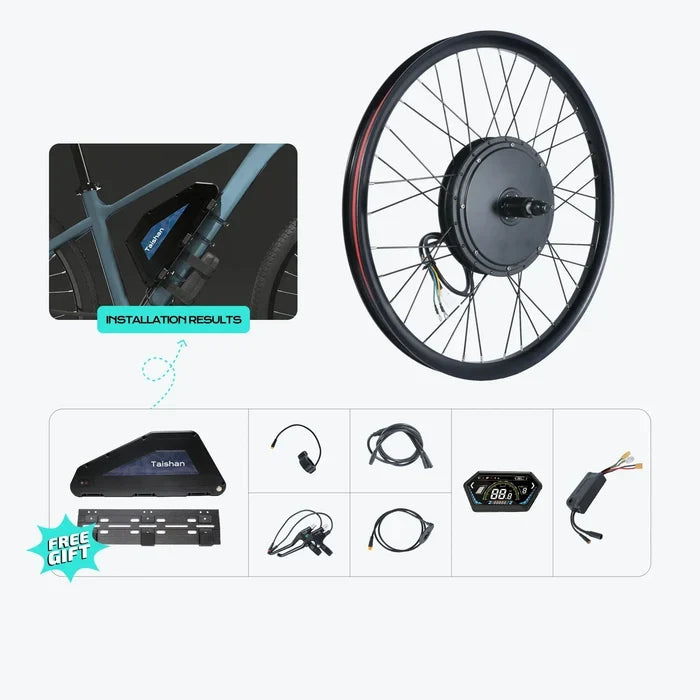
The 48V 1000W conversion kit and 52V 2000W systems available through various suppliers cannot legally operate on UK public roads without full motor vehicle compliance. This creates several practical considerations:
Private Land Use: These systems remain legal on private property with landowner permission, making them suitable for farms, large estates, and private trails.
Off-Road Recreation: Dedicated off-road facilities that don't require road-legal vehicles can accommodate high-power conversions.
Modification Potential: Some riders purchase higher-power systems with the intention of programming controllers to limit output to legal levels, though authorities may still view the motor's maximum capability as non-compliant.
European Union: Similar Restrictions
EU EPAC Standards
The European Union follows regulations closely aligned with UK requirements through the EN 15194 standard:
|
Requirement
|
Legal Limit
|
|
Motor Power
|
250W maximum continuous rated
|
|
Speed Limit
|
25 km/h assistance cutoff
|
|
Operation
|
Pedal-assist only
|
|
Throttle
|
Not permitted above 6 km/h
|
Country-Specific Enforcement:
Germany enforces these limits rigorously, with substantial fines and potential criminal charges for non-compliant systems. France and the Netherlands maintain similar standards but vary in enforcement strictness. Spain's regional variations create additional complexity.
Speed Pedelec Category
The EU recognizes a "speed pedelec" category for higher-performance e-bikes, but even this classification caps motor power at 4000W theoretical maximum with 500W typical, and these vehicles require:
- Type approval certification
- Registration and insurance
- Helmet (specific standards required)
- Minimum age restrictions
- License plate
Neither 1000W nor 2000W conversion kits typically meet speed pedelec requirements without extensive documentation and compliance testing.
United States: Complex State-by-State Regulations
![]()

Federal Guidelines
At the federal level, the Consumer Product Safety Commission defines low-speed electric bicycles as having:
- Motor power of 750W or less
- Maximum speed of 20 mph on motor power alone
- Fully operable pedals
This federal definition provides a baseline, but states maintain authority to impose additional regulations.
The 1000W Question in the US
States Where 1000W May Be Legal:
Several states have adopted regulations that either explicitly allow motors exceeding 750W or maintain flexible enforcement:
Texas: Generally permissive regulations with 750W nominal limit but flexible interpretation of peak vs. continuous power. Many riders operate 1000W systems without issues.
California: Three-class system technically limits motors to 750W, but enforcement focuses primarily on speed rather than precise wattage measurements. Some riders use 1000W systems programmed to comply with speed limits.
Florida: Follows federal guidelines with 750W limit and 20 mph standard, but enforcement varies significantly by locality.
Arizona: Relatively permissive e-bike laws with minimal enforcement of specific wattage limits when speed requirements are met.
The 2000W Reality in the US
Explicit Non-Compliance:
A 52V 2000W conversion kit clearly exceeds federal guidelines and virtually all state-specific e-bike definitions. These systems technically classify as motor vehicles in most jurisdictions, though practical enforcement varies:
Low Enforcement Scenarios:
- Rural areas with minimal cycling infrastructure
- Suburban roads without dedicated bike facilities
- Private property and off-road use
- Regions without active e-bike enforcement programs
High Enforcement Risk:
- Urban centers with extensive bike lane networks
- Parks and trails with explicit e-bike regulations
- Tourist areas with rental e-bike concerns
- Locations following high-profile accidents
State-Specific Examples
New York: Previously restrictive, now permits three-class e-bikes with 750W limit. A 1000W system programmed to meet speed and operation requirements might avoid scrutiny, but 2000W systems face clear non-compliance.
Colorado: Adopted three-class system with 750W limit. Enforcement focuses on trail access and speed compliance rather than precise wattage verification.
Washington: Three-class system with relatively strict interpretation. Both 1000W and 2000W systems risk citations in areas with active enforcement.
Practical Legal Strategies for High-Power Systems
Controller Programming and Limitation
Modern e-bike controllers offer extensive programmability, creating potential pathways to quasi-compliance:
Power Limitation Settings:
- Program maximum current draw to simulate lower wattage
- Implement speed governors matching legal limits
- Disable throttle or restrict to legal speeds
- Configure pedal-assist cutoff points
The Legal Gray Area:
Programming a 2000W system to output only 750W raises philosophical legal questions. Some argue that demonstrated compliance through programming satisfies the spirit of regulations. Others contend that the motor's physical capability determines classification regardless of software limitations.
Documentation Approach:
- Maintain records of controller programming
- Document speed limitation settings
- Preserve evidence of compliance configuration
- Understand this doesn't guarantee legal acceptance
Appropriate Use Cases for High-Power Conversions
Rather than fighting legal ambiguity, many riders identify legitimate uses for high-power systems:
Private Property Applications:
- Large farms and agricultural land
- Private estates and communities
- Industrial campuses and facilities
- Closed-course recreational areas
The Future of High-Power E-Bike Regulations
Regulatory Trends
E-bike regulations continue evolving as adoption grows and understanding improves:
Potential Liberalization:
- Some jurisdictions considering increased power limits
- Recognition that wattage alone poorly predicts speed/danger
- Growing acceptance of different e-bike categories
- Improved classification systems under development
Possible Restrictions:
- Increased enforcement as e-bike numbers grow
- Mandatory registration systems for higher-power bikes
- Geofencing technology to automatically limit performance
- Insurance requirements for powerful systems
Technological Solutions
Emerging technologies may resolve current legal tensions:
Smart Controllers:
- GPS-based automatic power/speed limitation
- Geofencing to match regulations by jurisdiction
- Automatic mode switching based on infrastructure type
- Compliance documentation and logging
Conclusion
The legality of 1000W and 2000W e-bike conversion kits depends entirely on your location and intended use. In the UK and EU, these systems clearly exceed legal limits for unrestricted road use, requiring either full motor vehicle compliance or restriction to private property.
In the United States, 1000W systems exist in a grey area where they may function with minimal issues in many locations, while 2000W systems definitively exceed legal thresholds almost everywhere.
For riders prioritizing unrestricted access to public infrastructure without legal concerns, staying within jurisdictional limits—250W for UK/EU, 750W for most US states—provides the clearest path forward. However, for those with access to private land, off-road facilities, or rural areas with minimal enforcement, high-power conversion kits offer exceptional performance within their appropriate contexts.
Frequently Asked Questions
Can I make my 2000W conversion kit legal by programming it to lower power?
Controller programming to limit power output and speed creates a grey area. While you can restrict actual performance to legal levels, authorities may still consider the motor's maximum physical capability as determining classification. Documentation of programming helps but doesn't guarantee legal acceptance in all jurisdictions.
Will police actually measure my motor wattage during a traffic stop?
Law enforcement rarely carries equipment to precisely measure motor wattage during routine stops. Officers typically assess legality through visible throttle operation, observed speed, and rider behavior. However, following accidents or serious violations, detailed investigations may examine actual specifications.
Are 1000W conversion kits legal anywhere in Europe?
Switzerland, while not an EU member, allows up to 500W for certain e-bike categories. Some Eastern European countries have less developed e-bike regulations where enforcement is minimal. However, across the EU proper, 250W remains the standard limit for unrestricted use on public roads and paths.
What happens if I'm caught riding an illegal high-power conversion on bike paths?
Consequences vary significantly by jurisdiction. In the UK, you might face immediate vehicle seizure and fines exceeding £300. In US cities, you'll more likely receive a warning or citation ($50-200) and be asked to leave. Repeated violations or dangerous riding increases severity of consequences.
Can I register my 1000W or 2000W e-bike as a moped or motorcycle?
In theory, yes, but practical challenges make this difficult. Most converted e-bikes lack required safety equipment (lights, signals, mirrors), won't meet emissions or safety certification standards, and can't pass typical motor vehicle inspections. Some jurisdictions offer "motor-assisted bicycle" or similar categories with specific registration pathways.
Do 1000W systems really perform that much better than legal 750W kits?
The performance difference between quality 750W and 1000W systems is often smaller than expected. Peak power output, controller quality, battery voltage, and overall system design impact performance significantly. A well-designed 750W system with optimized components often delivers comparable real-world performance to a mediocre 1000W setup.
If I buy a 2000W kit for off-road use, can I occasionally ride it on roads?
Legally, no—jurisdictional regulations apply regardless of primary use intent. Practically, many riders do exactly this, accepting the legal risk. The ethical consideration is whether occasional road use justifies potential enforcement complications and whether your riding style respects other road and path users.
: invalid url input)
usmile
Liquid error (snippets/blog-best-product line 36): product form must be given a product
Liquid error (snippets/blog-best-product line 59): product form must be given a product