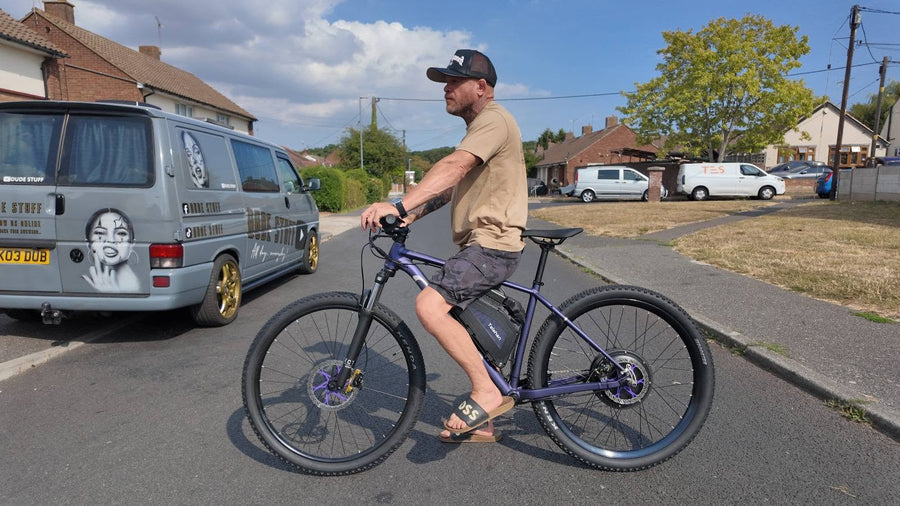
Same 3000 watts, two very different builds. The voltage you choose — 60V or 72V — changes the current your battery and controller must handle, the heat, the range and how the bike feels. This guide works through the 60V-versus-72V decision with the maths shown, not glossed over, then compares the complete 3000W kits UK riders can actually buy.
The short answer
For most riders, a 60V 3000W kit is the more balanced choice: it hits 3000W at around 50A, pairs cleanly with a 50A controller, and is easier to live with on mixed terrain. A 72V 3000W kit draws less current for the same power (about 42A) and leaves more headroom for speed, but is usually built for experienced riders who understand battery discharge, heat, braking and frame safety. Both are high-power, private-land / off-road setups — neither is a road-legal EAPC in the UK, where the limit is 250W and 15.5 mph.
60V or 72V: Choose Fast
If you already know your priorities, here’s the decision in short.
Choose 60V — the balanced high-power build
You want strong torque and speed without chasing the absolute top end.
You’d rather keep battery, controller and BMS matching simple.
You ride mixed terrain — some pedal-assist, some throttle, some hills.
You value a quieter, controllable feel over raw numbers.
Choose 72V — the performance-focused build
You want maximum speed headroom on private land.
You understand discharge rates, connectors, cable gauge and heat.
You’re ready to upgrade brakes and check frame strength.
You’re comfortable managing a more demanding electrical system.
The decision in one line: a 60V 3000W kit is usually the more balanced route; a 72V 3000W kit is usually configured for a higher controller input, so it tends to run faster and put more stress on the system. That comes from the build and how it’s ridden, not from the voltage on its own. Both sit outside standard UK road-legal limits.
60V vs 72V at a Glance
This is the core comparison — read it as “same 3000W target, two ways to get there.”
Factor
60V 3000W
72V 3000W
Current for 3000W (before losses)
≈ 50A
≈ 42A
Controller commonly paired
50A sine wave
60A–80A sine wave
Battery energy at 20Ah
≈ 1,260 Wh
≈ 1,440 Wh
Real-world stress
Moderate, predictable
Higher if pushed hard
Heat profile
Balanced with a matched 50A controller
Lower amps, but higher-speed heat elsewhere
Top-speed feel
Strong and controllable
Sharper at speed when the build supports it
Best rider
Balanced mixed riding
Experienced, speed-focused builders
UK legal context
Off-road only
Off-road only
Figures are nominal and before real-world losses. Actual current, range and heat depend on the controller, rider weight, terrain and how hard you ride.
UK 3000W Kits with Battery, Compared
The UK market for complete 3000W kits is almost entirely 72V, with KirbEbike’s 60V kit as one of the few 60V options. At first glance prices look wildly different — from about £525 to £1,300 — but the single biggest variable is simple: is a battery included or not? Compare like-for-like and the picture changes a lot.
💰
Read the price the right way: kit-only vs battery-included. Many eye-catching 3000W prices (roughly £525–£600) are for the motor, controller and display only — you still need a battery to ride. Core Ebikes, for example, lists its 72V 3000W kit at £525 but its matching 72V 20Ah Samsung battery at £592, and sells the two as a bundle for £1,097. A genuinely complete, battery-included 3000W kit therefore tends to land around £1,100–£1,300 — exactly where KirbEbike (£1,241) and Torbay Motocross (£1,299) sit.
*Manufacturers’ off-road claims; they depend on rider weight, wheel size, tyres, gradient and battery state, and mix continuous/peak/electrical-input ratings between sellers. Prices are the complete-kit, battery-included price where available (kit-only start prices in brackets). All prices GBP, last checked 17 July 2026 — confirm VAT, shipping, charger inclusion and the exact SKU before buying.
A few honest observations. For a complete kit with a quality battery already included, the closest like-for-like options are Core Ebikes’ bundle (£1,097, Samsung cells), KirbEbike (£1,241, LG cells) and Torbay Motocross (£1,299, LG cells) — three kits within about £200 of each other, with KirbEbike in the middle rather than at the top. The cheaper bare-kit prices look tempting, but only until you add a battery. The full brand-by-brand breakdown is kept in our 3000W performance comparison so this page stays focused on the 60V-versus-72V decision.
Supplied with a 72V 20Ah LG-cell battery, display, controller, throttle, PAS and torque arm — the priciest kit in this comparison at £1,299.
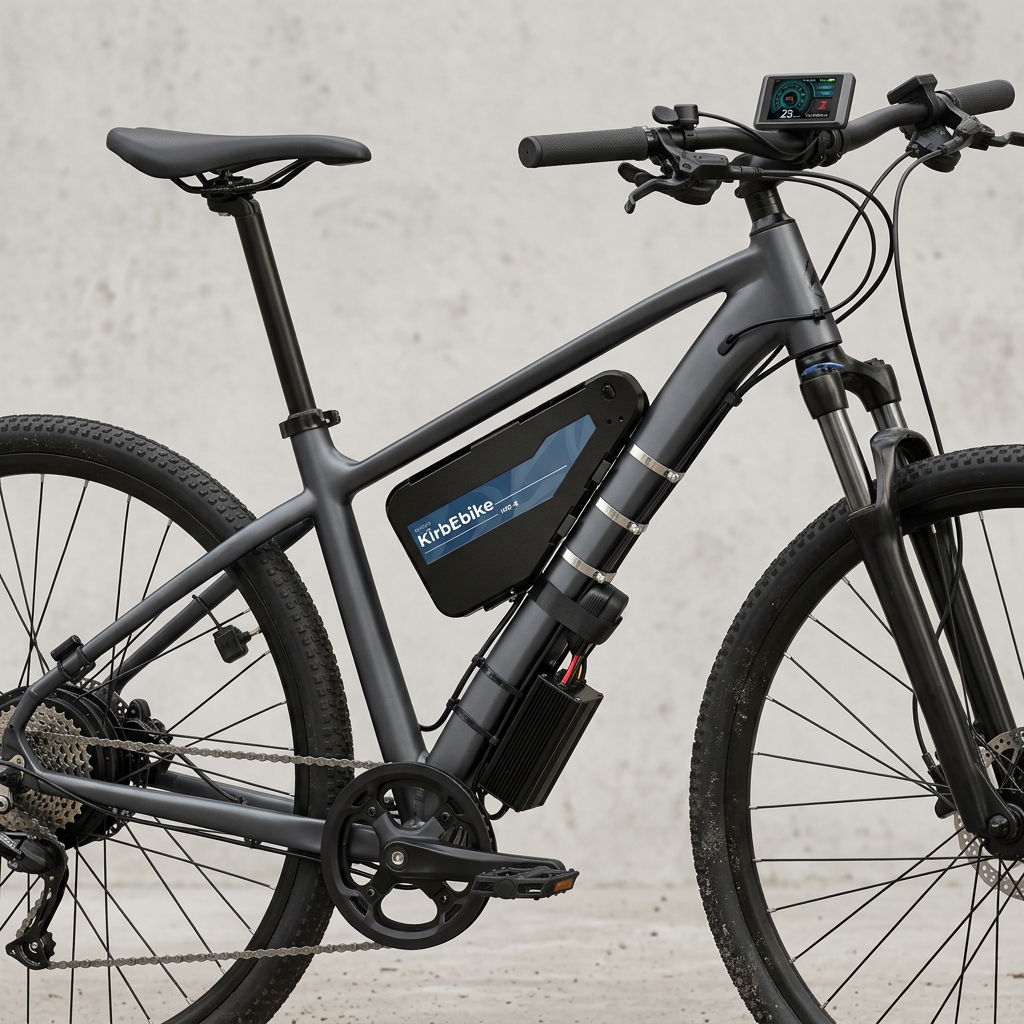
KirbEbike 60V 2500W–3000W MTX Rim Kit (60V, battery included)
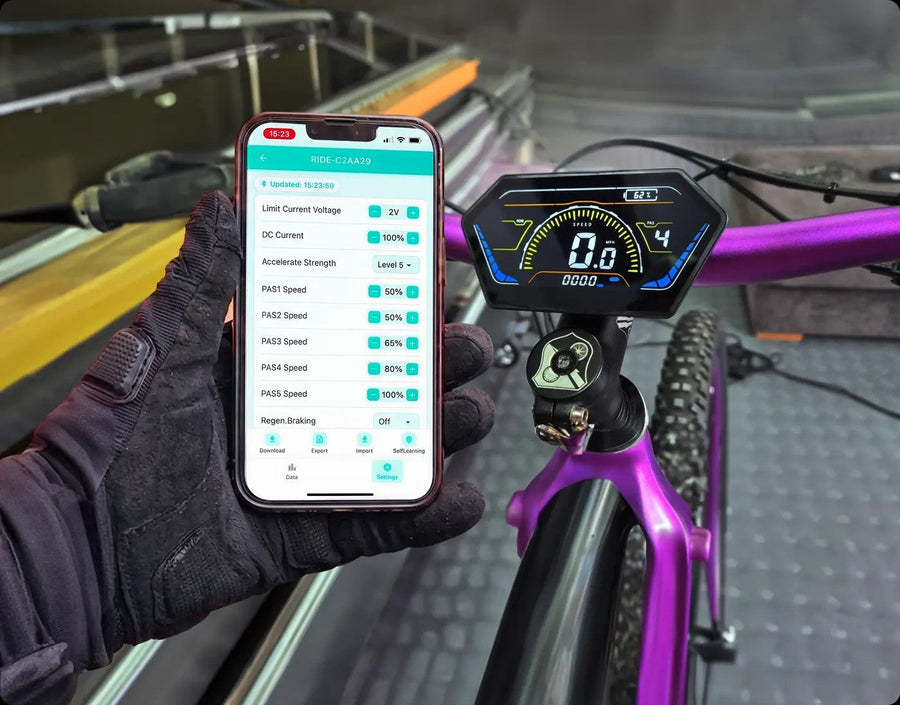
KirbEbike’s kit is the main 60V option in a mostly-72V field. Its live listing is a 60V system at 2500W continuous / 3000W peak on an MTX rim, with a 50A sine-wave FOC controller that’s fully potted (resin-sealed), plus Bluetooth Ride Power app tuning, a 1-year warranty and free UK shipping. Like Torbay and Core’s bundle, its price includes a battery — here a 60V 20Ah LG 21700 pack (nominal 60V, full charge 71.4V, about 1,260 Wh) with a 60A continuous BMS and a 5A charger.
The trade-offs are honest ones: at £1,241 it costs far more upfront than a bare kit, its 45+ mph claim is lower than the 50–58 mph some 72V kits quote, and the motor is on the heavier side (~6.8 kg). What you get in return is a matched, battery-included, app-tunable package with a potted controller and a 250W display toggle (useful for tuning behaviour, though it doesn’t make a 3000W kit road-legal).
KirbEbike 60V 2500W–3000W MTX kit. The 60V 20Ah LG battery, potted 50A FOC controller, colour display and 5A charger are all included; the inset shows a frame-mounted install.
KirbEbike’s 60V option
60V 2500W–3000W MTX Rim Kit
Battery included — a 60V 20Ah LG pack, potted 50A FOC controller, colour display and 5A charger. £1,241, 80Nm, 45+ mph off-road, ~30-min install, IP66. Costs more than a bare kit, but there’s nothing else to buy.
Shown as the bare kit (motor, controller, display, alarm, freewheel, torque arm); a 72V 20Ah Samsung battery is offered as a £1,097 bundle.
E-Bike Power UK 72V 3000W Rear-Wheel Kit
A 60A (tuned from 80A) controller with an optional 72V 20Ah 21700-cell battery; the seller states plainly that its high-power kits are not UK road-legal.
The Ebike Shop 72V 3000W Kit
A 72V 60A controller with Samsung-cell battery options; the battery is a paid add-on, shipped separately. Longest warranty here at 2 years.
Trail Surge 72V 3000W eBike Kit
A 72V 60A dual controller with a UKC1 Plus colour display and single-speed freewheel; confirm battery inclusion before ordering.
💡
Not sure 3000W is your level? If a 3000W build feels like more than you need, step back to a lower-power kit before you commit. Browse the full kit-and-battery range to compare power levels side by side.
60V vs 72V Current Draw: Why Amps Matter
The single most useful idea in this comparison is simple: watts are made from volts and amps. Reach the same 3000W with a lower voltage and you need more amps; reach it with a higher voltage and you need fewer. Amps are what heat wires, stress connectors and push a battery’s discharge limit — so this is not academic.
≈50A
60V for 3000W (battery-side)
≈42A
72V for 3000W (battery-side)
3000W
Same target power
🧮
The maths, shown: watts = volts × amps. 3000W ÷ 60V ≈ 50A; 3000W ÷ 72V ≈ 42A (battery-side electrical input at nominal voltage — not wheel output, and not fixed, since real draw rises as pack voltage falls under load). They assume a 3000W ceiling: a 72V controller rated at 60A can pull up to 72 × 60 ≈ 4,320W, and at 80A up to ≈ 5,760W — so a “72V 60A” build is no longer the same 3000W as a matched 60V 50A build. Read the controller’s battery-current limit separately from the voltage, and rate the battery and BMS with margin above whichever ceiling applies.
Same watts, different amps
A 60V system may need around 50A for 3000W — so the BMS, controller, connectors and phase wires all have to be comfortable at that current. A 72V system needs around 42A for the same 3000W, in theory gentler on the wiring. In practice, many 72V kits ship with 60A or even 80A controllers because they’re built for higher speed, so the real stress can be higher than the simple sum suggests.
What to check before you buy
Battery continuous discharge rating (not just the peak figure)
Battery peak discharge rating and how long it can sustain it
Controller amp rating — and whether it’s tuned down from a higher figure
BMS amp rating: it must match or exceed the controller’s draw
Connector type (XT60, XT90, XT150) rated for the current
Cable and phase-wire thickness
Controller heat management — potting, cooling and mounting
Range: It’s Watt-Hours, Not Volts
Voltage alone tells you almost nothing about range. Energy is what counts, and energy is watt-hours: volts × amp-hours. That’s why comparing a 60V and a 72V pack only makes sense once you know the amp-hours.
Nominal energy at 20Ah (watt-hours)
Wh = volts × amp-hours. More energy at 72V — but often spent on speed, not distance.
60V 20Ah
≈ 1,260 Wh
72V 20Ah
≈ 1,440 Wh
Why 72V doesn’t always mean more range
A 72V 20Ah pack holds more energy than a 60V 20Ah pack at the same amp-hours. But riders rarely leave that extra energy in the tank — they spend it on higher speed and harder acceleration, which burns watt-hours faster. So a 72V build can hold more energy yet deliver similar or shorter real-world range if it’s ridden hard.
Why 60V can feel more efficient for mixed riding
A 60V 3000W setup is often easier to manage for riders who mix pedal-assist, moderate throttle and varied terrain rather than pinning the throttle. For reference, KirbEbike quotes its 60V 20Ah LG pack at roughly 40–55 km, with more available on low pedal-assist.
The watt-hours inside set your range. The BMS, charge port and level indicator matter as much as the headline voltage. Shown is KirbEbike’s pack — the same principles apply whichever brand you choose.
How to test range fairly
Manufacturer range figures are best treated as ballpark. For a real comparison between two builds, keep everything else equal:
Same rider and the same (or a comparable) bike and wheel size
Same tyres and tyre pressure
Same route, on a similar temperature and wind day
Same assist/throttle pattern throughout
Record start and end voltage, plus watt-hours used if your display shows it
Note distance, elevation gain and average speed
Heat and Controller Stress
Heat is the quiet killer of high-power kits, and it isn’t only about voltage. It builds from current, controller efficiency, motor load, hill starts, low-speed throttle use, rider weight, wind resistance and how well the controller sheds heat.
60V heat profile
At around 50A for 3000W, a 60V build paired with a suitable 50A controller is a balanced setup. Repeated hill starts and heavy loads still build heat, so how well a controller sheds it — through its housing, thermal path and mounting — matters for how long it lasts. Resin potting helps protect the board from moisture and vibration; whether it also runs cooler depends on the compound and case, so treat cooling as a separate question from sealing.
72V heat profile
A 72V build draws fewer amps for the same watts, which eases wiring stress. But 72V kits are often ridden faster and paired with more aggressive 60A–80A controllers, so heat can simply move elsewhere. Lower amps do not automatically mean a cooler-running bike.
Controller amp ratings, compared
Controller
Build type
What to expect
50A
Balanced high-power
Clean match for a 60V 3000W build
60A
Common 72V performance
More speed; stricter battery/BMS needs
80A
Demanding custom build
Only as safe as the pack feeding it
Speed and Acceleration: What 3000W Really Does
It’s tempting to quote a single top speed, but honest numbers depend on the whole build and the conditions. Treat any “top speed” as a claim to verify, not a guarantee.
What actually changes your speed
Rider weight, wheel size, tyre type and pressure, controller current, battery voltage under load, wind, gradient, total bike weight and riding position all move the number. Two identical kits on different bikes and riders can post very different results.
60V vs 72V speed feel
A 60V 3000W build tends to feel strong and controllable across mixed riding. A 72V build can feel sharper at the top end when the controller, battery and brakes all support it. Throttle response, quietness and acceleration are shaped mainly by the controller (FOC/sine quality), the battery and phase current, the throttle curve, the motor windings and the wheel size — not by voltage on its own. If you’re weighing how a well-sorted 3000W hub kit performs in practice, this 3000W performance comparison covers real-world behaviour rather than headline numbers.
Which Suits Your Riding
Heavy rider or cargo use
Prioritise current headroom, heat management, stronger brakes and tougher tyres over top speed. A 60V build with a matched 50A controller and a 60A-rated pack is a sensible, manageable base; a 72V build works too, but leave more margin everywhere.
Steep hills and trails
Here it’s about torque, controller heat and low-speed load, not outright pace. Both voltages climb well at 3000W; the deciding factors are cooling, a torque arm (or two) and grippy tyres.
Fast private-land riding
This is where 72V’s extra voltage headroom earns its place — but only alongside upgraded brakes, a strong frame and a battery that can sustain the current without sagging. Speed you can’t stop is not performance.
Daily mixed use
If you’re not chasing maximum speed, a 60V 3000W setup is usually the easier bike to own: gentler current demand, simpler matching and a more predictable feel day to day.
Fit Checklist Before You Buy a 3000W Kit
Power means nothing if the kit won’t fit your bike. Run through these before ordering either a 60V or 72V kit.
Wheel size and rim: common options are 26″, 27.5″ and 29″, with 700C where a product supports it.
Dropout width and axle: most high-power hub motors use a solid bolt-on axle with flats and need open, slotted dropouts. A frame marked “142mm” usually means a 12×142 closed thru-axle, which these motors do not fit unless a version is engineered for it. Confirm your dropouts are open slots and match the motor’s stated axle type and width — not just a width in millimetres.
Drivetrain: lots of 72V 3000W kits are single-speed or freewheel-based. Check freewheel vs cassette compatibility carefully.
Brakes: high power needs strong braking. Check rotor size, pads and calipers, and consider a hydraulic upgrade.
Battery mounting space: triangle packs need frame room. Measure your front triangle’s height, length and width against the pack’s published dimensions — plus the clearance to slide it in and out, and the bottle-boss positions. A cardboard cut-out of the pack’s footprint, taped into the triangle, is a quick way to confirm fit before you order.
UK Legal Context: Is a 3000W Kit Road-Legal?
Put simply: no. In Great Britain, a converted bike is only treated like a normal bicycle if it qualifies as an EAPC — pedals fitted, a motor of no more than 250W continuous rated power, and assistance that cuts off at 15.5 mph. A 3000W kit exceeds the power condition many times over, so it cannot be used as an ordinary EAPC on public roads or other public places. Used that way it is treated as a motor vehicle and may need registration, tax, insurance, a licence and type approval. In practice it is a build for private land or a closed course, ridden with the landowner’s permission.
⚠️
A limiter does not make it legal. A display “250W mode” is a riding adjustment, not a change to the motor’s certification. An EAPC must meet two GOV.UK conditions at once: a maximum continuous rated power of 250W, and assistance that cuts off at 15.5 mph. A 3000W-class motor is rated far above 250W continuous, so it fails the power condition on the rating alone. Toggling a limit mode does not re-certify the motor. On public roads a build that doesn’t meet EAPC rules is treated as a motor vehicle and may require registration, tax, insurance, a licence and type approval. Ride high-power kits only on private land or a closed course, with the landowner’s permission.
If you actually need road legality, the honest answer is a 250W kit or a complete road-legal e-bike, not a de-restricted high-power build. See the GOV.UK e-bike rules for the compliant options in plain English.
Battery Safety for High-Power Builds
At 60V or 72V and tens of amps, the battery is the component to get right. A few non-negotiables:
Match the battery, controller and charger
High-power kits should never be paired with a random pack or an ill-matched charger. The battery, controller and charger need to be designed to work together at the currents involved.
The BMS must support the controller
If the controller can draw 50A, 60A or 80A, the battery’s BMS has to be rated to deliver it safely. A pack with a lower discharge limit than the controller’s draw is a recipe for sag, cut-outs and stress.
Charging and storage basics
Follow the manufacturer’s charging instructions, unplug once charging is complete, avoid charging unattended overnight, and don’t charge in a hallway or doorway that forms an escape route. These are the core points made by Electrical Safety First.
⚠️
Why this matters. As the London Fire Brigade notes, lithium-ion batteries can pose a serious fire risk if they’re damaged, faulty or charged incorrectly. Quality cells, a matched charger and sensible charging habits are the best defence — see the sources below for the official guidance.
Common Buying Mistakes with 60V and 72V 3000W Kits
Comparing volts without comparing amps — the two only make sense together.
Ignoring the BMS discharge rating and assuming any pack will do.
Buying a battery that can’t handle the controller’s current.
Assuming 72V automatically means more range — it depends on watt-hours and how you ride.
Forgetting to upgrade brakes for the extra speed.
Overlooking dropout width and freewheel/cassette compatibility.
Trusting exact speed or range claims without knowing the test conditions.
Treating a 3000W kit as a UK road-legal e-bike.
Conclusion: 60V or 72V for a 3000W Kit?
For most riders, a 60V 3000W kit is the more balanced route: around 50A for 3000W, a clean match with a 50A controller, and a setup that’s easier to manage across mixed terrain and daily use. A 72V 3000W kit suits experienced builders who want more voltage headroom for speed and are ready to manage the higher demands on the battery, brakes, frame and fit.
Whichever you pick, the decision comes down to current draw, battery watt-hours, controller rating, your route, your weight and — crucially — your legal use, since both are high-power systems outside standard UK EAPC public-road limits. If the 60V route fits you, the KirbEbike 60V 2500W–3000W MTX kit is a strong battery-included option; if you want to consider other power levels, browse the wider kit-and-battery collection. Buy for fit, safety and legality first, and the power will look after itself.
Battery included · 60V
KirbEbike 60V 2500W–3000W MTX Kit
The balanced 60V route — 50A potted FOC controller, LG 21700 pack and 5A charger, app-tunable, built to your wheel size. Off-road at full power, with a 250W display toggle.
Neither is universally better. A 60V 3000W kit draws about 50A and pairs cleanly with a 50A controller, which makes battery, BMS and controller matching simpler and the bike easier to manage on mixed terrain. A 72V 3000W kit draws less current for the same power and leaves more speed headroom, but is usually configured for a higher controller input and suits experienced builders. Match it to your riding rather than the bigger number.
Is a 72V kit faster than a 60V kit?
Often, but not because of the voltage on its own. Many 72V kits are set up with higher controller current, so their electrical input — and therefore their speed — is higher. At the same electrical power a 72V pack actually pulls lower battery-side current. Speed is set by the controller’s current limit, the motor windings, the wheel size and the rider, so compare the controller input ceiling, not just 60V versus 72V.
Which gives more range, 60V or 72V?
Range is set by watt-hours, not voltage. A 72V 20Ah pack (about 1,440 Wh) holds more energy than a 60V 20Ah pack (about 1,260 Wh) at the same amp-hours, but riders usually spend that extra energy on speed and harder acceleration. So a 72V build can hold more energy yet return similar or shorter real-world range when ridden hard.
Can a 60V controller and motor use a 72V battery?
Not unless the controller and motor are rated for it. A 72V pack charges to about 84V, which can exceed the voltage rating of a controller built for 60V and damage it. Voltage has to match across the battery, controller and motor as a system. If you want the 72V route, buy a kit specified for 72V rather than feeding a higher-voltage pack into 60V electronics.
What BMS and controller current does a 3000W kit need?
Enough to feed the controller with margin. A 60V 3000W build typically uses a 50A controller, so the battery’s BMS should be rated at or above that continuous draw; many 72V performance kits run 60A or even 80A controllers, which demand a higher BMS rating. A pack whose BMS limit is below the controller’s draw will sag, cut out and run hot. Always check the BMS continuous rating against the controller’s battery-current limit.
What frame and dropout fits a 3000W hub kit?
Most high-power hub motors use a solid bolt-on axle with flats and need open, slotted dropouts. A frame marked “142mm” usually means a 12×142 closed thru-axle, which these motors do not fit unless a version is engineered for it. Confirm your dropouts are open slots, measure the spacing, and match the motor’s stated axle type and width — plus wheel size, brake rotor clearance and freewheel or cassette compatibility.
Is a 3000W kit road legal in the UK?
No. An EAPC must have a motor rated no higher than 250W continuous and assistance that cuts off at 15.5 mph. A 3000W-class motor is rated far above 250W, so it fails on power alone and cannot be used as an ordinary EAPC on public roads. Used in a public place it is treated as a motor vehicle, which can mean registration, tax, insurance, a licence and type approval. In practice it is for private land or a closed course, with the landowner’s permission.