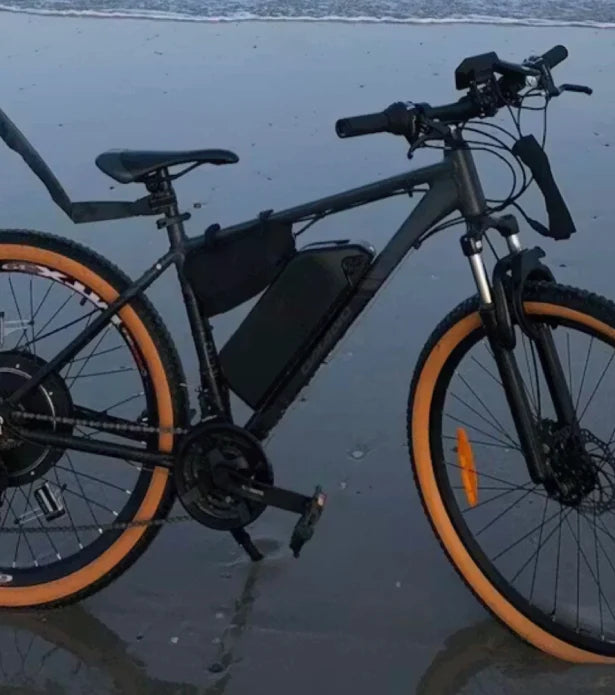
Matching your battery to your motor is the foundation of a safe, efficient, and powerful e-bike conversion. Get this pairing wrong, and you risk damaging components, creating safety hazards, or experiencing disappointing performance. Get it right, and you'll enjoy thousands of kilometers of reliable electric riding.
Understanding how to properly match your e-bike battery to motor specifications isn't just about voltage compatibility—it involves current delivery, controller ratings, connector types, and Battery Management System capabilities. This comprehensive guide will walk you through every critical consideration to ensure your conversion kit operates safely and performs optimally.
The Foundation: Voltage Compatibility
Why Voltage Matching Matters
Voltage is the first and most critical specification when pairing batteries with motors. Your battery voltage must align with your motor's rated voltage range, or you risk immediate damage to expensive components.
How Motors Handle Voltage:
- Motors are designed for specific voltage ranges (36V, 48V, 52V, 60V, 72V)
- Operating below rated voltage results in reduced power and sluggish performance
- Operating significantly above rated voltage can overheat windings and damage controllers
- Most modern motors tolerate slight voltage variations within their design range
Kirbebike Voltage Matching Standards
Kirbebike offers carefully engineered pairings across their complete product line:
|
Motor Power
|
Rated Voltage
|
Compatible Battery Voltage
|
Fully Charged Voltage
|
|
250W
|
36V
|
36V
|
42V
|
|
500W
|
36V
|
36V
|
42V
|
|
750W
|
48V
|
48V
|
54.6V
|
|
1000W
|
48V
|
48V / 52V
|
54.6V / 58.8V
|
|
1500-2000W
|
48V / 52V
|
48V / 52V
|
54.6V / 58.8V
|
|
2000W
|
52V
|
52V
|
58.8V
|
|
2500-3000W
|
60V
|
60V
|
67.2V
|
|
4000W
|
72V
|
72V
|
84V
|
Important Note: The "fully charged voltage" is always higher than the nominal voltage. A 48V battery charges to 54.6V, and quality controllers account for this voltage range automatically.
The 48V/52V Crossover
Many 48V motors can safely operate with 52V batteries, providing enhanced performance:
Benefits of 52V on 48V Motors:
- Approximately 8-10% power increase
- Better voltage stability under heavy loads
- Improved hill-climbing performance
- Minimal risk when controllers support the voltage range
Verification Steps:
- Confirm your controller's maximum voltage rating
- Check motor manufacturer specifications
- Ensure controller can handle 58.8V (52V fully charged)
- Kirbebike 1000W and higher systems typically support this crossover
Current Delivery: The Power Transfer Equation

Understanding Amperage Requirements
While voltage determines if components are compatible, amperage (current) determines how much power flows from battery to motor. This relationship follows a simple but critical formula:
Power (Watts) = Voltage (V) × Current (Amps)
Practical Example:
- 1000W motor at 48V requires: 1000W ÷ 48V = 20.8 amps continuous
- 2000W motor at 52V requires: 2000W ÷ 52V = 38.5 amps continuous
- 4000W motor at 72V requires: 4000W ÷ 72V = 55.6 amps continuous
Battery Discharge Rating (C-Rating)
Quality e-bike batteries specify their continuous discharge capability, usually expressed as a C-rating or maximum continuous amperage.
Understanding C-Ratings:
- 1C = battery can discharge its entire capacity in one hour
- 2C = battery can discharge its entire capacity in 30 minutes
- Higher C-ratings support more powerful motors
Example Calculations:
- 16Ah battery with 2C rating = 32 amps continuous discharge
- 20Ah battery with 3C rating = 60 amps continuous discharge
- 30Ah battery with 2C rating = 60 amps continuous discharge
Matching Current Capacity to Motor Power
Conservative Matching (Recommended):
-
250-500W motors: 15-20 amp continuous discharge minimum
-
750-1000W motors: 25-30 amp continuous discharge minimum
-
1500-2000W motors: 35-45 amp continuous discharge minimum
-
2500-3000W motors: 50-60 amp continuous discharge minimum
-
4000W motors: 60+ amp continuous discharge minimum
Kirbebike batteries are specifically rated for their paired motors, ensuring adequate current delivery with built-in safety margins.

Controller Specifications Matter
The controller sits between your battery and motor, regulating power flow. It must be compatible with both components.
Essential Controller Ratings:
-
Voltage range: Must accommodate your battery's full charge voltage
-
Amperage rating: Should match or exceed motor's continuous draw
-
Peak current: Handles brief acceleration surges
-
FOC capability: Modern Field-Oriented Control for efficiency
Kirbebike Integrated Controllers
All Kirbebike e-bike kits with batteries include properly matched controllers:
Controller Matching Examples:
-
36V 250W EZ Rider Kit: 36V 14A intelligent FOC controller
-
48V 750W Mid Motor Kit: 48V controller with torque sensor integration
-
52V 2000W Systems: 50A+ FOC controller for optimal power delivery
-
72V 4000W System: High-capacity controller rated for extreme performance
This integrated approach eliminates compatibility guesswork and ensures safe operation from day one.
Battery Management System (BMS) Protection

What BMS Does for Safety
Every quality e-bike battery includes a Battery Management System that protects both the battery and your motor system.
Critical BMS Functions:
-
Overcurrent protection: Prevents excessive amp draw that could damage cells
-
Overvoltage protection: Stops charging at safe maximum voltage
-
Undervoltage protection: Cuts power before cells discharge too deeply
-
Cell balancing: Ensures all cells charge and discharge evenly
-
Temperature monitoring: Shuts down if battery overheats
BMS Amp Rating Must Match Motor Needs:
- 30A BMS suitable for up to 1000W motors (at 48V)
- 50A BMS appropriate for 1500-2000W motors
- 60A+ BMS required for 2500W+ high-performance systems
Kirbebike batteries feature appropriately rated BMS for their intended motor pairings, providing multi-layer safety protection.
Minimum Wire Gauge Recommendations:
|
Current Draw
|
Minimum Wire Gauge
|
Typical Application
|
|
Up to 20A
|
16 AWG
|
250-500W systems
|
|
20-30A
|
14 AWG
|
750-1000W systems
|
|
30-45A
|
12 AWG
|
1500-2000W systems
|
|
45-60A
|
10 AWG
|
2500-3000W systems
|
|
60A+
|
8 AWG
|
4000W+ systems
|
Quality conversion kits include appropriately gauged wiring. If extending wire lengths or modifying systems, maintain or exceed these specifications.
Real-World Application: Kirbebike System Pairings
Entry-Level Systems: 36V 250W
Motor Specifications:
- 36V 250W brushless geared hub motor
- Nominal draw: ~7 amps continuous
- Peak draw: ~15 amps during acceleration
Matched Battery:
- 36V 7Ah (252Wh) or 36V 13Ah (468Wh)
- LG cells with appropriate BMS
- 15-20 amp continuous discharge capability
- Compact, lightweight design for urban commuting
Why This Works: The battery's discharge capability exceeds motor requirements by healthy margins, ensuring the motor never strains the battery even during maximum assist hill climbing.
Mid-Power Systems: 48V 1000W
Motor Specifications:
- 48V 1000W brushless direct drive rear motor
- Nominal draw: ~21 amps continuous
- Peak draw: ~35 amps during hard acceleration
Matched Battery:
- 48V 11.6Ah (556Wh) or 48V 16Ah (768Wh)
- 25-30 amp continuous discharge rating
- Quality BMS with overcurrent protection
- Balanced capacity for 35-45 km range
Why This Works: The battery comfortably handles continuous power delivery while maintaining reserve capacity for acceleration bursts and hill climbing without triggering BMS protection.
High-Performance Systems: 52V 2000W
Motor Specifications:
- 52V 2000W brushless direct drive motor
- Nominal draw: ~38 amps continuous
- Peak draw: ~60 amps during maximum load
Matched Battery:
- 52V 20Ah (1,040Wh) or 52V 30Ah (1,560Wh)
- 40-60 amp continuous discharge capability
- Advanced BMS with thermal management
- Extended range for performance riding
Why This Works: High-capacity cells and robust BMS handle sustained high-power output without voltage sag, maintaining performance during extended climbs and high-speed riding.
Extreme Performance Systems: 72V 4000W
Motor Specifications:
- 72V 4000W extreme performance motor
- Nominal draw: ~56 amps continuous
- Peak draw: ~80+ amps during launches
Matched Battery:
- 72V 20Ah (1,440Wh)
- 60+ amp continuous discharge rating
- Premium LG 21700 cells
- Advanced thermal management
Why This Works: This represents the pinnacle of e-bike power delivery, with battery cells specifically selected for their high discharge rates and thermal stability under extreme loads.
Making the Right Choice from the Start
Decision Framework for New Conversions
When building your e-bike conversion from scratch, follow this systematic approach:
Step 1: Define Your Power Needs
- Determine required motor wattage based on intended use
- Consider terrain, rider weight, and desired speed
- Account for future performance desires
Step 2: Select Appropriate Voltage
- 36V for legal-limit commuting (250-500W)
- 48V for versatile performance (750-1500W)
- 52V for enhanced power (1500-2600W)
- 60V-72V for extreme performance (2500-4000W+)
Step 3: Calculate Battery Requirements
- Determine necessary capacity (Ah) for desired range
- Ensure discharge rating exceeds motor draw by 25%+
- Verify BMS amperage rating supports motor power
- Choose quality cells (LG, Samsung) for reliability
Step 4: Verify Complete System Integration
- Confirm controller voltage and amperage ratings
- Check all physical connectors match
- Ensure wiring gauge handles current requirements
- Validate display compatibility
The Kirbebike Advantage
Rather than mixing components from various sources—risking compatibility issues, safety concerns, and performance disappointments—Kirbebike offers complete matched motor and battery systems.
Benefits of Integrated Systems:
- Factory-tested voltage and current matching
- Optimized controller programming for specific motor-battery pairings
- Matched connectors and proper wire gauging
- Comprehensive warranty covering complete system
- Technical support understanding your exact configuration
This eliminates the guesswork and potential safety hazards of DIY component matching while ensuring you achieve the performance specifications promised.
Frequently Asked Questions
Can I use a higher capacity (Ah) battery with the same voltage on my motor?
Yes, absolutely! Using a higher amp-hour rating at the same voltage is completely safe and simply provides longer range. For example, upgrading from a 48V 11.
What happens if I accidentally connect a 52V battery to a 36V motor?
This will likely damage your controller immediately and potentially harm your motor. The excessive voltage overwhelms components designed for lower voltage ranges, causing overheating and component failure.
How do I know if my battery's amperage rating is sufficient for my motor?
Divide your motor wattage by battery voltage to find required amps (Watts ÷ Volts = Amps). Your battery's continuous discharge rating should exceed this by at least 25%. For a 1000W motor at 48V: 1000 ÷ 48 = 20.
Can I mix batteries from different manufacturers with my Kirbebike motor?
While voltage and amperage compatibility are the critical factors, mixing brands introduces variables in connector types, BMS behavior, and cell quality.
Is it safe to run two batteries in parallel for increased capacity?
Running batteries in parallel can work but requires careful consideration: both batteries must be identical voltage, similar age/condition, and preferably the same model. Mismatched batteries can lead to unbalanced charging/discharging and potential safety issues.
How do I tell if my battery and motor are properly matched after installation?
A properly matched system shows these characteristics: smooth, consistent power delivery across all assist levels; battery voltage remains stable under load (minimal voltage sag); no overheating of battery.
What's the difference between nominal voltage and fully charged voltage, and which matters for matching?
Nominal voltage (36V, 48V, 52V, etc.) represents the average operating voltage, while fully charged voltage is higher (42V, 54.6V, 58.8V, respectively). Motors and controllers are designed to handle the full voltage range from fully charged to mostly depleted.
Conclusion
Successfully matching your e-bike battery to motor power is fundamental to building a conversion system that's safe, reliable, and performs to its full potential. While the technical specifications might seem complex initially, the principles are straightforward: match voltage precisely, ensure adequate current delivery, verify controller compatibility, and choose quality components.
The consequences of improper matching range from disappointing performance to serious safety hazards, making this one area where precision truly matters. By understanding the relationship between voltage, amperage, power, and the protective role of BMS and controllers, you can make informed decisions that result in thousands of kilometers of trouble-free electric riding.