If you’re searching for a 1500w electric bike conversion kit UK with battery, you probably want three things: real-world speed, dependable range, and a clear answer on where it’s legal to ride. This guide breaks down UK rules in plain English, explains how fast a 1500w electric bike can go, and shows you a straightforward parts list for building a powerful fat-tire e-bike—without the guesswork.
Quick Legal Check (UK)
In Great Britain, an e-bike is treated like a normal bicycle only if it meets the EAPC definition: 250 W maximum continuous rated power, assistance that cuts off at 15.5 mph (25 km/h), and working pedals. Riders must be 14+, and EAPCs do not require registration, tax, or insurance. Anything above those limits (for example a 1000 W or 1500 W electric bike kit) is not an EAPC for public roads. It’s classed like a motor vehicle and would need the full moped/motorcycle treatment (type approval, registration, insurance, etc.).
What about throttles? UK rules allow walk-assist up to 6 km/h (3.7 mph) without pedalling. But a “twist-and-go” throttle that propels faster than 6 km/h requires type approval to be road-legal—this is why most DIY high-power conversions are for private land use.
Bottom line: A 1500W electric bike (UK) build is fantastic for private land and off-road settings. For public roads, stick to 250 W / 15.5 mph if you want bicycle-like legal status.
How Fast Does a 1500W E-Bike Go?
Short answer: fast—with the right wheel size and voltage, many 1500–2000 W hub kits on fat bikes are built for around 50–60 km/h (31–37 mph) top speed. KirbEbike’s 1500W–2000W Fat Tire Kit lists a 50–60 km/h max and a 40–80 km estimated range (setup-dependent). That’s serious performance for sand, snow, and forest tracks.
Real-world top speed depends on:
-
Voltage & controller current (e.g., a 48 V / 35 A FOC controller can deliver ~1.6–1.7 kW peak)
-
Tyre diameter & tread (fat tyres add drag)
-
Rider weight & terrain (hills and headwinds sap speed)
- Assist level & throttle use
UK reminder: even if a kit offers a “legal mode” that caps speed/assist in the display, a 1500 W continuous-rated system is not an EAPC for public roads. Use those power levels on private land.
The Kit: What You Get With KirbEbike’s 1500W–2000W Fat Tire System
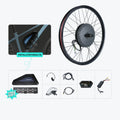
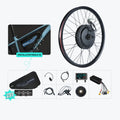
KirbEbike’s fat-tire hub kit is built around a brushless direct-drive rear motor and arrives with everything to convert a bike into an off-road machine:
-
Motor wheel & fat rim: 80 mm double-wall alloy rim, 175–190 mm dropouts (fat-bike standard), 7-speed freewheel compatible.
-
Controller: 48 V 35 A FOC sinewave (12 MOSFETs)—smooth, quiet, robust; works with 36/48/52 V lithium packs.
-
Display & controls: LCD81F color TFT display, V12 PAS, thumb throttle, e-brake levers, 1T4 waterproof harness.
-
Claimed performance: 50–60 km/h top speed; typical 40–80 km range depending on battery/terrain.
-
Box extras: torque arm, tools, ties, and wiring bits that make DIY installs easier.
-
Use case note: the PDP states “OFF-ROAD USE ONLY.”
If you’re moving from commuter-level kits to something with real grunt for wide tyres, that parts list covers the essentials and keeps the wiring neat in one harness. (Customer feedback on the PDP also mentions easy installation and quiet operation.)
Battery Options: 48 V vs 52 V (and Capacity)

You’ll see the phrase “electric bike battery 48V 1500W” a lot in searches. Here’s how to choose:
Voltage:
-
48 V is common for 1500 W builds (with a 35 A controller that’s ~1.68 kW peak).
-
52 V adds a little more punch and maintains speed better as the pack discharges. KirbEbike’s kit is frequently paired with 52 V 20 Ah or 52 V 30 Ah options.
Capaticy:
-
20 Ah (≈ 960–1,040 Wh depending on 48/52 V) is a solid baseline.
-
30 Ah significantly extends range but adds weight—fat bikes can handle it, but expect more effort lifting/transporting.
Range math (quick reality check):
On mixed terrain, fat tyres typically consume 20–30 Wh/km. A ~1,000 Wh pack therefore returns ~33–50 km in spirited riding and 50–70 km+ if you keep assist moderate—numbers that align with the kit’s 40–80 km estimate. Your cadence, tyre pressure, and wind matter more than you’d think.
Cycle life: The kit’s battery listing quotes ~1,000 charge cycles (care and storage can swing this up/down). Store cool, avoid full discharges, and don’t leave it at 100% for weeks to help it last.
Fit & Compatibility (Fat-Bike Essentials)
-
Frame spacing: You need 175–190 mm rear dropouts for this wheel; that’s standard on fat bikes. Double-check yours before ordering.
-
Freewheel vs cassette: The hub is 7-speed freewheel type—confirm your drivetrain or plan a small parts update.
-
Brakes: The wheel is disc-ready; powerful bikes deserve powerful brakes—budget for rotor/pad upgrades if yours are worn.
-
Torque management: Use the supplied torque arm and re-check axle nuts after your first few rides. It’s basic insurance for high-torque hubs.
-
Tidy wiring: Route the 1T4 waterproof harness along the downtube and secure with zip ties; avoid tight bends near the axle.
-
Controller cooling: The FOC sinewave unit likes airflow. Don’t smother it in a bag; mount it where it can shed heat.
-
Display limits: Use the LCD81F to set sensible current/speed limits for range and traction—especially on sand, snow, and wet roots.
-
Tyre pressure: Fat tyres are sensitive—1–2 PSI can transform grip and rolling resistance.
-
Bed-in brakes & re-torque: After 50–100 km, re-check spoke tension, axle nuts, torque arm bolts, and caliper mounts.
1500W vs 1000W vs 2000W: Which Power Tier Fits You?

-
1000 W: Noticeably quicker than commuter kits, easier on batteries and drivetrains. Still not an EAPC for public roads. Great halfway house for private estates/light trails.
-
1500–2000 W (this kit): Ideal for fat-tyre traction, sand, snow, and steep woodland climbs with 50–60 km/h headroom. Expect heavier batteries and the need for dialled-in brakes.
-
250 W (road-legal EAPC): Perfect for commutes and mixed cycling infrastructure—15.5 mph cut-off keeps you within the UK’s pedal-cycle rules.
Frequently Asked Questions
How fast will a 1500W e-bike go?
With a 48–52 V system and fat tyres, around 50–60 km/h (31–37 mph) is a realistic manufacturer claim for a dedicated 1500–2000 W fat-bike kit. Terrain, rider mass, and tyre pressure can move the needle either way.
Is a 1000W e-bike legal in the UK?
Not as an EAPC for public roads. UK EAPC rules cap continuous rated power at 250 W and assistance at 15.5 mph. Above that, you’re in motor-vehicle territory (type approval, registration, insurance).
How fast is 48V 20Ah 1500W?
Power alone doesn’t dictate speed, but a 48 V / ~35 A controller can deliver ~1.6–1.7 kW peak. On a fat-tyre 1500 W hub, 50 km/h-plus is common on private land. Range with a 48 V 20 Ah (~960 Wh) pack often lands ~35–60 km depending on riding style and terrain—figures consistent with the kit’s 40–80 km estimate at higher voltages/capacities.
What is the lifespan of a 1500W e-bike battery?
The kit’s listing quotes ~1,000 cycles. Actual life hinges on cell quality, storage temperature, and how deeply you discharge/charge. Treat the pack kindly (store cool, avoid sitting at 100% or 0% for long periods) to maximise years of use.
Safety & UK Use Summary
-
A 1500w electric bike kit is a blast on private land and off-road tracks.
-
For the road in the UK, the legal standard is 250 W continuous / 15.5 mph assist cut-off with pedal-assist and walk-assist throttles only. Twist-and-go throttles above 6 km/h need type approval.
-
KirbEbike’s PDP explicitly labels the 1500–2000 W fat-bike kit as off-road only—set it up for trails or private property.
Build Checklist (Copy-Paste Friendly)
Final Take
If you want the feel of a 1500w electric bike UK build—effortless sand runs, confident snow traction, and headroom for steep climbs—the KirbEbike 1500W–2000W Fat Tire Kit delivers the components and speed you’re after. Pair it with a 48–52 V, 20–30 Ah battery for the balance of punch and range. Just remember: on UK public roads, EAPC rules still mean 250 W / 15.5 mph—save the big power for private land.